West
Boise airport hangar collapse had unheard concerns from workers day before deadly disaster

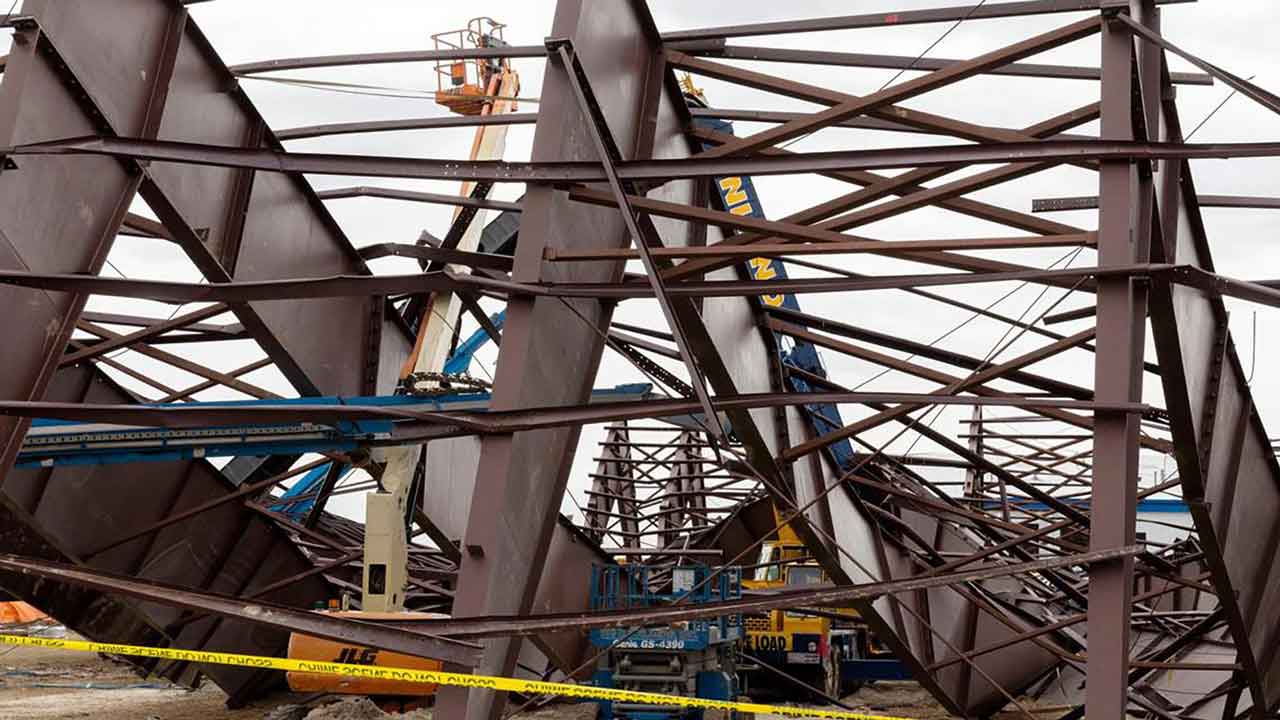
Workers had expressed concerns about bending or bowed beams and structural issues before a steel airport hangar under construction in Idaho collapsed in January, killing three people and injuring nine others, a newspaper reported.
IDAHO BUILDING COLLAPSE ON BOISE AIRPORT PROPERTY LEAVES 3 DEAD, 9 INJURED: ‘CATASTROPHIC’
Some employees told the site’s supervisor of their worries a day before the privately owned and partially built hangar collapsed Jan. 31 on the grounds of the Boise Airport, according to police reports released to the Idaho Statesman through a public records request.
Image shows the aftermath of the deadly collapse of a hangar under construction next to the Jackson Jet Center at the Boise Airport. (Darin Oswald/Idaho Statesman/Tribune News Service via Getty Images)
Meridian-based contractor Big D Builders was the general contractor of the $8.1 million, 39,000-square-foot (3,623-square-meter) hangar for Jackson Jet Center at the airport.
Inland Crane of Boise provided equipment and operators for the project, and that company’s supervisor told police he “has worked a crane on several of these types of sites, and the ‘bowing’ of the beam did not look right to him.”
The supervisor told the police he had reported the concerns to Big D Builders co-founder Craig Durrant, one of three victims in the collapse, and that Durrant said he had made calls to an engineer.
Dennis Durrant, Craig’s brother and company owner, told police in an interview that the beams were “bowing.” They contacted the manufacturer because the supports for the frame weren’t “adequate,” according to the police documents.
An engineer gave them guidance to reinforce the building, Durrant told officers.
GREYHOUND BUS CRASHES INTO ALABAMA SUV, KILLING 1 AND SENDING 9 TO HOSPITAL
The police interviews indicate Craig Durrant told the crane supervisor that the frame was fine after speaking to the engineer because workers added straps on the beams. They were also trying to place more beams to support the roof.
The Durrant brothers were in the center of the site when they heard loud popping noises, according to the police reports. They ran for the perimeter but Dennis Durrant told police the building “came down within seconds,” killing his brother. Also killed in the collapse were two construction workers, Mario Sontay Tzi , 32, and Mariano “Alex” Coc Och, 24.
Several Inland Crane employees also told their company’s safety officer about “structural integrity concerns” for the hangar, according to the police interviews.
“He also confirmed multiple crane operators from Inland Crane reported curved beams and snapped stiffener cables,” police wrote.
The hangar’s overhead beams were not straight, and there were not enough cross-sections to support the overhead beams, another crane operator told officers.
Yet another crane operator told police the cranes were brought to the construction site to “straighten out the hangar because portions of it were bending.”
A woman who answered the phone Wednesday at Big D Builders said owner Dennis Durrant declined to comment to The Associated Press.
However, David Stark, Big D Builders superintendent general contractor, maintained that there weren’t any problems at the site, and that he didn’t see anything out of the ordinary, the Statesman reported.
Boise police turned its information over to the Occupational Safety and Health Administration, which has said its investigation could take up to six months.
Inland Crane Vice President Jeremy Haener has previously said no action by Inland Crane operators or the crane itself were cause for the structure’s failure, based on the accounts of workers on the site and the steel erecting contractor.
“Inland Crane is actively participating in the OSHA investigation around the tragic incident that occurred on a Boise job site on Jan. 31,” Haener said in a statement Tuesday. “Out of respect for the integrity of that process, we have no additional statements to make until that review is completed.”
Read the full article from Here


Hawaiian Airlines’ passengers are back in federal court trying to stop something most people assumed was already finished. They are no longer arguing about whether they are allowed to sue. They are now asking a judge to intervene and preserve Hawaiian as a standalone airline before integration advances to a point this spring where it cannot realistically be reversed.
That approach is far more aggressive than what we covered in Can Travelers Really Undo Alaska’s Hawaiian Airlines Takeover?. The earlier round focused on whether passengers had standing and could amend their complaint. This court round focuses on whether harm is already occurring and whether the court should act immediately rather than later. The shift is moving from procedural survival to emergency relief, which makes this filing different for Hawaii travelers.
The post-merger record is now the focus.
When the $1.9 billion acquisition closed in September 2024, the narrative was straightforward. Hawaiian would gain financial stability. Alaska would impose what it described early as “discipline” across routes and costs. Travelers were told they would benefit from broader connectivity, stronger loyalty alignment, and long-term fleet investments that Hawaiian could no longer fund independently.
Eighteen months later, the plaintiffs argue that the outcome has not matched the pitch. They cite reduced nonstop options on some Hawaii mainland routes, redeye-heavy return schedules that many readers openly dislike, and loyalty program changes that longtime Hawaiian flyers say diminished redemption value. They frame these not as routine airline integration but as signs that competitive pressure has weakened in our island state, where airlift determines price and critical access for both visitors and residents.
What is different about this filing compared with earlier debates is that it relies on developments that have already occurred rather than on predictions about what might happen later.
The HA call sign has already been retired. Boston to Honolulu was cut before competitors signaled renewed service. Austin’s nonstop service ended. Multiple mainland departures shifted into overnight red-eyes. And next, the single reservation system transition is targeted for April 2026, a process already well underway.
Atmos replaced both Hawaiian Miles and Alaska’s legacy loyalty programs, and readers immediately reported higher award pricing, fewer cheap seats, no mileage upgrades, and confusion around status alignment and family accounts. Each of those events can be described as aspects of integration mechanics, but together they form the factual record that the plaintiffs are now asking a judge to examine in Yoshimoto v. Alaska Airlines.
The 40% capacity argument.
One of the more interesting claims tied to the court filing is that Alaska now controls more than 40% of Hawaii mainland U.S. capacity. That figure strikes at the core of the entire issue. That percentage does not automatically mean monopoly under antitrust law, but it does raise questions about concentration in a state that depends exclusively on air access for its only industry and its residents.
Hawaii is not a region where travelers have options. Every visitor, every neighbor island resident, and every business traveler depends on our limited air transportation. The plaintiffs contend that consolidation at that scale reduces competitive pressure and gives the dominant carrier far more leverage over pricing and scheduling decisions. Alaska says that competition remains robust from Delta, United, Southwest, and others, and that share shifts seasonally and by route.
Competitors reacted quickly.
While Alaska integrated Hawaiian’s network under its publicly stated discipline strategy, Delta announced its largest Hawaii winter schedule ever, beginning in December 2026. Delta’s Boston to Honolulu is slated to return, Minneapolis to Maui launches, and Detroit and JFK to Honolulu move to daily service. Atlanta also gains additional frequency. Widebodies are appearing where narrowbodies once operated, signaling Delta’s push into higher capacity and premium cabin layouts.
Those moves complicate the monopoly narrative. If Delta is expanding aggressively, one argument is that competition remains active and responsive. At the same time, Delta filling routes Alaska trimmed may reinforce the idea that structural changes created openings competitors believe are profitable, and that markets respond when gaps appear.
What changed since October.
In October, we examined whether the case would survive dismissal and whether passengers could refile. That moment felt more procedural than what’s afoot now. It did not alter flights, fares, or loyalty programs.
This filing is different because it is tied to post-merger developments and seeks emergency relief. The plaintiffs are asking the court to prevent further integration while the merits are evaluated, arguing that each added step toward full consolidation this spring makes reversal less feasible as systems merge, crew scheduling aligns, fleet plans shift, and branding converges.
Airline mergers are designed to become embedded quickly, and once those pieces are fully intertwined, unwinding them becomes exponentially more difficult, which is why the plaintiffs are pressing forward now rather than waiting any longer.
The DOT conditions and the defense.
When the purchase of Hawaiian closed, the Department of Transportation imposed conditions that run for six years. Those conditions addressed maintaining capacity on overlapping routes, preserving certain interline agreements, protecting aspects of loyalty commitments, and safeguarding interisland service levels.
Alaska will point to those commitments as evidence that consumer protections were built into the core approval. The plaintiffs, however, are essentially claiming that those conditions are either insufficient or that subsequent real-world changes undermine the spirit of what travelers were told would remain. That tension between formal commitments and actual experience is at the core of this dispute.
Hawaiian had not produced consistent profits for years.
That is the actual financial situation, without sentiment. Alaska did not spend $1.9 billion to preserve Hawaii nostalgia. It purchased aircraft, an international and trans-Pacific network reach, and a platform it thinks can return to profitability under tighter cost control.
What this means for travelers today.
Nothing about your Hawaiian Airlines ticket changes because of this filing. Flights remain scheduled. Atmos remains the reward program. Integration continues unless a judge intervenes.
However, Alaska now faces a renewed court challenge that points to concrete post-merger developments rather than speculative harm. That scrutiny alone can bring things to light and influence how aggressively future route decisions and loyalty adjustments occur.
Hawaiian Airlines’ travelers have been vocal since the start about pricing, redeyes, lost nonstops, and loyalty devaluation. Others have said very clearly that without Alaska, Hawaiian might not exist in any form at all. Both perspectives exist as background while a federal judge evaluates whether the integration should be impacted.
You tell us: Eighteen months after Alaska took over Hawaiian, are your Hawaii flights better or worse than before, and what changed first for you: price, schedule, routes, interisland flights, or loyalty programs?
Lead Photo Credit: © Beat of Hawaii at SALT At Our Kaka’ako in Honolulu.
Get Breaking Hawaii Travel News


ROUNDUP, Mont. —
The Rehder Creek Fire is burning 16 miles southeast of Roundup has grown to about 5,000 acres, prompting evacuation orders for residents in the Bruner Mountain Area/Subdivision.
The fire started Feb. 26, the cause is unknown and containment was at 0%.
Evacuation orders are in effect for all residents in the Bruner Mountain Area/Subdivision. The Musselshell County Sheriff’s Office is coordinating the evacuation orders, and 911 reverse calls have been sent out to advise people in the area.
A shelter is opening at the Roundup Community Center. Residents were told to contact Musselshell County DES for further information.
Firefighter and public safety remain the top priority. The public is asked to avoid the Fattig Creek and Rehder Road area so emergency personnel can safely and effectively perform their work.
Fire resources assigned to the incident include 40 total personnel, 11 engines, one Type 2 helicopter, three tenders and two dozers.

Elon Musk-Led Overhaul of Delaware Business Law Upheld by State Court

FuelFest kicks off at South Florida Fairgrounds this weekend

No. 3 Georgia to Host Top-Ranked Auburn for Regular Season Finale – University of Georgia Athletics

Travelers Sue: Promises Were Broken. They Want Hawaiian Airlines Back.

Idaho CBD retailers navigating uncertainty under new hemp rules

Florida High School Football Rankings: Top 25 teams – Oct. 21

Cleary's 21 help Le Moyne down Central Connecticut State 69-64 in OT

How old is Bo Nix? What to know about Oregon quarterback ahead of 2024 NFL Draft

99th annual Pony Swim held in Virginia

Indiana Members Credit Union announced as new anchor tenant at Bottleworks District

Where Iran’s ballistic missiles can reach — and how close they are to the US

Has India’s influence in Afghanistan grown under the Taliban?

Bill Clinton to testify before House committee investigating Epstein links

Read Judge Schiltz’s Order

Vulnerable House Dem lashes out at Trump’s ‘racist’ SOTU challenge: ‘That was uncomfortable’
-

 World2 days ago
Exclusive: DeepSeek withholds latest AI model from US chipmakers including Nvidia, sources say
-

 Massachusetts2 days ago
Mother and daughter injured in Taunton house explosion
-

 Montana1 week ago
2026 MHSA Montana Wrestling State Championship Brackets And Results – FloWrestling
-

 Oklahoma1 week ago
Wildfires rage in Oklahoma as thousands urged to evacuate a small city
-

 Louisiana5 days ago
Wildfire near Gum Swamp Road in Livingston Parish now under control; more than 200 acres burned
-

 Technology6 days ago
YouTube TV billing scam emails are hitting inboxes
-

 Denver, CO2 days ago
10 acres charred, 5 injured in Thornton grass fire, evacuation orders lifted
-

 Technology6 days ago
Stellantis is in a crisis of its own making