West
As Hawaiians struggle to find affordable housing after Lahaina wildfire, lawmakers reconsider vacation rentals

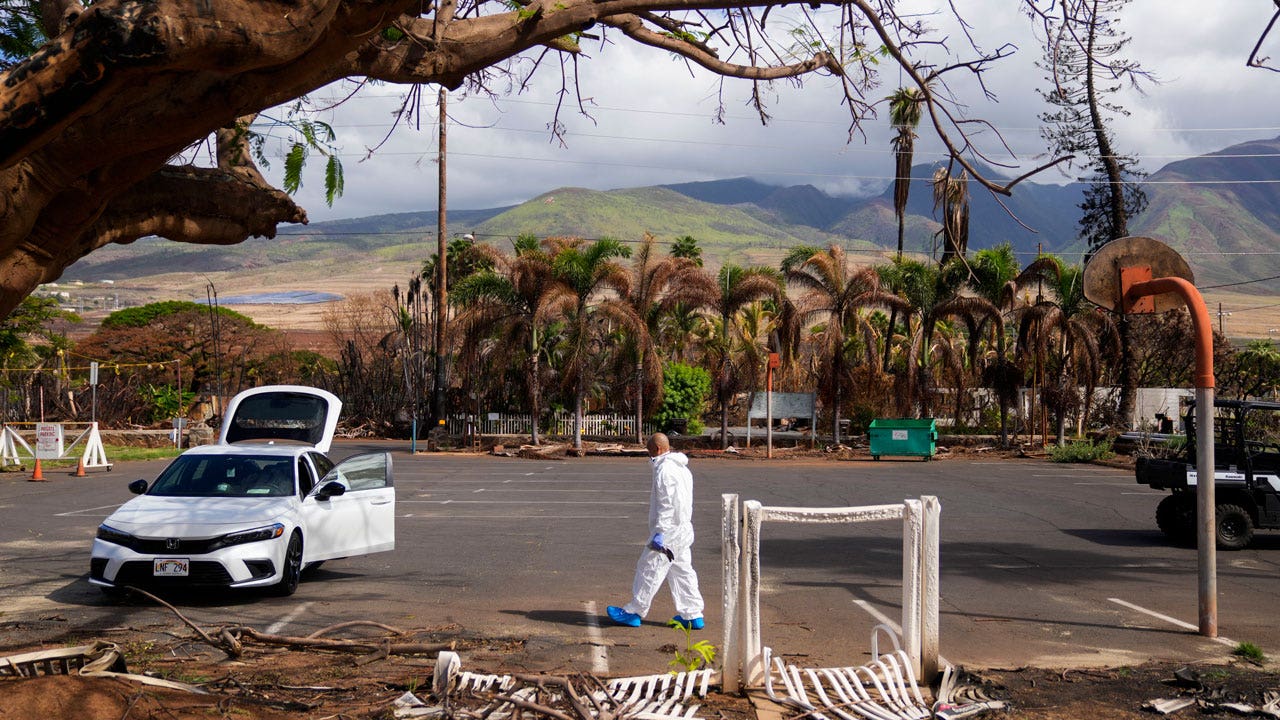
Amy Chadwick spent years scrimping and saving as a single mother of two to buy a house in the town of Lahaina on the Hawaiian island of Maui. But after a devastating fire leveled Lahaina in August and reduced Chadwick’s home to white dust, the cheapest rental she and her now-husband could find for their family and dogs cost $10,000 a month.
Chadwick, a fine-dining server, moved to Florida where she could stretch her homeowners insurance dollars. She’s worried Maui’s exorbitant rental prices, driven in part by vacation rentals that hog a limited housing supply, will hollow out her tight-knit town.
Most people in Lahaina work for hotels, restaurants and tour companies and can’t afford $5,000 to $10,000 a month in rent, she said.
MAUI FIRE REPORTS: KEY TAKEAWAYS FROM THE DEADLIEST US WILDFIRE IN OVER A CENTURY
“You’re pushing out an entire community of service industry people. So no one’s going to be able to support the tourism that you’re putting ahead of your community,” Chadwick said by phone from her new home in Satellite Beach on Florida’s Space Coast. “Nothing good is going to come of it unless they take a serious stance, putting their foot down and really regulating these short-term rentals.”
The Aug. 8 wildfire killed 101 people and destroyed housing for 6,200 families, amplifying Maui’s already acute housing shortage and laying bare the enormous presence of vacation rentals in Lahaina. It reminded lawmakers that short-term rentals are an issue across Hawaii, prompting them to consider bills that would give counties the authority to phase them out.
Gov. Josh Green got so frustrated he blurted out an expletive during a recent news conference.
The Rev. Ai Hironaka, resident minister of the Lahaina Hongwanji Mission, walks in the parking lot of his temple and residence on Dec. 7, 2023, that was destroyed by wildfire in Lahaina, Hawaii. An acute housing shortage hitting fire survivors on the Hawaiian island of Maui is squeezing out residents even as they try to overcome the loss of loved ones, their homes and their community. (AP Photo/Lindsey Wasson, File)
“This fire uncovered a clear truth, which is we have too many short-term rentals owned by too many individuals on the mainland and it is b———t,” Green said. “And our people deserve housing, here.”
Vacation rentals are a popular alternative to hotels for those seeking kitchens, lower costs and opportunities to sample everyday island life. Supporters say they boost tourism, the state’s biggest employer. Critics revile them for inflating housing costs, upending neighborhoods and contributing to the forces pushing locals and Native Hawaiians to leave Hawaii for less expensive states.
This migration has become a major concern in Lahaina. The Council for Native Hawaiian Advancement, a nonprofit, estimates at least 1,500 households — or a quarter of those who lost their homes — have left since the August wildfire.
The blaze burned single family homes and apartments in and around downtown, which is the core of Lahaina’s residential housing. An analysis by the University of Hawaii Economic Research Organization found a relatively low 7.5% of units there were vacation rentals as of February 2023.
Lahaina neighborhoods spared by the fire have a much higher ratio of vacation rentals: About half the housing in Napili, about 7 miles north of the burn zone, is short-term rentals.
Napili is where Chadwick thought she found a place to buy when she first went house hunting in 2016. But a Canadian woman secured it with a cash offer and turned it into a vacation rental.
Also outside the burn zone are dozens of short-term rental condominium buildings erected decades ago on land zoned for apartments.
In 1992, Maui County explicitly allowed owners in these buildings to rent units for less than 180 days at a time even without short-term rental permits. Since November, activists have occupied the beach in front of Lahaina’s biggest hotels to push the mayor or governor to use their emergency powers to revoke this exemption.
Money is a powerful incentive for owners to rent to travelers: a 2016 report prepared for the state found a Honolulu vacation rental generates 3.5 times the revenue of a long-term rental.
State Rep. Luke Evslin, the Housing Committee chair, said Maui and Kauai counties have suffered net losses of residential housing in recent years thanks to a paucity of new construction and the conversion of so many homes to short-term rentals.
“Every alarm bell we have should be ringing when we’re literally going backwards in our goal to provide more housing in Hawaii,” he said.
In his own Kauai district, Evslin sees people leaving, becoming homeless or working three jobs to stay afloat.
The Democrat was one of 47 House members who co-sponsored one version of legislation that would allow short-term rentals to be phased out. One objective is to give counties more power after a U.S. judge ruled in 2022 that Honolulu violated state law when it attempted to prohibit rentals for less than 90 days. Evslin said that decision left Hawaii’s counties with limited tools, such as property taxes, to control vacation rentals.
Lawmakers also considered trying to boost Hawaii’s housing supply by forcing counties to allow more houses to be built on individual lots. But they watered down the measure after local officials said they were already exploring the idea.
Short-term rental owners said a phase-out would violate their property rights and take their property without compensation, potentially pushing them into foreclosure. Some predicted legal challenges.
Alicia Humiston, president of the Rentals by Owner Awareness Association, said some areas in West Maui were designed for travelers and therefore lack schools and other infrastructure families need.
“This area in West Maui that is sort of like this resort apartment zone — that’s all north of Lahaina — it was never built to be local living,” Humiston said.
One housing advocate argues that just because a community allowed vacation rentals decades ago doesn’t mean it still needs to now.
“We are not living in the 1990s or in the 1970s,” said Sterling Higa, executive director of Housing Hawaii’s Future. Counties “should have the authority to look at existing laws and reform them as necessary to provide for the public good.”
Courtney Lazo, a real estate agent who is part of Lahaina Strong, the group occupying Kaanapali Beach, said tourists can stay in her hometown now but many locals can’t.
“How do you expect a community to recover and heal and move forward when the people who make Lahaina, Lahaina, aren’t even there anymore?” she said at a recent news conference as her voice quivered. “They’re moving away.”
Read the full article from Here

West
Las Vegas first responders conduct seven-hour rescue of injured climber stranded 600 feet up rock face
NEWYou can now listen to Fox News articles!
First responders in Nevada carried out a dramatic seven-hour rescue after a climber was seriously injured while stranded roughly 600 feet up a steep rock face near Las Vegas.
The Las Vegas Metropolitan Police Department (LVMPD) said search and rescue teams were notified around noon Saturday about an injured climber on the “Dream Safari” route along Dark Shadows Wall in Pine Creek.
Authorities said the climber had fallen an estimated 40 to 50 feet, suffering severe head and back injuries.
The victim’s climbing partner and a guide from another climbing party reached the injured climber and controlled the bleeding while awaiting rescue crews.
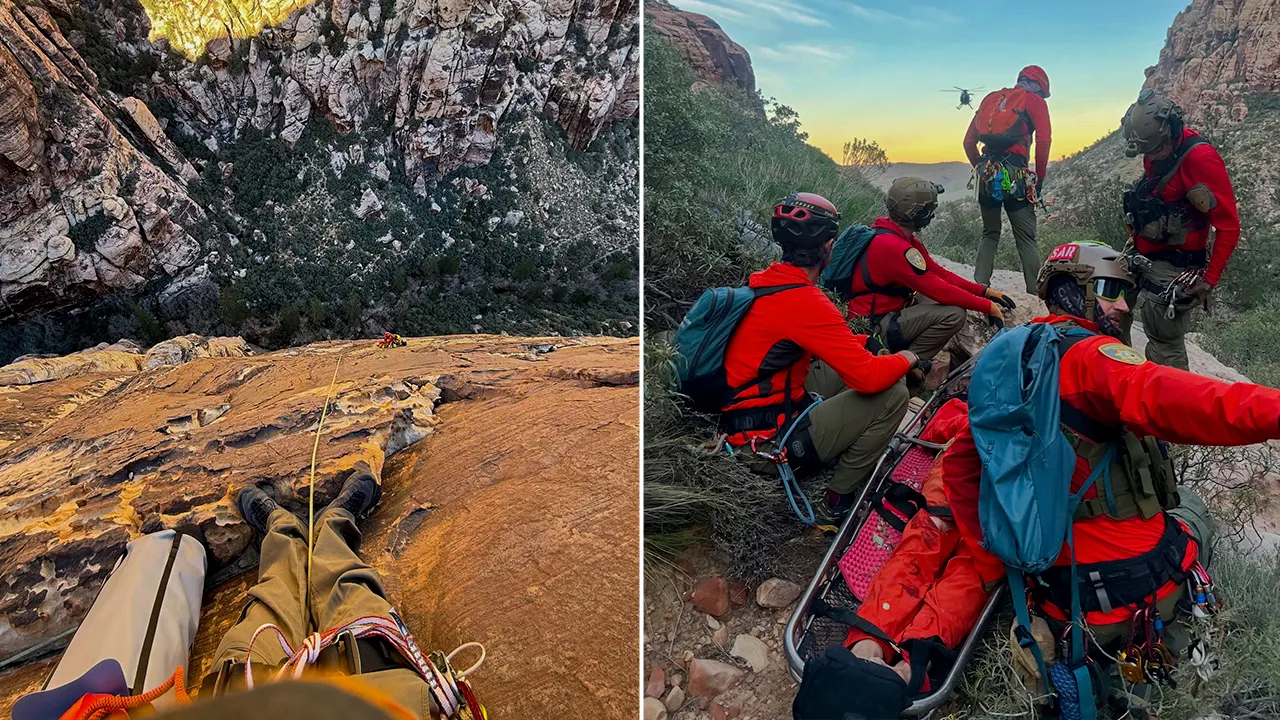
Rescuers secured the climber in a titanium litter and lowered the patient in stages down the rock face. (Las Vegas Metropolitan Police Department)
Four search and rescue officers and a lead climb volunteer were inserted by the department’s AIR3 helicopter several hundred feet above the victim at the top of the route.
Rescuers then rappelled down the rock face, provided medical treatment while suspended mid-face, and secured the patient in a titanium litter.
Crews constructed a lowering system and brought the climber several hundred feet down to the ground through three separate lowering stations, with a rescuer attending to the patient during the descent.
RAFTER VANISHES IN OREGON WILDERNESS, SURVIVES FIVE-DAY ORDEAL BEFORE HELICOPTER RESCUE
Las Vegas police search and rescue teams spent seven hours lowering an injured climber 600 feet to safety. (Las Vegas Metropolitan Police Department)
Once at the base, additional volunteers carried the litter to an extraction point where the helicopter returned to airlift the victim to a Bureau of Land Management helipad.
The climber was then transferred to a ground ambulance and taken to a local hospital.
NORWEGIAN CLIMBER LOOKING TO BECOME FASTEST PERSON TO CLIMB WORLD’S 14 HIGHEST MOUNTAINS
The climber’s helmet was destroyed in the fall but likely saved the person’s life, officials said. (Las Vegas Metropolitan Police Department)
CLICK HERE TO DOWNLOAD THE FOX NEWS APP
LVMPD wrote on Facebook that the entire operation lasted about seven hours from initial insertion to final extraction.
“Although the victim’s helmet was destroyed during the fall, it likely saved their life,” police said.
Related Article

Read the full article from Here

SAN FRANCISCO (KGO) — ABC7 Eyewitness News got a sneak peak as crews put the finishing touches on the floats you’ll see at Saturday’s San Francisco Chinese New Year Festival and Parade.
Since it’s the year of the fire horse, you’ll see a lot of horses and fire symbolism on the floats, housed at Pier 19.
“So Year of the Horse, it’s energy, it’s passion, it’s momentum so a lot of things that we’re really hoping to embody in the new year,” said Stephanie Mufson, owner of San Francisco-based The Parade Guys, which designs and constructs the floats.
She said they’ve been building them for about three months, with the designs starting in November.
MORE: Bay Area artist brings Year of the Horse statue to life for Golden State Warriors
“We’re in the home stretch,” she said. “We’ve got a couple of days left and we’ve got a nice little team that’s cranking out all the finishing work that needs to go into it.”
Derrick Shavers was sanding some wood that will be painted and become cherry blossom trees on a float.
“It’s exciting,” Shavers said. “I look forward to coming every year and just creating and making things shine and sparkle.”
Bon was painting mountains for a float, making sure everything is perfect in time for the parade.
MORE: Meet the 2026 San Francisco Chinese New Year Parade mascot, Maverick
“It’s one of the few parades that actually happens at night still,” Bon said. “So we got to make sure all the lighting is in check, and people are safe on the float. It’s all in the details, just for it to walk by you for 10 seconds.”
Ten seconds that bring so much joy to those watching the parade.
Here’s how you can watch the parade on ABC7 Eyewitness News on Saturday, March 7.
Coverage starts at 5 p.m. wherever you stream ABC7.
SF Chinese New Year Parade 2026: How to watch ABC7 Eyewitness News live coverage
If you’re on the ABC7 News app, click here to watch live
Copyright © 2026 KGO-TV. All Rights Reserved.

GRAND JUNCTION, Colo. (KREX) — The Class 5A Sweet 16 has arrived, and both Grand Junction and Palisade are still standing with trips to the Great Eight in Denver on the line.
At The Jungle, the No. 2 seed Grand Junction Tigers set the tone early against No. 18 Golden. Defense carried the Tigers from the opening tip as they held the Demons to nine first quarter points while scoring 16 of their own.
Advertisement
Grand Junction added eight points in the second quarter while Golden managed six, sending the Tigers into halftime with a nine point lead.
Golden responded in the third quarter, outscoring Grand Junction 16 to 11 to cut the deficit to five entering the fourth. The Tigers answered in the final period, attacking the rim and converting key shots to win the quarter 19 to 10. Grand Junction secured a 54 to 41 victory to protect its home court and advance to the Great Eight in Denver.
Top seeded Palisade also defended its home floor with a trip to Denver at stake. The Bulldogs opened with nine straight points to energize a packed gym, but Frederick settled in and closed the first quarter on a run to tie the game at nine.
Frederick continued to respond in the second quarter and took an eight point lead into halftime.
Advertisement
Palisade shifted momentum after the break. The Bulldogs tightened defensively, holding Frederick to 21 points in the second half while scoring 39 of their own. Palisade completed the comeback to advance to the Great Eight.
Colorado Mesa University Women Deliver Historic RMAC Tournament Win
In collegiate action, the top seeded Colorado Mesa University women’s basketball team defeated Colorado School of Mines 96 to 51 in the RMAC Tournament, marking the largest margin of victory in the tournament this century.
Olivia Reed-Thyne led the Mavericks with 34 points on 11 of 15 shooting, her third 30 point performance this season. Mason Rowland added 22 points and Hallie Clark contributed 10 as Colorado Mesa matched a program record with its 31st win. The Mavericks will host the semifinals Friday with a berth in the championship game at stake.
Advertisement
Colorado Mesa University Men Survive Overtime Thriller
The Colorado Mesa University men’s basketball team faced New Mexico Highlands University for the third time this season. The Mavericks scored 36 first half points and led by four at the break.
New Mexico Highlands shot 50 percent in the second half, received 21 bench points and outscored Colorado Mesa 43 to 39 to force a late push. With the season in the balance, Ty Allred hit a game tying 3 pointer to make it 75 and send the game to overtime. Allred scored seven points in the extra period as Colorado Mesa earned a 91 to 90 victory to advance to the next round.
Copyright 2026 Nexstar Media, Inc. All rights reserved. This material may not be published, broadcast, rewritten, or redistributed.
For the latest news, weather, sports, and streaming video, head to WesternSlopeNow.com.

Startup Varda Space Industries snags former Mattel plant in El Segundo

Meet the Mexican American talent behind ‘KPop Demon Hunters’

DTLA has a new theater — inside a fake electrical box

Sen. Padilla preps for Trump trying to seize control of elections via emergency order

After rash of overdose deaths, L.A. banned sales of kratom. Some say they lost lifeline for pain and opioid withdrawal

Florida High School Football Rankings: Top 25 teams – Oct. 21

Cleary's 21 help Le Moyne down Central Connecticut State 69-64 in OT

How old is Bo Nix? What to know about Oregon quarterback ahead of 2024 NFL Draft

99th annual Pony Swim held in Virginia

Indiana Members Credit Union announced as new anchor tenant at Bottleworks District

Which oil and gas facilities in the Gulf have been attacked?

Mojtaba Khamenei, son of former supreme leader, tipped to become Iran’s next head of state

Video: Senators Question Kristi Noem on ICE Immigration Tactics

Combustible Republican Senate primary in Texas heading into overtime

Hungarian veto proves EU needs less unanimity, says new Dutch PM
-

 World6 days ago
Exclusive: DeepSeek withholds latest AI model from US chipmakers including Nvidia, sources say
-

 Massachusetts7 days ago
Mother and daughter injured in Taunton house explosion
-

 Denver, CO7 days ago
10 acres charred, 5 injured in Thornton grass fire, evacuation orders lifted
-

 Louisiana1 week ago
Wildfire near Gum Swamp Road in Livingston Parish now under control; more than 200 acres burned
-

 Oregon5 days ago
2026 OSAA Oregon Wrestling State Championship Results And Brackets – FloWrestling
-

 Florida3 days ago
Florida man rescued after being stuck in shoulder-deep mud for days
-

 Maryland3 days ago
AM showers Sunday in Maryland
-

 Wisconsin2 days ago
Setting sail on iceboats across a frozen lake in Wisconsin