Arizona
WBIT: Arizona falls apart in the final seconds, drops 2nd game of the year to NAU


The game had a different feel this time. Arizona was in it throughout, but once again fell to an in-state mid-major. The Wildcats lost to NAU 71-69 in the first round of the WBIT. It was their second loss to the Lumberjacks this season.
“They play hard,” said Arizona guard Skylar Jones. “I gotta give it to them. Their big’s good. Their guards know how to get open areas. Yeah, they all that. And I would say not all of us came out with that same intensity.”
The Wildcats were down two with under seven seconds to go in the game. NAU had three fouls to give. The Lumberjacks gave one. Arizona inbounded again. The ball eventually ended up in the hands of leading scorer Jones, but it was still there when the buzzer went off.
It was an unfortunate end to the game. Barnes said that the ball was supposed to go either to Beh at the rim or a guard up top. However, she did not want to put the blame on Jones, who ended up with it.
“It was going to be a quick shot for a double stagger,” Barnes said. “We knew Isis would be open for a right-handed layup and, if not, the guard at the top would be open. It’s hard in the moment to recognize, but Sky was open and she’s a really good 3-point shooter, but I think she felt there wasn’t time up top…My philosophy as a coach is that it never comes down to the last play. If you look at it, it’s never the last play that defines winning and losing, because if we would have made a shot, it’s a very hard shot. I think it comes down to the toughness and the lack of communication from the beginning of the game. It comes down to the 13 offensive rebounds in the first half. It comes down to the lack of sprinting back and transition defense. It comes down to those little things that they accumulate. And when you dig yourself a hole and make it really hard to win.”
Arizona wouldn’t have been in a position to tie or win at the end without Jones, anyway. She had 21 points on 9-of-17 shooting. She barely missed a double-double with nine rebounds. She also had a block.
“I told y’all at the other press conference I was in pain,” Jones said. “I didn’t really want to play, but I still was like, if I’m gonna play, I’m going hard, I’m at least trying. And I feel like I did that. I feel like (Isis Beh and Breya Cunningham) did that too. I’m not gonna discount nobody else’s effort, but the three people up here, we tried.”
NAU beat Arizona in Flagstaff off 30 points from the 3-point line on 10-for-32 shooting and 22 from the free-throw line. Getting Breya Cunningham to foul out in 14 minutes was part of their 29 trips to the charity stripe.
The Wildcats avoided those issues this time out. The Lumberjacks jacked up a lot of 3s, they just didn’t make them. NAU went 5 for 24 from distance. Cunningham played 35 minutes and had a double-double. Her stat line was spectacular with 19 points, 11 rebounds, 2 assists, 5 blocks, and 1 steal. She was whistled for just three fouls.
It was the kind of stat line that would have helped Arizona win a lot more games this season and not end up in the WBIT to begin with, but it came too late. Besides, Arizona still couldn’t get it done this time.
Beh led the team with six assists. She also had six points, five rebounds, one block, and four steals.
In addition to Jones and Cunningham, freshman Lauryn Swann scored in double figures. The guard had 13 points. She was only 3 for 11 from the field but she went 4 for 4 from the line. She added five rebounds, two assists, and two steals.
Arizona went into the game without Jada Williams, Montaya Dew, and Jorynn Ross. Dew had surgery last week, but both Williams and Ross opted out of playing due to injuries they’ve been dealing with all season. The Wildcats weren’t as shorthanded as they could have been, though.
Sahnya Jah checked in with 2:07 to go in the first quarter. It was her first time on the court since Jan. 25. Although she was with the team in Kansas City, she did not warm up ahead of their quarterfinal loss to Colorado. She only played seven minutes.
Barnes said it was difficult not to have another true point guard, but it wasn’t why they lost.
“I think that despite all of those things, you can control your effort,” she said. “You can control boxing out. You can control transition defense because that’s an effort thing. So those are effort things. Those are controllables. It doesn’t take skill, it doesn’t take height, it doesn’t take athleticism. It takes want, and I think that there were a lot of times they wanted it more. They out-hustled us for 50-50 balls. And those things are unacceptable, and you’re not going to win games like that.”
The Wildcats have been strong in first and third quarters most of the year, primarily struggling in the second and fourth. That was partially true on Thursday.
The second quarter did not start well for Arizona. At the media timeout, the Wildcats were 1 for 9 from the field and had only scored four points. They had three turnovers.
Arizona shot 60 percent in the first quarter but took a nosedive to 23.5 percent in the second. Their issues continued as they came out of the locker room.
The Wildcats ended up going 7 for 16 from the floor in the third quarter, but they had difficulty stopping NAU. The Lumberjacks went on a 9-0 run over about 90 seconds early in the period. A seven-point Arizona lead became a two-point NAU advantage. It very much felt like it was the Lumberjacks’ game at that point.
There was more of that in the fourth. The teams both shot poorly, but NAU was just slightly better. The Lumberjacks hit 28.6 percent of their shots while Arizona connected on 26.3 percent.
The end of the game felt like the end of this team. While there was a lot of talk about what “we” will have to do better next year, there was also implications that the team would be different.
Barnes talked about what she will do with future teams. It largely came down to going after the best transfers she can get and not playing younger players unless they’re better than what she can get from the portal.
“We needed more experience, and we needed some players that were preparing to go play pro and that love basketball this year, and that would help us,” Barnes said. “That’s a mentality, and it’s hard because for me coming from the first 13 years and coaching the Kelsey Plums and a lot of different All-Americans, it’s like they really want it, and they breathe it every day. And I think most of the kids, they say they love basketball because it sounds good, but they really don’t. They don’t want to do skill work, they don’t want to be in a gym. They don’t want to put their all into it, and it’s a different mentality than we had. And so that’s the reality. So you have to get the players that you want to coach. They are going to be a mirror what you are, and I think we’re going to do that.”
After making choices to try to keep her young core by not bringing in players who might take playing time and cause them to transfer, she said she won’t do that going forward. In many ways, it would be a return to what Barnes did when she first became a head coach. Not only was the program more successful when it relied heavily on transfers, but she doesn’t think it pays off to protect playing time for young players, especially under the new model that focuses so heavily on money and movement.
“They transfer anyway,” she said.
Beh finished out her college career in front of 2,706 fans who paid $26 to $46 each to watch her play. That was about 500 fewer than the first game of the 2019 WNIT. She said she doesn’t know what she’ll do next besides going to bed and not setting an alarm, but there are things she will miss.
“I’ll remember the fans most,” Beh said. “They show a lot of love. A few of my teammates, I’m going to miss…I’m not going to sit up here and lie…I will miss the coaches.”
Barnes hopes the other players took something from it.
“I think that this is a life lesson for them, because there’s gonna be things in life like your when you’re gonna have to do what you don’t want to do,” she said. “You may not want to go to work, you may be on a pro team…but you don’t play. There’s different things that happen, but you still compete and you give it your all, shift your mentality. I think that it’s not easy, because everybody wants to go the NCAA tournament. That’s where we should be, but we didn’t take care of business at certain times, and we’re here. But this is a really competitive tournament. It’s run first class, and we had an opportunity to get revenge on a team, but we didn’t show up. And as a coach, that’s hard. I mean, I want to be in the NCAA tournament too. I never thought that I would be talking my ninth year somewhere, that we wouldn’t be in the tournament. That wasn’t something I ever envisioned in my career. It will be the last time.”
NAU will travel to Nashville, Tenn. to play Belmont in the second round. The Bruins beat Middle Tennessee State on Thursday.



An
Maricopa County, Ariz., asked the court to affirm its determination that the location was a 30-auditorium mixed used movie theater worth nearly $29 million in full cash value and $12.5 million in limited value.
However, AMC’s expert appraiser didn’t err when he limited the property’s valuation to the 17 auditoriums the theater currently uses to show films, the court determined in an unsigned opinion posted Tuesday. …

The Week 7 matchup between K-State and Arizona State will feature two of the youngest coaches in all of college football: Kenny Dillingham and Collin Klein. They are tied for the youngest in the Power 4 conferences, and only Kirby Moore of Washington State (35) and Zach Kittley (34) are younger Division I coaches.
While Dillingham didn’t play football at Arizona State, like Klein, he is at his alma mater. An injury in his high senior year forced him to stop playing and get into coaching. He became the offensive coordinator at Chaparral High School at 21 years old, and was hired just two years later by Mike Norvell as an offensive analyst at Arizona State. He went back to Tempe in 2023, after spending the previous season as the offensive coordinator at Oregon.
Both of these guys are looking to lead their alma maters to a Big 12 Championship, and this is one of those games that could be pivotal in that pursuit.
K-State Early Opponent Preview Series: Nicholls| Washington State| Tulane| Cincinnati| Houston| Kansas
Offense
Quarterback Sam Leavitt wasn’t able to live up to the hype after leading the Sun Devils to the Big 12 Championship in 2024, and he announced he was transferring to LSU during the off-season. Dillingham and his staff were quick to fill the vacany, as they picked up former Kentucky quarterback Cutter Boley in the transfer portal.
Boley was the highest-rated quarterback to ever commit to Kentucky, as he was a consensus 4-star recruit. He had an up-and-down freshman year in 2025, as he threw for 2,160 yards, 15 touchdowns and 12 interceptions. In a loss to Tennessee, he showed off the talent by throwing for 330 yards and five touchdowns.
The offense lost two great playmakers in Kaleek Brown and Jordan Tyson. Brown was one of the best running backs in the Big 12, as he rushed for 1,141 yards and 4 touchdowns. Tyson had to deal with injuries, but he still had 61 catches for 788 yards and eight touchdowns and ended up going No. 9 to the New Orleans Saints in the 2026 NFL Draft.
One guy who could make a strong impact in the Arizona State offense is Boston College transfer Reed Harris. He had 39 catches for 673 yards and five touchdowns. He is a matchup nightmare, as he towers over defensive backs with his 6-foot-5 frame. He plays a style similar to Tyson, and he stands three inches taller and 17 pounds heavier.
Defense
There are a lot of changes on the defense at Arizona State, but defensive lineman C.J. Fites is a player who is capable of being an anchor on a defense. He took a major leap last season, finishing the year with 27 tackles and 6.5 sacks. He was named a preseason All-Big 12 defensive tackle and is a guy who figures to hear his name in the 2027 NFL Draft. Fite’s presence will force offenses to throw double-teams at him, and should open up opportunities for others to get after the quarterback.
The two leading tacklers last year were linebackers Jordan Crook and Keyshaun Elliott, who had 101 and 98 tackles, respectively. With both of these players gone, Martell Hughes is a guy who the Sun Devils will need to step up.
While there were losses in the off-season, the Sun Devils’ secondary has a chance to be one of the better units in the country. They bring back two very talented safeties in Adrian Wilson and Jessiah McGrew. The cornerback duo of Rodney Bimage Jr. and Montana Warren was good, but the arrival of LSU transfer Ashton Stamps.
He made major news last year after he hit the transfer portal after playing in only one game against Louisiana Tech. While it was a weird year, he is the type of talent that could give the Sun Devils the best secondary in the Big 12.
Schedule
In today’s college football, many teams are becoming hesitant to take big challenges during the non-conference season. However, that isn’t the case with the Sun Devils, as they go to College Station to take on Texas A&M in Week 2. After that game, the schedule lightens up. Including the matchup against K-State, four of Arizona State’s next five games will be at home.
The challenging part of the Sun Devils’ conference schedule is that some of their toughest matchups are on the road. They have road trips at Texas Tech, BYU, and Arizona, who are looked at as contenders in the Big 12.
Outlook
Dillingham has been outstanding early in his tenure in Tempe. After going 3-9 in his first year in 2023, he helped lead the Sun Devils to an 11-2 record and an appearance in the College Football Playoff during the 2024 season. Last year, they finished the year 8-5, despite losing quarterback Sam Leavitt early in the year.
The Big 12 is wide-open, and the Sun Devils once again to have the pieces to compete for a spot in the conference championship.
Game Info
Date: Saturday, October, 24
Time: TBD
TV: TBD
Location: Mountain America Stadium
Series history: Arizona State leads the all-time series, 6-1. The Sun Devils have dominated this series, and won the most recent game 24-14 in 2024. The only time the Wildcats have knocked off Arizona State was in the 2002 Holiday Bowl.
Follow

Sanjay Suchak
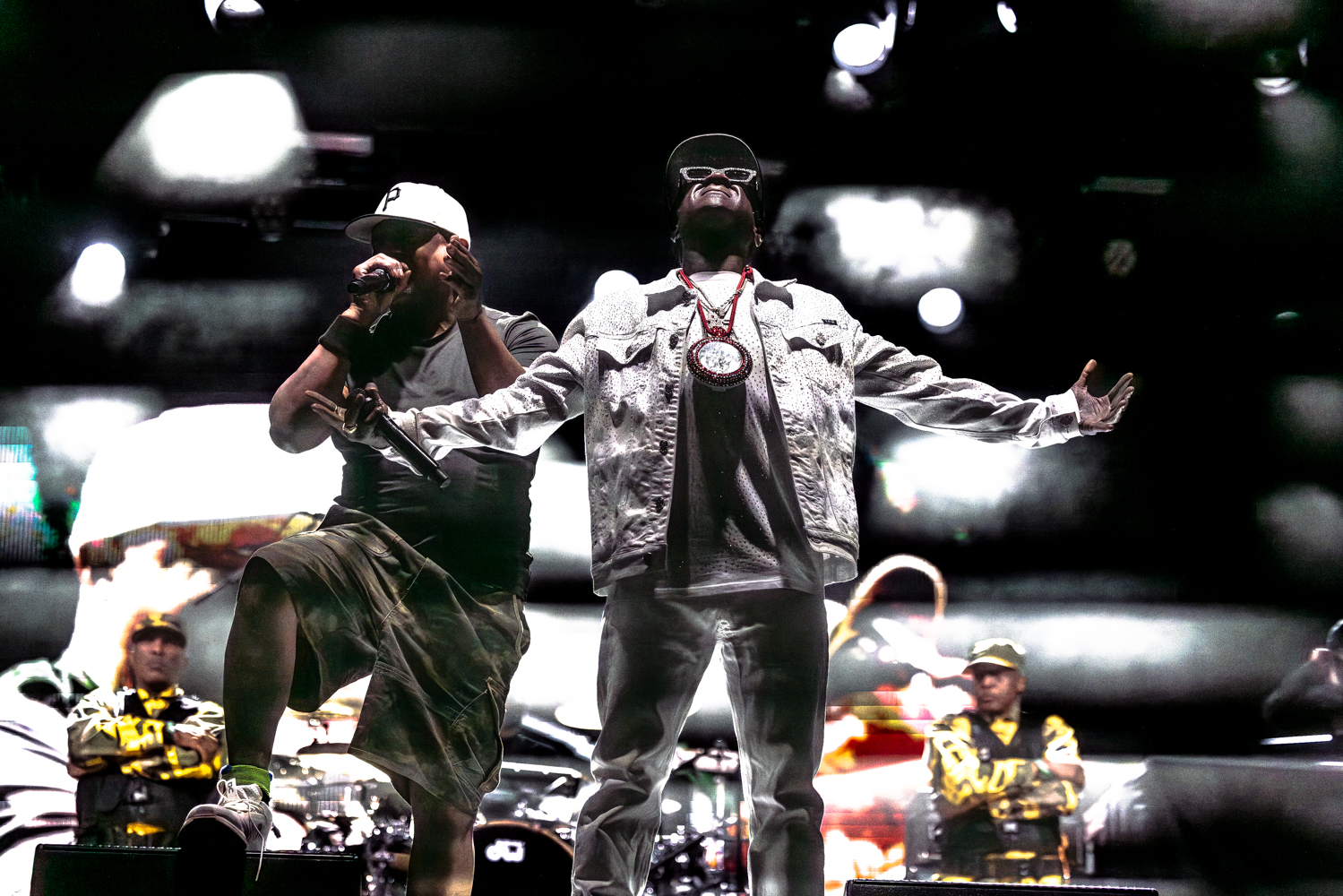
Two Arizona Public Enemy concerts in one year? As Chuck D. might say, bring the noise.
After a searing set in February at Tempe’s Innings Festival, the legendary hip-hop group will return to metro Phoenix on Saturday, Oct. 24, to perform as part of the Arizona State Fair’s concert series.
The concert starts at 7 p.m. inside the Arizona Veterans Memorial Coliseum with no opening act.
Public Enemy joins a growing lineup of artists set to perform at the 2026 Arizona State Fair, which runs weekends from Oct. 1 to Nov. 1.
Previously announced Coliseum Concert Series performers include alt-rockers Gin Blossoms on Friday, Oct. 2, R&B/pop star Becky G on Friday, Oct. 9 and punk favorites The Offspring on Friday Oct. 16.
Few hip-hop acts are as iconic as Public Enemy. Fronted by Chuck D. and Flavor Flav, the group has performed since the early ‘80s and has spent decades mixing politically charged lyrics with fierce bests on classic tracks like “Fight the Power,” “Bring the Noise” and “Welcome to the Terrordome.”
Public Enemy’s upcoming concert marks the first time the iconic hip-hop act has performed at the Arizona State Fair and their latest in a series of Valley gigs. It also continues a decades-long history of Valley performances.
Over the years, Public Enemy has played venues large and small across metro Phoenix, from arenas and stadium shows to concert halls Tempe’s Marquee Theatre. The group also famously staged an impromptu performance at the long-running local hip-hop event The Blunt Club back in 2006.
When do Arizona State Fair concert tickets go on sale?
Tickets for Gin Blossoms and Russell Dickerson are already available through azstatefair.com/concerts.
Tickets for Public Enemy at the fair go on sale at 10 a.m. on Friday through azstatefair.com/concerts. A presale for subscribers to the Fair Fandom newsletter begins at 10 a.m. on Thursday.
Reserved-seat upgrades are available for all four concerts. Each concert ticket also includes admission to the Arizona State Fair.
-
 Lifestyle15 minutes ago
‘The Trojan Teddy Bear’: The promise and peril of childhood in the age of AI
-

 Technology27 minutes ago
Google and Epic give up fighting — third-party Android app stores are coming next week
-

 World33 minutes ago
FBI snares an American heir indicted for allegedly bankrolling anti-cop, pro-Hamas communist revolution
-

 Politics39 minutes ago
Biden special counsel’s ‘runaway train’ scooped up sensitive lawmaker info: ‘Abuse of power’
-

 Health45 minutes ago
‘Miracle on the Hudson’ hero Captain ‘Sully’ Sullenberger reveals Alzheimer’s diagnosis
-

 Sports51 minutes ago
American League stars outshine National League in 96th MLB All-Star game
-

 Technology57 minutes ago
Before you connect another smart TV, tablet or phone, lock it down
-
 Business1 hour ago
Commentary: Trump greenlights California’s dumbest water project

