Arizona
Arizona vs. BYU is a battle of elite defenses. Which one is better?


Overpaid and underpaid college football coaches in salary data
USA TODAY Sports’ salary database highlights Hugh Freeze, Billy Napier and Luke Fickell as overpaid, while Curt Cignetti stands out as a value pick.
By almost every statistical measure, the three best defenses in the Big 12 Conference so far this season belong to Arizona, BYU and Texas Tech.
Two of those teams happen to be facing each other on Saturday, Oct. 11, at Arizona Stadium.
Which one actually has the better defense?
That’s what we’re going to explore in this week’s “Cats Stats.” The answer might surprise you.
At first blush, one would give the edge to the Cougars. They’re first in the league in total defense (239.6 ypg) and second in scoring defense (12.2 ppg). The Wildcats are third (244.8) and fourth (15.6), respectively.
Even if you adjust the latter to account for the pick-six against Arizona last week, the Wildcats are still two points worse per game than the Cougars.
But we like to dig beneath the surface here at Cats Stats Inc. Other numbers better illustrate the effectiveness of the UA defense under Danny Gonzales.
The statistic most often cited to measure a defense’s worth is yards per play. Arizona has the edge in that category — over everyone else in the conference.
The UA has allowed 3.92 yards per play. Texas Tech is second at 3.94. BYU is third at 4.06. No one else is under 4.50.
If you separate run and pass defense, you can argue that the advantages each side has basically cancel each other out. But we would argue that the gap between BYU and Arizona against the run is narrower than the gap between the Wildcats and Cougars against the pass.
BYU allows 92.2 rushing yards per game and 2.8 per attempt; Arizona is at 96.6 and 3.0. Not much of a difference.
The Wildcats have the No. 1 pass defense in the conference in terms of yards allowed per game (147.2) and per attempt (4.9). The Cougars are barely behind them in the former (147.4). They’re nearly a full yard behind in the latter (5.8).
Arizona also has a sizable edge in completion percentage allowed (51.3% vs. 57.0%) and sacks per game (2.6 vs. 2.0). Overall, the Wildcats spend more time in the opposition’s backfield, averaging a league-best 8.60 tackles for loss per game. BYU is sixth at 6.20.
Conversion case
Still not convinced? Let’s dig deeper.
Two areas that are critical to team success are third-down and red-zone efficiency. Arizona’s defense has been better than BYU’s, both through five games.
The Wildcats have allowed opponents to convert 25.7% of their third downs. Only Texas Tech, at 25.4%, has been better in the Big 12. BYU is third at 29.7%.
(In a related development, Arizona has been slightly better at first-down prevention. The UA has allowed 13.2 first downs per game, tied with Texas Tech for the fewest in the Big 12. BYU is third at 14.8.)
Arizona is No. 1 in the conference at keeping the opposition out of the end zone once it crosses the 20-yard line. The Wildcats have allowed a touchdown on only 42.9% of opponents’ red-zone opportunities. The Cougars are tied for fourth in the league at 50%.
Who’s better at taking the ball away? Again, at least so far, it’s been Arizona.
The Wildcats average 2.2 takeaways per game, second in the conference behind Texas Tech (2.4). The Cougars are fourth at 1.8.
Even if you include fourth-down stops — Gonzales classifies those as takeaways, worthy of footballs being punctured by the Turnover Sword — Arizona has the edge. The Wildcats have 18 combined takeaways and fourth-down stops, an average of 3.6 per game. The Cougars have 15, or 3.0 per game.
BYU has been better at preventing big plays, but the difference is negligible. The Cougars have allowed 13 plays of 20-plus yards, per cfbstats.com, or 2.6 per game. The Wildcats have allowed 14 — 2.8 per game.
The real deal?
Both defenses have been elite at almost all of the above. BYU has a more extensive track record; the Cougars finished first in the Big 12 in total defense and yards allowed per play last season.
As such, it’s reasonable to believe that what BYU has accomplished so far on defense is real — and wonder whether Arizona is due for some regression. The Wildcats are new to this shutdown business, after all.
Skeptics also might question Arizona’s schedule so far. “U of A hasn’t played anybody.” About that …
We looked at three websites that calculate strength of schedule: ESPN, Sagarin and Massey. Arizona’s average SOS on those sites entering this weekend was 91. BYU’s was … also 91.
Both have faced an FCS opponent from the Big Sky Conference — Portland State (BYU) and Weber State (Arizona). Both have faced a Group of Five foe — East Carolina (BYU) and Hawaii (Arizona). Both have faced a Power Four opponent — Stanford (BYU) and Kansas State (Arizona). Both have played two conference games.
BYU has played one more road game; the ECU contest was in Greenville. Counterpoint: Arizona blew out Hawaii, which defeated Stanford the previous week. And although Stanford has a better record (2-3) than Kansas State (2-4), KSU is considered superior by most metrics. For example, ESPN’s FPI ranks K-State 43rd and Stanford 86th.
BYU coach Kalani Sitake, for one, doesn’t need any convincing. He believes Arizona’s defense is legit.
“Danny’s done a great job with the defense,” Sitake told reporters on Oct. 6. “They tackle well. They’re aggressive.
“Danny’s done a great job everywhere he’s been. He’s from that same lineage as Rocky Long, Bronco Mendenhall and them. So we’re very familiar with the defense.
“But the way he’s able to combine their base coverages with the pressures — he calls a really good game, and he can make things really difficult for any offense. So we’re going to have to be at our best.”



A new study has ranked Arizona as one of the worst states to move to for two years in a row, largely due to what it calls a poor quality of life.
The study conducted by Consumer Affairs analyzed the best states to move to in the United States, putting Arizona at the bottom of the list.
Before Arizonans get too defensive about the Grand Canyon State, Consumer Affairs used factors such as affordability, safety, economic strength and education to measure each state, leaving out factors like entertainment, retirement benefits and other considerations that may be important to people living here.
Popular states such as California and New York also landed at the bottom of the list due to their lack of affordability, even though they both have some of the best health care and education in the nation, Consumer Affairs noted.
Here’s why the study says you shouldn’t move to Arizona. Do you agree?
Why you shouldn’t move to Arizona
Arizona ranked No. 10 out of the worst states to move to, scoring especially poorly in quality of life.
Quality of life was measured by the state’s Social Progress Index, average air quality, weather, environmental protection and number of national parks. Due to Arizona’s extreme summers and Phoenix’s consistently poor air quality, it’s easy to see why Arizona ranked No. 44 in quality of life out of 50 states, even though the Grand Canyon is one of the most popular national parks in the nation.
However, Arizona also ranked poorly in other categories, sitting at No. 42 in health care and education, No. 41 in safety and No. 34 in affordability out of 50 states.
There was one category Arizona did impressively well in, ranking No. 5 in economic strength even as one of the youngest states in the country. Still, Arizona’s economic power wasn’t enough to boost its ranking.
Top 10 worst states to move to
Arizona wasn’t alone; some of the biggest states in the country were also considered the worst states to move to in 2026.
- New Mexico
- Louisiana
- California
- Arkansas
- Oklahoma
- Nevada
- Alaska
- Mississippi
- Oregon
- Arizona
Top 10 best states to move to
- Utah
- New Hampshire
- Idaho
- Minnesota
- Massachusetts
- Maine
- North Dakota
- Pennsylvania
- Iowa
- South Dakota
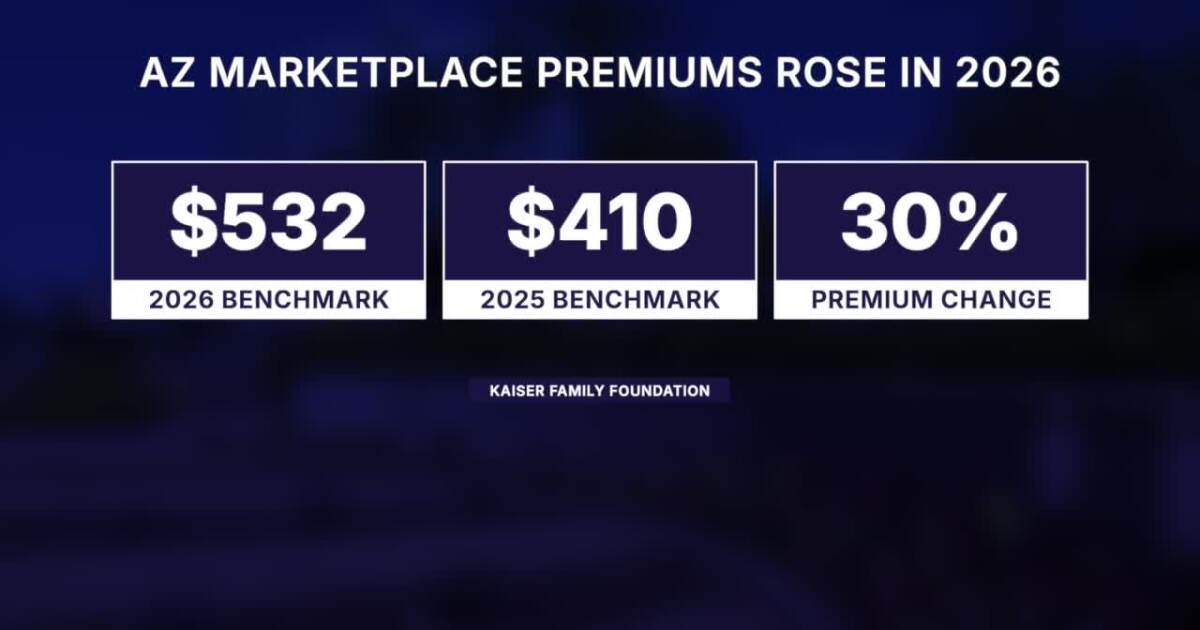
PHOENIX — Arizona’s ACA marketplace enrollment fell from 363,000 to just over 255,000 in a single year — a nearly 30% decline and the third-largest annual drop in the country.
Rising premiums and expired tax credits are driving the trend, with the average benchmark plan premium in Arizona now at $532 — up 30% from 2025.
In the player above, ABC15 Data Analyst Garrett Archer takes a look inside the numbers on how healthcare premiums are impacting health insurance enrollment.
This story was reported on-air by a journalist and has been converted to this platform with the assistance of AI. Our editorial team verifies all reporting on all platforms for fairness and accuracy.
Want more news in your community? Add ABC15 as a preferred source on Google below:

Arizona
Arizona man pleads guilty after illegally living in forest for years among ‘1,000lbs of trash’

A man in Arizona has pleaded guilty to violating federal fire restrictions and unlawfully residing in a national forest, after authorities said he spent years living at a makeshift campsite surrounded by what officials described as “approximately 1,000 pounds of trash”.
Mark Aaron Gatz was arrested on 25 June at his illegal campsite in Arizona’s Tonto national forest, according to court records. A United States Forest Service (USFS) officer wrote in documents submitted to court that Gatz had been operating an “illegal campsite” with a “hot wood burning campfire” despite fire restrictions and that he had told investigators that he had been living in the forest for about eight years.
The officer wrote that a records check found that Gatz had previously received multiple citations and was the subject of six outstanding federal arrest warrants for earlier violations, including for building fires during fire restrictions, constructing on national forest service lands, unsanitary conditions and occupying national forest as a residence.
Gatz “said that he knew about current fire restrictions but had to have fire to eat”, authorities said. The documents show that USFS officers made contact with Gatz multiple times over the last year or so, and issued him warnings as well as a violation notice for having campfires during fire restrictions.
Notes from officers’ previous encounters with Gatz earlier this year, submitted into the court docket, state that authorities observed “trash such as clothing, pans, tools, and plastic cups scattered throughout the campsite along with a structure that was four feet in height build using wood panels”.
During an encounter with Gatz in May, officers reported observing “approximately 1,000 pounds of trash” at the site, which they said included tires, plastic bags, trash bags, aluminum cans and other items. They also wrote that they found that the campfire site had been left unattended by Gatz the previous day while still hot.
In a separate report filed by law enforcement from an encounter in February, one officer wrote that “upon arrival at the camp, I was flabbergasted by the amount of debris in the area”.
Investigators said that during that encounter, the debris consisted of three ladders, six to eight totes “overfilled with debris”, five 55-gallon drums, eight tires, multiple bicycle frames, 5 gallons of motor oil, plywood and other “miscellaneous lumber”, and they wrote that trash was scattered over approximately half an acre of Forest Service land and creating what officers described as public safety concerns.
In a separate report from July 2025, officers said they observed what they described as a “large messy campsite” while patrolling the area due to complaints “from the district office abut one large messy camp”.
“There was roughly half an acre of resources ruined due to so much trash and goods on the ground for an extended period of time,” the officer wrote.
This week, after Gatz pleaded guilty, he was sentenced to time served and three years of probation, according to court records.
A representative for Gatz did not immediately respond to a request for comment.
-

 Michigan1 minute ago
Menominee, Michigan man arrested on sexual assault charges involving a minor
-

 Massachusetts8 minutes ago
Healey administration vows to appeal as Trump rejects Massachusetts blizzard aid request – The Boston Globe
-

 Minnesota11 minutes ago
Minnesota Looks to Add 1,100 Child Care Slots, With Melrose Among the 11 Funded Communities
-

 Mississippi16 minutes ago
Death of Mississippi teen Nolan Wells under investigation
-

 Missouri23 minutes ago
Missouri realtors hold statewide rally to vote no on Amendments 4 & 5
-

 Montana26 minutes ago
District court judge blocks new Montana GOP bylaws – WTOP News
-

 Nebraska31 minutes ago
Nebraska ag experts say early detection for livestock parasites, illnesses will be important during summer show season
-

 Nevada38 minutes ago
Local artists on Northern Nevada stages, now through Labor Day weekend

