Arizona
Arizona towns fight for federal disaster funding after deadly flooding

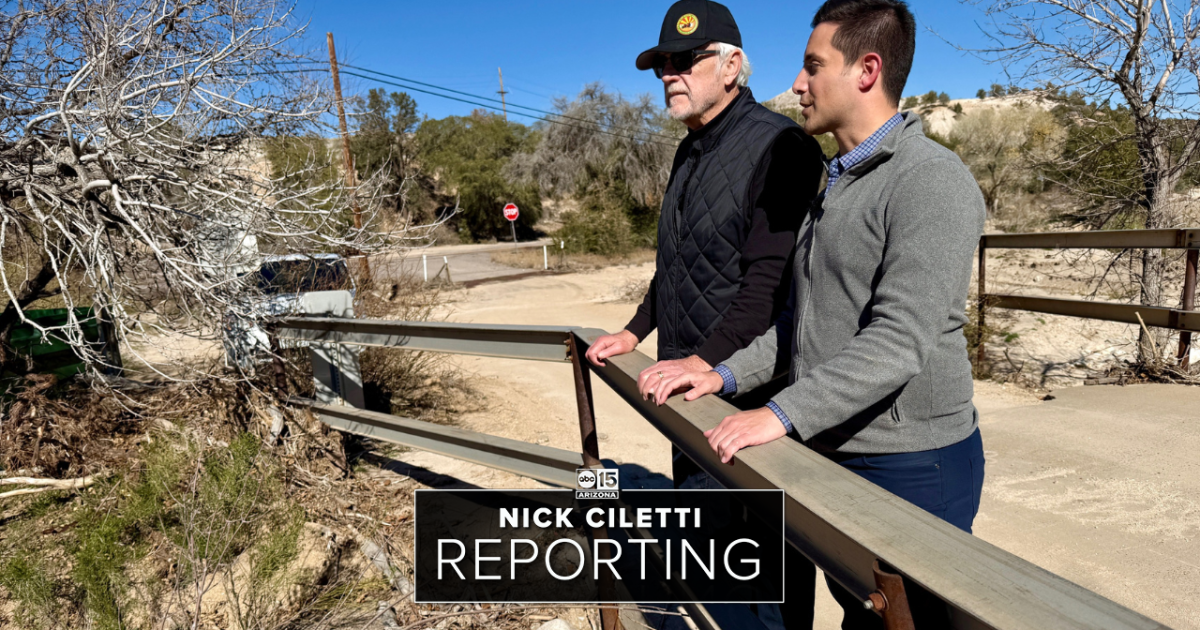
MIAMI, AZ — Late last week, officials with Arizona’s Department of Emergency and Military Affairs (DEMA) and the Federal Emergency Management Agency (FEMA) were back in Gila County, meeting with state and local leaders to reassess damage created by deadly flooding in September and October last year.
Late last year, Arizona Governor Katie Hobbs ‘ office announced that FEMA had denied their request for a Major Disaster Declaration, which would have provided critical funding for the towns of Miami, Globe, and the rest of Gila County.
Globe Mayor Al Gameros told ABC15 they’ve estimated their damage to be around $96 million, with Miami leaders telling ABC15 the damage is about $56 million.
If FEMA approves funding for towns, the percentage of the overall cost that is owed by each town is reduced substantially, critical for towns with smaller populations.
Nick covered the initial round of flooding in late September 2025 and returned to Globe in late October to get an update on the recovery there.
Late last week, ABC15 returned to Gila County – this time to Miami – to see how leaders there were rebounding, nearly four months after the flooding that killed three people.
“We had some floods here, but it wasn’t anything like that,” explains Miami Mayor Gil Madrid, who was also born and raised in the small Gila County mining town.
“It was unbelievable. Unbelievable. And sad to see what was going on.”
It’s damage the Mayor says totals about $56 million, but as of right now, FEMA isn’t helping cover any of it.
In December 2025, FEMA officials sent the state a letter, denying their request for a major disaster declaration, saying in part, “this event was not of such severity and magnitude as to be beyond the capabilities of the state and affected local governments.”
“How could they not stand with us in that disaster?” questioned Mayor Madrid.
So the Town of Miami sent its own appeal to FEMA, citing not just the flooding events in September and October last year, but also another major natural disaster – The Telegraph Fire in 2021, which burned more than 180,000 acres, creating larges areas of erosion on the Pinal Mountains, that helped send flood water, tree limbs, and other debris down the mountains, and into areas like downtown Globe and Miami.
ABC15 surveyed the area of Mackey Camp Road and saw several areas covered in dirt and sand that had accumulated in the nearly five years since the fire.
For Miami Town Manager Alexis Rivera, who reached out directly to ABC15 after seeing his follow-up series in Globe, not having that funding from FEMA means money from other critical departments and resources will have to wait for key projects to begin, things like new work trucks, new police vehicles, and infrastructure improvements.
“We are going to keep fighting,” says Rivera.
ABC15 reached back out to FEMA late last week and received this statement:
FEMA has received the State of Arizona’s appeal related to the September 25–27, 2025 severe storms and flooding. The appeal is currently under review in accordance with the Robert T. Stafford Disaster Relief and Emergency Assistance Act. FEMA has sent staff to Arizona to join state and local representatives to validate new information contained in the State’s appeal. There is no timeline for appeal determinations, as each request is evaluated based on the specific circumstances.


PAGE, ARIZ., – A suspect has been arrested after two people were found shot to death inside a home near the Arizona-Utah border.
What we know:
On July 5 at 11:30 p.m., the Page Police and Fire Communications Center responded to a report that two people had been shot near Elm and El Camino.
Once at the home, officers found a man and a woman with gunshot wounds. They were pronounced dead at the scene.
“The suspect was unknown and not on scene when officers arrived,” police said.
Dig deeper:
Police secured the home and obtained a search warrant. Investigators then began processing the crime scene.
“Evidence collected provided investigators with a person of interest who may have been present when the shootings occurred,” police said. “Investigators located the person of interest and interviewed him but did not initially charge him with any crimes related to the double homicide investigation.”
The next day, the person of interest was arrested and booked into jail. He’s accused of two counts of first-degree murder.
What we don’t know:
No identities were released. Police didn’t release any details on what led up to the shooting.
Local perspective:
Police “do not believe there is any remaining threat to the community, as the alleged suspect and the weapon allegedly used have been seized by law enforcement.”
What you can do:
If anyone has information related to the investigation, they advise contacting Detective Terry TerEick at ttereick@pageaz.gov.
Map of the cross streets where the shooting occurred:
The Source: Information for this article was gathered from the Page Police Department’s Facebook page.

Arizona Diamondbacks (45-45, second in the NL West) vs. San Diego Padres (44-46, third in the NL West)
San Diego; Tuesday, 9:40 p.m. EDT
PITCHING PROBABLES: Diamondbacks: Zac Gallen (0-0); Padres: TBD
LINE: Padres -131, Diamondbacks +108; over/under is 8 1/2 runs
BOTTOM LINE: The San Diego Padres are looking to end their three-game home slide with a victory over the Arizona Diamondbacks.
San Diego has a 44-46 record overall and a 23-22 record at home. The Padres have a 26-13 record in games when they record at least eight hits.
Arizona is 45-45 overall and 18-25 on the road. The Diamondbacks have gone 16-4 in games when they hit two or more home runs.
The teams match up Tuesday for the fourth time this season.
TOP PERFORMERS: Manny Machado has 16 doubles and 18 home runs for the Padres. Fernando Tatis Jr. is 11 for 43 with three doubles, two home runs and five RBIs over the last 10 games.
Ketel Marte has 18 doubles, three triples and 17 home runs for the Diamondbacks. Geraldo Perdomo is 13 for 39 with three doubles and two home runs over the past 10 games.
LAST 10 GAMES: Padres: 1-9, .255 batting average, 8.02 ERA, outscored by 51 runs
Diamondbacks: 4-6, .222 batting average, 3.84 ERA, outscored by one run
INJURIES: Padres: Jason Adam: 15-Day IL (shoulder), Randy Vasquez: 15-Day IL (ankle), Freddy Fermin: 10-Day IL (head), Matt Waldron: 15-Day IL (arm), David Morgan: 15-Day IL (knee), Jeremiah Estrada: 15-Day IL (knee), Lucas Giolito: 15-Day IL (elbow), Nick Pivetta: 60-Day IL (elbow), Joe Musgrove: 60-Day IL (elbow), Ramon Laureano: 60-Day IL (hip), Bryan Hoeing: 60-Day IL (elbow)
Diamondbacks: James McCann: 10-Day IL (quadricep), Blake Walston: 60-Day IL (elbow), Jordan Lawlar: 10-Day IL (hamstring), A.J. Puk: 60-Day IL (elbow), Ryne Nelson: 60-Day IL (elbow), Mike Soroka: 15-Day IL (lower body), Corbin Burnes: 60-Day IL (elbow), Cristian Mena: 60-Day IL (shoulder), Andrew Saalfrank: 60-Day IL (shoulder), Justin Martinez: 60-Day IL (elbow)
___
The Associated Press created this story using technology provided by Data Skrive and data from Sportradar.

MESA, AZ — For many seniors, scam texts and phone calls can be confusing, intimidating, and costly.
One Mesa teenager believes getting help shouldn’t be.
BASIS Mesa student Shilo Karakkattu created ScamSafe after watching older family members struggle to sort through suspicious messages.
The goal is straightforward: help people avoid becoming the next victim of fraud.
For many seniors, scam texts and phone calls can be confusing, intimidating, and costly. Karakkattu saw that the problem was affecting people he loves and decided to create a solution.
Now, organizations that work with seniors are taking notice of his invention, which could soon help thousands of people across Arizona stay one step ahead of scammers.
Watch in the player above to see the remarkable student whose latest project is protecting some of Arizona’s most vulnerable residents.
Want more news in your community? Add ABC15 as a preferred source on Google below:

-

 Health18 minutes ago
I Tried the Viral Gelatin Weight-Loss Recipe—Here’s My Honest Take
-
 Lifestyle33 minutes ago
Why Gen Z is movie-maxxing : Pop Culture Happy Hour
-

 Technology43 minutes ago
Meta’s glasses will turn off the camera if you tamper with the privacy light
-

 World48 minutes ago
WATCH: Mike Waltz tells Cuban delegation ‘this is not Havana’ during heated UN speech
-

 Politics55 minutes ago
Abbott orders probe after Texas hospital advertises ‘birth packages’ in Mexico: ‘Citizenship is not for sale’
-

 Health1 hour ago
Dr Oz warns Medicare scammers are stealing billions — and your personal information could be next
-

 Sports1 hour ago
Donovan Mitchell signs massive $273M Cavaliers extension as LeBron James return speculation grows
-
 Business1 hour ago
Waymo reports teen riders for bad behavior and delivers them to the police

