
Connect with us

West

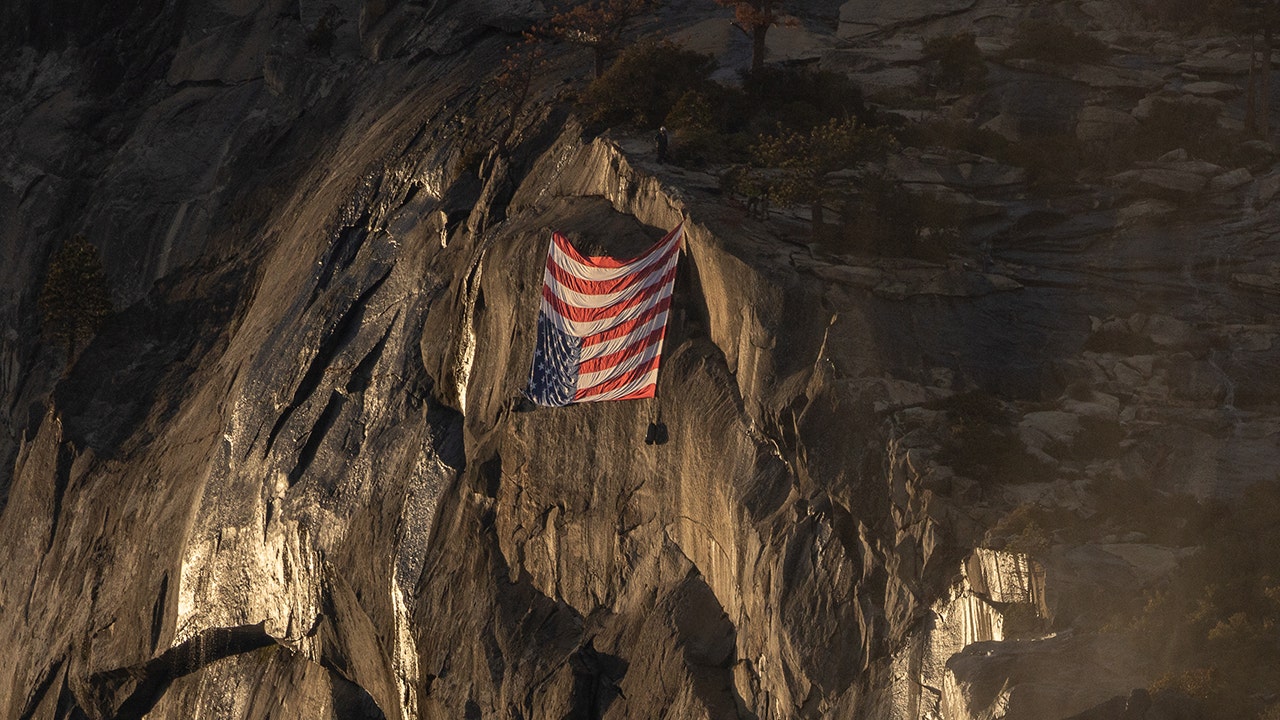
American flag hung upside down in Yosemite National Park in protest over layoffs

Published

on

American flag hung upside down in Yosemite National Park in protest over layoffs

A “distress” signal hung on one of Yosemite National Park’s most iconic sites by staff members was done in protest of recent layoffs by the Trump administration.

The inverted Stars and Stripes hung on the side of El Capitan, a 3,000-foot wall of sheer granite, on Saturday, Feb. 22. 

Anand K Sankaran captured footage, and told media-gathering website Storyful the flag was hung upside-down just before “firefall,” a period of time when the small waterfall Horsetail Fall “can glow orange when it’s backlit by sunset,” the park’s website says. 

Flying a flag upside down is traditionally a sign of “dire distress,” the United States Flag Code states. The symbol of protest was done by park staffers, media outlets report. The practice dates back at least 50 years, according to the Free Speech Center at Middle Tennessee State University.

WHITE HOUSE WILL NOT RELEASE VISITOR LOGS DURING TRUMP’S SECOND TERM

Advertisement

The upside-down flag was placed by Yosemite Park workers on Saturday to protest layoffs by the Trump administration.  (Brittany Colt, www.brittanycolt.com, @brittanycolt)

“We’re bringing attention to what’s happening to the parks, which are every American’s properties,” Gavin Carpenter, a Yosemite maintenance mechanic and disabled military veteran who assisted Saturday, told the San Francisco Chronicle. 

“It’s super important we take care of them, and we’re losing people here, and it’s not sustainable if we want to keep the parks open,” he continued.

CONSERVATIVES SEE PRO-MAGA YOUTH SHIFT AS VP VANCE VOWS TO ‘FIGHT’ FOR YOUNGER GENERATION

A close-up look of the upside-down flag hung in protest at Yosemite National Park in California. (Brittany Colt, www.brittanycolt.com, @brittanycolt)

Advertisement

Last week, the Trump administration fired about 1,000 newly hired National Park Service employees who maintain and clean parks, educate visitors and perform other functions as part of its broad-based effort to downsize government, the Associated Press reported.

Facing outcry, the administration plans to restore at least 50 jobs across the parks. The park service also said in a new memo it will hire more seasonal workers than normal. The park service has about 20,000 employees.

The flag was hung at a time when many tourists look at Horsetail Fall for the phenomenon that creates an orange glow.  (Brittany Colt, www.brittanycolt.com, @brittanycolt)

At least a dozen of those who lost their jobs worked at Yosemite.

Advertisement

“The National Park Service is aware of the unauthorized and inappropriate display that occurred at Yosemite National Park over the weekend,” an Interior Department spokesperson said in a statement to Fox News Digital.

“This blatant disregard for park regulations and respect for our national symbols is unacceptable. The NPS does not condone such actions, and the flag was removed as soon as possible. We take the protection of our national parks seriously and will not tolerate behavior that undermines their integrity,” the statement concluded.

The White House did not respond to a Fox News Digital request for comment. 

The Associated Press contributed to this report. 

Read the full article from Here

Advertisement
Continue Reading
Click to comment

Leave a Reply

Your email address will not be published. Required fields are marked *

This site uses Akismet to reduce spam. Learn how your comment data is processed.

San Diego, CA

Here are the 9 San Diego County communities that set or tied heat records

Published

on

Here are the 9 San Diego County communities that set or tied heat records


San Diego County is known for having wet, cold weather in February. But it had numerous hot spells this year. And when the month ended on Saturday a high pressure system produced heat that broke or tied temperature records in nine communities from the desert to the sea, the National Weather Service said.

The most notable temperature occurred in Borrego Springs, which reached 99, five degrees higher than the previous record for Feb. 28, set in 1986. The 99 reading is also the highest temperature ever recorded in Borrego in February.

Escondido reached 95, tying a record set in 1901.

El Cajon reached 92, three degrees higher than the record set in 2009.

Advertisement

Ramona topped out at 88, five degrees higher than the record set in 2009.

Alpine hit 88, four degrees higher the record set in 1986.

Campo reached 87, four degrees higher than the record set in 1999.

Vista hit 86, four degrees higher than the record set in 2020.

Chula Vista reached 84, one degree higher than the record set in 2020.

Advertisement

Lake Cuyamaca rose to 76, four degrees higher than the record set in 1986.

Forecasters say the weather is not likely to broadly produce new highs on Sunday. Cooler air is moving to the coast, and on Monday, San Diego’s high will only reach 67, a degree above normal.


Source link

Advertisement
Continue Reading

Alaska

Marten visits are a glimpse into mystery

Published

on

Marten visits are a glimpse into mystery


A trapper fresh out of the Cosna River country in Interior Alaska said he can’t believe how many martens he had caught in a small area so far this winter.

Friends are talking about the house-cat size creatures visiting their wood piles and porches. Could this be a boom in the number of these handsome woodland creatures?

Since the late 1970s, the University of Alaska Fairbanks’ Geophysical Institute has provided this column free in cooperation with the UAF research community. Ned Rozell is a science writer for the Geophysical Institute. Portions of this story appeared in 2000.


Source link

Continue Reading

Arizona

Here’s how to give public comment on future Colorado River plans

Published

on

Here’s how to give public comment on future Colorado River plans


PHOENIX — After years of negotiations, Arizona still doesn’t know what its long-term water future will look like, and now the federal government is preparing to step in.

States across the Colorado River Basin have failed to reach a deal on how to share the shrinking river after current operating rules expire in 2026. With no state-led agreement in place, federal officials are moving forward with their own plan, one that could bring steep cuts to Arizona’s water supply.

And for Arizonans, the clock is ticking to weigh in. Public comment remains open until March 2. To submit your comment on what the government should do, send your comments in email to crbpost2026@usbr.gov.

Additional information is available online. The project website can be accessed here, along with links to YouTube videos published by the government, recorded in January and February which walk through of the options available.

Advertisement

Many Arizona leaders have already offered their public comments, which are overwhelmingly negative.

“We were very disappointed with that document,” said Brenda Burman, the Central Arizona Project General Manager “If any of those alternatives were implemented, it would be very difficult, and perhaps devastating for Arizona.”

Arizona’s top Colorado River negotiator, Tom Buschatzke, echoed those concerns.

“None of those alternatives are very good for the state of Arizona,” Buschatzke said. “I’m not seeing how we’re going to break that stalemate.”

Congressman Juan Ciscomani also criticized the proposals, saying the impacts of Colorado River cuts extends into Pinal, and Pima counties.

Advertisement

“That’s not an acceptable solution for us,” Ciscomani said. “We want to play ball, but we want to make sure everyone across the board uses less and becomes more efficient.”

Some of the federal alternatives would reduce Arizona’s Colorado River supply by 40%, 50%, or in the most extreme case up to 70%.

Experts at ASU Kyl Center for Water Policy say part of the problem lies upstream.

“The reason for this current impasse is because the upper basin states have refused to take cuts in their Colorado River use,” said Sarah Porter, the center’s director.

Upper Basin states like Colorado and Utah rely on different water rules than Arizona and other Lower Basin states, complicating negotiations that have dragged on for years.

Advertisement

Arizona has already been living with cuts for several years. Since 2021, the state has faced an 18% reduction in Colorado River water deliveries due to a Tier 1 shortage declaration. Most of those cuts have fallen on Central Arizona Project users, including agriculture and some tribal communities.

Buschatzke argues that pushing Arizona into deeper reductions would violate long-standing Western water law.

“We will be protecting the state of Arizona,” he said. “And if that has to be litigation, it will be litigation.”

That means a lawsuit against the federal government, or upper basin states is now a real possibility if the final plan moves forward unchanged. The state legislature has put $3 million in a state fund for potential litigation on the Colorado River.

After the comment period closes, the federal government is required to review public feedback and issue a formal ‘Record of Decision’, likely sometime this summer. Advocacy groups say public feedback matters.

Advertisement

“I just encourage Arizonans to look at this document, understand what that means for your family, your businesses, and what it means for the future,” said Kyle Roerink of the Great Basin Water Network. “Then figure out if you want to advocate for one scenario over another.”

A new operating plan must be in place by October 1, setting the rules for how the Colorado River will be managed for years to come, and shaping Arizona’s water future in the process.

This story was reported on-air by a journalist and has been converted to this platform with the assistance of AI. Our editorial team verifies all reporting on all platforms for fairness and accuracy.


Source link

Advertisement
Continue Reading

Trending
