Oxidized rock colors a ridge above where one of Seabridge Gold’s KSM project’s open pit mines is being dug, from the KSM Project’s Prefeasibility Technical Report. (Courtesy of Seabridge Gold)
At the river’s mouth
The Southeast Alaska Indigenous Transboundary Commission is worried about the region’s rivers. They are a group of 15 Tlingit, Haida, and Tsimshian nations who came together because they believe mining in British Columbia poses a threat to their spawning salmon and hooligan habitats, like the Unuk and Stikine Rivers.
The transboundary commission’s attention is currently on the Kerr-Sulphurets-Mitchell project, a proposed gold and copper mine at the foot of a glacier just across the Canadian border.
“KSM is on a whole other scale of mining, one of the world’s largest open pit mines, if it’s ever built,” said Guy Archibald, the director of the Southeast Alaska Indigenous Transboundary Commission. “Our tribes and communities are directly downstream. We rely on fish and the food security opportunities that the Unuk provides.”
The KSM Project is being developed by Seabridge Gold. According to the Canadian exploration company, the mine could generate nearly 1,500 jobs and over $30 billion for British Columbia and $60 billion for Canada over its projected 60-ish year lifespan.
Advertisement
For Archibald, the stakes are “Billions of tons of acid-generating waste rock just piled into valleys. Valley fills in direct tributaries to the Unuk River. And so it’s almost inevitable that bad things are gonna happen.”
Mine tailings are the materials left over from the mining process, like acidic rock waste, undesirable metals, and the chemicals and discharge from processing the ore. All of this waste is stored in tailings facilities or dammed ponds until it can organically break down. According to the U.S. Environmental Protection Agency, many decommissioned mine tailing facilities are designated as Superfund sites.
Archibald cited the Mount Polley disaster, a 2014 failure at another mine in British Columbia that is widely referred to as one of the worst mining disasters in Canadian history. Canadian news outlet The Narwhal reported that KSM’s tailing ponds would be around 28 times the size of the one that failed at Mount Polley. The Southeast Alaska Indigenous Transboundary Commission estimated that KSM’s tailings ponds would require ongoing maintenance for at least 250 years, long after the mine shutters.
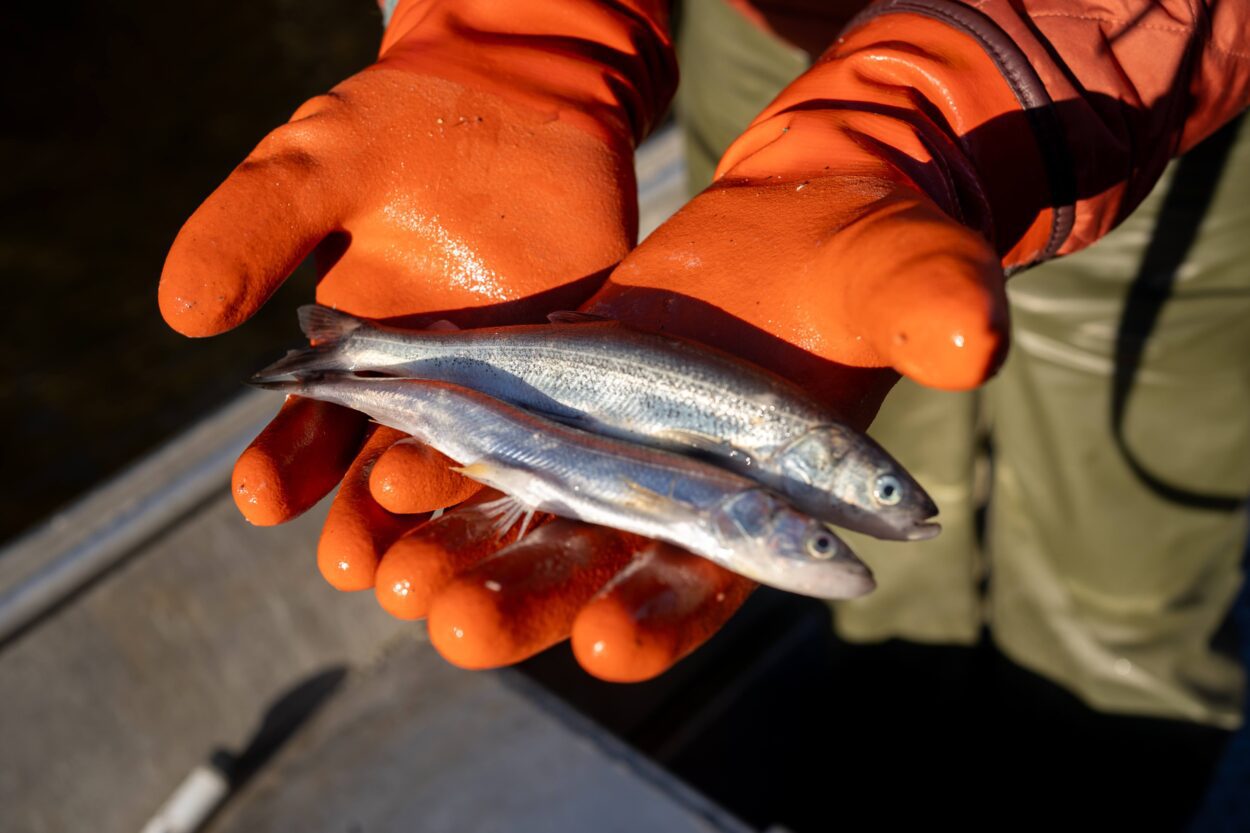
Tazia Wagner holds a pair of hooligan caught on the Unuk River. March 18, 2024. (Jack Darrell/KRBD)
A voice in the process
In July, the British Columbia government issued a finding in the permitting process for the project known as a “Substantially Started Determination.” Under British Columbia’s law, environmental permits for development projects like mines come with an expiration date. According to the British Columbia Environmental Assessment Office, that’s partially because the environmental assessment process is constantly evolving – i.e. new science, new information, new regulations. Once a mine reaches a certain stage in development, though, the province can declare that it is far enough along and has met the environmental permitting requirements to move forward without its environmental “stamp of approval” lapsing.
Part of that environmental assessment process involves public comment and “a legal obligation to consult with Indigenous nations whose interests could be affected by the outcome of a substantially started determination.”
“And yet, the Alaska tribes are not really afforded any kind of voice in how this process works out. So we are trying every way possible to try to be sure that our communities are protected,” said Archibald, alleging that tribes in the transboundary commission weren’t afforded a meaningful seat at the table in that process.
Advertisement
In late November, the transboundary commission and SkeenaWild Conservation Trust filed a legal challenge against the British Columbia government. They’re represented by the Canadian law firm EcoJustice and are arguing that the mine was “rubber stamped” – challenging the premise of the province’s decision that the mine is “substantially started.”
The KSM mine received its environmental assessment a decade ago. EcoJustice attorney Rachel Gutman said that the process has changed since then and the province has a “deeper understanding of a rapidly changing climate” and “threats to salmon populations.”
“There are good reasons why the law has expiration dates for environmental assessments, including ensuring that mega projects like the KSM mine do not proceed based on outdated information,” Gutman said in a press release. “This is particularly important in this case due to the rapidly changing climate in Northern BC.”
The challenge also alleged that the province specifically considered whether the “substantially started determination” would help the mine in its timeline to secure outside funding when it issued the determination.
“We believe it is inappropriate for the [British Columbia Environmental Assessment Office], the agency tasked with assessing the environmental impacts of a project, to consider how their decision might support a company with project funding,” said Greg Knox, the executive director of SkeenaWild.
Advertisement
R. Brent Murphy is Seabridge’s Vice President of Environmental Affairs. In an email to KRBD, he wrote that Seabridge’s legal counsel are preparing to defend the validity of British Columbia’s determination. In his view, the Southeast Alaska tribal commission’s “ultimate goal is to halt all mining and exploration activities in the transboundary region.”
Murphy claimed that mining projects like the KSM aren’t responsible for declines in salmon and hooligan habitats. He chalked them up instead to “changes in ocean conditions, declines in quantity and quality of spawning habitat, and overfishing.”
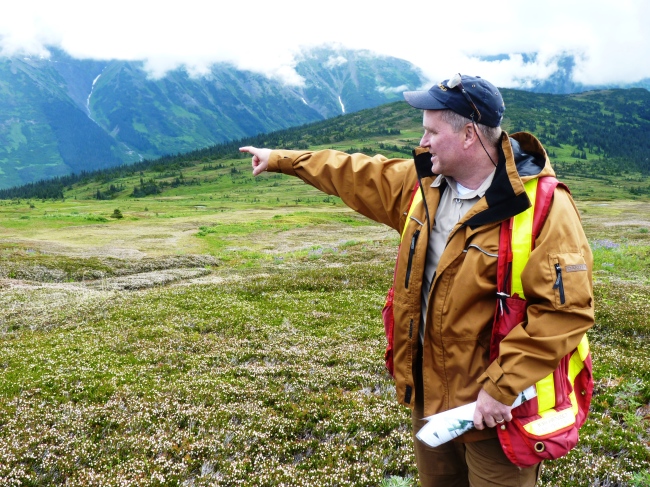
Seabridge Gold’s Brent Murphy points to the valley to be dammed to hold tailings from the KSM mine during a tour in 2014, soon after the project received Canada’s federal environmental approval. (Ed Schoenfeld/CoastAlaska News)
“There is also a misconception that Alaskans were not engaged during the [environmental assessment] process of the KSM Project,” Murphy said about the transboundary commission’s challenge that tribes weren’t properly consulted in the process. “On the contrary, the BC Environmental Assessment Office actively receives input and feedback from Alaskan regulators, tribal groups, and the Alaskan public for any mining project undergoing the EA process within the transboundary region.”
For Archibald and the transboundary commission, though, those requests for feedback amounted to an empty promise. He called British Columbia’s consultation process for Alaskans “everything short of being meaningful or consent-based at all.”
The Southeast Alaska Transboundary Commission’s challenge, as well as their recent petition to an international human rights commission, hinges on their demand to be afforded the same sway in the consultation process as Canada-based First Nations, a request that has been categorically denied by both British Columbia and the larger Canadian ministry.
There is Canadian legal precedent for U.S.-based tribes to be afforded the same rights to consultation as First Nations protected under the Canadian constitution. That precedent is R. v. Desautel,a 2021 Canadian Supreme Court finding. An indigenous American citizen was tried in Canada’s courts for killing an elk in British Columbia without a hunting license. The defendant lived on a reservation in Washington and argued that he was exercising his Aboriginal right to hunt in the traditional territory of his ancestors.
Advertisement
As Archibald put it, the case forced the Canadian Supreme Court to ask a central question: “Do indigenous, non-resident people of Canada – people who live outside of Canada but have ties to traditional lands within Canada – have any rights to those lands? And the Supreme Court said yes.”
“Given the complex nature of an ecosystem, a productive ecosystem, like the Unuk watershed, and the complex nature of one of the world’s largest mines, what the outcome of that is going to be if it moves forward, is really anybody’s guess,” said Archibald.
In a September opinion piece in the Anchorage Daily News, Murphy struck back at the legal challenge and its supporters categorizing Canada’s decision as a “rubber stamp,” saying that Seabridge had already sunk roughly CAD $1 billion into the project which constitutes substantial progress. He also challenged what he called “widespread misinformation” surrounding the mining industry.
Murphy said that the KSM project met British Columbia’s three main criteria for a “substantial start determination” – work had begun on the mine, they’d spent significant money on construction, and they’d received “the support of our First Nations partners.”
The headwaters
The Tsetsaut Skii km Lax Ha Nation is an Indigenous First Nation in British Columbia that borders the KSM site.
Advertisement
In November, they filed their own legal challenge against British Columbia. Ryan Beaton, who provides legal counsel for the nation, said that the KSM project’s proposed tailings facility is on the nation’s land and the province didn’t properly consult with them either before “essentially greenlighting” the project.
“If we’re going to go ahead with this permitting, and this is going forward, where’s the consultation? Where are the funds to deal with the environmental damage from this?” Beaton asked.
Beaton described Tsetsaut Skii km Lax Ha as a small tribal nation “surrounded by larger, more powerful or more connected First Nations neighbors.”
Those larger First Nations surrounding the Tsetsaut Skii km Lax Ha’s traditional territory are the Tahltan and the Nisg̱a’a. And both nations publicly support the mine.
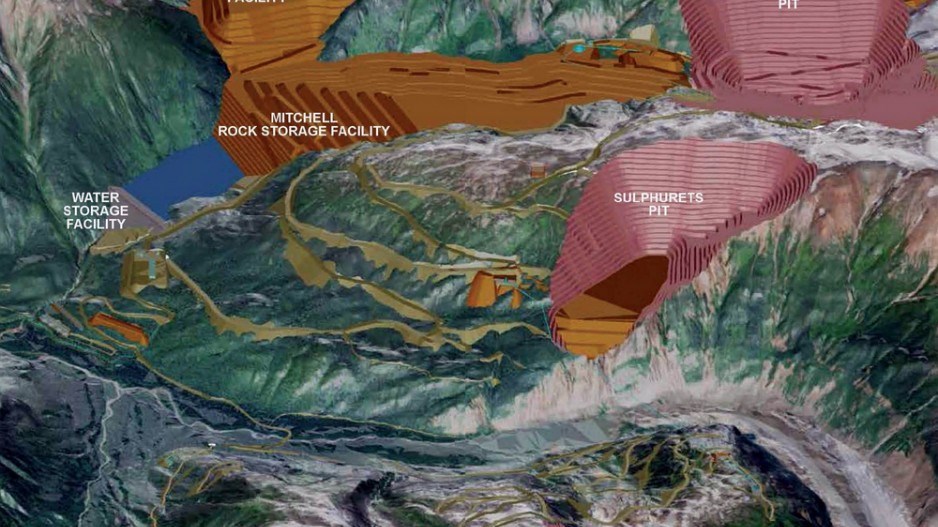
If the KSM project is built, Seabridge envisions three open-pit mines that will feed a processing facility and a tailings facility to store mine waste. Seabridge anticipates those mines could produce at least 47 million ounces of gold and 7 billion pounds of copper over their lifespan.
Advertisement
“The concern is a huge amount of toxic waste flowing out onto the territory, into the waterways, destroying the fishing for the nation, affecting wildlife,” he said, explaining the nation’s concerns if one of the dams at the tailing facility failed.
The KSM project’s mine site layout during the operation phase, from its environmental assessment certificate application. (Image courtesy Seabridge Gold)
For Beaton and the Tsetsaut Skii km Lax Ha, even if all goes according to Seabridge’s plan, some of the damage has already been done.
“Just the construction of the project on its own terms, if everything goes well, has had a huge impact on their hunting territories, their traditional ways of life, huge swaths of forest cut down, so there’s already been major impact,” Beaton said.
The KSM project has also caused particular friction between the Tsetsaut Skii km Lax Ha and their First Nations neighbors. That’s because Beaton said if the project moves ahead, gold and copper aren’t the only things that will be flowing out of it – so will huge sums of money to the Tahltan and the Nisg̱a’a.
The Tahltan and the Nisg̱a’a both signed agreements with Seabridge over the last decade. Publicly, Nisg̱a’a Nation President Eva Clayton has said that projects like Seabridge’s KSM stand to attract investors to First Nations territories in the Golden Triangle and “improve the quality of life of our Nisg̱a’a and Tahltan people.”
Recently, the two nations announced a partnership to “maximize joint opportunities on the Seabridge KSM Project.”
Advertisement
“On behalf of both the Nisg̱a’a Nation and the Tahltan Nation, I would like to acknowledge Seabridge for their support and encouragement,” Tahltan Nation Development Corporation Chair Carol Danielson wrote in a statement at the time, “and their willingness to actively engage and work with our Partnership on their KSM project, the world’s largest undeveloped gold project.”
Neither Tahltan nor Nisg̱a’a leadership responded to requests for comment.
Beaton compared the tailings facility dispute to hearing there was a big construction project happening in your neighborhood and then finding out “all the toilets for the project were going to be built in your backyard while the money flowed elsewhere.”
“When the [KSM project] is over, the Nisg̱a’a and Tahltan get to go home and the Skii km Lax Ha, this small First Nation, is stuck with a huge waste facility on its territory, and that is not the way Indigenous consultation should go,” said Beaton.
The Tsetsaut Skii km Lax Ha aren’t strangers to mining, though. They’ve worked with other mining projects in the past and recently signed an agreement with a different company for a neighboring mine.
Advertisement
“Our nation is certainly not anti industry,” said Beaton, adding that the nation does see the benefits mining could have on the province and their communities. “But it’s got to be done responsibly and in a way that respects both the nation’s rights but also the environmental concerns that they have.”
“[Its] the ‘Asserted’ territory of the Tsetsaut Skii km Lax Ha,” said Seabridges’ R. Brent Murphy about the First Nation’s claim that the land for the tailing facility belongs to them. “While they have sought recognition of their ‘exclusive’ rights to this area, it is currently not recognized by the government.”
The federal government of Canada marks the site of the proposed tailings facility as traditional Tahltan territory.
In their legal challenge, the Tsetsaut Skii km Lax Ha allege that this comes from a complex history of misinterpreted treaties and shaky ethnographic accounts that essentially, as Beaton puts it, “writes the Skii km Lax Ha out of their own history on their own territory.”
This assertion is backed by a 2021 report from British Columbia’s Attorney General, as well as a 2017 environmental assessment of a different mine, that supports the Tsetsaut Skii km Lax Ha’s exclusive rights to the area where the tailings facility will be located.
Advertisement
“We’re not asking them to take our word for it,” Beaton said. “We’re asking the province to act on their own assessment.”
Similar to the legal challenge EcoJustice filed on behalf of Alaska tribes across the border, the Tsetsaut Skii km Lax Ha’s legal complaint is lobbied against the provincial government. According to Beaton, that’s because the small First Nation is alleging that the province officially recognized their territory but because of their size and their lack of support for the KSM project, their constitutional right to consultation was minimized.
“The province is really picking and choosing who gets rights, and that is not appropriate. It’s really colonialism in action,” said Karen McCluskey, Beaton’s co-counsel representing the Tsetsaut Skii km Lax Ha.
For Seabridge, the could-be world’s largest gold mine passed its comprehensive seven-year environmental review process and according to Murphy, the company plans to invest millions of dollars annually into ongoing water quality reviews. For him, the province’s determination just reflects that Seabridge has done its part in making sure the project is safe and sustainable. He also continuously pointed to the support of their Indigenous partners – the Tahltan and Nisg̱a’a – and how they’ve allowed the project to move forward on their ancestral lands.
“The benefits are flowing to neighboring First Nations, to the government, and to industry. You know, the Tsetsaut Skii km Lax Ha nation has said they would like to have no dump on their land. That’s their position,” Beaton said.
Advertisement
The ball is currently in British Columbia’s court to determine how long they’ll need to respond to these legal challenges on both sides of the border. Beaton estimated the whole process could take about a year.
For the KSM mine, Seabridge is hoping to solicit a partner for the venture, another mining company big enough to build and operate a mine this scale. After that, they anticipate construction on the mine would take about five years.
Lee Wagner, Assistant Director of the Southeast Alaska Indigenous Transboundary Commission, fishes for hooligan on the Unuk River. March 18, 2024. (Jack Darrell/KRBD)
The first Jesuit missionaries in Alaska sailed up the Yukon River in 1887. By the turn of the 20th century, the religious order of the Catholic Church had as many as 50 Jesuits in the state.
Now, only two remain. And by the end of June, there will be none.
The Jesuits’ nearly 140 years in the state was honored at an event at Bethel’s Immaculate Conception Church on June 16. A procession of priests wearing long white gowns with red hems walked down the aisle to open the event. The Bishop of the Diocese of Fairbanks, Stephen Maekawa, thumped the ground with a shimmering silver staff known as a clozier as he approached the altar.
Bishop of the Diocese of Fairbanks, Steven Maekawa, walks toward the altar at the Immaculate Conception Church in Bethel.
“My brothers and sisters, we gather together to celebrate this wonderful and blessed occasion to acknowledge the love of God and the work of God through the 139 year mission of the Society of Jesus of the Jesuit fathers,” Maekawa said to open the event.
Advertisement
A traditional Catholic mass followed, with readings in both English and Yup’ik. During the sermon, Maekawa acknowledged the vastness of the Fairbanks diocese, and the tremendous amount of work done by the Jesuits to establish it.
“All of the 46 churches of the Diocese of Fairbanks that we currently have were established by either the Jesuit fathers or by direction of a Jesuit bishop,” Maekawa said. “We have a long history of the Society of Jesus’ presence and ministry here in all of Alaska.”
The Jesuits are an order within the Catholic Church, akin to the Dominicans or Franciscans. They have a reputation for taking on some of the Catholic Church’s most remote assignments.
That missionary spirit brought the Jesuits to the Yukon River in 1887, where they built churches, schools, and ministries. Without their work, Catholicism may not have taken root in huge swaths of Alaska, particularly among Alaska Native communities.
The Immaculate Conception Church in Bethel.
But the Jesuits leave a complicated legacy. Their methods of converting Native people to the religion, particularly in the first half of the 20th century, created generational traumas still felt to this day.
Advertisement
Fr. Sean Carroll is the provincial of the Jesuits West Province, which oversees Alaska and nine other states.
Fr. Sean Carroll, provincial of the Jesuits West Province, speaks at an event recognizing nearly 140 years of Jesuit service in Alaska.
“Thank you for all that you have taught us about who Jesus is and how to love and serve Him wholeheartedly,” Carroll said. “I also thank you for your patience with us. For there have been times when we have sinned and when we have hurt you.”
Missionaries, including the Jesuits, forcefully converted and assimilated Alaska Native people into Western culture and religion. Students at Jesuit-run boarding schools were forced to abandon their Native languages and physically punished when caught speaking languages other than English. Native dancing and drumming were also banned.
The Jesuits West Province maintains a list of 150 Jesuits with credible claims of sexual abuse against minors or vulnerable adults. A quarter of the accused Jesuits served in Alaska at some point in time.
“I ask for your forgiveness for all that we have done that was not rooted in Christ and love for Him, and for when we did not value your culture nor recognize the presence of God in you,” Carroll said.
Advertisement
Carroll gave the order to withdraw from the state last spring. A big issue was the recruitment of Jesuits willing to travel and serve in remote villages. He told the congregation that the Jesuits’ work would continue, just without a permanent presence.
Fr. Rich Magner, one of the two remaining Jesuit priests in Alaska, attends a ceremony in Bethel.
Fr. Rich Magner is one of the two remaining Jesuit priests in Alaska. His last day serving Chevak, Hooper Bay, and Scammon Bay is June 30.
“We all always knew coming in, or should have known, that we’re not going to be here forever. It’s going to be mission accomplished at some point,” Magner said. “And then we hand it off to the diocese that we’ve helped create, and so that’s a good feeling.”
Magner’s next stop is a Clinical Pastoral Education residency in Tacoma, Washington.
The other remaining priest, Fr. Tom Provinsal, first came to Alaska in 1968 to teach. A fond memory, he said, was meeting Elders that practiced traditional subsistence lifestyles.
Advertisement
“Some of the grandmothers, their fingers were just all bent with arthritis and stuff like that, you know, their whole lives they’ve been working out in the cold and the wet, doing food, sewing, all that kind of stuff,” Provinsal said. “I’d say I just feel very privileged to have come when I did come and to see that.”
Provinsal returned in 1975 as a priest and has served in the region ever since. After moving away, he plans to take a five month sabbatical. What happens next, he said, is in God’s hands.
Two lines formed in the aisle for communion at the end of the mass. After taking communion, Bethel’s Parish Administrator Susan Murphy gave a final thank you.
“It’s difficult to say goodbye to people who have been a part of our lives for so long,” Murphy said. “We know that you have done what was yours to do, and have taught us to do what is ours to do. We are grateful.”
Jesuit priests form a row along the altar of Bethel’s Immaculate Conception Church as members of the congregation lift their arms and pray.
Dominic Hunt, a Yup’ik deacon that flew in from Emmonak for the event, led the congregation through a final prayer.
Advertisement
“Bless them with your wisdom, that they may be a word of hope, a world in need. We ask this through Christ, our Lord. Amen,” Hunt said.
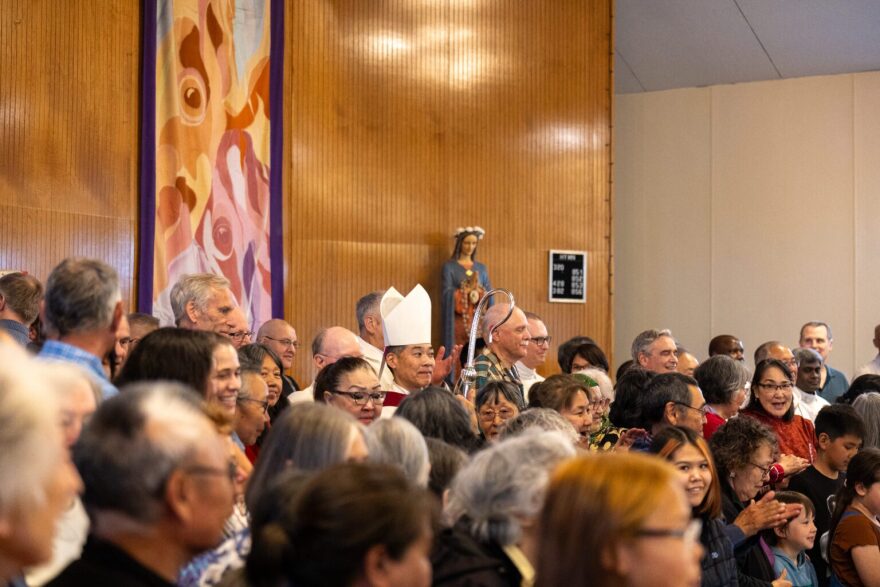
About 70 people posed for a photo on the altar – priests, deacons, parishioners, Elders and children — many of them smiling, some standing quietly.
The photo doesn’t tell the whole story. But it’s a moment when gratitude, grief, and memory all shared the same room.
Bishop of the Diocese of Fairbanks, Steven Maekawa, stands in the middle of a crowd waiting to take a photo at Bethel’s Immaculate Conception Church.
JUNEAU, Alaska (KTUU) – The Supreme Court of Alaska will be taking up the case of the State of Alaska, Division of Elections v. Daniel J. Sullivan, Jr.
The oral arguments will be held Monday at 10 a.m. via Zoom, according to an order and opening notice.
The document also specifies that a decision is expected to be made before noon on Tuesday.
According to documents from the Division of Elections, the state must start printing ballots at noon on the same day.
Advertisement
This comes after an Anchorage Superior Court Judge ordered Dan J. Sullivan on to the ballot Friday.
See a spelling or grammar error? Report it to web@ktuu.com