Alaska
Why water in many Alaska’s rivers is turning orange – Times of India


“The more we flew around, we started noticing more and more orange rivers and streams,” said study co-author and National Park Service ecologist Jon O’Donnell.“There are certain sites that look almost like a milky orange juice. Those orange streams can be problematic both in terms of being toxic but might also prevent migration of fish to spawning areas.”
Permafrost, which is rock or soil containing ice that remains frozen for two or more years, covers about 80 percent of the ground in Alaska. The state is warming two to three times faster than the global average, causing significant thawing of permafrost, a report in Popular Science said.
As ice-filled permafrost begins to thaw, it can turn into mud that cannot support the weight of the soil or vegetation above it. This can lead to damage to human-built infrastructure including buildings, homes, pipes, and roads. Thawing permafrost can also expose organic matter, including the remains of dead plants, which release methane and carbon dioxide into the atmosphere. Additionally, long-dead viruses or bacteria that could potentially threaten human health may be released.
Visible from space
In 2018, O’Donnell first noticed a river that appeared rusty, despite being clear the year before. To investigate further, O’Donnell and the research team documented and sampled some of the impaired waters. They examined 75 locations across northern Alaska’s Brooks Range, an area about the size of Texas.
“The stained rivers are so big we can see them from space,” said study co-author and University of California, Davis geochemist Brett Poulin. “These have to be stained a lot to pick them up from space.”
Poulin observed that the staining in the water appeared similar to what happens during acid mine drainage. However, there were no mines near the impaired rivers, which include the Salmon River and other federally protected waters.
Chemical changes
The researchers hypothesize that as the permafrost melts, the minerals stored inside the frozen ground are released. Metal ores that were once locked up are then exposed to water and oxygen, releasing acid and metals into the river.
“Chemistry tells us minerals are weathering,” Poulin explained. “Understanding what’s in the water is a fingerprint as to what occurred.”
Initial samples collected in June and July 2023 showed some waters had a pH of 2.3, while the average pH for these rivers is 8. This indicates that sulfide materials are weathering and making the water more acidic. The researchers also found elevated levels of iron, zinc, nickel, copper, and cadmium. “One of the most dominant metals is iron. That’s what is causing the color change,” noted UC Davis Ph.D. candidate Taylor Evinger.
Implications for ecosystems
The team is currently in the second year of a three-year grant aimed at understanding what is happening in the waters, determining what other areas could be at risk, and assessing what it means for fishing stocks and drinking water. The problem is growing, affecting habitat, water quality, and other ecological systems. It is degrading otherwise healthy habitats and could threaten the safety of drinking water in rural areas.
“There’s a lot of implications,” O’Donnell said. “As the climate continues to warm, we would expect permafrost to continue to thaw and so wherever there are these types of minerals, there’s potential for streams to be turning orange and becoming degraded in terms of water quality.”
More detailed work is needed to better understand the problem and to see if rivers and streams can rebound after colder weather restores permafrost. Satellite images dating back to 2008 show that the waters have been changing color for well over a decade and could only be growing over time.
“The issue is slowly propagating from small headwaters into bigger rivers over time,” O’Donnell said. “When emergent issues or threats come about, we need to be able to understand them.”






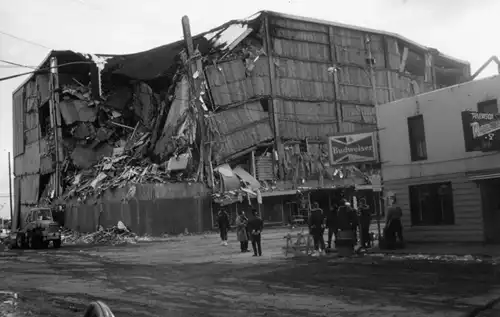
It was on this day in 1964 that a massive 9.2 earthquake in Southcentral Alaska.
The massive quake at 5:36 pm on March 27th caused much devastation throughout the region and generated a huge tsunami that inundated many communities in the region.
The quake was the largest in the history of the United States and initially killed 15 people while the resulting tsunami killed an additional 100 people in the new state and another 13 in California as well as five in Oregon.
The megathrust earthquake endured for four minutes and thirty-eight seconds and ruptured over 600 miles of fault and moved up to 60 feet in places.
The deadly quake occurred 15 and a half miles deep 40 miles west of Valdez and generated a ocean floor shift that created a wave 220 feet high.
As many as 20 other smaller tsunamis were generated by submarine landslides.

I grew up greeting friends and neighbors on my walk to my neighborhood Anchorage public school, just as my kids do now. It’s an essential, and value-added, part of living in our community.
In the late 1990s, when I attended Service High School, I had amazing teachers. My AP chemistry teacher left the oil and gas industry to teach. He could have earned significantly more money in another field, but teaching was competitive enough, given pensions and compensation, that he stayed in the job he loved and gave a generation of students a solid foundation in chemistry.
Now, my kids, who are in first, third and fifth grade, face a different reality. Teachers across our state are leaving in droves. Neighborhood schools across Alaska are closing. Art and music are being combined, which is nonsensical — they are not the same and they are both valuable independently. When he was in second grade, my oldest had a cohort of more than 60 students in his grade — split between two teachers. When he enters sixth grade next year, there will be no middle school sports and he will lose out on electives. Support systems and specialists to help when kids are falling behind have been cut. I’m lucky that my children have had amazing teachers, but many excellent teachers are nearing retirement age or don’t have a pension and are pursuing other careers. What happens then?
Despite skyrocketing inflation, last year was the first time in years that our schools received a significant increase in the Base Student Allocation — and that money doesn’t begin to make up for what they have lost over the years. Even that increase had to overcome two vetoes from what a recent teacher of the year calls “possibly the most anti-public education governor in the history of Alaska.” Shockingly, my own representative, Mia Costello, despite voting for the increase, failed to join the override to support education. She has failed to explain that decision when asked.
State spending on corrections is up 54% since 2019; meanwhile, spending on education is up only 12% in the same timeframe. Schools are now working with 77% of the funding they had 15 years ago when accounting for inflation.
When we starve our public schools of funding, Alaska families leave. No one wants their child to suffer from a subpar education and the lower test scores and opportunities that come with it. A significant number of people are working in Alaska but choosing not to raise their families here.
To the elected officials who preach school “choice” but starve public schools: our family’s choice is our neighborhood school. It’s our community. It’s where our friends are. Neighborhood public schools, which are required to accept all children, should be the best option out there. Public schools should be a good, strong, viable option for communities and neighborhoods across our great state. Once, they were.
I am thankful for those in the Legislature working to solve these problems. This includes HB 374, which raises the BSA by $630, and HB 261, which would make education funding less volatile.
It breaks my heart that across the state, dedicated teachers keep showing up for our kids while being underpaid and undervalued. Underfunding our schools is also a violation of Alaska’s constitution, which requires “adequate funding so as to accord to schools the ability to provide instruction in the standards.”
Not so long ago, Alaska’s public schools were adequately funded, and they produced well-educated students and retained excellent teachers. It’s up to all of us to reach out to our elected officials and urge them to make that the case once again.
Colleen Bolling is a lifelong Alaskan and mother of three who cares deeply about Alaska’s schools.
• • •
The Anchorage Daily News welcomes a broad range of viewpoints. To submit a piece for consideration, email commentary(at)adn.com. Send submissions shorter than 200 words to letters@adn.com or click here to submit via any web browser. Read our full guidelines for letters and commentaries here.

ANCHORAGE, Alaska — Karen Burnett spends most days in the sorting room at the Food Bank of Alaska, ensuring every donated item finds its place.
The Anchorage woman dedicates her time to sorting, packing and organizing food donations.
Finding purpose after loss
Burnett’s journey at the Food Bank of Alaska began after a personal loss. Following the death of her husband, Burnett said she found herself with time on her hands and a desire to help.
“I had a friend who had talked to me about it, and it just sounded like a good thing to be out doing,” she said.
Burnett now volunteers between 500 and 600 hours each year.
“I started, but it got to be so fun. I spent more and more time here,” Burnett added.
Understanding community need
Burnett has witnessed the growing need in the community, particularly as more families struggle to make ends meet.
“If you took a look at the pantry and saw those empty shelves, it’s hard sometimes when you know people are coming in and looking for something, for their clients, and there’s absolutely nothing in there,” Burnett said.
Her dedication has made a lasting impact on countless families.
“I just feel real involvement in a way that is appreciated,” Burnett said. “You know, people need this food. They need people to put it out for them.”
See the full story by Ariane Aramburo and John Perry.
Copyright 2025 Gray Media Group, Inc. All rights reserved.

The White House has an app now, and Trump wants you to report people to ICE on it

The race against time to destroy Iran’s illicit nuclear weapons program heats up amid fresh strikes

WATCH: Senate hearing goes silent after Angel Father confronts top Dem over daughter’s death

Another state bans ‘gas station heroin’ as officials warn of deadly risks

Tiger Woods involved in rollover crash in Florida less than 2 weeks before Masters: reports

Florida High School Football Rankings: Top 25 teams – Oct. 21

How old is Bo Nix? What to know about Oregon quarterback ahead of 2024 NFL Draft

Cleary's 21 help Le Moyne down Central Connecticut State 69-64 in OT

99th annual Pony Swim held in Virginia

Indiana Members Credit Union announced as new anchor tenant at Bottleworks District
WATCH: Senate hearing goes silent after Angel Father confronts top Dem over daughter’s death

US diplomat Marco Rubio denounces settler violence, tolls in Hormuz strait

Iran-linked hackers have breached FBI Director Kash Patel’s personal emails | CNN Politics

Live: CPAC 2026 Day 2

Video: Will ICE Change Under Its New Leader?
-

 Detroit, MI1 week ago
Drummer Brian Pastoria, longtime Detroit music advocate, dies at 68
-

 Movie Reviews1 week ago
‘Youth’ Twitter review: Ken Karunaas impresses audiences; Suraj Venjaramoodu adds charm; music wins praise | – The Times of India
-

 Sports6 days ago
IOC addresses execution of 19-year-old Iranian wrestler Saleh Mohammadi
-

 New Mexico5 days ago
Clovis shooting leaves one dead, four injured
-
 Business1 week ago
Disney’s new CEO says his focus is on storytelling and creativity
-

 Technology5 days ago
YouTube job scam text: How to spot it fast
-

 Tennessee4 days ago
Tennessee Police Investigating Alleged Assault Involving ‘Reacher’ Star Alan Ritchson
-

 Texas1 week ago
How to buy Houston vs. Texas A&M 2026 March Madness tickets