Alaska
What to know about the Alaska Airlines 737 Max 9 jet that suffered a blowout


NEW YORK — An emergency landing by an Alaska Airlines jetliner has prompted U.S. federal authorities to ground some Boeing 737 Max 9 aircraft, adding another episode to the troubled history of Boeing’s Max lineup of jets.
Here is what to know about the Max 9 plane involved, and what comes next.
WHAT HAPPENED?
An Alaska Airlines jetliner blew out a portion of its fuselage seven minutes after takeoff 3 miles (4.8 kilometers) above Oregon Friday night, forcing the pilots to make an emergency landing. None of the 171 passengers or six crew were seriously injured but the rapid loss of cabin pressure caused oxygen masks to drop from the ceiling. National Transportation Safety Board Chair Jennifer Homendy said the two seats next to the part that tore off were unoccupied.
HOW ARE FEDERAL AUTHORITIES RESPONDING?
The Federal Aviation Administration ordered the grounding of some Boeing Max 9 operated by U.S. airlines or flown into the country by foreign carriers until they are inspected. The emergency order affects about 171 planes worldwide.
The NTSB has begun an investigation that is likely to last months and focus on the paneled-over exit door that blew off. The so-called door plug is installed on some jets with fewer seats instead of an emergency exit panel. The jets ordered grounded by the FAA all have those panels installed.
College students Fiona Max, left, and her twin sister Isabel Max check their phones while trying to rebook their flight back to school at Princeton after their Alaska Airlines flight was canceled at Seattle-Tacoma International Airport on Saturday, Jan. 6, 2024, in SeaTac, Wash. Alaska Airlines canceled more than 100 flights after grounding Boeing’s fleet of 65 Max 9s for inspections following Friday’s emergency landing of a Boeing 737 Max 9 jetliner. Credit: AP/Karen Ducey
Authorities are still searching for the door plug, which likely landed near Oregon Route 217 and Barnes Road in the Cedar Hills area west of Portland.
HOW ARE AIRLINES RESPONDING?
Alaska Airlines has grounded its entire fleet of 65 Max 9s for inspections and maintenance. The airline initially kept 18 of its Max 9s in service Saturday because they had received in-depth inspections as part of recent maintenance checks. But the airline pulled those jets from service Saturday night to comply with an FAA directive for all operators of Max9s to conduct specific inspections.
United Airlines, the world’s biggest operator of Max 9s, has grounded its entire fleet of 79 Max 9s.
Alaska and United are the only two U.S. passenger airlines that operate Max 9 aircraft. The companies operate nearly two-thirds of the 215 Max 9 aircraft in service around the world, according to aviation analytics firm Cirium. Six other airlines use the Max 9: Panama’s Copa Airlines, Aeromexico, Turkish airlines, Icelandair, flydubai, and SCAT Airlines in Kazakhstan, according to Cirium.
Copa said it had temporarily suspended 21 Boeing 737 Max 9s to comply with the FAA’s order.
Alaska Airlines had canceled 163 flights on Sunday, or 21% of its schedule, according to Flightaware. United Airlines had canceled 247, about 9% of its scheduled flights. Not all of the cancelations were necessarily due to the Max 9 crisis.
Alaska Airlines said the groundings had resulted in at least 160 flight cancelations by Saturday evening and disruptions will last through at least mid-week. United had said Saturday evening said the inspections will result in about 60 cancelations.
Alaska Airlines has said affected passengers should go online to view rebooking options and can request a refund. The airline has said passengers whose flights are canceled will be moved the next available flight but they can also request a change or a refund without incurring fees under a flexible travel policy. United Airlines has not instituted a policy specific to the Max 9 inspections but the airline waives change fees for significant delays.
HOW SAFE IS IT TO FLY ON ONE OF THESE PLANES?
Federal officials and airline executives regularly tout the safety of air travel. There has not been a fatal crash of a U.S. airliner since 2009, when a Colgan Air plane operated for Continental crashed near Buffalo, New York, killing all 49 people on board and one on the ground.
After arriving in Portland to investigate the Alaska Airlines incident, the NTSB’s Homendy said the U.S. has “the safest aviation system in the world.” However, a surge in close calls between planes at U.S. airports in the past year prompted the FAA to convene a “safety summit” last year, in which officials encouraged airlines and pilots to redouble their attention to careful flying.
The incident has also renewed questions about the safety of Boeing’s Max aircraft, which the newest version of the company’s storied 737. There are two versions of the aircraft in service: the Max 8 and the Max 9, which is the larger of the two.
Regulators around the world grounded Max 8 planes for nearly two years after a Lion Air flight crashed in Indonesia in 2018, and an Ethiopian Airlines Max 8 crashed in 2019. Boeing changed an automated flight control system implicated in the crashes.
Last year, the FAA told pilots to limit use of an anti-ice system on the Max in dry conditions because of concern that inlets around the engines could overheat and break away, possibly striking the plane. And in December, Boeing told airlines to inspect the planes for a possible loose bolt in the rudder-control system.
However, those past issues are unrelated to Friday’s blowout, which is exceedingly rare in air travel, according to Anthony Brickhouse, a professor of aerospace safety at Embry-Riddle Aeronautical University. Brickhouse said fuselage panels sometimes tears off planes but he could not recall a previous incident that blew a gaping hole like the one that forced Friday’s emergency landing.
In 2018, a passenger on a Southwest Airlines jet was killed in when a piece of engine housing blew off and shattered the window she was sitting next to. However, that incident involved an earlier version of the Boeing 737, not a Max.
WHAT IS BOEING’S RESPONSE?
The company, based in Arlington, Virginia, issued a brief statement saying “we deeply regret the impact this event has had on our customers and their passengers.” Boeing said it supported the FAA’s decision to require immediate inspections and said it was providing technical help to the investigators. The company has declined to make an executive available for interviews.



An aide to Gov. Mike Dunleavy, Forrest Wolfe, was arrested and charged with driving under the influence Thursday evening in Juneau. Wolfe is Dunleavy’s deputy legislative director, according to a state personnel database.
In a charging document, a Juneau police officer said he stopped Wolfe in Downtown Juneau at roughly 10:30 Thursday night after Wolfe’s red Chevy Tahoe nearly caused an accident in a busy downtown area near bars, restaurants and the Alaska State Capitol.
Police say Wolfe smelled of alcohol, offered conflicting stories about what he’d been doing, then stopped answering questions. Wolfe allegedly failed field sobriety tests and later performed a test showing his breath alcohol level at 0.10, above the legal limit of 0.08.
Wolfe posted $500 bail and was released from Lemon Creek Correctional Center early Friday morning.
Wolfe declined to comment on the allegations in a brief phone call. A spokesperson for Gov. Dunleavy had no immediate comment.
Before he joined the governor’s office, Wolfe worked for the Department of Administration and as a legislative aide. He was a Republican candidate for an Anchorage state House seat in 2022.
Wolfe is due back in court Tuesday.
Alaska
How Sanctioned Russian Arctic LNG Hardware Could Find a Second Life in Alaska’s ‘Polar LNG’ Project
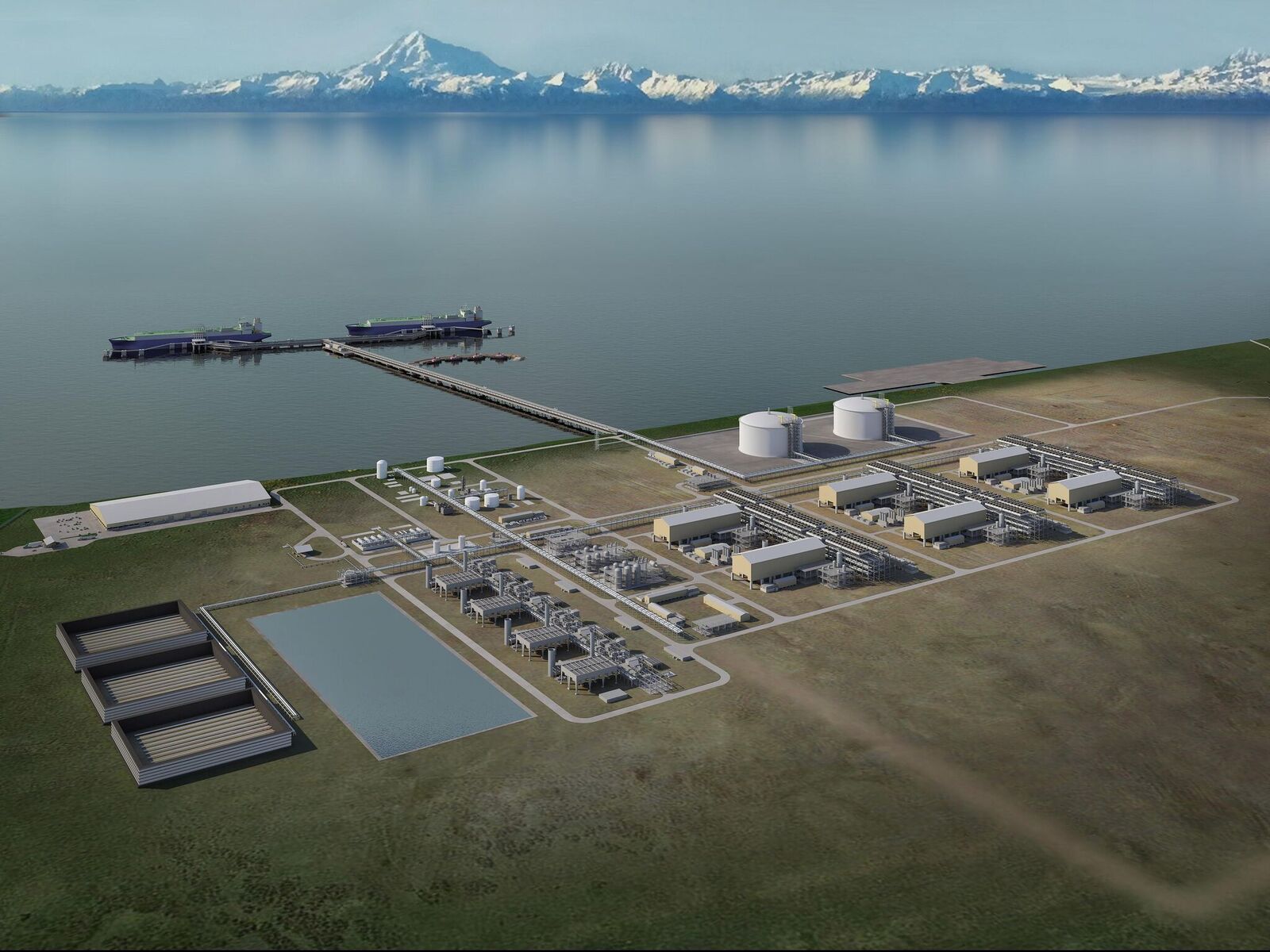
A newly proposed liquefied natural gas project on Alaska’s North Slope is exploring whether sanctioned equipment originally built for Russia’s Arctic LNG 2 development could be repurposed – highlighting both the opportunities and geopolitical hurdles shaping the next phase of Arctic energy.
The Polar LNG project, backed by U.S. investors including Joel Riddle, is seeking permission from U.S. authorities to acquire hardware stranded by sanctions on Russia’s Novatek-led Arctic LNG 2 project, Semafor first reported.
Riddle said the venture has strong political momentum as a result of the increase in natural gas prices following the Hormuz crisis, describing “hurricane-force winds behind us to accelerate this project,” according to Semafor.
Polar LNG aims to develop a nearshore liquefaction facility on Alaska’s North Slope, offering a modular and potentially faster alternative to the Glenfarne-AGDC Alaska LNG pipeline project. One of the investors in Polar LNG is Gentry Beach, friend of Trump’s son Donald Jr., who, according to the NY Times, has been pursuing energy deals with Russia’s largest energy firms.
Russian LNG firm Novatek as recently as last month confirmed that it was “indeed having negotiations on the potential use” of its Arctic liquefaction technology in remote northern Alaska.
The idea of reusing Arctic LNG 2 equipment stems from the availability of partially completed modules and hardware left undeliverable across multiple Chinese yards after sanctions halted construction.
However, only a limited portion of Train 3 modules – identified as 3-TMR-001 through 3-TMR-004 – have been built, and their compatibility with a different project design remains uncertain.
Arctic LNG 2 relies on a gravity-based structure (GBS), a novel platform engineered for harsh ice conditions assembled at Novatek’s massive Belokamenka yard. Polar LNG, by contrast, is proposing a nearshore configuration. Industry specialists say it is unclear whether the Russian-built modules could be adapted without significant redesign, raising questions about cost and feasibility. Polar LNG’s proposed capacity of 7mtpa, however, aligns with Arctic LNG 2’s T3 design of 6.6mtpa.
Shipping constraints present an additional challenge. Arctic LNG developments depend on Arc7 ice-class carriers capable of navigating year-round ice conditions. Several such vessels constructed by South Korea’s Hanwha remain undeliverable due to sanctions tied to Russian projects. While Polar LNG would require similar ships, it is uncertain whether the completed vessels could be reassigned or whether new capacity would need to be built in Korean or Chinese shipyards.
The broader concept also faces substantial legal and political barriers.
Any transfer of equipment linked to Arctic LNG 2 would likely require U.S. sanctions waivers or policy changes, given restrictions on transactions involving Russian energy companies. The feasibility of such approvals remains unclear amid ongoing geopolitical tensions.
The involvement of investors connected to previous U.S.-Russia energy discussions adds another layer of scrutiny. The New York Times reported that some Trump-linked figures had explored cooperation with Russian LNG projects.
At the same time, Alaska officials and developers are pushing to reassert the state’s role in global LNG markets as a potential supplier to Asia, particularly as demand for non-Russian gas grows. Shipping distances from Alaska to Japan can be as short as 3,600 nautical miles compared to more than 10,000 from the US Gulf.
Proponents argue that stranded Arctic equipment, if made available, could shorten development timelines and reduce costs for new projects. But with possible technical mismatches, uncertain vessel availability, and the need for sanctions relief, the path forward remains highly uncertain.
Subscribe for Daily Maritime Insights
Sign up for gCaptain’s newsletter and never miss an update
— trusted by our 107,461 members

Alaska covers over 665,000 square miles and holds more national parkland and wildlife refuge acreage than the rest of the country combined. All of which matters when you’re planning a wildlife trip to this beautiful North American destination. Unlike other parts of the country, animals here have plenty of space to roam, so knowing where to find them takes a little more effort. But whether you’re looking to view bears gorging on salmon in Denali National Park or whales cruising the Kenai Fjords, Alaska is a wildlife viewer’s paradise.
Denali National Park And Preserve
Covering more than six million acres of Interior Alaska, Denali National Park and Preserve is home to 39 mammal species and 169 bird species. But most visitors come with a single goal in mind: the chance to spot the park’s so-called “Big Five” of grizzly bears, wolves, moose, caribou, and Dall sheep.
The park’s popularity stems from its consistently high wildlife-sighting rates, which are attributed to the fact that private vehicles aren’t permitted beyond Mile 15 on the 92-mile-long Denali Park Road. From here, only park buses and transit vehicles travel the road, resulting in low traffic… and lots of animal activity.

Grizzlies feed throughout the summer here, with Thorofare Pass near Mile 37 being particularly rich in sightings. The Denali Caribou Herd uses the park year-round, providing some of the more dependable wildlife sightings. Dall sheep tend to cling to the steep ridgelines visible from Polychrome Pass, roughly 45 miles in. Wolves are also present in the park but are rarely seen, preferring to avoid human traffic as much as possible.
Bus tours depart from the Denali Visitor Center at the park entrance and range from half-day Tundra Wilderness Tours to full-day trips reaching Kantishna at the road’s end. For the best chance of seeing all of the “Big Five” species, the longer routes reaching beyond Eielson Visitor Center at Mile 66 are recommended.
Kenai Fjords National Park
Kenai Fjords National Park, located on the Kenai Peninsula near the town of Seward, protects a spectacular stretch of coastline where glaciers descend to the water’s edge, creating ideal conditions for marine life to use as feeding and breeding grounds.
This meeting point of the Gulf of Alaska and the inland fjord system of Resurrection Bay supports five species of whale, large colonies of sea lions and seals, as well as sea otters. Other wildlife you might spot include Dall’s porpoises, tufted and horned puffins, and bald eagles. Mountain goats and black bears also inhabit the park’s coastal slopes and can sometimes be spotted from the water.
Day cruises out of Seward offer the most practical way to access the park’s marine wildlife. One of the best, Major Marine Tours, offers half-day cruises through Resurrection Bay as well as full-day trips into Aialik Bay, where the park’s tidewater glaciers are located. Kenai Fjords Tours travels similar routes with stops at the Chiswell Islands, part of the Alaska Maritime National Wildlife Refuge, where puffins nest on sea cliffs from May through August.
Humpback whales are present in the fjords from mid-April through November, feeding on krill and small fish, and orca pods frequent Resurrection Bay from mid-May through mid-June
Katmai National Park and Preserve
Located on the Alaska Peninsula, 290 miles southwest of Anchorage, Katmai National Park and Preserve is where you’ll find one of the most dramatic wildlife encounters in North America. The action takes place in summer as sockeye salmon head up the Brooks River in enormous numbers, attracting brown bears to feast. It’s a remarkable site, especially around Brooks Falls, a six-foot waterfall that forces the salmon to leap out of the water to continue their upstream journey. Bears literally line the lip of the falls to intercept the leaping salmon.
Three elevated viewing platforms have been erected along the river: one at the falls itself, one downstream, and one at the river’s mouth where it meets Naknek Lake. Up to 43 bears have been recorded at the falls in a single day, with peak viewing taking place in July when sockeye is most active. A second bear surge happens in September, when spawned-out salmon weaken and die, making them easier catches.
Getting to Brooks Camp, the region’s ranger station, requires either a floatplane or a boat from King Salmon, about 30 miles away. But it’s well worth the effort and expense. Regular scheduled service connects Anchorage to King Salmon, from which charter floatplanes complete the final leg. Tour operators, including Rust’s Flying Service, run day trips from Anchorage that include the floatplane transfer, safety orientation at Brooks Camp Visitor Center, and several hours on the viewing platforms.
If you want more time here, Brooks Lodge on the shore of Naknek Lake offers multi-day packages. Reservations are hard to get, though, and are handled through a lottery system.
Arctic National Wildlife Refuge
The Arctic National Wildlife Refuge (ANWR) covers a vast 19 million acres of northeastern Alaska, stretching from the Brooks Range south through the boreal forest all the way to the Beaufort Sea coast to the north. And for dedicated wildlife spotters, it’s a must-visit as it’s the only place in the United States where all three North American bear species (black, brown, and polar) share a single protected landscape.
It’s also home to the Porcupine caribou herd, one of the world’s largest at around 200,000 animals (calving season is in June). Other wildlife you’ll want to look out for include Dall sheep, muskoxen, wolves, and wolverines, which all inhabit the mountain ranges and river corridors inland. The refuge is also home to more than 200 bird species from four continents that come to breed, feed, and rest during the brief Arctic summer.
While access to the ANWR requires serious planning (there are no roads, trails, or facilities within the refuge), it’s doable via charter plane from Fairbanks. River rafting trips are a great way to travel through the interior refuge, with adventures typically taking six to ten days. Polar bear viewing is also popular, with groups like the Northern Alaska Tour Company running day trips from Fairbanks to Kaktovik, combining a floatplane flight over the refuge with a boat tour to the bear viewing areas.
Your Alaska Wildlife Experience
Getting to the best wildlife hotspots in Alaska does require plenty of planning, but it’s worth the effort. The practical window for most of these experiences runs from late May through September, with those wanting to visit multiple sites in a single trip typically basing themselves in Anchorage, which is within easy reach of the Kenai Peninsula and is the main hub for flights to Katmai and other remote parks. The ANWR is the most challenging (and expensive) destination, requiring advance planning, guide arrangements, and flexibility for weather delays, but it’s the most rewarding if you can swing it.

Shedeur Sanders ditches rookie number as Browns announce change heading into 2026 season

Tech giants unite to fight online scams

Californian chocolate recalled for being spiked with Viagra ingredients

Laura Dern will play journalist who investigated Jeffrey Epstein crimes in a new series

In a frenetic digital era, he’s helping Angelenos rediscover the classic cassette player

Florida High School Football Rankings: Top 25 teams – Oct. 21

How old is Bo Nix? What to know about Oregon quarterback ahead of 2024 NFL Draft

Cleary's 21 help Le Moyne down Central Connecticut State 69-64 in OT

99th annual Pony Swim held in Virginia

Indiana Members Credit Union announced as new anchor tenant at Bottleworks District

EU to urge Israel to scrap death penalty bill as ‘grave regression’

Army reviewing after helicopters hovered alongside Kid Rock’s swimming pool as he saluted

Emanuel pushes back on ‘straight White man’ question, says ideas matter most in 2028

French police make two more arrests over foiled attack on Bank of America

‘What’s going on?’: US judge calls aspects of new Pentagon press policy ‘weird’
-

 Sports1 week ago
IOC addresses execution of 19-year-old Iranian wrestler Saleh Mohammadi
-

 Miami, FL5 days ago
Jannik Sinner’s Girlfriend Laila Hasanovic Stuns in Ab-Revealing Post Amid Miami Open
-

 South-Carolina2 days ago
South Carolina vs TCU predictions for Elite Eight game in March Madness
-

 New Mexico1 week ago
Clovis shooting leaves one dead, four injured
-

 Politics1 week ago
Schumer gambit fails as DHS shutdown hits 36 days and airport lines grow
-

 Minneapolis, MN5 days ago
Boy who shielded classmate during school shooting receives Medal of Honor
-

 Tennessee1 week ago
Tennessee Police Investigating Alleged Assault Involving ‘Reacher’ Star Alan Ritchson
-

 Science1 week ago
Record Heat Meets a Major Snow Drought Across the West