Connect with us

Alaska

Southcentral Foundation begins work on $100 million facility to expand behavioral health services in Alaska

Published

on

Southcentral Foundation begins work on 0 million facility to expand behavioral health services in Alaska


Southcentral Foundation on Tuesday launched a $100 million construction project to expand behavioral health care services in Alaska.

The Alaska Native-owned health care provider is building a 100,000-square-foot, three-story facility at the northwest corner of Tudor and Elmore roads to expand crisis care in the state to better support people experiencing behavioral health and substance disorder-related emergencies, representatives with the organization said.

Alaska has long experienced a shortage of mental health treatment options. Crisis care outside of costly emergency departments that can act as a kind of intervention before requiring higher-level care is a particular need, representatives of health care organizations say.

Advertisement

Southcentral Foundation employs 2,700 people and operates the Alaska Native Medical Center along with the Alaska Native Tribal Health Consortium.

The new center is set to be completed in early 2026, said April Kyle, chief executive of Southcentral Foundation, during a ceremonial groundbreaking at the site on Tuesday.

The building will be located on the lot that’s now home to the 22-bed Southcentral Foundation Detox facility at 4330 Elmore Road, which will continue to operate during construction. The existing building will eventually be torn down to house the center’s parking lot. The project will also replace the Rainmaker car wash, purchased by Southcentral Foundation, that previously operated at the site.

The services at the center, once built, will include an expansion of the number of detox beds to 30. The center will also offer 23-hour adult crisis stabilization with 16 spots for walk-in care, and short-term adult residential crisis care with 16 beds, Southcentral said in a prepared statement Tuesday.

The services will also include expanded withdrawal management and outpatient behavioral health services.

Advertisement

“It’s essential that when a community member is experiencing a ‘right-now’ behavioral health crisis, that we have the right service for them,” Kyle told around 150 people gathered for the ceremony. “I think we know that we don’t have that today. Far too often when somebody is in a crisis, they end up in our emergency services department, or worse, in jail.”

That currently forces first responders and emergency room clinicians to care for people even though they might not have the right resources for the task, she said.

The new center will provide adequate placement options for people in distress, she said.

The center will be a “big deal” that will help take pressure off emergency rooms, said Jared Kosin, chief executive of the Alaska Hospital and Healthcare Association. It will address some of the high rates in Alaska of addiction, such as for opioids and alcohol, he said.

“For so many years, for people experiencing behavioral health crises there’s really been nowhere to turn, and so they have to go to the emergency room,” Kosin said. “And that has created just a really crowded pressure point in the health care system. To be able to provide an access point that is specifically tailored for the types of crises that people are experiencing so often is exactly what we need in our health care system.”

Advertisement

The project is moving ahead as another crisis stabilization facility is also in the works at Providence Alaska. It will offer walk-in care to Alaskans experiencing emergencies related to behavioral health and substance disorders, as well as 23-hour crisis stabilization for adults, and short-term crisis stabilization care for adults, if needed. Construction began for that crisis stabilization center last year. That center is set to be open early next year, said Mikal Canfield, a Providence spokesperson.

The new Southcentral Foundation program will be open to all Alaska residents who would like to have support in completing medical detox, the organization said in the prepared statement.

The crisis stabilization center will provide timely access to crisis intervention and stabilization, the statement said. A multidisciplinary team will help meet an individual’s needs. A plan will be developed for discharge to the appropriate inpatient or outpatient care facilities, the statement said.

Individuals who need more support can transition to the short-term residential program for additional observation and treatment, the statement said. The program will provide care for up to seven days. Services will include crisis intervention, continued assessment and stabilization, individual and group counseling by master’s-level therapists and peer support specialists, and case management to support discharge planning, the statement said.

Medication-assisted treatment will be available, the statement said. Participants can detox in a shared space under 24-hour medical supervision and will work with a multi-disciplinary team to determine the next steps in their recovery, the statement said.

Advertisement

The Southcentral project has been in planning for several years, Kyle said.

A long list of state and federal officials and others, representing organizations that have helped make the project possible, attended the ceremony Tuesday. Several of those supporters lined up to turn the first crumbs of dirt with gold-colored shovels, following a performance by Alaska Native dancers. Among the ceremonial ground-breakers was Roselyn Tso, director of the Indian Health Service.

Kyle said in an interview after the groundbreaking that the center is only part of the solution for addressing addictions that include alcohol and opioids.

“Detox is just one part of how we solve that,” she said. “So we’re adding detox beds with this facility. We need to continue to grow residential treatment programs and prevention programs.”

Katie Baldwin-Johnson, chief operating officer of the Alaska Mental Health Trust Authority, said the center will be “absolutely critical” to help properly address mental health crises people are facing.

Advertisement

The trust and partners such as leaders with Southcentral Foundation and Providence have been studying the gaps in mental health emergency treatment that can leave someone suffering in the community without the services they need, she said.

“Our trustees have been a big proponent and supporter of the reform within the state,” she said.

• • •


Source link

Advertisement
Continue Reading
Click to comment

Leave a Reply

Your email address will not be published. Required fields are marked *

This site uses Akismet to reduce spam. Learn how your comment data is processed.

Alaska

Jesuits say goodbye to Alaska at Bethel ceremony

Published

on

Jesuits say goodbye to Alaska at Bethel ceremony


The first Jesuit missionaries in Alaska sailed up the Yukon River in 1887. By the turn of the 20th century, the religious order of the Catholic Church had as many as 50 Jesuits in the state.

Now, only two remain. And by the end of June, there will be none.

The Jesuits’ nearly 140 years in the state was honored at an event at Bethel’s Immaculate Conception Church on June 16. A procession of priests wearing long white gowns with red hems walked down the aisle to open the event. The Bishop of the Diocese of Fairbanks, Stephen Maekawa, thumped the ground with a shimmering silver staff known as a clozier as he approached the altar.

Bishop of the Diocese of Fairbanks, Steven Maekawa, walks toward the altar at the Immaculate Conception Church in Bethel.

“My brothers and sisters, we gather together to celebrate this wonderful and blessed occasion to acknowledge the love of God and the work of God through the 139 year mission of the Society of Jesus of the Jesuit fathers,” Maekawa said to open the event.

Advertisement

A traditional Catholic mass followed, with readings in both English and Yup’ik. During the sermon, Maekawa acknowledged the vastness of the Fairbanks diocese, and the tremendous amount of work done by the Jesuits to establish it.

“All of the 46 churches of the Diocese of Fairbanks that we currently have were established by either the Jesuit fathers or by direction of a Jesuit bishop,” Maekawa said. “We have a long history of the Society of Jesus’ presence and ministry here in all of Alaska.”

The Jesuits are an order within the Catholic Church, akin to the Dominicans or Franciscans. They have a reputation for taking on some of the Catholic Church’s most remote assignments.

That missionary spirit brought the Jesuits to the Yukon River in 1887, where they built churches, schools, and ministries. Without their work, Catholicism may not have taken root in huge swaths of Alaska, particularly among Alaska Native communities.

The Immaculate Conception Church in Bethel.

But the Jesuits leave a complicated legacy. Their methods of converting Native people to the religion, particularly in the first half of the 20th century, created generational traumas still felt to this day.

Advertisement

Fr. Sean Carroll is the provincial of the Jesuits West Province, which oversees Alaska and nine other states.

Father Sean Carroll, provincial of the Jesuits West Province, speaks at an event recognizing nearly 140 years of Jesuit service in Alaska.
Fr. Sean Carroll, provincial of the Jesuits West Province, speaks at an event recognizing nearly 140 years of Jesuit service in Alaska.

“Thank you for all that you have taught us about who Jesus is and how to love and serve Him wholeheartedly,” Carroll said. “I also thank you for your patience with us. For there have been times when we have sinned and when we have hurt you.”

Missionaries, including the Jesuits, forcefully converted and assimilated Alaska Native people into Western culture and religion. Students at Jesuit-run boarding schools were forced to abandon their Native languages and physically punished when caught speaking languages other than English. Native dancing and drumming were also banned.

The Jesuits West Province maintains a list of 150 Jesuits with credible claims of sexual abuse against minors or vulnerable adults. A quarter of the accused Jesuits served in Alaska at some point in time.

“I ask for your forgiveness for all that we have done that was not rooted in Christ and love for Him, and for when we did not value your culture nor recognize the presence of God in you,” Carroll said.

Advertisement

Carroll gave the order to withdraw from the state last spring. A big issue was the recruitment of Jesuits willing to travel and serve in remote villages. He told the congregation that the Jesuits’ work would continue, just without a permanent presence.

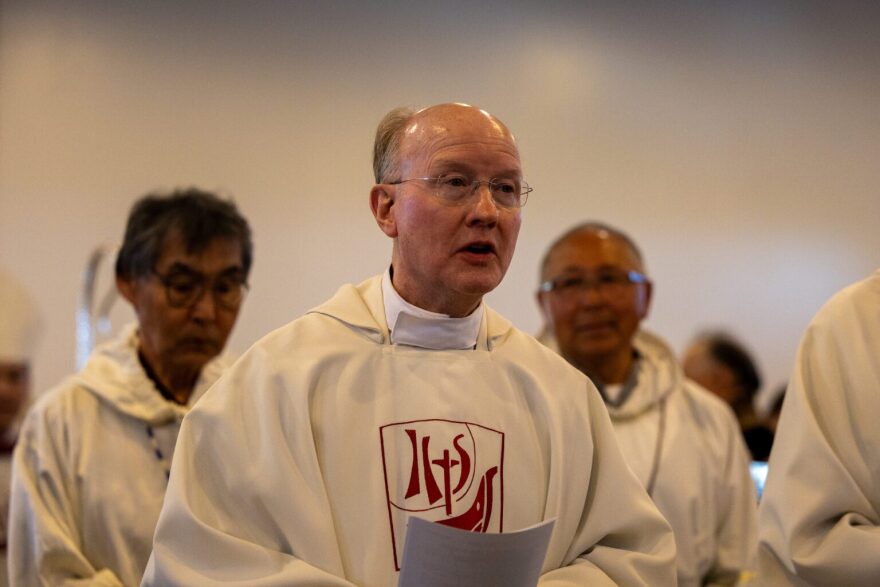
Father Rich Magner, one of the two remaining Jesuit priests in Alaska, attends a ceremony in Bethel.
Fr. Rich Magner, one of the two remaining Jesuit priests in Alaska, attends a ceremony in Bethel.

Fr. Rich Magner is one of the two remaining Jesuit priests in Alaska. His last day serving Chevak, Hooper Bay, and Scammon Bay is June 30.

“We all always knew coming in, or should have known, that we’re not going to be here forever. It’s going to be mission accomplished at some point,” Magner said. “And then we hand it off to the diocese that we’ve helped create, and so that’s a good feeling.”

Magner’s next stop is a Clinical Pastoral Education residency in Tacoma, Washington.

The other remaining priest, Fr. Tom Provinsal, first came to Alaska in 1968 to teach. A fond memory, he said, was meeting Elders that practiced traditional subsistence lifestyles.

Advertisement

“Some of the grandmothers, their fingers were just all bent with arthritis and stuff like that, you know, their whole lives they’ve been working out in the cold and the wet, doing food, sewing, all that kind of stuff,” Provinsal said. “I’d say I just feel very privileged to have come when I did come and to see that.”

Provinsal returned in 1975 as a priest and has served in the region ever since. After moving away, he plans to take a five month sabbatical. What happens next, he said, is in God’s hands.

Two lines formed in the aisle for communion at the end of the mass. After taking communion, Bethel’s Parish Administrator Susan Murphy gave a final thank you.

“It’s difficult to say goodbye to people who have been a part of our lives for so long,” Murphy said. “We know that you have done what was yours to do, and have taught us to do what is ours to do. We are grateful.”

Jesuit priests form a row along the altar of Bethel's Immaculate Conception Church as members of the congregation lift their arms and pray.
Jesuit priests form a row along the altar of Bethel’s Immaculate Conception Church as members of the congregation lift their arms and pray.

Dominic Hunt, a Yup’ik deacon that flew in from Emmonak for the event, led the congregation through a final prayer.

Advertisement

“Bless them with your wisdom, that they may be a word of hope, a world in need. We ask this through Christ, our Lord. Amen,” Hunt said.

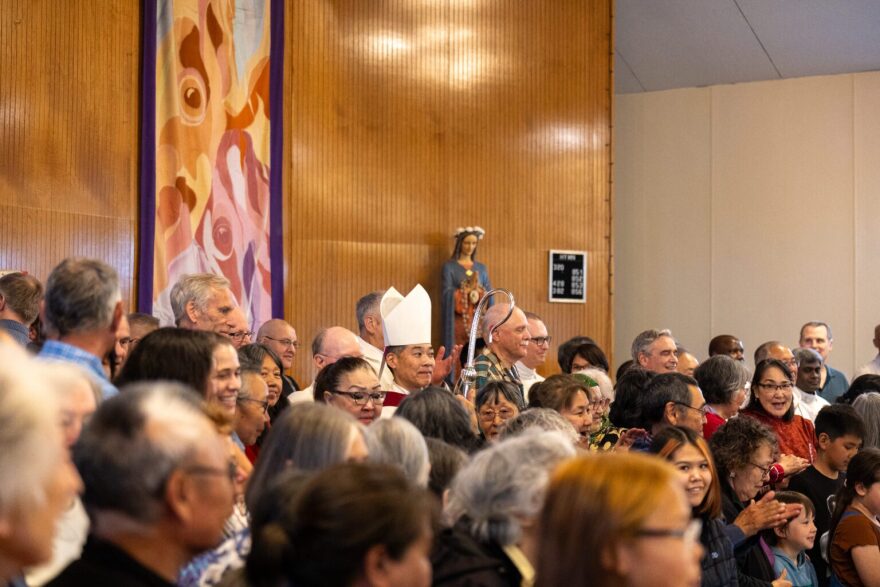
About 70 people posed for a photo on the altar – priests, deacons, parishioners, Elders and children — many of them smiling, some standing quietly.

The photo doesn’t tell the whole story. But it’s a moment when gratitude, grief, and memory all shared the same room.

Bishop of the Diocese of Fairbanks, Steven Maekawa, stands in the middle of a crowd waiting to take a photo at Bethel's Immaculate Conception Church.
Bishop of the Diocese of Fairbanks, Steven Maekawa, stands in the middle of a crowd waiting to take a photo at Bethel’s Immaculate Conception Church.


Source link

Advertisement
Continue Reading

Alaska

Alaska Supreme Court to take up case on Dan J. Sullivan, decision expected by Tuesday

Published

on

Alaska Supreme Court to take up case on Dan J. Sullivan, decision expected by Tuesday


JUNEAU, Alaska (KTUU) – The Supreme Court of Alaska will be taking up the case of the State of Alaska, Division of Elections v. Daniel J. Sullivan, Jr.

The oral arguments will be held Monday at 10 a.m. via Zoom, according to an order and opening notice.

The document also specifies that a decision is expected to be made before noon on Tuesday.

According to documents from the Division of Elections, the state must start printing ballots at noon on the same day.

Advertisement

This comes after an Anchorage Superior Court Judge ordered Dan J. Sullivan on to the ballot Friday.

See a spelling or grammar error? Report it to web@ktuu.com

Copyright 2026 KTUU. All rights reserved.


Source link

Advertisement
Continue Reading

Alaska

Mat-Su Initial Attack Responding to Fire in Flat Lake

Published

on

Mat-Su Initial Attack Responding to Fire in Flat Lake


An engine and firefighters from the Division of Forestry & Fire Protection’s Mat-Su Area are responding to a fire near Flat Lake.

A caller reported a fire on an island in Flat Lake, with 2 foot flame lengths and structures near by.

The engine crew responding will be shuttled by boat to the fire. The fire is currently reported as .1 acre, creeping and smoldering.

Advertisement

Additional updates will be shared as they become available.

‹ Pioneer Peak Hotshots, Gannett Glacier Crew Join Fight Against 2 Fires Near Ruby

Categories: Active Wildland Fire

Tags: #FireYear2026 #2026AKFIRESEASON, 2026 Alaska Fire Season


Source link

Advertisement
Continue Reading
Advertisement

Trending