Connect with us

Alaska

Many Alaska lawmakers remain unopposed with election filing deadline looming

Published

on

Many Alaska lawmakers remain unopposed with election filing deadline looming


With days remaining before the filing deadline for Alaska’s legislative candidates, more than a third of the state’s 40 House members are poised to run for reelection unopposed.

Candidates have until June 1 to formally declare their intent to run with the Alaska Division of Elections. Some candidates wait until the last minute to file their paperwork. But in large swaths of the state, lawmakers could keep their seats with little or no competition.

The 2022 election led to the largest freshman class of lawmakers in two decades, with 20 out of 60 lawmakers new to the Alaska Legislature. The change was brought about in part by a one-a-decade redistricting process that put multiple incumbents in the same districts, and allowed newcomers to run outside the shadow of longtime politicians.

Advertisement

But 2024 is set to bring far less turnover. In the Senate, every incumbent up for reelection has indicated an intention to run again. In the House, only three lawmakers have indicated they don’t plan to attempt to keep their seats — creating limiting possibilities for open races.

Rep. Jennie Armstrong, D-Anchorage, whose Alaska residency was challenged during the 2022 election cycle, is not running again. Democrat Carolyn Hall is currently the only candidate registered to run for the seat.

Rep. Laddie Shaw, R-Anchorage, is retiring this year at the age of 75. Multiple candidates have indicated they could run for the seat, including Girdwood Republican Lee Ellis, a craft brewery president, and Ky Holland, a nonpartisan candidate and entrepreneur.

Rep. Ben Carpenter, R-Nikiski, is not seeking reelection to his House seat, instead running for a Senate seat against incumbent Sen. Jesse Bjorkman. The two Republicans differ on key issues, including education funding. Bjorkman voted to override Gov. Mike Dunleavy’s veto of a bill that would have permanently increased education spending, while Carpenter voted to sustain Dunleavy’s veto.

Two Republicans have registered to run for Carpenter’s seat — Ben Elam and John Hillyer, both of Soldotna. Elam is a member of the Kenai Peninsula Borough Assembly. Hillyer is a retired Air Force general and pilot.

Advertisement

Rep. Jesse Sumner, R-Wasilla, said Thursday that he was still undecided on whether he would run again, after winning the open seat in 2022 a four-way Republican race. He said he was weighing several factors, including his family and his business, and would likely decide whether to run close to the June 1 deadline.

Where incumbents do face challengers, several races promise repeats of 2022 match-ups.

Rep. Tom McKay, R-Anchorage, will again face Democrat Denny Wells. In 2022, McKay beat Wells in a ranked choice tabulation by seven votes, and the race is again expected to be very tight this year.

Rep. Stanley Wright, R-Anchorage, has indicated he plans to run again. So has Democrat Ted Eischeid, who in 2022 lost to Wright by 72 votes.

Rep. Dan Ortiz, I-Ketchikan, is again facing Republican challenger Jeremy Bynum. In 2022, Ortiz beat Bynum by 343 votes.

Advertisement

Rep. Julie Coulombe, R-Anchorage, will again face nonpartisan candidate Walter Featherly. In 2022, Featherly received over 45% of the vote but was bested by Coulombe in a ranked choice tabulation, after third-place Republican finisher Ross Bieling was eliminated.

Rep. Cliff Groh, D-Anchorage, will face Republican David Nelson. Groh bested Nelson in 2022, when Nelson garnered 44% of votes in the district.

Rep. Neal Foster, D-Nome, will face Tyler Ivanoff, a member of the Alaska Independence Party from Shishmaref. In 2022, Foster beat Ivanoff by 92 votes.

Sen. James Kaufman, R-Anchorage, will face Democrat Janice Park, who lost to Kaufman by more than 1,300 votes in 2022.

Sen. Kelly Merrick, R-Eagle River, is set to again face Republican Ken McCarty, along with two other Republican challengers. McCarty, a former House member, ran to the right of Merrick in 2022, and lost to her by more than 2,400 votes.

Advertisement

At stake for challengers hoping to unseat incumbents is control of the Alaska House and Senate. The Senate is governed by a 17-member bipartisan coalition that is likely — though not guaranteed — to survive the coming election. But in the House, Republicans narrowly gained control of the chamber in 2023 thanks to support from four non-Republican members of the Bush Caucus, which represents rural districts. Control of the chamber could easily flip, many say, if one or more seats currently held by Republicans are won by Democrats or nonpartisan candidates.

A single seat can make a difference in control of the Legislature and in the outcome of key legislation, as lawmakers learned earlier this year, when they failed by a single vote to override Dunleavy’s veto of the education bill.

In District 6, incumbent Rep. Sarah Vance, R-Homer, faces multiple challengers — including nonpartisan candidate Brent Johnson, who is currently the Kenai Peninsula Borough Assembly president. Announcing his legislative bid earlier this month, Johnson cited Vance’s decision not to override the governor’s veto of the education bill, which was broadly supported by public school educators across the state.

The announcement foreshadows what lawmakers have discussed behind closed doors ever since Dunleavy vetoed Senate Bill 140 earlier this year: that opposition to veto override vote would come back to haunt some Republican incumbents in their reelection bids.

Johnson said in an interview last week that he had first considered running for the Legislature more than a decade ago. But he enjoyed working on his local borough assembly and living in his Clam Gulch home.

Advertisement

“I didn’t want to change any of that. And I held that position consistent, even though people asked me to run several times, until the failure to override the governor’s veto of education funding,” Johnson said.

Vance is a conservative member of the current Republican-dominated majority, and a key backer of Dunleavy’s policies. Johnson said that if elected, he would look to join a bipartisan caucus, and to rebuke some of Dunleavy’s policies, including in the areas of education and fishery management.

The Kenai Peninsula is not the only place where the veto override vote has motivated some challengers to enter a race.

In District 40, which includes the North Slope and Northwest Alaska, Robyn Burke, an Utqiagvik Democrat, said she decided to run for the state House after Rep. Thomas Baker, R-Kotzebue, became one of several Republicans who initially voted in favor of the education legislation but later voted to sustain Dunleavy’s veto.

“Baker’s vote virtually assured deep education cuts that make it improbable to adequately staff our schools or provide basic materials,” Burke, the North Slope Borough School District board president, wrote in an op-ed that appeared in the Daily News.

Advertisement

Burke is one of two challengers who have so far indicated they plan to run against Baker, along with Kotzebue city mayor Saima Chase. Baker was appointed to the seat by Dunleavy after former Rep. Josiah Patkotak was elected North Slope Borough Mayor last year. Baker had not yet filed to run for the seat as of Thursday and did not respond to a message asking if he intended to. Earlier this month, Baker announced on social media that he would change his party affiliation from Republican to undeclared “to more effectively address the specific needs” of his constituents.

The primary election is set to take place on Aug. 20. Under Alaska’s election system, the top-four vote getters in every legislative race, regardless of political party, advance to the general election.

• • •


Source link

Advertisement

Alaska

‘Just-add-water living at its finest’: An Alaska bike journey rolls along

Published

on

‘Just-add-water living at its finest’: An Alaska bike journey rolls along


Forest Wagner pushes his fat bike on a drifted-in section of trail in Minto Flats National Wildlife Refuge on March 25, 2026.(Photo by Ned Rozell)

MANLEY HOT SPRINGS — It’s so quiet in these spruce hills and tamarack swamps that 27 hours and 50 miles passed between when Forest Wagner and I said goodbye to one human being at Old Minto and hello to the next near Baker.

Space is in ample supply here on these pressed-in snow trails between towns and villages of Interior Alaska.

Forest and I are out here riding these ephemeral ribbons of blue-white moving westward, with a goal of reaching Nome.

Last Saturday, when it warmed to minus 12 degrees Fahrenheit, I lurched my loaded fat bike out of my home in Fairbanks. Saying goodbye to my wife and dogs, I rumbled eastward on a boot-packed trail that after a mile led to a plowed bike path. I then rolled through the familiar University of Alaska Fairbanks campus and onward 8 miles to Forest’s cabin.

Advertisement

He handed me a mug of coffee and an egg sandwich. Then we started pedaling our fat bikes down Chena Pump Road until we reached the Tanana River.

Forest Wagner, left, and Ned Rozell pause in front of the tripod on the ice of the Tanana River at the town of Nenana. When river ice breaks up, whoever guesses the exact time the tripod falls and pulls a cable will be the winner of the Nenana Ice Classic. (Photo by Ned Rozell)

We found a trail groomed for a multi-sport winter race, turned right, and headed downstream on our home river, there half a mile wide. It was a day when the weather finally nodded toward spring. Fair-a-dise showed up with bluebird skies as the day warmed to 8 degrees Fahrenheit.

After a month of pillowy snows and crazy cold temperatures and re-telling people our new takeoff days to semi-suppressed eye rolls, we were finally unstuck from the glue of town.

If an object wasn’t hanging off our bikes, we didn’t need it. No more fiddling with the load or obsessing on the 7-day weather forecast. Just big ol’ tires humming on dry snow.

Now, five days and 145 miles later, Forest and I are digesting French toast and bacon our friend Steve O’Brien cooked for us as we wait on the dryer in the Manley washeteria. When we get a few dollar bills we will take showers.

The Tolovana Roadhouse at the mouth of the Tolovana River is open for travelers to rent a bunk in the original structure from the 1925 Serum Run lifesaving dog team mission. Ned and Forest slept here. (Photo by Ned Rozell)

It’s a good life here on the trail, just-add-water living at its finest. Eat everything in front of you, apply some sunblock and keep mashing on the pedals.

Steve O’Brien is one of the many people helping us move westward. In one of the most clutch moments, my wife Kristen and our friend Jen Wenrick appeared wearing headlamps on the packed snow ramp off the Tanana River in Nenana. They handed us burgers and fries from the Monderosa.

Advertisement

After a surprise tough day due to soft trail that had us working real hard, those burgers and Cokes were like oxygen.

There have been many other acts of kindness from Jenna and David Jonas, Steve Ketzler, Forest’s dad Joe Wagner and others. Tonic for the body and soul.

Jenna Jonas holds her daughter Juniper while her other daughter Celia looks on. Jenna and David Jonas hosted Ned and Forest at their Tanana River homestead on the first night of the bikers’ trip. (Photo by Ned Rozell)

We will meet more excellent people, including some old friends, as we ratchet toward Nome.

When my satellite tracker is on, you can see our arrow creeping across the landscape here: https://share.garmin.com/NedRozell.


Source link

Advertisement
Continue Reading

Alaska

This Day in Alaska History-March 27th, 1964

Published

on

This Day in Alaska History-March 27th, 1964


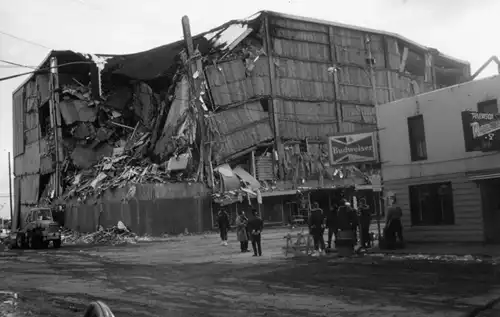
The largest landslide in Anchorage occurred along Knik Arm between Point Woronzof and Fish Creek, causing substantial damage to numerous homes in the Turnagain-By-The-Sea subdivision. Courtesy of Wikipedia

J.C. Penney Department Store at Fifth Avenue and D Street, Anchorage District, Cook Inlet Region, Alaska, 1964. Courtesy of USGS

It was on this day in 1964 that a massive 9.2 earthquake in Southcentral Alaska.

The massive quake at 5:36 pm on March 27th caused much devastation throughout the region and generated a huge tsunami that inundated many communities in the region.

The quake was the largest in the history of the United States and initially killed 15 people while the resulting tsunami killed an additional 100 people in the new state and another 13 in California as well as five in Oregon.

Advertisement

The megathrust earthquake endured for four minutes and thirty-eight seconds and ruptured over 600 miles of fault and moved up to 60 feet in places.

The deadly quake occurred 15 and a half miles deep 40 miles west of Valdez and generated a ocean floor shift that created a wave 220 feet high.

As many as 20 other smaller tsunamis were generated by submarine landslides.


Source link

Advertisement
Continue Reading

Alaska

Opinion: Alaska’s public schools were once incredible. They can be that way again.

Published

on

Opinion: Alaska’s public schools were once incredible. They can be that way again.


(iStock / Getty Images)

I grew up greeting friends and neighbors on my walk to my neighborhood Anchorage public school, just as my kids do now. It’s an essential, and value-added, part of living in our community.

In the late 1990s, when I attended Service High School, I had amazing teachers. My AP chemistry teacher left the oil and gas industry to teach. He could have earned significantly more money in another field, but teaching was competitive enough, given pensions and compensation, that he stayed in the job he loved and gave a generation of students a solid foundation in chemistry.

Now, my kids, who are in first, third and fifth grade, face a different reality. Teachers across our state are leaving in droves. Neighborhood schools across Alaska are closing. Art and music are being combined, which is nonsensical — they are not the same and they are both valuable independently. When he was in second grade, my oldest had a cohort of more than 60 students in his grade — split between two teachers. When he enters sixth grade next year, there will be no middle school sports and he will lose out on electives. Support systems and specialists to help when kids are falling behind have been cut. I’m lucky that my children have had amazing teachers, but many excellent teachers are nearing retirement age or don’t have a pension and are pursuing other careers. What happens then?

Despite skyrocketing inflation, last year was the first time in years that our schools received a significant increase in the Base Student Allocation — and that money doesn’t begin to make up for what they have lost over the years. Even that increase had to overcome two vetoes from what a recent teacher of the year calls “possibly the most anti-public education governor in the history of Alaska.” Shockingly, my own representative, Mia Costello, despite voting for the increase, failed to join the override to support education. She has failed to explain that decision when asked.

Advertisement

State spending on corrections is up 54% since 2019; meanwhile, spending on education is up only 12% in the same timeframe. Schools are now working with 77% of the funding they had 15 years ago when accounting for inflation.

When we starve our public schools of funding, Alaska families leave. No one wants their child to suffer from a subpar education and the lower test scores and opportunities that come with it. A significant number of people are working in Alaska but choosing not to raise their families here.

To the elected officials who preach school “choice” but starve public schools: our family’s choice is our neighborhood school. It’s our community. It’s where our friends are. Neighborhood public schools, which are required to accept all children, should be the best option out there. Public schools should be a good, strong, viable option for communities and neighborhoods across our great state. Once, they were.

I am thankful for those in the Legislature working to solve these problems. This includes HB 374, which raises the BSA by $630, and HB 261, which would make education funding less volatile.

It breaks my heart that across the state, dedicated teachers keep showing up for our kids while being underpaid and undervalued. Underfunding our schools is also a violation of Alaska’s constitution, which requires “adequate funding so as to accord to schools the ability to provide instruction in the standards.”

Advertisement

Not so long ago, Alaska’s public schools were adequately funded, and they produced well-educated students and retained excellent teachers. It’s up to all of us to reach out to our elected officials and urge them to make that the case once again.

Colleen Bolling is a lifelong Alaskan and mother of three who cares deeply about Alaska’s schools.

• • •

The Anchorage Daily News welcomes a broad range of viewpoints. To submit a piece for consideration, email commentary(at)adn.com. Send submissions shorter than 200 words to letters@adn.com or click here to submit via any web browser. Read our full guidelines for letters and commentaries here.


Source link

Advertisement
Continue Reading
Advertisement

Trending