Meghan Tabacek, the executive director of Trail Mix Inc., stands over an anti-erosion “gabion basket” on Juneau’s Black Bear Trail. (Photo by Anna Canny/KTOO)
Meghan Tabacek stepped off the narrow path of the Black Bear Trail in Juneau and pointed to a U-shaped bend in Montana Creek where loose dirt and tree roots jut out over the water.
“If this all were to erode out and cut under the bank, then our whole trail could collapse,” she said. “At first glance, this looks pretty subtle and pretty far away from the trail. But give it like, three or four big storm cycles, and that could really get eaten away.”
Tabacek is the executive director of Trail Mix, Inc., a local non-profit that spends each summer clearing brush, downed trees and — occasionally — landslide debris, on trails managed by the City and Borough of Juneau, the state and the Forest Service.
Advertisement
But mostly, her crews work to strengthen trails against the rain that pummels Southeast Alaska.
“We’re used to mud,” Tabacek said. “Mud is our bread and butter.”
What they’re not used to is the intensity of the mud, the erosion and the wash-outs that are wreaking havoc on trails as human-caused climate change makes rainstorms more extreme. Typically, Tabacek says, trails have a lifespan of 10 to 20 years before they need major maintenance. But that’s changing now.
“The time from when we build a trail or do a refurbishment of a trail to the time it needs touch-ups and fixings is shortening,” Tabacek said. “We’re having to do a lot of maintenance that isn’t technically planned.”
Erosion is eating away at the bank of lower Montana Creek, which borders the Black Bear Trail. Rapid stream erosion is one of the most common threats to Juneau’s trails. (Photo by Anna Canny/KTOO)
Warmer air holds more moisture. So as greenhouse gas pollution drives up global temperatures, rainy Southeast Alaska is becoming even rainier. According to Juneau’s Climate Change report, Juneau’s average annual precipitation has increased 20 inches in the last century. And a lot of that rain is coming down in atmospheric rivers — periods of heavy, prolonged rainfall that are often accompanied by high winds.
An atmospheric river in December 2020 brought record-breaking rain that caused flooding and mudslides across Juneau. It also washed out local trails like the Blackerby Ridge Trail, which took weeks to clear and repair.
Advertisement
Then another storm in 2021 blew down enormous trees that made some trails impassable, like the Herbert Glacier Trail. Tabacek recalls chainsawing and hauling out hundreds of downed trees.
“Those trees would have dropped at some point anyway. But when we have these big storms and big wind events, then they’ll drop at once,” Tabacek said. “So we’ve been seeing some of these things that we have to react to more frequently.”
Tools used for trail maintenance and restoration. (Photo by Anna Canny/KTOO)
Storms may become more frequent over time, but Southeast Alaska’s trail system has always taken a beating. James King, who was the executive director when Trail Mix got started back in the 1990s, says he remembers cleaning up frequent landslides on the city-owned Perseverance Trail.
That trail was closed just this spring because of landslides.
Like a lot of trails in Alaska, Perseverance was created from an old mining road. Those routes were built to get to resources as fast as possible — not for longevity or climate resilience.
“They go up narrow canyons. They’re going along creeks,” said King, referring to routes which make trails vulnerable to threats like landslides and erosion. “Some of these trails just aren’t in the right spot.”
Advertisement
Now King is the director of Recreations, Lands and Minerals for the Tongass and Chucagh National Forests. In the Tongass, the Forest Service manages nearly 1,000 miles of trails for nearly 3 million annual visitors.
Even without climate change, upkeep on some of these trails has been disrupted as federal funding fluctuated over the years. But right now the agency is relatively flush. And as they work on a new iteration of the Tongass forest plan, climate change and tourism are some of the most pressing priorities.
Trail Mix crew remember Jessie Harlan prepares the bank for a new bridge abutment, which will support a crossing that collapses because of erosion. (Photo by Anna Canny/KTOO)
“So rerouting, rethinking how we get people through these places and how we build infrastructure that’s more resilient, that reduces that long term maintenance? That’s a big goal of ours,” King said.
Building trails with climate resilience in mind might mean putting in larger bridges that can handle larger floods. It might also mean laying down gravel paths to weigh down the soil and stop water from pooling or rerouting trails so they’re less vulnerable to erosion.
Those improvements tend to make trails more accessible for hikers of all abilities too.
Just down the Black Bear Trail, crews are building up a new fortified abutment for a lopsided wooden bridge. The bridge itself is in good condition, but it falls short of one bank and slumps into the mud. Erosion caused it to collapse.
Advertisement
One of the bridges on Black Bear Trail falls short of the stream bank. Tabacek said damage like this drives up the cost of trail maintenance. (Photo by Anna Canny/KTOO)
“You see trail damage like this, and it’s just like a line of dollar signs floating down the water,” Tabacek said.
On a sunny spring day, the creek below the bridge is running low and the forest undergrowth is full of fresh fans of Skunk Cabbage and Fiddlehead Ferns.
“We get a couple weeks of rain and then it gets sunny for two days and everything goes ‘poof,’ she said.
The first Jesuit missionaries in Alaska sailed up the Yukon River in 1887. By the turn of the 20th century, the religious order of the Catholic Church had as many as 50 Jesuits in the state.
Now, only two remain. And by the end of June, there will be none.
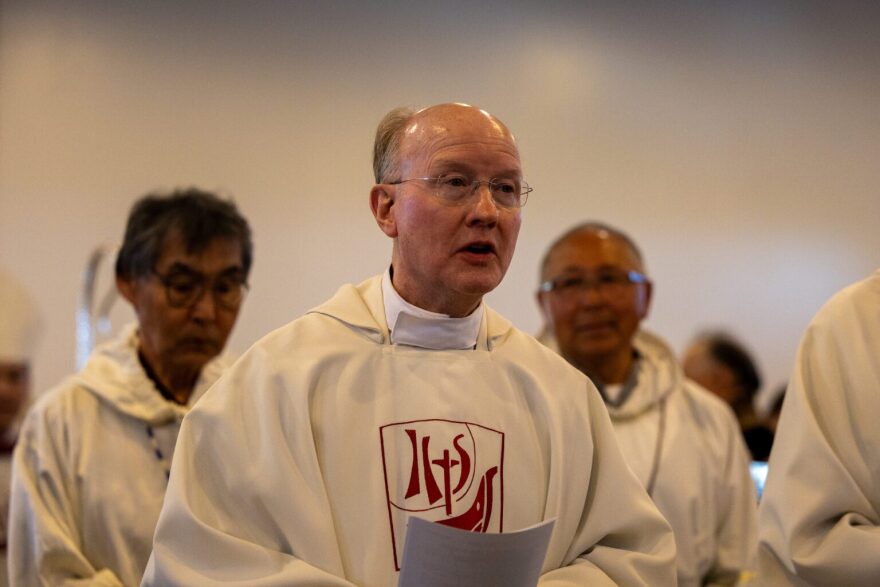
The Jesuits’ nearly 140 years in the state was honored at an event at Bethel’s Immaculate Conception Church on June 16. A procession of priests wearing long white gowns with red hems walked down the aisle to open the event. The Bishop of the Diocese of Fairbanks, Stephen Maekawa, thumped the ground with a shimmering silver staff known as a clozier as he approached the altar.
Bishop of the Diocese of Fairbanks, Steven Maekawa, walks toward the altar at the Immaculate Conception Church in Bethel.
“My brothers and sisters, we gather together to celebrate this wonderful and blessed occasion to acknowledge the love of God and the work of God through the 139 year mission of the Society of Jesus of the Jesuit fathers,” Maekawa said to open the event.
Advertisement
A traditional Catholic mass followed, with readings in both English and Yup’ik. During the sermon, Maekawa acknowledged the vastness of the Fairbanks diocese, and the tremendous amount of work done by the Jesuits to establish it.
“All of the 46 churches of the Diocese of Fairbanks that we currently have were established by either the Jesuit fathers or by direction of a Jesuit bishop,” Maekawa said. “We have a long history of the Society of Jesus’ presence and ministry here in all of Alaska.”
The Jesuits are an order within the Catholic Church, akin to the Dominicans or Franciscans. They have a reputation for taking on some of the Catholic Church’s most remote assignments.
That missionary spirit brought the Jesuits to the Yukon River in 1887, where they built churches, schools, and ministries. Without their work, Catholicism may not have taken root in huge swaths of Alaska, particularly among Alaska Native communities.
The Immaculate Conception Church in Bethel.
But the Jesuits leave a complicated legacy. Their methods of converting Native people to the religion, particularly in the first half of the 20th century, created generational traumas still felt to this day.
Advertisement
Fr. Sean Carroll is the provincial of the Jesuits West Province, which oversees Alaska and nine other states.
Fr. Sean Carroll, provincial of the Jesuits West Province, speaks at an event recognizing nearly 140 years of Jesuit service in Alaska.
“Thank you for all that you have taught us about who Jesus is and how to love and serve Him wholeheartedly,” Carroll said. “I also thank you for your patience with us. For there have been times when we have sinned and when we have hurt you.”
Missionaries, including the Jesuits, forcefully converted and assimilated Alaska Native people into Western culture and religion. Students at Jesuit-run boarding schools were forced to abandon their Native languages and physically punished when caught speaking languages other than English. Native dancing and drumming were also banned.
The Jesuits West Province maintains a list of 150 Jesuits with credible claims of sexual abuse against minors or vulnerable adults. A quarter of the accused Jesuits served in Alaska at some point in time.
“I ask for your forgiveness for all that we have done that was not rooted in Christ and love for Him, and for when we did not value your culture nor recognize the presence of God in you,” Carroll said.
Advertisement
Carroll gave the order to withdraw from the state last spring. A big issue was the recruitment of Jesuits willing to travel and serve in remote villages. He told the congregation that the Jesuits’ work would continue, just without a permanent presence.
Fr. Rich Magner, one of the two remaining Jesuit priests in Alaska, attends a ceremony in Bethel.
Fr. Rich Magner is one of the two remaining Jesuit priests in Alaska. His last day serving Chevak, Hooper Bay, and Scammon Bay is June 30.
“We all always knew coming in, or should have known, that we’re not going to be here forever. It’s going to be mission accomplished at some point,” Magner said. “And then we hand it off to the diocese that we’ve helped create, and so that’s a good feeling.”
Magner’s next stop is a Clinical Pastoral Education residency in Tacoma, Washington.
The other remaining priest, Fr. Tom Provinsal, first came to Alaska in 1968 to teach. A fond memory, he said, was meeting Elders that practiced traditional subsistence lifestyles.
Advertisement
“Some of the grandmothers, their fingers were just all bent with arthritis and stuff like that, you know, their whole lives they’ve been working out in the cold and the wet, doing food, sewing, all that kind of stuff,” Provinsal said. “I’d say I just feel very privileged to have come when I did come and to see that.”
Provinsal returned in 1975 as a priest and has served in the region ever since. After moving away, he plans to take a five month sabbatical. What happens next, he said, is in God’s hands.
Two lines formed in the aisle for communion at the end of the mass. After taking communion, Bethel’s Parish Administrator Susan Murphy gave a final thank you.
“It’s difficult to say goodbye to people who have been a part of our lives for so long,” Murphy said. “We know that you have done what was yours to do, and have taught us to do what is ours to do. We are grateful.”
Jesuit priests form a row along the altar of Bethel’s Immaculate Conception Church as members of the congregation lift their arms and pray.
Dominic Hunt, a Yup’ik deacon that flew in from Emmonak for the event, led the congregation through a final prayer.
Advertisement
“Bless them with your wisdom, that they may be a word of hope, a world in need. We ask this through Christ, our Lord. Amen,” Hunt said.
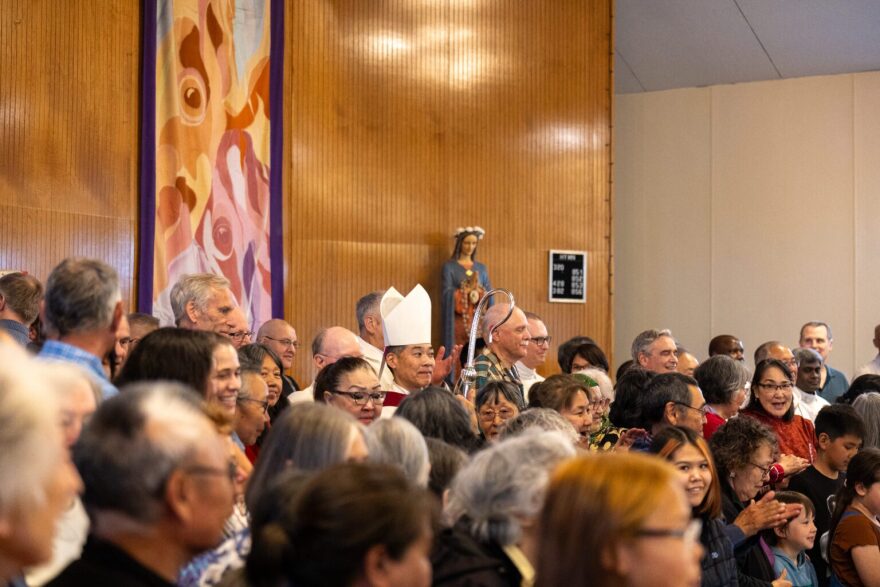
About 70 people posed for a photo on the altar – priests, deacons, parishioners, Elders and children — many of them smiling, some standing quietly.
The photo doesn’t tell the whole story. But it’s a moment when gratitude, grief, and memory all shared the same room.
Bishop of the Diocese of Fairbanks, Steven Maekawa, stands in the middle of a crowd waiting to take a photo at Bethel’s Immaculate Conception Church.
JUNEAU, Alaska (KTUU) – The Supreme Court of Alaska will be taking up the case of the State of Alaska, Division of Elections v. Daniel J. Sullivan, Jr.
The oral arguments will be held Monday at 10 a.m. via Zoom, according to an order and opening notice.
The document also specifies that a decision is expected to be made before noon on Tuesday.
According to documents from the Division of Elections, the state must start printing ballots at noon on the same day.
Advertisement
This comes after an Anchorage Superior Court Judge ordered Dan J. Sullivan on to the ballot Friday.
See a spelling or grammar error? Report it to web@ktuu.com