Alaska flight attendants: Tell us how you’re voting on this tentative agreement and why by filling out the form below. All submissions will be kept anonymous.
Alaska Airlines aircraft sit in the airline’s hangar at Seattle-Tacoma International Airport Wednesday, Jan. 10, 2024, in SeaTac, Washington. [AP Photo/Lindsey Wasson]
More than two years after contract negotiations began, the Association of Flight Attendants (AFA) has announced a vote on the latest tentative agreement (TA) reached by the union leadership and Alaska Airlines.
Rank-and-file workers soundly rejected the previous TA in August by a vote of 68 percent, with a high turnout of 94 percent of the 6,900 flight attendants in the bargaining unit. Flight attendants cited “poverty-level wages,” building up unsustainable debt and scrambling to make rent as reasons to vote down the agreement that did not address their concerns.
The AFA bureaucracy hailed the August TA as a “record” deal, with AFA President and Democratic Socialists of America (DSA) member Sara Nelson telling Forbes that the agreement was “leading the industry.” At the time, voting was opened on the TA before the contract language was even finalized, angering workers who called for a postponement of the vote until they could see the final details.
Advertisement
At the time, the company was offering a 15 percent wage increase with 2 percent raises each year over four years. Accounting for 20 percent inflation since 2019, however, the offer equated to only a 1 percent raise above pre-pandemic wages.
The latest TA is essentially unchanged, with base pay seeing only minimal increases for flight attendants with over 13 years of seniority. Flight attendants currently receive no boarding pay, meaning they work for free while performing critical safety and preparatory tasks during passenger boarding. The new TA provides a marginal amount of boarding pay which would slightly benefit only more junior flight attendants, who tend to work shorter routes and thus have more boardings.
Voting will begin on February 11 and close on February 18, giving workers a week to decide whether to ratify the contract. The AFA fully backs the new TA and expects the membership to vote to approve it, despite the agreement being nearly the same as before with only a new coat of paint.
Flight attendant workers should once again rally for the rejection of the tentative agreement at Alaska Airlines. The fact that the AFA is presenting an agreement that is for all purposes the same as the one workers voted down in August is a slap in the face and a betrayal to the rank and file who desperately need significant raises.
With this proposal, the AFA is siding with the company on the issue of maximizing profits and minimizing wages. To achieve their necessary demands, flight attendant workers will need to override their own union and insist on a contract with adequate pay and working conditions.
Advertisement
Flight attendants must carry their struggle forward in rebellion against the corporate flunkeys in the AFA apparatus. This means forming rank-and-file committees to enforce democratic decision-making, countermanding actions which violate their will and providing workers with a platform to discuss and plan actions they deem necessary.
The union bureaucrats anticipate the rebellious rank and file to fold from the pressure of this being the last chance to vote on a proposal before fresh bargaining begins in April, for a combined contract covering both Alaska Airlines and Hawaiian Airlines flight attendants following a merger between the two entities.
The Alaska contract, if approved, would provide a baseline for negotiating an agreement covering 6,900 Alaska Airlines and 2,200 Hawaiian Airlines flight attendants. The union bureaucracy sees the ratification of this TA as a way to grease the wheels to ram the next contract through without significant worker resistance in April.
Taylor Garland, spokesperson for the AFA, puffed up the new agreement when he said it “addresses issues identified by members, puts in place significant economic gains, and provides the foundation we need for a second bite of the apple in this merger.”
Christina Frees, a Seattle-based flight attendant who has worked for Alaska for 13 years said she expects the agreement to pass this time under the pressure even though it is “not an overall improvement at all.”
“They put us in between a rock and a hard place. I do believe it’s likely to be ratified because the cost of living is high and the pay is so bad,” Frees said. “We have to get the increase in pay, otherwise we sit for another two to three years waiting for a merger contract.”
Advertisement
Thresia Raynor, a flight attendant based in Anchorage, Alaska with over 17 years of experience said that rank-and-file union members “are all fully aware of the consequences of turning it down this time.” She repeated the coercive hope dangled in front of members by the union bureaucracy when she said, “It’s the only deal we are going to get, with the hope of more gains later in the joint collective bargaining agreement” with the Hawaiian flight attendants.
The AFA union is using this “ticking clock” pressure against their own membership in order to ram through the same sellout agreement as before with only token changes. The union bureaucracy is only interested in securing their own positions and cozy relationships with the company management and politicians who have a vested stake in securing a subpar agreement.
The Alaska Airlines and Hawaiian Airlines merger will also trigger a union election for new leadership. The president, vice president and secretary-treasurer will be selected using a highly undemocratic process. Eight voting members will be responsible for choosing the slate, six local presidents from Alaska bases and two from Hawaiian bases. Two out of eight of these individuals will be candidates seeking election, which is a huge conflict of interest. Rank-and-file union members will be allowed to vote for candidates who essentially chose themselves for the bureaucratic leadership roles.
The AFA stands by its undemocratic farce of an election process, claiming it provides equal representation for smaller bases such as San Diego. In practice, the system allows a small clique to maintain control over the union bureaucracy.
A proposal was made during the AFA board of directors convention in Atlanta last May to amend the bylaws to allow a democratic full membership vote for leadership positions, but the same small clique used their exclusive voting rights to swiftly kill the proposal.
Despite the costly impending merger with Hawaiian Airlines and a rough start to 2024, Alaska Airlines raked in record profits this last year. Passenger levels rose even higher than pre-pandemic counts in 2024 and Alaska rode the air traffic boom along with the rest of the major US airlines.
Advertisement
Alaska Air Group reported a net 2024 profit of $395 million compared to $235 million in 2023. Alaska ended the year with a positive cash flow of $949 million, despite spending $659 million on the merger with Hawaiian Airlines and $1.3 billion on aircraft and equipment. Alaska projects the Hawaiian merger will increase their pretax profits by $1 billion over the next three years. Delta Airlines similarly reported $3.5 billion in net profits and United Airlines $3.1 billion in 2024.
In a recent earnings call, Alaska Air Group CEO Ben Minicucci said he “couldn’t be happier that we reached an agreement in concept” with the AFA. Boasting about the airline’s “outstanding financial performance,” he said he looks forward to the April joint negotiations after the merger.
By way of contrast with the thriving corporate profits, in 2023, Alaska flight attendants set up a private Facebook page called “Alaska Airlines FAs experiencing hunger and homelessness.” In this group, workers share their stories of poverty and are able to receive financial help through Venmo and tips about where to find free food in the cities where the airline operates.
Rebecca Owens is one of the group’s founders along with fellow Anchorage-based flight attendant Thresia Raynor. “When you go to work, you see all these bright shining faces. We’re known for that, right?” Owens said. “You don’t see the difficulty that people are facing. Oftentimes it’s actually hidden because people feel so ashamed.”
“We needed somewhere that people can finally talk about it so that nobody is struggling alone anymore,” she said.
Advertisement
The “last chance” pressure tactics used by the union bureaucracy should be seen for what they are, a collusion with the company to ram through an insulting contract against the wishes of the membership. To prepare a struggle against both Alaska Airlines and the AFA bureaucracy, flight attendants should organize rank-and-file committees which will provide the means to link up with workers in other airline companies and separate industries to receive and provide support in the fight for workers’ common interests.
The first Jesuit missionaries in Alaska sailed up the Yukon River in 1887. By the turn of the 20th century, the religious order of the Catholic Church had as many as 50 Jesuits in the state.
Now, only two remain. And by the end of June, there will be none.
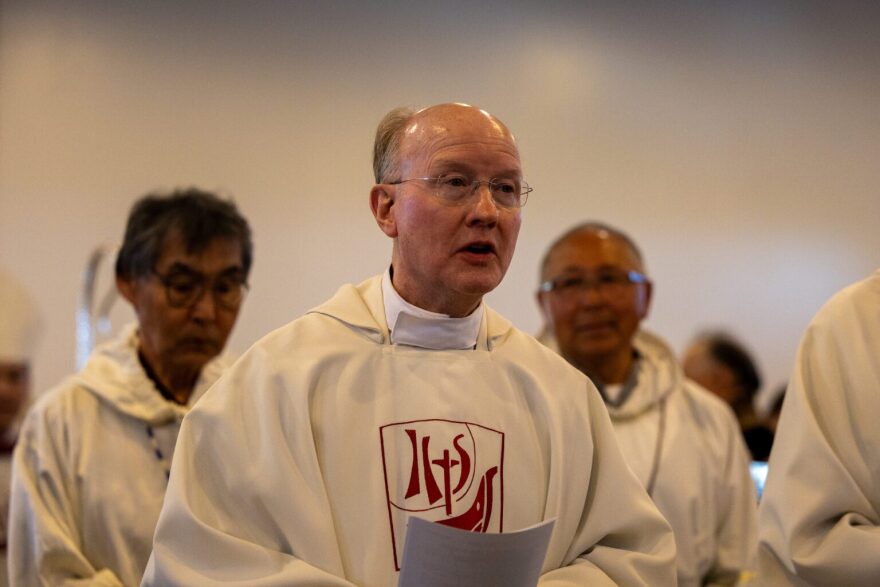
The Jesuits’ nearly 140 years in the state was honored at an event at Bethel’s Immaculate Conception Church on June 16. A procession of priests wearing long white gowns with red hems walked down the aisle to open the event. The Bishop of the Diocese of Fairbanks, Stephen Maekawa, thumped the ground with a shimmering silver staff known as a clozier as he approached the altar.
Bishop of the Diocese of Fairbanks, Steven Maekawa, walks toward the altar at the Immaculate Conception Church in Bethel.
“My brothers and sisters, we gather together to celebrate this wonderful and blessed occasion to acknowledge the love of God and the work of God through the 139 year mission of the Society of Jesus of the Jesuit fathers,” Maekawa said to open the event.
Advertisement
A traditional Catholic mass followed, with readings in both English and Yup’ik. During the sermon, Maekawa acknowledged the vastness of the Fairbanks diocese, and the tremendous amount of work done by the Jesuits to establish it.
“All of the 46 churches of the Diocese of Fairbanks that we currently have were established by either the Jesuit fathers or by direction of a Jesuit bishop,” Maekawa said. “We have a long history of the Society of Jesus’ presence and ministry here in all of Alaska.”
The Jesuits are an order within the Catholic Church, akin to the Dominicans or Franciscans. They have a reputation for taking on some of the Catholic Church’s most remote assignments.
That missionary spirit brought the Jesuits to the Yukon River in 1887, where they built churches, schools, and ministries. Without their work, Catholicism may not have taken root in huge swaths of Alaska, particularly among Alaska Native communities.
The Immaculate Conception Church in Bethel.
But the Jesuits leave a complicated legacy. Their methods of converting Native people to the religion, particularly in the first half of the 20th century, created generational traumas still felt to this day.
Advertisement
Fr. Sean Carroll is the provincial of the Jesuits West Province, which oversees Alaska and nine other states.
Fr. Sean Carroll, provincial of the Jesuits West Province, speaks at an event recognizing nearly 140 years of Jesuit service in Alaska.
“Thank you for all that you have taught us about who Jesus is and how to love and serve Him wholeheartedly,” Carroll said. “I also thank you for your patience with us. For there have been times when we have sinned and when we have hurt you.”
Missionaries, including the Jesuits, forcefully converted and assimilated Alaska Native people into Western culture and religion. Students at Jesuit-run boarding schools were forced to abandon their Native languages and physically punished when caught speaking languages other than English. Native dancing and drumming were also banned.
The Jesuits West Province maintains a list of 150 Jesuits with credible claims of sexual abuse against minors or vulnerable adults. A quarter of the accused Jesuits served in Alaska at some point in time.
“I ask for your forgiveness for all that we have done that was not rooted in Christ and love for Him, and for when we did not value your culture nor recognize the presence of God in you,” Carroll said.
Advertisement
Carroll gave the order to withdraw from the state last spring. A big issue was the recruitment of Jesuits willing to travel and serve in remote villages. He told the congregation that the Jesuits’ work would continue, just without a permanent presence.
Fr. Rich Magner, one of the two remaining Jesuit priests in Alaska, attends a ceremony in Bethel.
Fr. Rich Magner is one of the two remaining Jesuit priests in Alaska. His last day serving Chevak, Hooper Bay, and Scammon Bay is June 30.
“We all always knew coming in, or should have known, that we’re not going to be here forever. It’s going to be mission accomplished at some point,” Magner said. “And then we hand it off to the diocese that we’ve helped create, and so that’s a good feeling.”
Magner’s next stop is a Clinical Pastoral Education residency in Tacoma, Washington.
The other remaining priest, Fr. Tom Provinsal, first came to Alaska in 1968 to teach. A fond memory, he said, was meeting Elders that practiced traditional subsistence lifestyles.
Advertisement
“Some of the grandmothers, their fingers were just all bent with arthritis and stuff like that, you know, their whole lives they’ve been working out in the cold and the wet, doing food, sewing, all that kind of stuff,” Provinsal said. “I’d say I just feel very privileged to have come when I did come and to see that.”
Provinsal returned in 1975 as a priest and has served in the region ever since. After moving away, he plans to take a five month sabbatical. What happens next, he said, is in God’s hands.
Two lines formed in the aisle for communion at the end of the mass. After taking communion, Bethel’s Parish Administrator Susan Murphy gave a final thank you.
“It’s difficult to say goodbye to people who have been a part of our lives for so long,” Murphy said. “We know that you have done what was yours to do, and have taught us to do what is ours to do. We are grateful.”
Jesuit priests form a row along the altar of Bethel’s Immaculate Conception Church as members of the congregation lift their arms and pray.
Dominic Hunt, a Yup’ik deacon that flew in from Emmonak for the event, led the congregation through a final prayer.
Advertisement
“Bless them with your wisdom, that they may be a word of hope, a world in need. We ask this through Christ, our Lord. Amen,” Hunt said.
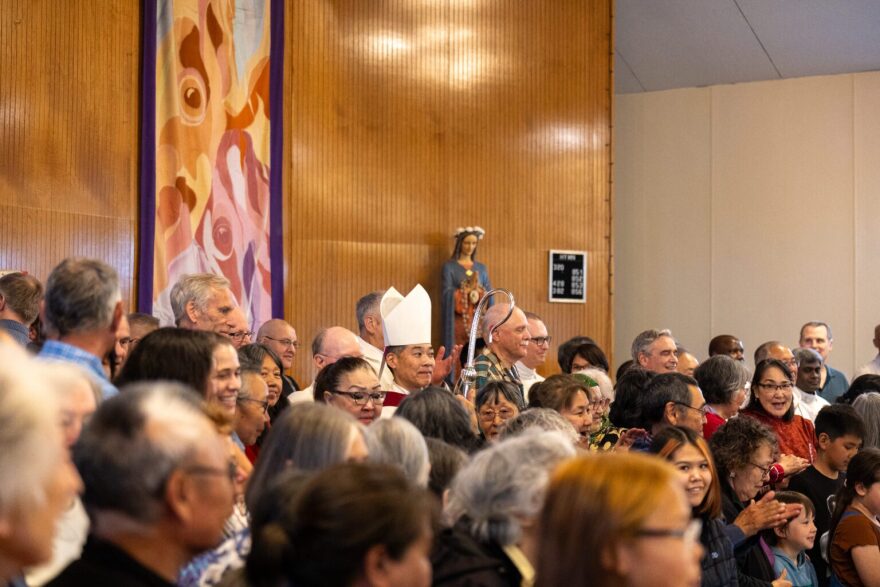
About 70 people posed for a photo on the altar – priests, deacons, parishioners, Elders and children — many of them smiling, some standing quietly.
The photo doesn’t tell the whole story. But it’s a moment when gratitude, grief, and memory all shared the same room.
Bishop of the Diocese of Fairbanks, Steven Maekawa, stands in the middle of a crowd waiting to take a photo at Bethel’s Immaculate Conception Church.
JUNEAU, Alaska (KTUU) – The Supreme Court of Alaska will be taking up the case of the State of Alaska, Division of Elections v. Daniel J. Sullivan, Jr.
The oral arguments will be held Monday at 10 a.m. via Zoom, according to an order and opening notice.
The document also specifies that a decision is expected to be made before noon on Tuesday.
According to documents from the Division of Elections, the state must start printing ballots at noon on the same day.
Advertisement
This comes after an Anchorage Superior Court Judge ordered Dan J. Sullivan on to the ballot Friday.
See a spelling or grammar error? Report it to web@ktuu.com