West
2 hikers in Yosemite National Park reported missing

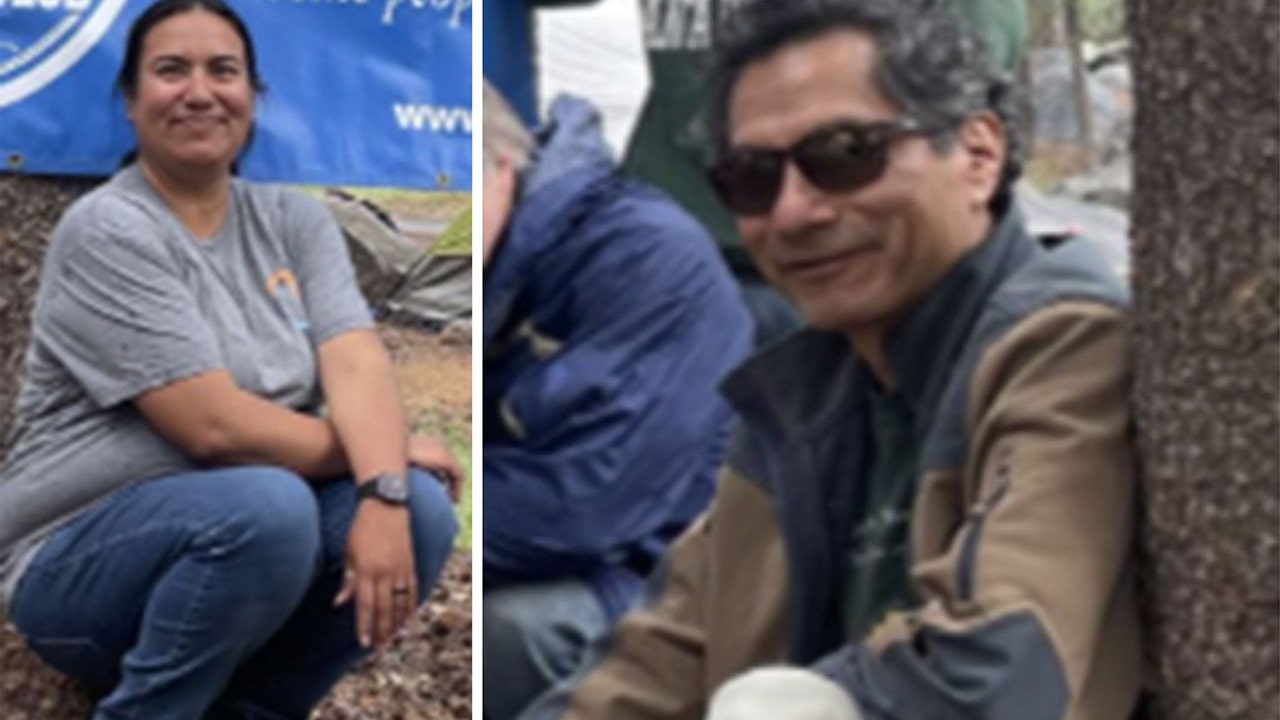
A search is underway at Yosemite National Park in California after two hikers failed to return to a campground on Saturday, officials said.
The two hikers, identified as 63-year-old Miguel Delgado and 40-year-old Ana Rodarte, were last seen setting off from Bridalveil Creek Campground around 10 a.m., the National Park Service (NPS) said in a statement on Sunday.
The pair were believed to be going on a day hike toward Ostrander Lake and were expected to return within a couple of hours, according to officials. The hikers have yet to return as of Monday morning.
Fox Digital has reached out to the NPS for additional information about the search for the hikers and their suspected route but did not immediately hear back.
BASE JUMPER DIES AFTER 500-FOOT FALL AT GRAND CANYON
Ana Rodarte, 40, and Miguel Delgado, 63, were reported missing at Yosemite National Park after failing to return from a day hike on Saturday, officials said. (National Park Service)
Rangers described Delgado as a Hispanic male, about 6 feet, 1 inch tall and weighing 160 pounds with black hair and brown eyes. He was last seen wearing a brown jacket with blue accents, an orange t-shirt, tan pants and a backpack.
Delgado and Rodarte set off Saturday morning from the Bridalveil Creek Campground, but never returned, officials said. (National Park Service)
Rangers described Rodarte as a Hispanic female, 5 feet, 7 inches tall and weighing 198 pounds with brown hair and brown eyes. She was last seen wearing a gray windbreaker jacket, green pants or jeans and a blue ball cap.
Bridalveil Creek Campground, which is surrounded by a forest of red fir and lodgepole pine, has numerous hiking trails located nearby. (National Park Service)
HIKER’S DEATH IN UTAH SPOTLIGHTS NEED FOR SAFETY PROTOCOLS ON THE TRAIL
The Bridalveil Creek Campground sits at an elevation of 7,200 and is surrounded by a forest of red fir and lodgepole pine, according to the NPS website. Numerous hiking trails are located along the nearby Glacier Point Road, and the website warned there were no services available in the area.
CLICK TO GET THE FOX NEWS APP
Rangers asked anyone with information about the missing hikers to contact the NPS at 888-653-0009 or by emailing nps_isb@nps.gov.
Read the full article from Here


MISSOULA, Mont. — Amid recent flooding and ahead of wildfire season, Montana State Auditor James Brown is urging homeowners to make sure their homes are properly insured.
Brown said flooding is the leading cause of insurance peril in the nation and can happen year-round in Montana.
He said homeowners should not wait until flooding is imminent to seek coverage because there is typically a 30-day waiting period before flood insurance takes effect.
“Number one, by far the number one source of confusion related to flood insurance is the basic homeowners policy doesn’t cover flood damage, most Montanans may not know that,” said Brown.
Brown said some private flood insurance options exist, but the National Flood Insurance Program remains the main way Montanans can get covered.
He also said wildfire coverage is becoming less common in standard homeowners insurance policies and increasingly expensive.
Brown encouraged homeowners to be careful when shopping for the lowest-cost policy, because cheaper plans may offer less coverage or come with higher deductibles.
“That may not be enough to cover the loss if their house were to burn down, so one of the things we encourage as well is to talk to your agent about what the level of coverage that you have for your home to make sure that it’s fully insured so if you do have a fire or flood or some sort of peril, you’re able to replace your home,” said Brown.
Lower-cost policies may leave homeowners responsible for the first several thousand dollars in losses before insurance coverage begins.
Brown said homeowners should speak with their insurance agents to make sure their policies covers damages if a disaster occurs.

LAS VEGAS (FOX5) — As the nation marks its 250th anniversary, one chapter of American history was written in the Nevada desert, where the Nevada Test Site became the center of the country’s nuclear testing program during the Cold War.
The National Atomic Testing Museum in Las Vegas preserves that history, telling the story of what happened at the site roughly 65 miles northwest of the city.
From Truman’s order to 928 nuclear tests
President Truman established the Nevada Test Site in 1950. It was formally activated in 1951 at the height of the Cold War and ultimately served as the location for 928 nuclear weapons tests.
Scott Wade, chairman of the board of trustees for the National Atomic Testing Museum, said the program emerged from unanswered questions following the Manhattan Project.
“After the atomic bomb was developed by the Manhattan Project and the two weapons were used in Hiroshima and Nagasaki, there were still questions about how to safely utilize them — even as a weapon of war, this was emerging technology, something that had never been done before,” Wade said.
MORE ON FOX5: Veterans, downwinders demand recognition claiming Cold War radiation exposure
A family legacy tied to the site
Wade’s connection to the site is personal. His father began working there in 1958 and eventually rose through the Atomic Energy Commission, retiring as the Assistant Secretary for Defense Programs in charge of the nation’s nuclear weapons program.
In the 1990s, Wade’s family, along with six other families of former employees, worked with state and federal partners to establish the Atomic Testing Museum.
“There are a lot of feelings about nuclear weapons, and that’s actually the wonder and beauty of a museum,” Wade said.
Impact beyond weapons testing
Supporters of the program argue its influence extended well beyond military strategy. Wade said the testing program advanced scientific research with applications that reach into medicine today.
“I don’t think as a nation, maybe as a world, we would be anywhere near as far as we are with nuclear material separation even for medical uses,” Wade said.
Supporters also argue the program’s greatest impact was helping deter a global nuclear conflict during the Cold War between the U.S. and the Soviet Union.
Nevada’s role continues today
The Nevada Test Site is now known as the Nevada National Security Site and continues to operate. Wade said Nevada’s role in nuclear security remains active.
“Right now, nuclear weapons are still a very big topic. So we’re saying it’s history, but really, Nevada is still playing a very critical role in our everyday lives,” Wade said. “Everything still contributes to making sure that the weapons that are within the stockpile are safe and secure. And because you can’t do an underground nuclear weapons test, you do it with pieces and parts so you understand those pieces and parts.”
The Nevada National Security Site continues to play a role in maintaining the safety, security, and reliability of the U.S. nuclear stockpile.
The National Atomic Testing Museum is open Monday through Saturday from 9 a.m. to 6 p.m. and Sundays from 9 a.m. to 5 p.m.
Copyright 2026 KVVU. All rights reserved.

NEW MEXICO (KRQE) – License plate readers remain a controversial law enforcement tool. During this past legislative session, New Mexico lawmakers passed a bill that puts limits on how police use a controversial piece of technology.
The Driver Privacy and Safety Act implements safeguards on how the data collected by license plate readers is shared. It comes after instances where the technology was found to be used for non-law enforcement reasons, like people seeking abortions and immigration enforcement.
The lawmakers behind the bill said they want to ensure private information remains private. Santa Fe Police Interim Chief Ben Valdez says they are already restricted from sharing data collected from license plate readers, but he says it’s still important to have the law on the books.
“As a state, I think it puts us on the same page, which I think is very helpful. The data is the property of the City of Santa Fe. So if there’s going to be any sharing of that data. It has to be given with the express permission of the City of Santa Fe. It can’t just be used for any purpose, including being sold to a third party,” said Interim Chief Ben Valdez, Santa Fe Police Department.
Chief Valdez also emphasized that the plate readers can only be used in public spaces. “So it’s on a street that is a public road. It may be in a shopping area where that’s again within the public purview. We’re not doing plate reads in private areas that people have an expectation of privacy,” said Chief Valdez.
There are some cases where the license plate reader data would be shared, including homicide investigations that cross state lines or kidnapping. “They’ve been able to find children that were taken either by a custodial parent or another person, or even missing persons where their plate read came back as a missing person,” said Chief Valdez.
Under the new law, agencies are also required to submit annual reports to the Department of Public Safety on how the tech is being used.
In all, 15 new laws went into effect on Wednesday, including shifting “aggravated battery on a peace officer inflicting great bodily harm” from a third-degree felony to second degree and creating an Office of Special Education in the Public Education Department.
-

 Michigan3 minutes ago
Michigan ‘defined’ by waves of immigration that keep shifting
-

 Massachusetts6 minutes ago
Massachusetts state police use robotic dog and drone in highway standoff
-

 Minnesota11 minutes ago
Luverne, Minnesota’s 65-foot nutcracker, may be the tallest in the world
-

 Mississippi18 minutes ago
Mississippi Lottery Mississippi Match 5, Cash 3 results for July 1, 2026
-
Missouri21 minutes ago
Missouri Lottery Powerball, Pick 3 winning numbers for July 1, 2026
-

 Montana26 minutes ago
Montana state auditor urges homeowners to review flood, wildfire insurance coverage
-

 Nebraska33 minutes ago
Online sports betting petition heads to Nebraska ballot review as opposition mounts
-

 Nevada36 minutes ago
Nevada Test Site shaped U.S. nuclear history, Southern Nevada’s growth

