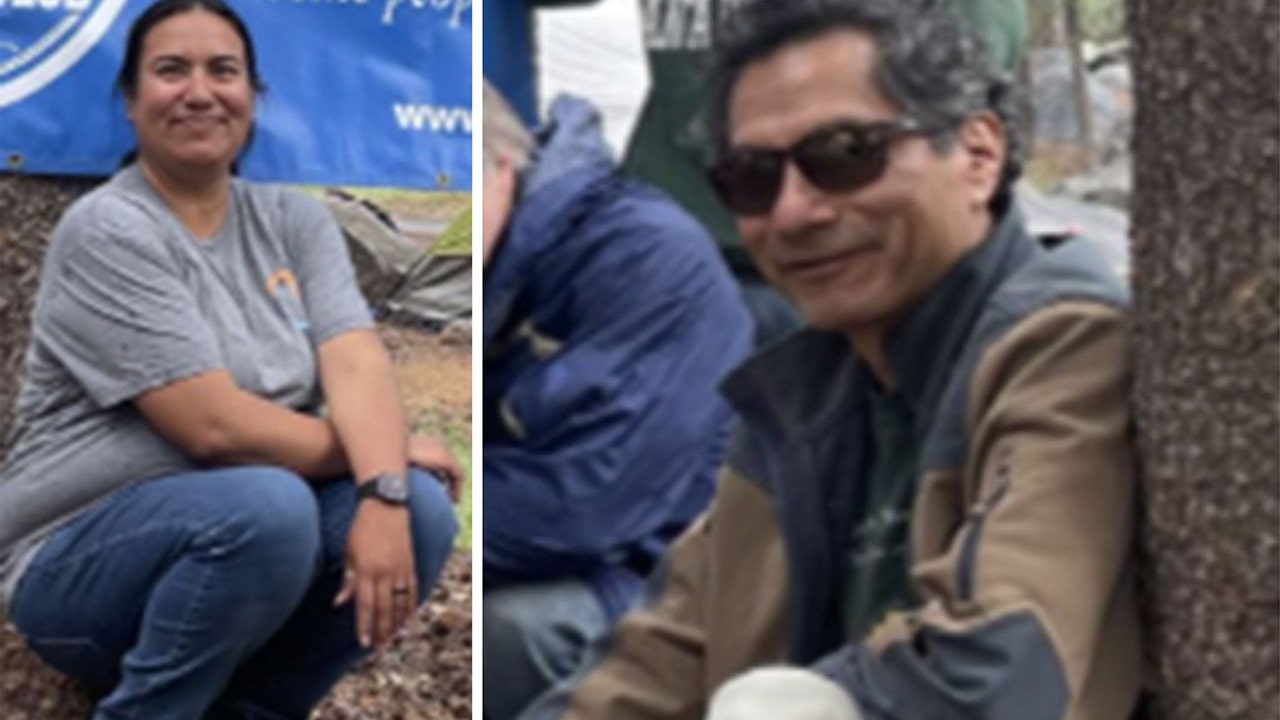
A search is underway at Yosemite National Park in California after two hikers failed to return to a campground on Saturday, officials said.
The two hikers, identified as 63-year-old Miguel Delgado and 40-year-old Ana Rodarte, were last seen setting off from Bridalveil Creek Campground around 10 a.m., the National Park Service (NPS) said in a statement on Sunday.
The pair were believed to be going on a day hike toward Ostrander Lake and were expected to return within a couple of hours, according to officials. The hikers have yet to return as of Monday morning.
Fox Digital has reached out to the NPS for additional information about the search for the hikers and their suspected route but did not immediately hear back.
BASE JUMPER DIES AFTER 500-FOOT FALL AT GRAND CANYON
Advertisement
Ana Rodarte, 40, and Miguel Delgado, 63, were reported missing at Yosemite National Park after failing to return from a day hike on Saturday, officials said.(National Park Service)
Rangers described Delgado as a Hispanic male, about 6 feet, 1 inch tall and weighing 160 pounds with black hair and brown eyes. He was last seen wearing a brown jacket with blue accents, an orange t-shirt, tan pants and a backpack.
Delgado and Rodarte set off Saturday morning from the Bridalveil Creek Campground, but never returned, officials said.(National Park Service)
Rangers described Rodarte as a Hispanic female, 5 feet, 7 inches tall and weighing 198 pounds with brown hair and brown eyes. She was last seen wearing a gray windbreaker jacket, green pants or jeans and a blue ball cap.
Bridalveil Creek Campground, which is surrounded by a forest of red fir and lodgepole pine, has numerous hiking trails located nearby.(National Park Service)
Advertisement
HIKER’S DEATH IN UTAH SPOTLIGHTS NEED FOR SAFETY PROTOCOLS ON THE TRAIL
The Bridalveil Creek Campground sits at an elevation of 7,200 and is surrounded by a forest of red fir and lodgepole pine, according to the NPS website. Numerous hiking trails are located along the nearby Glacier Point Road, and the website warned there were no services available in the area.
CLICK TO GET THE FOX NEWS APP
Rangers asked anyone with information about the missing hikers to contact the NPS at 888-653-0009 or by emailing nps_isb@nps.gov.
Albuquerque’s downtown neighborhoods, like those in many metro areas across the nation, are a study in contrasts.
Close to the interchange of Interstate 25 and Interstate 40, the area is dotted with distilleries and other trendy businesses, as well as large manufacturing yards and a Creamland Dairies garage.
Amid the affluence and industry, homeless people gathered throughout the area on a brisk, sunny day in late January, congregating on city sidewalks in makeshift tents and flanked by shopping carts full of gear. Many had canine companions with them, some wearing dog vests in the cold weather.
Advertisement
The sight has become familiar in communities throughout New Mexico, but is particularly prominent in the state’s most populous city.
How many people are homeless in Albuquerque and across the state? Accurate estimates are hard to come by. But teams of volunteers set out during a four-day period late last month to count those who are perhaps most visible and vulnerable — the street homeless — as well as those living in shelters.
A homeless man who wished to remain unidentified organizes his collection of remote control car tires after answering questions for the annual Point in Time Count on the corner of McKnight Avenue and First Street in Albuquerque on Jan. 28. The man told The New Mexican how he lost many of his personal items during an encampment sweep done by the city, and he was only able to keep a handful of his personal belongings.
Advertisement
Gabriela Campos/The New Mexican
The annual Point in Time Count, conducted nationwide, is the largest data collection effort focused on the homeless population. It found 771,000 homeless people across the U.S. in 2024, the most ever recorded. That compares with nearly 4,700 counted in New Mexico in 2025 — with almost 3,000 in Albuquerque alone. While the PIT Count’s numbers largely are considered a significant undercount of the true homeless population, advocates say it’s the best method available to assess a growing problem.
“The PIT is a deeply flawed survey, but it is one of the best tools we have,” said Sara Lucero, a development director for Albuquerque Health Care for the Homeless, who coordinated an outing Jan. 28 to count — and connect with — the city’s homeless.
Advertisement
The volunteer power
A small group of volunteers and staff members departed from the headquarters of Albuquerque Health Care for the Homeless — at 1217 First St., about a mile north of the Alvarado Transportation Center on Central Avenue — with a rolling cart full of snacks, water, hygiene kits, socks and other cold-weather gear.
While distributing the supplies, gratefully received, volunteers also asked homeless people where they had spent the night and if they would be willing to fill out a survey offering more details on their experiences.
One woman said she had slept on the street in downtown Albuquerque. She had previously spent time at one of the city’s shelters, she said, but left after being harassed. She would rather be on the street, she told a surveyor.
One man asked if there was any reimbursement for participating, which there is not.
Advertisement
“Time is money!” he said with a laugh.
A man with the street name Buffalo, who said he has been homeless for 23 years, said he had been surveyed by PIT Count volunteers a day earlier but accepted some snacks and a hand warmer. He was playing music he had recorded on a portable stereo and said he dreamed about producing an album and performing for record executive and TV personality Simon Cowell.
Dr. Elizabeth “Bee” Cumby visits with a homeless man while collecting information for the annual Point in Time Count on the corner of McKnight Avenue and First Street in Albuquerque on Jan. 28.
Advertisement
Gabriela Campos/The New Mexican
One of the volunteers in the group was Dr. Elizabeth “Bee” Cumby, who came from her home in Los Lunas that morning to pitch in. It was her first time volunteering for the PIT count, but she had worked at Health Care for the Homeless during her career as a medical doctor, much of which had been spent as a contractor with the federal Indian Health Service.
Cumby was troubled by the increase in visible homelessness in her community following the coronavirus pandemic, saying many more people seem to be living in recreational vehicles on other people’s property or along the bosque of the Rio Grande than she recalls seeing previously.
Advertisement
She also wondered about the connection between mental health and homelessness, a question with no easy answers.
Part of her medical training involved going to the New Mexico Behavioral Health Institute in Las Vegas, which she described as “a sad place.”
Still, she said, people living on the street are vulnerable to many of the same problems as those who are institutionalized, including physical and sexual violence, neglect and theft, and she wondered if the shuttering of residential mental health facilities in decades past was wise.
“On a cold night like last night, I keep thinking if we had kept all these facilities going, at least these people would be housed, and getting food,” she said.
Lucero encouraged people the group encountered to come to Health Care for the Homeless if they needed help with medical conditions.
Advertisement
One woman said she had a prescription for arthritis in her hands, but the medication was discarded during a city sweep of a homeless encampment. She was one of several people the volunteers encountered during a shift who said they had lost items during a sweep.
More stringent enforcement of bans on camping on public property has impacted the PIT count, advocates say, making it more difficult for volunteers to locate and survey homeless people. The New Mexico Coalition to End Homelessness, which oversees the state’s PIT Count each year, cites the city of Albuquerque’s “aggressive decommissioning policy” of homeless encampments in its 2025 report as an impediment to the effort.
Federally mandated survey
The Point in Time Count, an annual survey of the nation’s sheltered and unsheltered homeless people on a single night in January, is mandated by the U.S. Department of Housing and Urban Development for organizations that receive funding through the federal Continuum of Care program.
While the count is for a single night — Jan. 26 this year — the department gives organizers up to a week to do outreach, and the New Mexico coalition conducted a four-day count this year.
Advertisement
The nationwide endeavor largely is carried out by volunteers who venture into city streets, parks and out-of-the-way places to find and survey those living without shelter. It’s not an easy task.
William Bowen, a program director for the New Mexico Coalition to End Homelessness, said several factors lead to depressed numbers.
The midwinter count is contingent on volunteer participation, which widely varies by location. The Department of Housing and Urban Development’s narrow definition of homelessness, which does not include people who are couch-surfing or families doubled up in a home, also fails to capture a large number of homeless people.
More recently, the PIT Count has been affected by encampment sweeps.
Still, Bowen and other coalition officials say the count is the best system of collecting large-scale data on homelessness and can be used to identify trends.
Advertisement
“No one else is trying to do this,” noted Axton Nichols, a director with the coalition’s Continuum of Care team.
Bowen said the Point in Time Count data, as the name implies, is only intended to capture a snapshot in time and reflects the transitory nature of the homeless experience. If the count was taken again several months later, even if the numbers were similar, there’s no guarantee it would be tallying the same people.
“People cycle in and out of homelessness, I think, a lot more rapidly than the public maybe understands,” he said.
Nichols noted measures are in place to prevent the same people from being counted more than once.
How much of the homeless population remains uncounted is unclear.
Advertisement
Bowen said the coalition believes the PIT Count is capturing about 50% to 60% of the Albuquerque’s true homeless population, but the statewide numbers are harder to estimate.
The survey is not conducted in every county in New Mexico, as it relies on volunteers being available and willing to organize it in their communities. It was administered in 18 of New Mexico’s 33 counties in 2025.
About 200 volunteers participated this year in the Albuquerque count, Bowen said.
A study last year by the New Mexico Department of Health, based on hospital data, found the state’s homeless population could be two to four times higher than numbers reflected in the PIT Count, at more than 9,000.
Data collected under the requirements of the federal McKinney-Veto Act, a law that requires public schools to serve homeless children, shows 10,533 homeless students in New Mexico during the 2024-25 school year.
Advertisement
The McKinney-Veto Act uses a broader definition of homelessness than the federal government, which includes only people who are living in shelters or on the streets.
Nichols said that leads to homeless youth and women being particularly underrepresented in the PIT Count, as they are both hard-to-reach populations.
That contributes to a perception that the average homeless person is a man, Nichols said, which makes it more difficult to prove there is a need for resources for some of the most vulnerable groups of homeless people, including those engaging in sex work.
He provided an example: A person who “used sex work to pay for a hotel one night, but otherwise they’d be on the street — HUD considers them housed.”
Who are the homeless?
Advertisement
Along with asking people where they were sleeping on a designated night, PIT Count surveys ask how long they have been homeless and inquire about their race and gender, if they have a disability, substance addiction or mental illness, and what barriers they have experienced when it comes to accessing housing.
Some of the questions can bring up painful emotions for people. Lucero reminded volunteers people can decline to answer questions, even after they’ve agreed to take the survey.
The Department of Housing and Urban Development requires certain questions, but survey coordinators can add additional questions. One added by the New Mexico Coalition to End Homelessness inquires about where a person is originally from, and if they were homeless when they arrived in their current city.
Half of the people surveyed in Albuquerque in 2025 reported being from the city, and 58% were from somewhere in New Mexico. Of those originally from out of state, 64% were not homeless when they arrived. Surveys of people in Santa Fe and other areas of the state showed similar numbers.
The majority of out-of-staters were from the Western U.S., including Texas, California, Arizona and Colorado.
Advertisement
Sara Lucero, development director for Albuquerque Health Care for the Homeless, fists bumps a homeless man after speaking with him about the annual Point in Time Count in Albuquerque on Jan. 28.
Gabriela Campos/The New Mexican
Advertisement
Nichols said a popular sentiment, especially in major cities, that homeless people travel there from other places to take advantage of resources is not reflected in the numbers: “The data has never borne that out.”
The coalition’s 2025 report points to a slight increase in homelessness in Albuquerque compared to the past year and a slight decrease in the numbers from other areas of New Mexico.
Something shown in the count’s data over time are “persistent racial disparities,” Bowen said. The percentage of Indigenous people who were homeless in 2025 was more than double the percentage of Indigenous people in the state’s population. For Black people, the rate of those who were homeless was more than triple.
More than half of homeless Indigenous people surveyed in 2025 were from the Navajo Nation, with small numbers from New Mexico pueblos and a few from out-of-state tribes.
Advertisement
In recent years, Bowen said, reports also have identified a rise in the homeless senior population, mirroring a national trend that has been seen in Santa Fe.
About one-third of women surveyed said their homelessness was due to domestic violence, according to the 2025 report, and 9% of unsheltered homeless people reported having served in the U.S. military.
For all its shortcomings, Bowen said one advantage of the PIT Count is that it gives people the opportunity to meet with those in their community in need and other people who want to make a difference.
“Even if the general systemic benefit of PIT Count is maybe debatable, it’s an opportunity to connect with people,” he said. “And I think that that has value as well.”
When the Oregon Ducks added Ole Miss and Northwestern transfer cornerbacks Jadon Canady and Theran Johnson, respectively, they were each seen as potential starters but likely depth pieces for a cornerback room sporting several four- and five-star prospects.
And while Johnson provided an impact, settling into a rotational role, Canady proved to be one of the most integral pieces of defensive coordinator Tosh Lupoi’s unit. The former Rebels’ versatility was a major weapon for Lupoi, as he was deployed out wide at times and, most effectively, as the Ducks’ nickel corner.
The 5-foot-11, 185-pound senior more than held his own despite limited size, using his physicality and impressive leaping ability to register 39 tackles and two interceptions. He also broke up six passes and forced a fumble, making his presence felt in all facets of the defense.
While true freshman cornerback Brandon Finney Jr. and standout safety Dillon Thieneman received much of the shine in the Oregon secondary, Canady stuck out in his own right. According to PFF College, Canady had an 85.3 grade across the 2025 season, good for tenth best in the country among cornerbacks.
Advertisement
With Canady having exhausted his eligibility and departing for the 2026 NFL Draft, the nickel cornerback spot is arguably one of the biggest holes that head coach Dan Lanning and new defensive coordinator Chris Hampton will have to fill before next fall.
The bar that Canady set is high for the next player that takes that role in the Ducks’ defense.
Contact/Follow @Ducks_Wire on X (formerly Twitter) and like our page on Facebook to follow ongoing coverage of Oregon Ducks news, notes, and opinions.
“It is the role of this institution to create positive change,” Taylor Randall told donors and others in a ceremony for an iconic “LOVE” sculpture.
(Trent Nelson | The Salt Lake Tribune) Jason and Courtney Hawks take a selfie in front of Robert Indiana’s LOVE sculpture at the Utah Museum of Fine Arts in Salt Lake City on Saturday, Feb. 7, 2026.
Taylor Randall said people have asked him why the University of Utah, where he’s the president, just spent millions on a sculpture when the school is working under a tight budget.
At a formal ceremony Saturday at the Utah Museum of Fine Arts to welcome the “LOVE” sculpture designed by the late artist Robert Indiana, Randall told donors and other attendees that universities exist not only to inspire students’ intellect, but also “to teach about emotion.”
“It is the role of this institution to create positive change,” he said. “So we have a statue that screams love in the midst of often chaos, competition and argument.”
Advertisement
The U. announced last October that it had purchased the sculpture for $4.5 million. To meet that price, donors put up $2.5 million, and another $2 million came from Utah’s public art funding.
(Trent Nelson | The Salt Lake Tribune) University of Utah President Taylor Randall speaks at a celebration of the installation of Robert Indiana’s LOVE sculpture at the Utah Museum of Fine Arts in Salt Lake City on Saturday, Feb. 7, 2026.
The sculpture’s design was first created by Indiana for a holiday card in 1965, according to UMFA director Gretchen Dietrich, when the artist, she said, “was thinking about the very, very big, complex ideas of love — and love is complicated.”
“Love is full of every human emotion that there is,” Dietrich said. “I think now, just as many times before, we need more love in this world, and I absolutely hope that this will be an emblem for that in our city.”
According to Dietrich, the “LOVE” sculpture that now sits on the U.’s campus is one of 86 such statutes placed around the world. Only eight others match the size of UMFA’s — 12 feet tall, 12 feet wide and 6 feet thick.
Advertisement
The statue, she said, was displayed in New York City for more than 20 years before its journey to Utah began in December 2023, when she had lunch with Jonathan Freedman — a former advisory member for UMFA — and he told her it was for sale.
(Trent Nelson | The Salt Lake Tribune) People pose for a photo during a celebration of the installation of Robert Indiana’s LOVE sculpture at the Utah Museum of Fine Arts in Salt Lake City on Saturday, Feb. 7, 2026.
“The acquisition of this amazing artwork has come to fruition thanks in large part to this man’s tenacity,” Dietrich said of Freedman.
Freedman said he worked with Lindsay Griffith of New York City’s Christie’s auction house to acquire the “LOVE” sculpture for UMFA after she told him The Robert Indiana Legacy Initiative was interested in selling the art.
“This is the best part of what we do,” said Griffith, who came to Salt Lake City for the celebration. “Bringing iconic works to universities and museums and cities like this.”
Advertisement
(Trent Nelson | The Salt Lake Tribune) People gather for a celebration of the installation of Robert Indiana’s LOVE sculpture at the Utah Museum of Fine Arts in Salt Lake City on Saturday, Feb. 7, 2026.
Freedman said he hopes the statue can serve as a unifying declaration amidst turbulent times.
“Robert Indiana always said that he considered love a one-word poem,” he said. “There’s no more important time … than now to have a big and bold statement staked in Utah that says we believe in love, we believe in coming together, we believe in solving problems.”