Sports
With World Cup in her backyard, Mikaela Shiffrin and Aleksander Kilde — skiing’s golden couple — focus on recovery


This wasn’t the way alpine skiing aficionados drew it up when they scheduled men’s and women’s speed races on the famed Birds of Prey course in Beaver Creek, Colo., on back-to-back weekends this month.
They figured the events held major potential for a celebration of the sport’s golden couple: American Mikaela Shiffrin, who might be closing in on her record 100th World Cup win, and her fiancé, Aleksander Aamodt Kilde of Norway, arguably the best speed skier in the world, both making the podium just a few miles from Shiffrin’s home down the road in Edwards.
That was Plan A. Not happening as Kilde announced in October he’d miss the entire World Cup season due to injuries sustained in a January crash.
On the bright side, Shiffrin is up on her feet and walking again after a crash of her own over Thanksgiving weekend in a World Cup giant slalom race in Vermont that left her banged and cut up and with a significant puncture wound in her abdomen. She is sidelined indefinitely, though she expects to be back before too long. Last weekend, she shot a video while walking carefully outside her home.
“I got my trusty little wound vacuum, we got it put in yesterday,” she said, showing off the gadget that can accelerate healing by decreasing air pressure over a wound, pulling out fluid and dead tissue and reducing swelling. “This is where I’m at,” she added with a look of reluctant acceptance as she stepped gingerly on an icy mountain street.
An update from Mikaela Shiffrin about her injury from the Killington World Cup race. pic.twitter.com/jTUIqyeZ12
— NBC Olympics & Paralympics (@NBCOlympics) December 7, 2024
Shiffrin’s latest injury also killed Plan B, which was for Kilde, who has spent nearly a year recovering from the major crash 11 months ago in Switzerland, to help coach Shiffrin this weekend on Beaver Creek’s Birds of Prey track — where he won three years ago and where she had never competed. Instead, he’s been coaching her in the art of patience and recovery.
Kilde has had to become an expert in that, unfortunately. The January crash wrecked his left shoulder, ripping muscles from the joint. It also left a deep gash in his right calf, courtesy of one of his skis. Then, in July, out of nowhere, an infection raged through his surgically repaired shoulder. He was on the edge of sepsis, a potentially life-threatening condition that occurs when the body’s immune system overreacts to an infection, damaging the body’s tissues and organs.
His heart racing, his shoulder swelling, his fever spiking, he went to the emergency room during a visit with Shiffrin in Colorado. Doctors took one look at him and told him he wasn’t going anywhere for a while.
There are few sports that test an athlete’s ability to manage injuries the way alpine skiing does. It has basically a 100 percent injury rate. So many of its top performers have missed full seasons or more to recover from ghastly bone breaks, torn ligaments, ruptured joints, concussions and everything else that can happen during high-speed crashes on ice while clamped into long, sharp-edged carbon boards. Skiers are good at doing the thumbs-up Instagram post from their hospital bed, but recovery and rehabilitation is anything but a happy process.
Shiffrin, 29, has been pretty lucky so far during her storied career, though last season she missed six weeks while recovering from damage to her knee ligaments that she suffered during a downhill race on the Olympia delle Tofane course in Cortina d’Ampezzo, Italy, where the 2026 women’s Olympic competition will take place. She returned in time to capture another season slalom title, but the experience taxed her brain as much as her body.
“When you’re injured, whether it’s for nine months or eight weeks, you’re watching the world carry on without you being in a space where you are supposed to be, and that’s frustrating,” she said during an interview this fall before the start of the season. “There are so many moments of doubt when you feel pain or weakness, when it’s like, ‘I don’t know that I can do that.’”
Mikaela Shiffrin was seeking her 100th World Cup event win in Killington, Vermont, when she crashed and suffered an injury. (Sarah Stier / Getty Images)
That’s basically been Kilde’s life since his January crash.
The damage to both his shoulder and his leg left him wheelchair-bound for weeks, since he couldn’t use crutches. Kilde has been called “the Arnold Schwarzenegger of skiing” for his strength. His being too weak to get out of a wheelchair is a difficult image to conjure.
The gash in his calf severed nerves. For months, he could not make his foot and toes move the way he wanted them to. Sometimes his toes would just hang like appendages. Only in late spring did he begin to think that his foot would eventually work properly again, though he still hasn’t regained much feeling in the toes.
For months he felt like he had no purpose in his life.
“You lose your job and you’re injured, you can’t even do anything,” he said. “I can’t work on my shoulder which needed to be worked on. I can’t work on my leg which needed to be worked on. I can’t even be in the sun because of antibiotics. I had to be indoors. Just a really, really boring life, honestly.”
A few weeks in, he realized he needed to find a reason to get out of bed in the morning, especially since this recovery was going to take a while. So he looked into finding some way to stimulate his mind.
Kilde may be a two-time Olympic medalist with 48 World Cup podiums, but by some measures he is the black sheep of his very educated family. His father is an engineer. His mother is a nurse. His brother is a finance executive. He has a high school education, and for the last couple of years, he has largely focused on being outdoors and his athletic career. It had been a long time since he had to study. And even longer since he was interested in studying.

Aleksander Kilde gets evacuated by helicopter after a crash at a World Cup event in Wengen, Switzerland, in January. He’s still recovering. (Marco Bertorello / AFP via Getty Images)
He does have an interest in real estate, though. So he signed up for an eight-week online course in real estate and finance through the London School of Economics. There were a series of modules to complete each week, plus assignments and tasks, a final project and a certificate at the end.
The course description said the work would take up roughly 10 hours each week. He said it took him at least 20. He hadn’t worked with mathematical formulas in 15 years.
He said he learned plenty about his investments, but more than that, he learned something about himself.
“Reading and learning is really something that can give you a lot of energy,” he said. “I never thought of it like that before. I felt like I didn’t need it. But I think now, just always strive to learn. It’s really something that is good for you. Not only for your mental capacity but also for your mental health. It’s very nice to know things.”
It will be nice to ski again, too. He’s been cleared to get back on snow, but just for free skiing. He can’t go fast. He can’t crash. He needs another operation on his shoulder since doctors had to remove a lot of the work that had been done when they were trying to rid his body of the infection.
The next surgery will be the one that will make a comeback possible. For now, he can basically live a normal life. He just can’t ski race. To set himself up for that, he’s been paying close attention to his diet, cutting out alcohol and most sugar, making sure to eat quality meats and other proteins, biding his time for the opportunity to be able to do the thing that he has dedicated most of his life to. And if he needs his speed rush, he’s got a nice Audi that can go from zero to 60 pretty fast.
“And that’s fine,” he said.
His fiancée still has to work on her patience as she manages through her latest injury. She can be a little less zen than him at times, especially when she is on the sidelines, waiting to be healthy enough to get back into the starting hut at the top of the hill.
Then again, this one’s a little different.
“I’ve been impaled,” she announced in a video she posted on social media days after her crash.
You don’t get to say that every day. Not even when you’re an alpine skier.

GO DEEPER
Lindsey Vonn, at 40, returns to competitive skiing, earns World Cup eligibility
(Top photo of Aleksander Kilde and Mikaela Shiffrin: Alain Grosclaude / Agence Zoom / Getty Images)



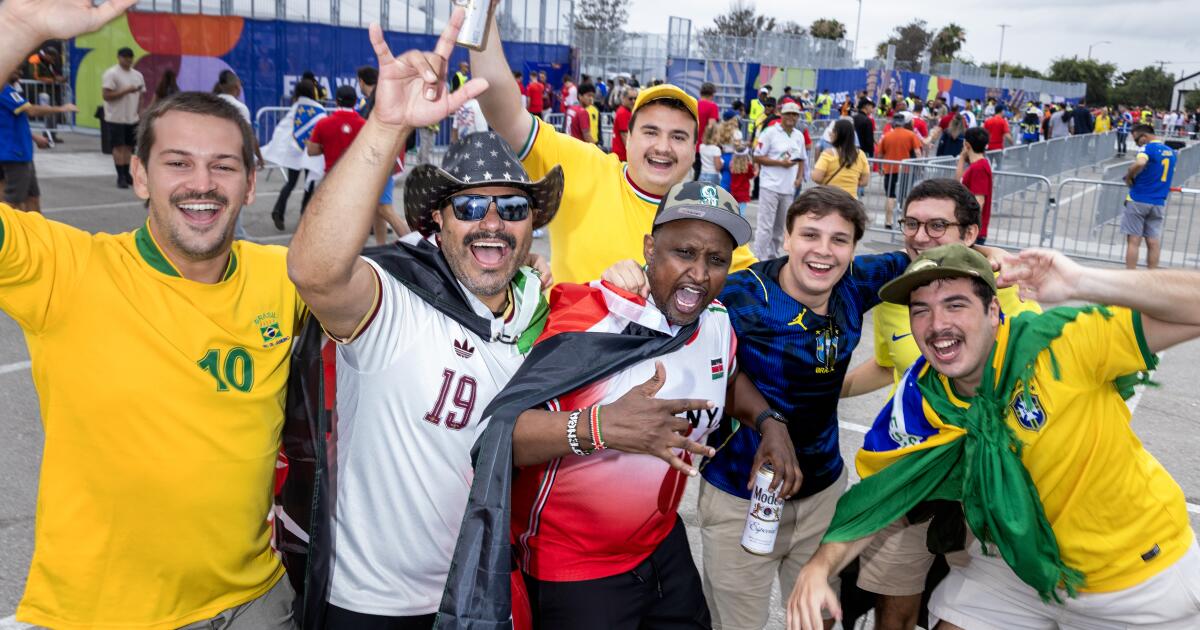
World Cup tourists are coming to L.A. for the soccer, but they’re staying for the $21 smoothies and Double-Doubles.
As the last Los Angeles FIFA World Cup event ended Friday, soccer fans were eating like locals and famous chains from the region were cashing in.
In the weeks that L.A. has hosted the World Cup, international soccer enthusiasts have flocked to big brands from the area, often in large groups wearing their countries’ jerseys.
It is a phenomenon seen at many of the host cities. In Dallas, giant gas station Buc-ee’s is the main attraction. For people visiting New Jersey, deli shops have been a hot ticket. In L.A., the place to be between matches was Erewhon.
Thirsty international sports fans gathered for pictures outside different Erewhons, wandered their aisles smiling, and, of course, picked up pricey smoothies.
While Erewhon would not comment on its business, mobility data company Arity, which uses phone data to track consumers, said Erewhon visits at the outlets around SoFi Stadium were quadruple what they were a week earlier on June 12, the day of the U.S. national soccer team’s opening match there.
Arity looked at what stores people visited within a 10-mile radius of SoFi that day and also found surges in visitors to nearby El Pollo Loco and Trader Joe’s.
Locals have spotted groups of people in Korea jerseys huddled together, trying to decide what to order at In-N-Out.
Some complained on social media that international tourists at Trader Joe’s were buying up all the mini canvas tote bags.
Soon after the Belgium vs. Spain quarterfinal ended Friday, the In-N-Out near SoFi had a long line of soccer fans stretching out the door in bright red and yellow and black jerseys and matching striped hats and scarves.
One of the workers said he had to explain “spread” and “animal style” to foreign football fans.
“I didn’t know this place existed,” a fan from Romania said while waiting in line.
Los Angeles and other cities and states that have hosted the event need the soccer fans to spend money to make the event worth all the time, effort and money it requires.
A rosy 2024 report projected the World Cup could bring more than $800 million to the L.A. region as 180,000 people converge on the area to sleep, eat and spend.
There were early concerns people weren’t turning up for the event because of the high ticket prices and the difficulty of obtaining visas for citizens of some countries.
However, at least for some L.A. hotels, there was a surge of last-minute visitors which pushed up occupancy and room rates.
While sports fans are not in the region to shop, they do make time for it.
World Cup customer spending is also apparent in beer sales. Andrew Heritage, the chief economist at the Beer Institute said beer purchases at entertainment and attractions in L.A. – outside of World Cup spaces – were up around 10% from normal.
“That tells me that fans in the L.A. area have decided to extend their stay and take in all the other things that the area has to offer, rather than just the match itself,” he said.
On social media, the purpose of these shoppers is clear: grab a quick souvenir or local specialty and take a selfie.
The data from Arity suggests that fans are very efficient when they spend at local spots, diving in, getting what they want and getting out as soon as possible, said Jeff Schlitt, a director at the company.
“Normally you’re there for an hour. They’re going to be there for 15, 18 minutes,” he said. “Why is that? Because they were purpose-driven shoppers.”
For some travelers, the more popular American chains aren’t unfamiliar. But some of the native L.A. fare still comes as a surprise.
As one Belgium-Spain matchgoer from the Netherlands stood taking a picture of the In-N-Out sign after the game, he said he’d never had a burger like the one he’d just tried.
“We only have McDonald’s and Burger King,” he said. “It’s way better.”

NEWYou can now listen to Fox News articles!
The face of baseball will not be at Tuesday’s All-Star Game.
Shohei Ohtani was scratched from his start on Friday as the Los Angeles Dodgers said he will also miss the Midsummer Classic with what the team called left knee irritation.
Ohtani, for obvious reasons, has become an All-Star Game fixture. He has earned the honor in each of the past five seasons and made his first start in 2021.
Starting pitcher Shohei Ohtani #17 of the Los Angeles Dodgers warms up before the MLB game against the Arizona Diamondbacks at Chase Field on June 03, 2026 in Phoenix, Arizona. (Photo by Christian Petersen/Getty Images) (Christian Petersen/Getty Images)
The two-way phenom is on his way to winning his fifth MVP award in his last six seasons as he is hitting .290 with a .939 OPS and pitching to a minuscule 1.79 ERA, the second-lowest in the sport among pitchers with 80-plus innings. His OPS is also the seventh-best mark in the league.
The Dodgers said Ohtani will be the team’s designated hitter up until the break, but he will “have some interventions on his knee to put him in the best position for the second half of the season.”
Ohtani dealt with knee issues earlier in the season.
It is certainly a big hit for the game as the other face of the sport, Aaron Judge, will miss the game due to a fractured rib that has kept him out since late May.
Shohei Ohtani #17 of the Los Angeles Dodgers gets ready in the on deck circle against the Arizona Diamondbacks at Chase Field on June 01, 2026 in Phoenix, Arizona. (Photo by Norm Hall/Getty Images) (Norm Hall/Getty Images)
DODGERS WILL AGAIN VISIT WHITE HOUSE TO CELEBRATE WORLD SERIES CHAMPIONSHIP, OFFICIAL SAYS
Ohtani hit 99 home runs combined in 2024 and 2025, leading the National League with a 1.025 OPS in that span. Ohtani did not pitch in 2024 after elbow surgery but returned to the bump last year and owned a 2.87 ERA and 11.9 K/9, a figure he also put up in 2022 that led the American League.
The “Japanese Babe Ruth” is the only player in MLB history to have 300-plus plate appearances and 40-plus innings in six separate seasons (Ruth only did it twice and never stole 50 bases), and he has more than excelled at both.
Shohei Ohtani pitches for the Los Angeles Dodgers against the San Francisco Giants at Dodger Stadium in Los Angeles, California, on May 13, 2026. (Gary A. Vasquez/Imagn Images)
CLICK HERE TO DOWNLOAD THE FOX NEWS APP
Ohtani is not hitting like he has in the past, but certainly the best pitching performance of his career will make up for it. He “only” has 20 homers and 56 RBI this season.
Follow Fox News Digital’s sports coverage on X, and subscribe to the Fox News Sports Huddle newsletter.

If Mikel Merino is sleeping, please don’t wake him. If the last week has been a dream, he’d just as soon keep dreaming.
Because on Friday, for the second time in five days, Merino came off the bench for the final five minutes of a World Cup knockout game and scored the winning goal, the latest lifting Spain to a 2-1 victory over Belgium and into next week’s semifinal against France in Arlington, Texas.
“Not even in my wildest dreams could I have imagined what’s happening right now, right?” Merino said in Spanish. “Honestly, it’s crazy.”
How crazy? Merino has played less than 10 minutes in the last two games and has two goals. He’s taken four shots in the World Cup and put two of them in the back of the net, the first in stoppage time to beat Portugal in the Round of 16 and in the 88th minute Friday to beat Belgium in a quarterfinal and extend Spain’s unbeaten to streak to 36 games.
“I don’t really even know what to say. I still can’t quite believe it,” Merino said.
Yet Spain’s final substitution, which brought on Merino in the 86th minute, wasn’t the only one that figured heavily in the result. Fifteen minutes earlier Belgian coach Rudi Garcia sent backup goalkeeper Senne Lammens on for Thibaut Courtois — not by choice, by necessity.
The dropoff in talent wasn’t great — Lammens started 32 times for Manchester United this season — but the difference in experience was. Courtois was playing in his 21st World Cup game, second-most all-time, and he had been brilliant up to then.
But he tweaked a muscle making a save minutes earlier and dropped to the turf just before the second-half hydration break. After being attended to by the team’s trainers, he tried to continue but couldn’t, eventually hobbling to the sideline and collapsing on the bench in tears.
“We didn’t want his injury to get worse. That’s why I subbed him off,” Garcia said.
“It’s part and parcel of high-level sport. You need to be concentrated, 100% focused, and need to be able to perform. I did not want to put players on the pitch who were not 100%.”
The margin between Belgium and Spain, after all, is a small one, even if the teams took completely different routes to the quarterfinal.
Spain, which hadn’t gone past the Round of 16 in a World Cup since 2010 when it won its only title, had gone a record six games and 609 minutes without allowing a World Cup goal, dating to the group stage of the last tournament four years ago.
Spain midfielder Mikel Merino scores off a rebound in front of Belgium goalkeeper Senne Lammens during the second half of Spain’s 2-1 quarterfinal win in the World Cup quarterfinals Friday at SoFi Stadium.
(Robert Gauthier / Los Angeles Times)
You could binge watch two seasons of “Abbott Elementary” in that time.
But if Spain, the reigning European champion, and goalkeeper Unai Simón were the immovable objects, Belgium, playing in the quarterfinals for the third time in four World Cups, was an unstoppable force. With 12 goals in the last three games, it entered the quarterfinals with the third-most goals in the tournament. And no team had taken more shots.
Spain struck first, with Fabián Ruiz giving La Roja a 1-0 lead with his first goal of the tournament in the 30th minute. The sequence started with Pedro Porro sending a cross into the box for Dani Olmo, whose shot was parried away by Courtois. But Ruiz pounced on the rebound and deflected a shot off defender Timothy Castagne and into the back of the net.
In any other game of this tournament, that would have been enough for Simón. But not against Belgium, which ended Spain’s shutout streak in the 41st minute on a brilliant header from Charles De Keterlaere, who shielded Pau Cubarsí with his body and one-hopped a Castagne cross past a flat-footed Simón for his third goal in two games.
“The record and the milestones are there,” Spanish coach Luis de la Fuente said of his goalkeeper’s record streak. “It’s been decades since the last record was set. And perhaps somebody will break the clean-sheet record.
“But it’s going to be many, many years before that happens.”
Belgium opened the game up a bit when Garcia brought Romelu Lukaku, the country’s all-time leading scorer, on at the hour mark. But Courtois was called to make two saves in the next three minutes and came up lame after the second.
Shorty after he came off, De la Fuente summoned Merino over.
“He didn’t say much to me,” Merino said. “He told me I was coming in as the No. 10. And then, as the game was coming to an end, he told me I was incredible.
“Those are the only two things he said to me.”
The first shot Lammens faced came moments later, when Cubarsí put a one-hop shot on goal from distance. The keeper dove to his right to stop it with both hands, but the ball skipped just before it reached he and Lammens had trouble with the rebound, pushing it toward the edge of the six-yard box for Merino, who tapped it in.
“Unfortunately, to beat a team of this caliber, you need luck on your side,” Garcia, the Belgian coach, said. And the stars didn’t align for us.”
So while Belgium goes home, Spain goes to Texas for Tuesday’s semifinal with France, the only team in the world ranked ahead of it.
“Ever since the World Cup started, everyone has been waiting for this match,” Spanish wunderkind Lamine Yamal said. “I’ve been really looking forward to it. To me, they’re the two best teams in the World Cup.
“If anyone can take on France with confidence, it’s us.”
Especially if Merino keeps dreaming.
Sports editor Iliana Limón Romero contributed to this story.
-
 Politics6 minutes ago
Trump administration clears path for controversial Mojave Desert water pipeline
-
Sports14 minutes ago
World Cup fans flock to In-N-Out, Erewhon and Trader Joe’s for a taste of California
-

 World24 minutes ago
Hundreds of thousands evacuated as Typhoon Bavi barrels towards China
-
 News51 minutes ago
With the white nationalist group Patriot Front, what you see is not what you get
-

 New York2 hours ago
How ‘The Wire’ Star Jamie Hector Spends a Hot Day in Brooklyn
-

 Los Angeles, Ca2 hours ago
Burglars ransack Sherman Oaks condo building during fumigation
-

 Detroit, MI2 hours ago
Metro Detroit weather forecast, July 10, 2026 — 11 p.m. Update
-

 San Francisco, CA3 hours ago
Classical music series helps reconnect downtown San Francisco community

