Sports
The search for a high school basketball all-time scorer that time forgot


CHARLESTON, S.C. — Faint yellow with a blue screened-in entrance, the house on Cypress Street is squeezed in among the others, easy to miss if you’re driving past. The roof is adorned with exposed rafters beneath the eaves. A blotch of grass buffers a short, black, chainlink fence from the street. Things are typically quiet inside, other than the chatter of daytime TV or an occasional developer knocking on the front door, trying to buy the place.
The looks shooting around the living room early last month weren’t accusatory, but cautious. Maybe confused. Jackie White and her mother, Mary Lee Rhodes, had known a stranger was coming down to visit, but never could figure out what any of this was about. Back when we’d first spoken, a few weeks earlier, they hung up the landline, looked at each other and wondered why, after all these years, anyone wanted to know.
Ronnie Gadsden introduced everyone. An old coach, one used to making connections, he made sure Jackie and Mary Lee were comfortable with the visitor on the couch. Then he pulled over a chair, positioned himself to the side and sat down. He wanted to hear this for himself.
That’s when Jackie removed her glasses, placed them atop her head, gave a smile that invited a hug and asked the stranger to remind her how all this came to be.
“All right, so there’s this webpage on the internet …”
MaxPreps.com is a longtime chronicler of high school sports, one offering rankings, recruiting headlines and highlights of whatever LeBron James’ son is doing at any given time. Down in the site’s archives, past the volleyball All-America lists and the 8-man football national rankings, are loads of historical pages chronicling everyone from American icons to the anonymous names of high school sports. That’s where you can find an assembled record book of the highest single-season scoring averages in boys high school basketball history.
Start scrolling and you fall into the page. A gorge packed with all varieties of names from all imaginable places. Each one a story. Bennie Fuller (No. 5, 50.9 ppg) once scored 102 points in a single game for Arkansas School for the Deaf in 1971, then played at Pensacola (Fla.) Junior College, then worked for the U.S. Postal Service. Bjorn Broman (No. 9, 49.4 ppg), a recent Minnesota high school legend, reached the 2017 NCAA Tournament at Winthrop and is now a TikTok creator with 1.4 million followers. Truitt Weldon (No. 23, 45.0 ppg) was raised in a strict religious home in Sabine Parish, La., and mocked for playing high school games in blue jeans.
You find college coaches. Current pros. A former Congressman. Wilt Chamberlain. Trae Young. You find Mickey Crowe, the Wisconsin schoolboy cult hero who witnessed John W. Hinckley Jr.’s assassination attempt on President Reagan and was the subject of a 2013 biography titled “Over and Back.”
You get lost for hours. One name after another. Records were compiled by Kevin Askeland, a 59-year-old math teacher from Yuba City, Calif. The self-described high school sports historian says he exhausted all available resources of the National Federation of State High School Associations record books, scanning all 50 state record books. He ended up with a list of 112 names. Each is a rabbit hole, one that should take you somewhere.
Except for the No. 1 name on the list.
55.6 ppg — Finnell White, Lowcountry Academy (Charleston, S.C.), 1987-88
Up comes Google. In goes the name.
F-I-N-N-E-L-L W-H-I-T-E
The search results land like a discarded scratch-off ticket. The only other mention of White’s name comes from the “Faces in the Crowd” section of a March 1988 Sports Illustrated. Kirk Gibson was on the cover that week, wearing Dodger blue. The blurb reads: “Finnell, a senior guard, scored 79 points, made a 64-foot three-pointer to end the first half and a game-winning three-pointer with :06 left as Lowcountry Academy beat Andrews Academy 90-89.”
That’s it. No wiki page, no link to a Hall of Fame induction, not even a link to an old story or two. No obituary.
How can this possibly be? Such empty results are an affront to our info-wired world. If 55.6 points is indeed the highest average ever by an American prep player, how do we know nothing at all about Finnell White of Lowcountry Academy? How does someone with such a mark vanish in time?
And why, more importantly, is there a headstone a few miles from here, over in Sunset Memorial Gardens, for Finell Demetrios White, where the name, apparently misspelled everywhere else, is etched correctly F-I-N-E-L-L?
Hearing all this, Jackie White, now 75, nodded and smiled, along for the ride, trying to get her hands around all this. She traded glances with her mom. Ms. Rhodes, 93, suffered a recent stroke but is still strong enough to walk to the corner store. She narrowed her eyes and nodded her head.
Then they began.
Jackie White knew what was going on both on the inside and the outside. A single mom of two, she worked at Bedford Hills Correctional Facility, a maximum-security prison for women just north of New York City. She clocked shifts in the mailroom looking for contraband, shifts on the floor monitoring gen pop, shifts overseeing the chow hall. Her philosophy on inmate care: “If you act right, I treat you right. If you act a fool, me and you gonna fool together.”
It was the mid-80s in East Harlem and Jackie’s rules carried over to home. Raising her boys on Madison Avenue and East 135th Street, she ran a tight ship and often offered sage advice for the streets. Never hold a package someone hands you. Don’t walk around in your nice sneakers; keep ’em in your backpack until you get where you’re going. Finell, the oldest, and his brother, Daryl, mostly listened, but eventually other forces started taking over.
Finell grew up playing at Rucker Park, the streetball mecca about a mile and a half from the family’s apartment. If he wasn’t there, he was on any of the other courts dotting the area. He ran in games mixed among the characters of the parks. Old guys, young guys. Guys there to play. Guys there to fight. Guys who played in high school, maybe even college. Guys who’d never worn a real jersey, but were good enough for any team, anywhere. Finell was a little lefty guard. Strong, thick, quick, and clever. He learned the game the way he saw it. Imagination, improvisation, aggression.
But that wasn’t his only interest. “Helluva card player, that one,” Jackie laughs, head shaking, hands in the air.
Finell didn’t simply play the occasional card game. He started gambling in elementary school, emptying kids’ pockets before lunch break. When he went to Julia Richman High on the Upper East Side, what some local police referred to as “Julia Rikers,” he’d hold court in the cafeteria, dealing hand after hand. That is, when he actually went to school. More often than not, Jackie caught him skipping class, out doing God knows what. By the time Finell was 15, she was no longer worried about him getting arrested, but expecting it.
“And that’s when I was like, nah, he’s got to go,” Jackie remembers. “I told him, ‘It’s time to go down South.’”
Jackie Rhodes was born in South Carolina. She had moved from Charleston to New York more than a decade earlier, back in 1967, arriving in a city burning with civil unrest. She was 18, on her own, and hoping to enroll in medical trade school. Within a year she was pregnant with Finell. Having split with his father, James White, in 1971, Jackie began making regular treks down to Charleston every summer, where her mother could lend a hand raising the boy. As a toddler, Finell called his grandma “Mae Mae.”
Now 16, Finell was moving to Charleston to live full-time. He was the type of kid to get along with anyone, talk to anyone. Fast, funny. Even if he got in trouble, it was hard to be mad at him, let alone stay mad at him. Heading south, he was about to experience life as an outsider. Slower, stricter, smaller. He rode in the passenger seat of Jackie’s burgundy Toyota Corolla along 700 miles of Eastern seaboard, through Philadelphia, through Washington, D.C., past Norfolk, Va., through North Carolina, down to the South Carolina coastline. Jackie dropped him off on Cypress Street and drove 700 miles back.
“I told him, ‘This ain’t like New York, now,’” Jackie says. “You’re a squirrel in their world down there.”
Mae Mae lived in North Charleston, where the local public school, Burke High, had a booming enrollment of over 1,700 students and a pair of boys 4A state basketball titles in 1976 and 1984. It also had its issues.
“We were kind of the trouble school,” says Jamar Washington, a Burke player at the time. “It was a big school with different guys from different areas, different projects, different hoods, all going to one school. Fights, always. East side, west side. Rival gangs. All that.”
Mae Mae wasn’t about to send Finell to Burke. Instead, she found a tiny, undersung school out on the edges of Charleston, near the old Middleton Place plantation. Lowcountry Academy was exactly what she wanted — small, private and deeply unserious about basketball. The school’s headmaster, Samm McConnell, once told a Columbia, S.C., newspaper that “the smallness of the place has been conducive to keeping people in school.” Perfect.
The Lowcountry basketball team was coached by a man named Howie Comen, a local private eye whom McConnell originally enlisted to investigate what he suspected was possible dope smoking behind the school. Comen didn’t uncover narcotics, but did discover a student body with nothing to do after classes. Comen told McConnell that the kids needed to play sports. McConnell responded by hiring Comen as the school’s athletic director, basketball coach and political science teacher. That’s how the Lowcountry Wildcats were born.
“I didn’t exactly know much,” says Comen, whose only prior basketball experience, he explains, was playing in a synagogue league as a kid. “We were pretty dismal, to be honest.”
The 1985-86 season was tough. A 1-9 record. In a school with about 120 students from kindergarten through 12th grade, Comen didn’t have enough young men to field a high school boys team or enough young women to field a girls team. So Lowcountry was one of only a handful of high schools in the country with a co-ed varsity basketball team. The lack of a home gym was arguably a larger issue.
This was the program Finell White, straight from Harlem, walked into in the fall of 1986.
From a distance, at 5 feet 11, he looked like any other kid. Up close, he looked like a man. Sensible mustache. Shoulders like hubcaps. Mellow eyes that had seen some things. Playing a schedule of small, rural, almost exclusively White private schools, the 17-year-old was immediately, and comically, the greatest player the South Carolina Independent School Association (SCISA) had ever seen. He averaged 34.7 points per game in his first season, leading Lowcountry to a 9-5 record. His grade level wasn’t totally clear, but no one seemed to mind.
“He was phenomenal,” Comen says. “But the best part was that he didn’t come off like a badass. He wasn’t Mr. Basketball. He had this demeanor that everyone was drawn to. I think he appreciated getting to be a kid.”
Comen stepped aside after the 1986-87 season, handing the Lowcountry team over to assistant coach Ronnie Gadsden. He, in turn, set out to improve the Wildcats’ schedule and spread word of the team’s star. The 1987-88 season began with Finell scoring 50 in the opener against St. John’s, 59 against St. Stephen, 60 against Lord Berkeley. The joke among SCISA officials was that Finell averaged 12 steals a game, but eight were from his teammates.
None of this sat particularly well with Finell’s friends in North Charleston. No one could understand why one of the city’s best ballers was playing out in the sticks, destroying 5-foot-5 15-year-olds. Everyone at Burke High knew Finell from pickup games in neighborhood parks. They knew he grew up playing at Rucker. They wanted desperately for him to join them on the school team.
“We’d have been unstoppable,” Washington says. “He came with a skill set we’d never seen before. No one handled the ball like him. No one. The jumper was kinda suspect, but, hell, he could get to the hole whenever he wanted, so that didn’t matter.”
Finell’s scoring totals, fantastical figures tallied in obscure games, grew more and more absurd. Oronde Gadsden (no relation to Ronnie), a future six-year NFL wide receiver with the Miami Dolphins, lived on the same block and counted Finell among his friends. A two-sport star at Burke, Gadsden would race home on Friday nights to watch the 10 o’clock news.
“Had to see if our game made the highlights,” Gadsden says, “and how many points Finell scored.”
Gaudy numbers are how some names come to drop into and out of history, and how lines begin to blur between myth and reality, legend and lore. In February 1988, Lowcountry traveled to Andrews Academy, an independent school about an hour outside Charleston. Walking in, the Wildcats, according to Ronnie Gadsden, heard a voice yell out, “N— aren’t allowed in this gym.” Finell, one of four Black players on the team, and Gadsden, the only Black coach in the SCISA, seethed.
Finell responded by scoring 79 of Lowcounry’s 90 points. In the end, launching a 3-pointer with his team down two and six seconds remaining, the 18-year-old turned to the Andrews bench, kept his follow-through high in the air and yelled, “Game!” At least, that’s how the story goes.
Gadsden raced to call the newspapers. The Evening Post. The News and Courier. The State. Not only had Finell scored 79 points, but also had done so with his team missing four — four! — starters. Two missed the bus to the game, one was out with the flu, and another fouled out in the first half. The fact that the game was played on a rubber floor in front of maybe 50 people? That didn’t particularly matter. The story soon spread nationally, syndicated in papers across the country. Sports Illustrated printed Finell’s headshot among its “Faces in the Crowd” in the March 7, 1988 issue, a smile so confident you know he flashed it after every one of those 79 points.

Appearing in SI, at the time, was equivalent to a moon landing. Issues were passed around Lowcountry, passed about Burke, and passed around Julia Richman, up in New York.
Finell followed his 79-point game with a 71-point outing against Country Day School. Then 56 against Archibald Rutledge Academy. Then 48 against Sea Island Academy.
All the expected scenes of a schoolboy fever dream followed. Finell was featured in those local papers, named to local all-star teams and rumored to be getting recruited by major colleges near and far. Yet, everywhere he drew praise, his first name was misspelled. An extra N. No one ever bothered to correct anyone. To this day, Jackie remembers once asking her son why. He answered, “Oh, Mommy, they know who it is.”
There are disconnects required for threads of history to come short, failing to reach from then to now. For Finell, it wasn’t his name. Hell, today, if you search it correctly, you come up with fewer results than the incorrect version.
No, in this case, the disconnect comes via an abrupt end of events.
Those rumors of Finell being a big-time college recruit? They don’t particularly hold up. Neither Cliff Ellis, the Clemson head coach at the time, nor George Felton, the South Carolina head coach, can recall his name. Tubby Smith, one of Felton’s assistants, says with a hint of sad uncertainty, “I remember the name, but it’s hard to picture him,” before asking, sincerely, “Did we recruit him?”
Finell’s brother, Daryl, is convinced North Carolina was a real possibility, saying, “I don’t know why that didn’t happen. Maybe grades or whatever.” Jim Boeheim, who a local Charleston paper reported had invited Finell to a 1988 spring break visit, based on “sources” around Finell, today can’t recall pursuing anyone by the name of Finell White.
Other in-state college coaches, Butch Estes (Furman), Randy Nesbit (Citadel) and even John Kresse, the legendary College of Charleston coach, who worked only 2 miles from Cypress Street, all draw blanks.
See, like in life, this story cooperates less the longer it goes. Of all the twists, it turns out Finell finished the 1988 school year a few credits short of graduating and had to complete them at, of all places, Burke High. In the movie version of this tale, he would’ve finally played alongside Jamar Washington, Oronde Gadsden and the rest of the guys from North Charleston, and exploded into the star recruit he could have been. In this version, he was instead ruled ineligible to play, ending his high school career. Depending on whom you ask, it was either the school’s decision, or the coach’s decision, or a high school athletic association ruling. Either way, it’s impossible not to wonder what-if.
“If he had a chance to play at Burke,” says Ronnie Gadsden, “I think he would have shown all these people that he was the real deal.”
After sitting out the year and finishing high school in the spring of 1989, Finell ultimately considered offers to play basketball at Morgan State, North Carolina A&T, Anderson (S.C.) Junior College and Benedict College. He chose Benedict, an NAIA historically Black college in nearby Columbia, S.C., but lasted only one season. Story goes that, as a 20-year-old freshman, Finell didn’t get on with the coach, but who knows? Neither the school nor the NAIA have any statistical records from that 1989-90 season. Newspaper clippings dug up in the Charleston Public Library say he regularly came off the bench to score 10 or 12 or 14 points.
And that was it.
Finell was done. He packed his things after one season at Benedict, gave Mae Mae a hug and set off back to New York, leaving behind a name that lingered, then faded, and the question that persists anytime a story leaves you feeling empty afterward. What happened?

In June 1994, Houston Chronicle writer George Flynn traveled to Third Street in New York, to the legendary blacktop known as “The Cage,” for a story idea. Flynn wanted to meet the “street-hoop hall of famers” who were on the courts that day to preview an upcoming NBA Finals matchup between the Knicks and the Rockets. Mario Elie and Kenny Smith, two members of the Rockets, had both played at The Cage years prior.
One by one, Flynn described the players at the park that day. Finell White (spelled correctly), age 24, was “glistening with game sweat,” he wrote. Flynn shared Finell’s thoughts on the series — that Hakeem Olajuwon needed to go to his left, that Charles Smith needed to focus, and that Vernon Maxwell was taking too many jumpers.
It was a coincidence Finell was at The Cage to be interviewed that day because, in the mid-90s, he could have been at any court, anywhere, at any time. “Brooklyn one day, Queens another,” says Daryl Smith, 46. “It didn’t matter. He just wanted to play other great players.” It’s said Finell dueled with Felipe Lopez in some all-time bangers. It’s said that he nearly landed a spot in one of those old Spirit streetball commercials. It’s said he carried the cachet of being a known player on any court he stepped upon.
Finell White grew up to be one of the guys he grew up playing against.
“People would always ask him, like, ‘How are you not in the league?’” Daryl White says.
It was a complicated question. In his early 20s, Finell thought another college might come around one day, but the phone never rang. He stayed in shape, his brother says, thinking there might be a tryout somewhere, sometime. At one point, he tried out for an arena league football team. “Almost made it, I think,” Daryl says. He considered traveling overseas, looking for a pro basketball contract, but, as Jackie puts it, didn’t know how to go about such things.
“Tried to make the best of it,” Jackie says slowly, thinking of all the chances they thought might come and of all the limits that proved otherwise. “He had a lot of potential, but didn’t know how to carry it. He played all that ball and when he got older, some people would ask, why ain’t he famous? Well, I’ll tell you why. It’s because we didn’t know what to do. And when you don’t know what to do, you don’t know what to do. Maybe it just wasn’t for him.”
It could be that simple. In 1980, Bobby Joe Douglas scored 54.0 points per game for tiny Marion High in north central Louisiana — ranking No. 2 all-time, behind Finell. Douglas played college ball at Northeast Louisiana University (now Louisiana-Monroe) and kicked around the old Continental Basketball Association for a bit as a pro. Now 62, Douglas, a minister, says it all bluntly: “Honestly, I don’t think people have a clue how hard it is to make it. When people ask me, I just tell ’em, ‘Man, I wasn’t good enough!’”
When friends and fellow players would mention Sports Illustrated or the 79-point game, Finell would laugh it off, the way old guys do. Those were the days. He was embarrassed, Daryl says, during his first few years back in New York.
Time, though, has a way of changing things. As years passed, Finell came to appreciate having those old days. He knew all too well what the likely alternative would have been if, as a younger man, he’d stayed at Julia Richman, stayed in New York, stayed doing what he was doing. That would’ve been the real vanishing act.
Not everyone gets to say they went and did something. Finell, his friends say, came to understand that.
In Charleston, meanwhile, those who witnessed Finell do what he did were always left wondering where the comet went. Contacted for a story 37 years after coaching him, Ronnie Gadsden said he’d always thought Finell played pro ball overseas before dying young. Old Charleston sportswriters all voiced curiosity, with Charles Twardy, formerly of The State, writing in an email: “I was just thinking about that assignment recently and wondered what might have happened to (him)?” Oronde Gadsden thought on it and said: “He ended up going back to New York and playing at a small school or something, right?” Howie Comen knew Finell had died, but didn’t know how. He never could find an obituary.
“For people not to know what happened to him,” Comen says, “feels like an injustice.”
Finell got older and took a job as a doorman and porter at 2 Horatio Street, a high-end, 17-story co-op overlooking the West Village. He loved the job, loved the people. His best friend and co-worker, Mike Delfish, remembers him carrying on with tenants, always telling stories and cracking jokes.
“None of them knew of him as a ballplayer,” he says. “To them, he was just a really friendly guy.”
Delfish works at 2 Horatio to this day. In his locker, there’s an old glossy picture of Finell thumbed to the wall with Scotch tape. He was godfather to Delfish’s youngest son, Marquise.
After a failed relationship, Finell moved back in with his mother sometime in the late ’90s. He helped her through some health issues, but had one rule — no doctor’s appointments on Mondays. That was his day off, his day to get back to the park.
In December 2000, on the day before Christmas, Daryl and Finell played video games at their mom’s place, talking their typical trash. Daryl, then a college student at Delaware State, was home on break. Both he and Jackie were there when Finell suffered a seizure that resulted in him being placed on life support.
Finell Demetrios White died two days later at 31. He was mourned in New York and buried in Charleston. Tenants from 2 Horatio handed envelopes of cash — what would’ve been Finell’s holiday bonuses, plus more — to help the family pay for the expenses. Many attended the funeral in New York totally unaware of Finell’s high school heroics.
“Everyone was there for the same reason,” Daryl says. “Because he had a good heart.”
Someone like that deserves to have his story told.
That’s certainly how Jackie White and Mary Lee “Mae Mae” Rhodes see it. Today, down in Charleston, inside that house on Cypress Street, they sit surrounded by pictures of the boy they remember. Some are cracked and curling, others in frames, well-preserved. After all this time, and after hours and hours talking to a stranger, laughing and crying, they can’t quite believe any of this.
That there’s this record out there on the internet. That the name atop the list is the one they thought everyone forgot about.
And that now Finell can be remembered, just in case anyone goes searching.

(Illustration: Oboh Moses for The Athletic; photos: Brendan Quinn / The Athletic, Courtesy of the White family)



NEWYou can now listen to Fox News articles!
In just his second season at the helm, Curt Cignetti led Indiana to its first national championship.
During the Hoosiers’ title run, Cignetti became known for his demanding coaching style. Indiana opened spring practice Thursday, and incoming transfer wide receiver Nick Marsh got a crash course in what it means to play for Cignetti.
Marsh, who transferred from Michigan State, arrived at practice in gold cleats. After noting Marsh’s productive two-year stint in East Lansing, Cignetti pivoted to the wideout’s footwear.
Nick Marsh (6) of the Michigan State Spartans runs the ball up the field during the first quarter of a game against the Maryland Terrapins at Ford Field Nov. 29, 2025, in Detroit. (Mike Mulholland/Getty Images)
“I didn’t love those gold shoes he came out in today,” Cignetti said. “He learned what getting your a– ripped is all about. I don’t know if that happened to him very often at Michigan State. That was before practice started.”
INDIANA’S CURT CIGNETTI SHUTS DOWN NFL COACHING SPECULATION: ‘I’VE ALWAYS BEEN MORE OF A COLLEGE FOOTBALL GUY’
Marsh totaled 1,311 receiving yards and nine touchdowns at Michigan State. TCU quarterback Josh Hoover also headlines Indiana’s transfer additions.
An Indiana Hoosiers helmet during a game against the Ball State Cardinals at Lucas Oil Stadium Aug. 31, 2019, in Indianapolis. (Michael Hickey/Getty Images)
Cignetti added that the coaching staff has “more work to do with this group than the first two teams,” noting the group is still learning more about players the team will likely rely on next season.
Indiana Hoosiers head coach Curt Cignetti during the second quarter against the Miami Hurricanes in the 2026 College Football Playoff national championship at Hard Rock Stadium Jan. 19, 2026, in Miami Gardens, Fla. (Alex Slitz/Getty Images)
Indiana went 16-0 en route to a thrilling win over Miami in the College Football Playoff national championship in January.
Cignetti framed his callout of Marsh’s cleats as an early message about expectations.
“That was a wake-up call,” Cignetti said of the receiver’s pre-practice cleats. “But he’s really worked hard, done a great job for us.”
Follow Fox News Digital’s sports coverage on X, and subscribe to the Fox News Sports Huddle newsletter.
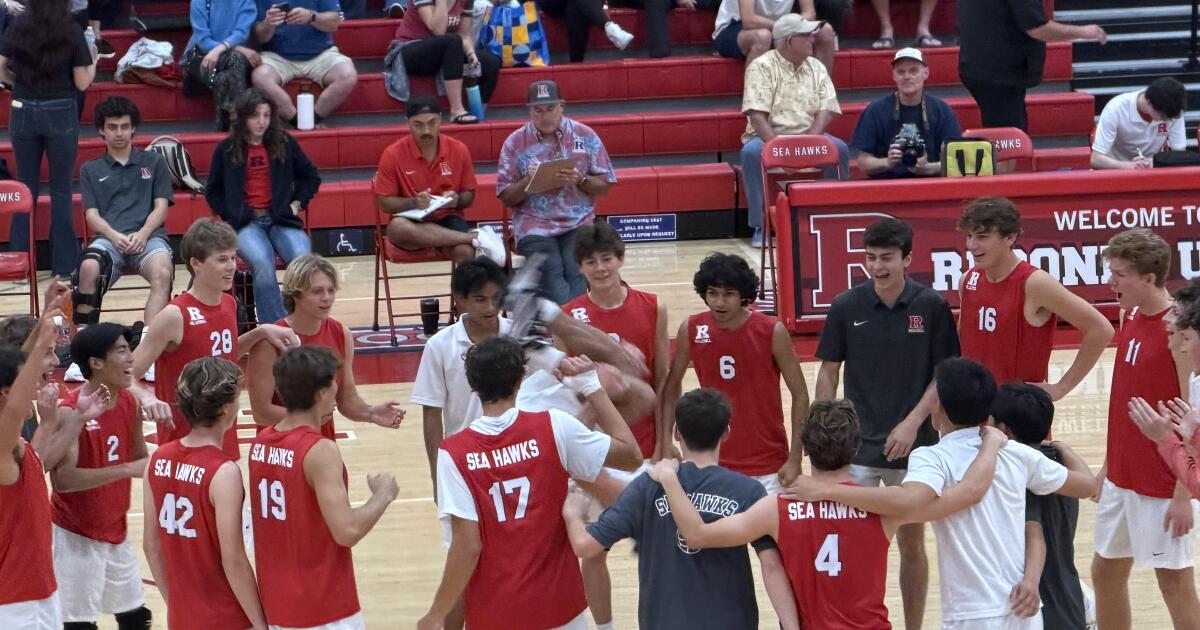
Redondo Union didn’t care that Mira Costa’s volleyball team was ranked No. 1 in California. This was their South Bay rival coming to their gym Thursday night, and anything can happen when a team digs deep and doesn’t fear losing.
The Sea Hawks (14-2) were aggressive from the outset and came away with a 27-25, 21-25, 25-22, 21-25, 15-13 victory.
“Chemistry,” setter Tommy Spalding said about the Sea Hawks’ triumph. He’s one of three players headed to MIT, and all three had big matches.
At one point on back-to-back plays, Carter Mirabal had a block and Vaughan Flaherty followed with a kill off an assist from Spalding. Chemistry.
JR Boice, a Long Beach State commit, was delivering kills, and Cash Essert’s serving and all-around play kept Mira Costa’s Mateo Fuerbringer looking frustrated. The Sea Hawks’ focus was on Fuerbringer, who came alive in the fifth set with six kills, but Redondo was able to come back from an 11-9 deficit.
It was only Mira Costa’s second loss in 25 matches. Redondo Union took over first place in the Bay League.
Baseball
Orange Lutheran 3, Jacksonville (Fla.) Trinity Christian 2: The Lancers advanced to the semifinals of the National High School Invitational in Cary, N.C., behind a walk-off single in the eighth inning by Andrew Felizzari. Brady Murrietta had tied the score with a squeeze bunt in the bottom of the seventh. CJ Weinstein had two doubles for the Lancers.
Venice (Fla.) 12, Harvard-Westlake 0: The Wolverines were limited to three hits at the National High School Invitational in Cary, N.C.
Casteel (Queen Creek, Ariz.) 3, St. John Bosco 2: The Braves suffered their first defeat in North Carolina. Jack Champlin threw five innings and also had two RBIs.
Chatsworth 6, Taft 3: Tony Del Rio Nava threw six innings and had two RBIs in the West Valley League win.
Granada Hills 4, El Camino Real 3: A two-run single by Nicholas Penaranda in the seventh inning keyed a three-run inning for the Highlanders in their West Valley League upset. JJ Saffie had three hits for ECR.
Cleveland 4, Birmingham 3: The Cavaliers pushed across a run in the top of the 10th inning to break a 3-3 tie in the West Valley League win. Joshua Pearlstein finished with three hits, including a home run.
Sun Valley Poly 4, San Fernando 2: Fabian Bravo gave up four hits in 6 2/3 innings for the Parrots, who are tied with Sylmar for first place in the Valley Mission League. Ray Pelayo struck out eight for San Fernando.
Verdugo Hills 15, Kennedy 1: Cutlor Fannon had two doubles and four RBIs in the five-inning win. Anthony Velasquez added two singles and four RBIs.
Westlake 9, Agoura 4: Jaxson Neckien hit a three-run home run to power the Warriors.
Thousand Oaks 7, Calabasas 5: Gavin Berigan, Jeff Adams and Cru Hopkins each had two hits for the Lancers.
Oaks Christian 11, Newbury Park 2: Dane Disney contributed three hits in the Marmonte League win. Carson Sheffer had two doubles and three RBIs.
Santa Monica 12, Simi Valley 4: Ryan Breslo and Johnny Recendez had two RBIs and a triple for Santa Monica. Ravi Chernack had three RBIs.
Dana Hills 7, Corona Santiago 0: Gavin Giese finished with eight strikeouts over six innings and gave up one hit for Dana Hills.
Softball
Sherman Oaks Notre Dame 10, Sierra Canyon 0: Kelsey Luderer contributed three hits and two RBIs while freshman Ainsley Jenkins threw five scoreless innings.
Chaminade 15, Louisville 2: Norah Pettersen had two hits and four RBIs.
Carson 10, San Pedro 0: Atiana Rodriguez finished with three hits, including a double and triple, and three RBIs.
Huntington Beach 6, El Modena 2: Willow Kellen had three hits for the Oilers.
Murrieta Mesa 15, Chaparral 0: It’s a 16-0 start for the Rams. Tatum Wolff hit two home runs.

NEWYou can now listen to Fox News articles!
The fiancée of Buffalo Sabres star Rasmus Dahlin received a roaring welcome home in her first appearance of the season Wednesday night, months after undergoing a lifesaving transplant after she suffered heart failure during a vacation in France.
Carolina Matovac, 25, was shown on the jumbotron during Wednesday’s game against the Boston Bruins. Fans cheered as she waved, and Dahlin, who was also shown on the screen in a split, cracked a smile at the crowd’s reaction.
Carolina Matovac and Rasmus Dahlin of the Buffalo Sabres pose on the red carpet at the Metro Toronto Convention Centre in Toronto, Ontario, Canada, Feb. 1, 2024. (Nicole Osborne/NHLI via Getty Images)
“Welcome home to Carolina Matovac, the fiancée of our captain Rasmus Dahlin,” the arena announcer said. “She is back with us, attending her first game of the season. The Sabrehood loves you, Carolina.”
In an open letter to fans in September, Dahlin shared that Matovac had been feeling ill for several days during their trip, which led to her experiencing “major heart failure.”
“Fortunately, she received CPR on multiple occasions, and up to a couple of hours at a time to keep her alive, which ultimately saved her life. Without her receiving lifesaving CPR, the result would have been unimaginable. It is hard to even think about the worst-case scenario,” he wrote at the time.
Rasmus Dahlin (of the Buffalo Sabres prepares for a faceoff during a game against the New York Rangers at KeyBank Center in Buffalo, N.Y., Oct. 9, 2025. (Bill Wippert/NHLI via Getty Images)
Matovac remained on life support for weeks before receiving the transplant in France.
JACOB WINTERTON, FORMER OHL PLAYER AND BROTHER OF NHL’S RYAN WINTERTON, DEAD AT 25 AFTER CANCER BATTLE
In January, Matovac revealed she was pregnant when her heart failed, adding that her unborn child was the reason she went to the hospital initially.
“You will always hold a special place in our hearts as our first baby, even though we never had the chance to meet. Our love for you is endless,” she wrote in a post on Instagram on what was supposed to be her due date.
“Though you didn’t get to experience this world, you played a vital role in ensuring that I could continue to be a part of it.”
Buffalo Sabres defenseman Rasmus Dahlin follows the puck in the first period against the Ottawa Senators at the Canadian Tire Centre in Ottawa, Ontario, Canada, on April 1, 2025. (Marc DesRosiers/Imagn Images)
CLICK HERE TO DOWNLOAD THE FOX NEWS APP
Despite taking some time to be with Matovac as she recovered in their native Sweden, Dahlin is second on the team with 65 points, and the Sabres are on the cusp of ending an NHL-record 14-season playoff drought.
The Associated Press contributed to this report.
Follow Fox News Digital’s sports coverage on X, and subscribe to the Fox News Sports Huddle newsletter.

50 years of DC Metro: A look back in photos

WKYC Channel 3

Austin’s Star Is Still Shining Bright: Venture Funding To City’s Startups Hits All-Time High

How To Watch: Michigan vs Alabama in NCAA Tournament Sweet 16

This Day in Alaska History-March 27th, 1964

Florida High School Football Rankings: Top 25 teams – Oct. 21

How old is Bo Nix? What to know about Oregon quarterback ahead of 2024 NFL Draft

Cleary's 21 help Le Moyne down Central Connecticut State 69-64 in OT

99th annual Pony Swim held in Virginia

Indiana Members Credit Union announced as new anchor tenant at Bottleworks District

Video: Will ICE Change Under Its New Leader?

DHS shutdown breakthrough comes at cost for Republicans as funding fights nears end

Rubio joins crucial G7 talks as Iran war set to dominate second day

A surprise resignation could open the door for an independent to win a Montana Senate seat

Video: Savannah Guthrie Says She Believes Her Mother Was Taken for Ransom
-

 Detroit, MI1 week ago
Drummer Brian Pastoria, longtime Detroit music advocate, dies at 68
-

 Science1 week ago
How a Melting Glacier in Antarctica Could Affect Tens of Millions Around the Globe
-
 Science1 week ago
I had to man up and get a mammogram
-

 Movie Reviews1 week ago
‘Youth’ Twitter review: Ken Karunaas impresses audiences; Suraj Venjaramoodu adds charm; music wins praise | – The Times of India
-

 Sports6 days ago
IOC addresses execution of 19-year-old Iranian wrestler Saleh Mohammadi
-

 New Mexico5 days ago
Clovis shooting leaves one dead, four injured
-
 Business1 week ago
Disney’s new CEO says his focus is on storytelling and creativity
-

 Texas1 week ago
How to buy Houston vs. Texas A&M 2026 March Madness tickets