Sports
‘The Basketball 100’ GOAT Points: A new way to look at the greatest (players) of all time


“The Basketball 100” is the definitive ranking of the 100 greatest NBA players of all time from The Athletic’s team of award-winning writers and analysts, including veteran columnists David Aldridge and John Hollinger. This excerpt is reprinted from the book, which also features a foreword by Hall of Famer Charles Barkley.
“The Basketball 100” is available today. Read David Aldridge’s introduction and all of the excerpts here.
How do you rank the greatest players in history?
With great difficulty, would be my answer. Attempting to rank the best players in history from one to 100 for this book was impossible, especially when asked to compare between different roles, different positions, and different eras. How the heck are we supposed to split hairs between Ricky Barry and Dwyane Wade, the 26th- and 27th-ranked players on The Athletic’s list?
Well, that’s where data can help us. Or at least, if we use it well, it can help refine and improve our thought process for making the list. There is no ultimate truth here, no one correct and final answer. But for a sport that has been uniquely awful at preserving and discussing its history, it seems that developing a framework for the discussion might be a good place to start.
So how do we make a list of the best players of all time? There are some questions that I think should guide this. That perhaps, if pondered more deeply, might produce a bit less of the reflexive leaning toward secondary players on great teams that has plagued most “best-of” historical lists I’ve seen, including those by the league.
Let’s start here: If we’re covering more than 75 years worth of players, more or less, and only naming 100, that’s basically only one player a year. I get that most good players play for 10 to 20 years, but still, their prime seasons don’t encompass that whole span. (Except LeBron, you freak.) Only three players in history have been First Team All-NBA more than 10 times; only 20 did it more than five times.
The story of the greatest players in NBA history. In 100 riveting profiles, top basketball writers justify their selections and uncover the history of the NBA in the process.
The story of the greatest plays in NBA history.
Buy
Do the math: split 100 half-decade-long “peak primes” across 75 years and you get fewer than seven players a year; do the same with a decade-long prime and you get three. Any way you slice it, the bar for this list is pretty darned high.
Work backward, and one of the first gates for considering somebody for the top-100 list is: was this guy ever considered one of the 10 best players in the league?
That’s just the cover charge to get in the door. To really crack the list, you probably want to answer yes to the next question. Was this guy ever considered one of the five best players? It’s amazing how many players made the NBA’s list for whom those questions are, at best, iffy.
Or look at it another way: through the 2022–23 season, 72 players had made First Team All-NBA at least twice. That includes virtually all of the shoo-in types on the top 100, as well as some great players who didn’t quite make the list (it also includes Max Zaslofsky and Bob Feerick, but I digress).
Those two questions above are not the only valid ones, of course. There are a lot of related questions that should be part of the discussion, especially if we’re ranking players from one to 100.
In particular, if we’re talking about the cream of the cream, I would propose the following outline of important questions. (This cribs heavily from Bill James’s work in the 1985 Baseball Abstract, a dog-eared copy of which still lines my office bookshelf.)
- Was he the best player in the league? Did anyone, at any point, suggest that he might be the best player in the league?
- Did he win MVP? Did he factor heavily in MVP races?
- Was he the best player in the league at his position?
- Was he ever voted First Team All-NBA?
What about Second Team?
- How many All-NBA–caliber seasons did he have?
- Was he the best player on his team?
- If he wasn’t the best player on his team, was he at least the second-best player on a team with a clear all-time great as the best player?
- Was he ever the best player on a champion? Is it likely that this player could be the best player on a championship team?
- Did he have a major impact on the postseason, beyond just lucking into being on the same team as Magic Johnson or LeBron James? Did he have a greater impact on games played at the highest level?
- Was he good enough to be an impact player past his prime or was his career over at 30?
- How many All-Star–caliber seasons did he have?
- Was he a fixture on the All-Star team? And, um, not because of fan voting?
- Do players with similar advanced stats get consideration in the top 100?
- Is there any evidence that he was significantly better or worse than his stats?
- Is there evidence that he was significantly better or worse than contemporaries voted in awards?
As a 16th item, I’ll note that we should value the opinion of the contemporaries who were watching these players in the ’60s, ’70s, and ’80s, when most of us couldn’t . . . either because we weren’t alive yet or because the games were only televised locally, if at all. Additionally, the statistical record from this era just isn’t nearly as complete. Like it or not, the eye test matters quite a bit for that era.
You might look at these questions and think, know what would be great? It would be cool if someone had a formula to weigh these accomplishments and rank players by where they stood. Well, funny you should ask. In the process of making my own list for The Athletic’s Basketball 100 project, I developed a formula to help guide my process.
That formula is called GOAT points, which stands for . . . Greatest Of All Time, duh. I don’t have some funky alternative abbreviation, sorry, nor have I found an obscure backup center to name this after. (Someday I will create a formula called “SMREK.” Someday . . . )
Again, we’re trying to divine the players who succeeded at the highest levels and separate them from the ones who were merely very good players for a long time. Because of that, the highest-value achievements are orders of magnitude more important than more common accomplishments (like making the All-Star team or Third Team All-NBA) that in any other company might be very impressive.
GOAT points is a cumulative points system that adds up all the “quality” from a player’s career. In that way, it rewards longevity, but not at the expense of excellence. Bill Walton’s 1976–77 and 1977–78 seasons are worth more than a lot of players’ entire careers.
Here’s the system:
MVP vote shares: 50 points for each 1.0
Basketball-reference.com has a system for determining a player’s share of the MVP vote, which is a more precise metric than a binary first-second-third and even allows us to distinguish among near-unanimous awards from more contested votes.
For example, Bill Walton had 0.117 MVP vote shares in 1977 (when he finished second) and 0.403 MVP vote shares in 1978 (when he won). He goes in the books with 0.52 career vote shares. The all-time leader here through 2022–23 is LeBron James, with 8.8.
One note here: There are eight players (Julius Erving, Rick Barry, Billy Cunningham, Spencer Haywood, Artis Gilmore, Connie Hawkins, George McGinnis, and Mel Daniels) who factor at least somewhat into the top-100 discussion and received significant ABA MVP vote shares; I took these at one-third of their value. This feels like a fair adjustment: first, because the ABA had half as many teams as the NBA for nearly the entirety of its existence and, second, while it was close to the NBA in quality, I don’t think anyone thought it achieved full parity.
Additionally, I had to go back in time and give an estimated 3.5 MVP vote shares to George Mikan; the league didn’t give out the award until 1955–56, when Mikan’s prime years had passed. If you’re scoring at home, I also gave 1.0 to Joe Fulks and 0.5 to Paul Arizin.
- First Team All-NBA: 10 points each
- Second Team All-NBA: 3 points each
- Third Team All-NBA: 1 point each
- First Team All-ABA: 5 points each
Roughly tripling the value between First and Second Team, and again between second and third, keeps the emphasis on the highest-order achievements. Note that even First Team All-NBA is just one-fifth as valuable as a full MVP vote share. Consistent with the treatment above, I also halved the reward for achieving ABA First Team and didn’t acknowledge the second team.
Finals MVP: 10 points
Note that for those who played before the advent of the award in 1969, I had to “award” a Finals MVP based on who likely would have won it that year. I handed out seven to Bill Russell, four to George Mikan, one more to Wilt Chamberlain, and one each to Bob Pettit, Bob Cousy, Paul Arizin, Bob Davies, Sam Jones, and Dolph Schayes. Hopefully you agree with my voting.
All-Star team: 1 point
In the context of comparing all-time greats, making the All-Star team is just not that big a deal; it’s the floor, not the ceiling.
Every player in the GOAT points top 100 was named to at least five All-Star teams except the players from before the ’50s, who didn’t have an All-Star Game to play in. (I “selected” those players for the years they were first-team all-league and didn’t have a game to play in.)
I did not acknowledge making an ABA All-Star team; in conferences with five and six teams, respectively, the bar was just too low.
Career win shares above 100: 1 point
To balance some of the emphasis on peak value versus career value, and to reward more general team accomplishment and durability, I added a bonus for players who achieved at least 100 career win shares on basketball-reference.com. This is a fairly simplistic measurement, yes, but it has the advantage of being available back to the beginning of the NBA.
Conveniently, 96 players in NBA history had at least 100 career win shares through 2022–23, and received extra points this way. Most got scraps, however; only 24 players in league annals have cleared 150 win shares. Setting a bar at 100 strikes a balance between rewarding quality longevity without overly rewarding “hanging around” years or overly punishing players with brief peaks.
Note that I did not count ABA win shares here; there are some totals from the early years of that league especially that are just batty; suffice to say it produced results that I do not think I could defend.
Career BPM above 2.0: 7.5 points per point
Finally, we have a contribution from the advanced stats, somewhat. Basketball-reference.com only has BPM dating to 1974, and uses some tricks to fill in gaps for everything prior to 1985, so it’s definitely more valuable for modern players than for old-timers. I included it here to help weigh the modern players in particular; I think it’s hard for us to answer the question “How great is Paul George?” while his career is going on, and this helps provide a historical guidepost.
The limitation here is that I had to make crude estimates for pre-1974 players, generally giving them the benefit of the doubt and rating them comparable to historical peers from later eras. Because of this, I had to make BPM’s contribution relatively minor; doubling my estimate for Elgin Baylor, for instance, would only move him up three spots in the GOAT point standings.
So what do GOAT points give us? Still a lot of questions about comparing eras and roles, of course. What do we do with Mikan, for example? GOAT points tells us something we already know — he dominated the early 1950s — but tells us nothing about the relative strength of the league then versus in 1972, let alone 1992 or 2022.
For that matter, GOAT points doesn’t really know what to do with Dennis Rodman, either, or how to handle cases of extreme longevity (Karl Malone, John Stockton), or what to do about Michael Jordan skipping two years of his prime and then retiring at 35.* It can’t tell you whether Walt Frazier was better than Isiah Thomas, or if Clyde Drexler was better than Dwyane Wade, or if 1.75 God-level seasons from Bill Walton is better than 15 years of Robert Parish being the third-best center in the East.
* (Those Wizards years didn’t happen.)
What it can do, at least, is set the stage for the discussion. Maybe I weighted some stuff too highly and other things not highly enough; surely there are ways this can be improved in the coming years, especially if we get better historical advanced stats.
That said, it also brings some important debate questions to light, particularly regarding a few players who were excluded from this list or, perhaps, vaulted too prominently in it.
OK, enough of my yapping. It’s time for the envelopes. Here’s what the GOAT points formula spits out for the top 100 players in pro basketball history:
GOAT Points: “The Basketball 100”
| RANK | PLAYER | GOAT POINTS |
|---|---|---|
|
1 |
LeBron James |
857.3 |
|
2 |
Michael Jordan |
750.2 |
|
3 |
Kareem Abdul-Jabbar |
660.1 |
|
4 |
Tim Duncan |
504.2 |
|
5 |
Karl Malone |
503.6 |
|
6 |
Wilt Chamberlain |
499.0 |
|
7 |
Larry Bird |
487.7 |
|
8 |
Magic Johnson |
486.6 |
|
9 |
Bill Russell |
471.5 |
|
10 |
Shaquille O’Neal |
459.6 |
|
11 |
Kobe Bryant |
457.1 |
|
12 |
Kevin Durant |
373.7 |
|
13 |
James Harden |
356.2 |
|
14 |
Oscar Robertson |
344.5 |
|
15 |
David Robinson |
335.1 |
|
16 |
Kevin Garnett |
324.1 |
|
17 |
George Mikan |
320.0 |
|
18 |
Bob Pettit |
317.5 |
|
19 |
Hakeem Olajuwon |
316.0 |
|
20 |
Jerry West |
315.5 |
|
21 |
Nikola Jokić |
307.9 |
|
22 |
Giannis Antetokounmpo |
307.1 |
|
23 |
Chris Paul |
305.2 |
|
24 |
Charles Barkley |
305.0 |
|
25 |
Dirk Nowitzki |
297.1 |
|
26 |
Moses Malone |
286.0 |
|
27 |
Steph Curry |
268.0 |
|
28 |
Julius Erving |
230.5 |
|
29 |
Steve Nash |
218.7 |
|
30 |
John Stockton |
204.2 |
|
31 |
Elgin Baylor |
202.5 |
|
32 |
Bob Cousy |
196.5 |
|
33 |
Dolph Schayes |
184.5 |
|
34 |
Joel Embiid |
181.5 |
|
35 |
Dwight Howard |
161.0 |
|
36 |
Kawhi Leonard |
160.3 |
|
37 |
Jason Kidd |
159.6 |
|
38 |
Rick Barry |
152.8 |
|
39 |
Russell Westbrook |
150.9 |
|
40 |
Patrick Ewing |
141.8 |
|
41 |
Gary Payton |
140.5 |
|
42 |
Allen Iverson |
140.0 |
|
43 |
John Havlicek |
138.5 |
|
44 |
Dwyane Wade |
138.4 |
|
45 |
Luka Dončić |
133.5 |
|
46 |
Clyde Drexler |
129.7 |
|
47 |
Anthony Davis |
129.1 |
|
48 |
George Gervin |
123.8 |
|
49 |
Scottie Pippen |
120.7 |
|
50 |
Tracy McGrady |
107.0 |
|
51 |
Willis Reed |
106.5 |
|
52 |
Elvin Hayes |
102.0 |
|
53 |
Dominique Wilkins |
99.4 |
|
54 |
Joe Fulks |
98.0 |
|
55 |
Bob McAdoo |
94.2 |
|
56 |
Paul Pierce |
93.6 |
|
57 |
Reggie Miller |
93.3 |
|
58 |
Dave Cowens |
89.0 |
|
59 |
Paul Arizin |
87.0 |
|
60 |
Walt Frazier |
83.5 |
|
61 |
Damian Lillard |
83.1 |
|
62 |
Hal Greer |
82.0 |
|
63 |
Wes Unseld |
76.8 |
|
64 |
Robert Parish |
75.0 |
|
65 |
Isiah Thomas |
74.8 |
|
66 |
Sidney Moncrief |
74.5 |
|
67 |
Billy Cunningham |
73.0 |
|
68 |
Alonzo Mourning |
71.5 |
|
69 |
Connie Hawkins |
71.1 |
|
70 |
Ray Allen |
70.9 |
|
71 |
Chauncey Billups |
70.0 |
|
72 |
Pau Gasol |
70.0 |
|
73 |
Bill Sharman |
69.5 |
|
74 |
Bob Lanier |
68.6 |
|
75 |
Bill Walton |
67.3 |
|
76 |
Tiny Archibald |
67.0 |
|
77 |
Mel Daniels |
66.6 |
|
78 |
Chris Webber |
65.7 |
|
79 |
Artis Gilmore |
65.4 |
|
80 |
Adrian Dantley |
64.3 |
|
81 |
Shai Gilgeous-Alexander |
64.3 |
|
82 |
Jayson Tatum |
63.0 |
|
83 |
Spencer Haywood |
62.0 |
|
84 |
Grant Hill |
61.5 |
|
85 |
Derrick Rose |
59.5 |
|
86 |
Paul George |
59.3 |
|
87 |
Bernard King |
58.0 |
|
88 |
Tony Parker |
57.0 |
|
89 |
Bob Davies |
57.0 |
|
90 |
Jimmy Butler |
50.5 |
|
91 |
Carmelo Anthony |
50.0 |
|
92 |
Dave Bing |
50.0 |
|
93 |
Vince Carter |
49.5 |
|
94 |
Neil Johnston |
49.0 |
|
95 |
Kevin McHale |
48.8 |
|
96 |
Tim Hardaway Sr. |
48.3 |
|
97 |
Jerry Lucas |
48.0 |
|
98 |
Blake Griffin |
48.0 |
|
99 |
Paul Westphal |
44.0 |
|
100 |
Penny Hardaway |
43.8 |
Excerpted from “The Basketball 100” published by William Morrow. Copyright © 2024 by The Athletic Media Company. Reprinted courtesy of HarperCollins Publishers
(Illustration: Kelsea Petersen / The Athletic; Photo: Jesse D. Garrabrant / NBAE via Getty Images)



Sports
Thekla embarrasses Stardom’s Starlight Kid after retaining AEW World Women’s Championship at Forbidden Door

NEWYou can now listen to Fox News articles!
Thekla has had every reason to talk as much trash as she’s done.
She made her debut in All Elite Wrestling (AEW) last year and quickly moved up the ladder to win the AEW Women’s World Championship in a strap match against Kris Statlander in February. She’s continued to hold the title even when three opponents were thrown her way at Double or Nothing.
COMPLETE PRO WRESTLING COVERAGE ON FOX NEWS DIGITAL
Thekla enters the ring during the women’s pro-wrestling event “Stardom” at Korakuen Hall in Tokyo, Japan, on Jan. 13, 2025. (Etsuo Hara/Getty Images)
Thekla declared war on Stardom and New Japan Pro-Wrestling (NJPW) in the buildup to Forbidden Door. She demanded that Stardom send its best to challenge her at Forbidden Door, and they obliged. Starlight Kid stepped up against the “Toxic Spider” and the two put on a great match in front of the pro wrestling audience at the SAP Center in San Jose, California.
Thekla taunted Starlight Kid throughout the match and it appeared she got more than she bargained for at points during the match.
Starlight Kid wouldn’t stay down and gave every effort to bring the AEW Women’s World Championship back to Japan with her. Starlight Kid worked on Thekla’s knee toward the end of the match. But the champion would not quit.
Starlight Kid enters the ring during the Women’s Pro-Wrestling “Stardom” 15th Anniversary at Edion Arena Osaka in Osaka, Japan, on Feb. 7, 2026. (Etsuo Hara/Getty Images)
Thekla got out of the submission hold and avoided being pinned by mere seconds. Thekla was put to the test more than any other opponent she’s faced since becoming the champion.
The “Toxic Spider” hit two stomps and finally put away Starlight Kid to retain the title.
With Stardom president Taro Okada in attendance, Thekla continued her assault against Starlight Kid. Skye Blue and Julia Hart came out to support Thekla. Hart handed Thekla a pair of scissors and the champion ripped the mask off Starlight Kid’s head and spit in it.
Thekla taunted Okada with the mask and hit the wrestling executive with it.
Thekla enters the ring during the women’s pro-wrestling event Stardom at Yokohama Budokan in Yokohama, Kanagawa, Japan, on March 8, 2025. (Etsuo Hara/Getty Images)
CLICK HERE TO DOWNLOAD THE FOX NEWS APP
Thekla stayed the champion and added a trophy to her mantel.
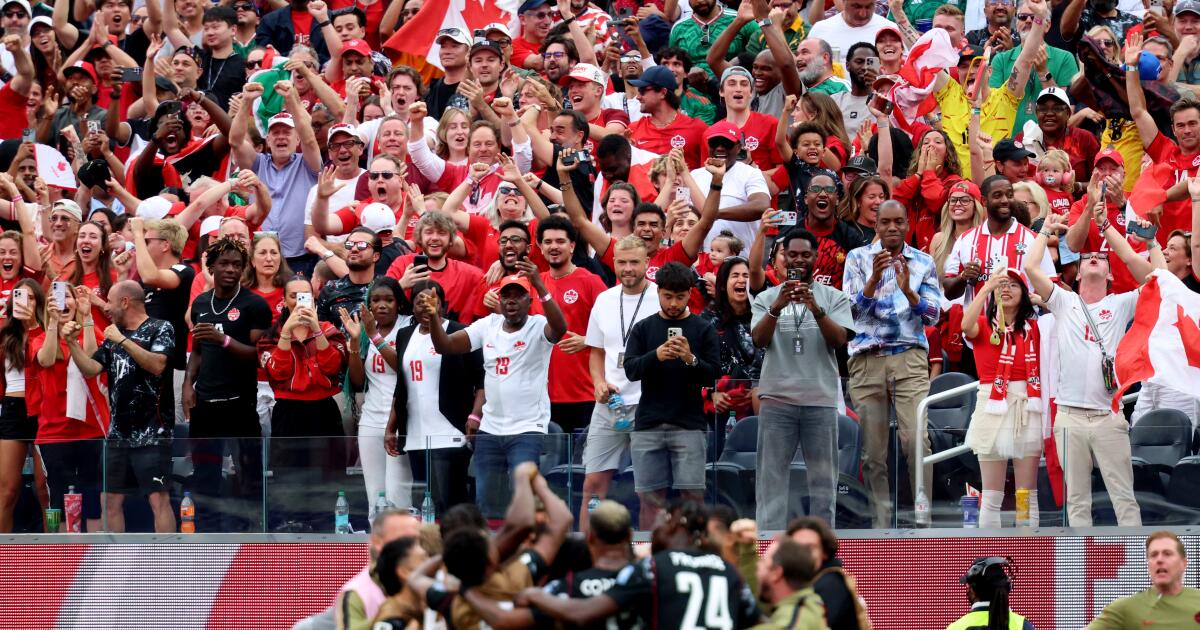
Remember when we were sure the World Cup would suffer from all the issues that had everyone seeing red before the first ball was kicked?
And remember when we were certain soccer could never catch on in this country?
Despite controversies over visas and ticket prices and transportation, and in spite of consternation over expansion and new rules, the game has, as usual, proved too good to fail.
And we, the American people, have become unusually engrossed in it.
We’ve been tuning in on TV in record numbers and, even at exorbitant prices, helping to sell out our 70,000-some-capacity stadiums. Before group play was even finished, this tournament — staged also in Mexico and Canada — already outdrew the 1994 World Cup, which was hosted by the United States and set an attendance record of nearly 3.6 million.
We’ve been loving the healthy cultural exchange, and we’re being reminded that cultural barriers of traditional sports fandom can be breached.
So now, to keep our interest from drying out like a pitch on a hot summer day, the goal should be to keep the market saturated with soccer. That will take Major League Soccer tearing down all the walls.
It’s already turned the page on its calendar, adopting a summer-to-spring season format that will better blend with the global game.
Now MLS needs to make its games easier to watch, and to do its part to make the sport easier to play.
Canada goalkeeper Maxime Crépeau, left, celebrates with teammate Jonathan David after a 1-0 win over South Africa at the World Cup on Sunday.
(Kelvin Kuo / Los Angeles Times)
While the proverbial iron is hot, it needs a strike like Stephen Eustáquio’s winning rocket in the 92nd minute of Canada’s 1-0 victory against South Africa on Sunday at SoFi Stadium.
Eleven players on the two teams were MLS representatives — including Eustáquio, who spent the last six months in LAFC’s midfield.
Goalkeeper Maxime Crépeau, who played two seasons with LAFC and now plays for Orlando City, stopped the only shot he saw for his second clean sheet this World Cup, which saw the Canadians succeed in their first knockout stage appearance.
There’s been no avoiding MLS players in this World Cup. The greatest of them is piling up goals for Argentina: Lionel Messi, the Inter Miami superstar, is now the all-time World Cup goal-scorer (with 19).
MLS has set an attendance record too, with 45 players participating. It ranks as the league with the second-most players apart from the top five European leagues. LAFC had three current players in the mix.
But wait. Record skip. Before you celebrate the MLS’s contributions to this soccer spectacle, check with the VAR. Yep, without the 13 MLS players representing nations that rank 40th or lower in FIFA’s world ranking, there actually would be fewer than the 37 MLS participants at the World Cup four years ago.
A baby’s first steps are for celebrating, but three decades after the league’s formation, MLS is still searching for a giant leap. It’s still having a mean time of trying to make “fetch” happen for real.
It would help to make its games more readily available — not to the already converted, but to fans who didn’t even know what they didn’t know about soccer until the World Cup began in their backyards.
MLS has already brought MLS from behind Apple’s season pass paywall. And the league and streaming service also reportedly have agreed to a revised media rights deal that will end at the end of the 2028-29 season, three and a half years earlier than expected.
But the hat trick would be to remove the need to subscribe to streaming service to watch MLS games altogether, and then get those matches onto the networks people know to tune into for their sports.
Normalize watching American soccer.
And stop gatekeeping. MLS’s developmental programs are too restrictive and exclusive — they’re not developing more soccer players, they’re curtailing who can play.
It’s in the league’s interests, and the sport’s in this country, to encourage as many players to play as much as they can — including for their high school teams, which MLS Next bars.
They’ve got people in the tent; the goal should be to make them want to stay.
To make them want to join the world’s circus, not to let it pack up and move on, out of sight and out of mind, until it swings back through years from now.

NEWYou can now listen to Fox News articles!
Golf humbles many, including those who are the best in the world.
Just ask J.T. Poston at the Travelers Championship on Sunday.
What started out as a chance to put a low score on the card at the 13th hole after getting greenside in two shots, Poston, the world No. 32 in the Official World Golf Ranking, posted a 12 in an absolute meltdown that derailed his entire day.
J.T. Poston plays a shot from the first tee during the first round of the Travelers Championship at TPC River Highlands in Cromwell, Conn., on June 25, 2026. (Jordan Bank/Getty Images)
While Poston may not have been in contention, he wasn’t picturing himself at the bottom of the leaderboard by the end of the tournament, but the 12 was the main reason behind finishing 6-over and 1-over on the tournament for 69th place out of the remaining 72 that made the cut.
So, what exactly happened to Poston?
MICROPHONE ENDURES GOLFER SHANE LOWRY’S WRATH DURING MELTDOWN AT US OPEN
Well, the 13th hole began with a perfect tee shot that found the middle of the fairway. Then, his second shot found a greenside bunker, but professionals sometimes don’t mind finding those bunkers because of how great their short game is. A good bunker shot and Poston has a chance at birdie on the par-5.
But things went awry from there, as the bunker shot came out quite short, leaving him with a chipping situation. Again, professionals understand that’s not the end of the world, with a chance at par after a solid chip.
The nightmare was just beginning for Poston, though, as his fourth shot went clear across the green and ended up in the water on the other side.
From there, Poston had to drop not once, but three separate times because he couldn’t get his ball back on the green. On his 10th stroke, he finally got the ball into a putting position.
J.T. Poston stands on the first tee box during the second round of the Travelers Championship at TPC River Highlands in Cromwell, Conn., on June 26, 2026. (Ben Jared/PGA Tour)
Poston still had to keep going, putting his 11th stroke and missing it before a tap-in 12 and ending the meltdown in front of the fans.
Poston spoke about the multiple drop balls near the water that continued to roll back into the drink.
“It’s not really rough, where you can kind of blast it out,” Poston said, per Golfweek. “It’s into the grain, but it looks like you can get enough golf ball on it, which is why I kept trying to hit a good chip.”
Poston was asked if he even thought about putting it out of the greenside rough with his chips clearly not working out.
“I feel like it’s just going to hop and that takes all the speed out of it,” he responded. “And you’ve got this big false front you got to get it over. So my worry with trying to putt it was it would not have enough speed to really get there.”
J.T. Poston plays a tee shot on the first hole during the second round of the Travelers Championship at TPC River Highlands in Cromwell, Conn., on June 26, 2026. (Ben Jared/PGA Tour)
CLICK HERE TO DOWNLOAD THE FOX NEWS APP
Poston didn’t bounce back on the 14th hole either, as he posted a double bogey on the par-4 to put himself down even more. In the end, Poston posted a 76 on the day to finish off his tournament.
Meanwhile, the Travelers Championship will come down to a playoff that must be played on Monday after Viktor Hovland and Scottie Scheffler found themselves deadlocked at 21-under after the latter sank a putt to force it. Hovland’s putt to win it all just missed and Scheffler took advantage of the open opportunity.
Follow Fox News Digital’s sports coverage on X and subscribe to the Fox News Sports Huddle newsletter.
-

 North Dakota11 minutes ago
Where can Air Force One land in North Dakota?
-

 Ohio14 minutes ago
Every Ohio State Player’s Remaining Eligibility After NCAA Adopts Five-Year Eligibility Model
-

 Oklahoma19 minutes ago
Oklahoma Highway Patrol enters ’37 patrol car in national contest
-

 Oregon26 minutes ago
National Weather Service says no tsunami threat after 5.5 quake off Oregon coast
-

 Pennsylvania29 minutes ago
Black Cap Brewing to halt happy hour specials due to Pennsylvania liquor code update
-

 Rhode Island35 minutes ago
State leaders announce millions in funding for road improvements in Aquidneck Island
-

 South-Carolina41 minutes ago
Recapping South Carolina’s Hot Start to Summer Recruiting As July Approaches
-

 South Dakota44 minutes ago
Norma Lindell, 93

