Sports
Tennis has a problem with players, umpires and rules. How to fix it?


In less than 24 hours, three tennis players subjected three umpires to three tirades of different flavors in Shanghai.
Tuesday night in that Chinese city, world No. 17 and U.S. Open semifinalist Frances Tiafoe told umpire Jimmy Pinoargote that he “f***ed the match up’ after the umpire called a time violation against him at 5-5 in a deciding tiebreak. Tiafoe had walked to the baseline as the shot clock, which adjudicates time between points, went to zero, and then tossed the ball into the air with no intention of hitting it.
Tiafoe lost his first serve for the violation, his third of the match, and then lost the next two points and the match against Roman Safiullin.
Then on Wednesday, Fergus Murphy called a time violation against world No. 12 Stefanos Tsitsipas, also a two-time Grand Slam finalist. At the change of ends, Tsitsipas laid into Murphy, saying, “You have never played tennis in your life.” Murphy replied, “I’m not as good as you, but I have.”
“No cardio,” Tsitsipas, who eventually lost to Daniil Medvedev, then said. “You probably play every time serve-and-volley.”
The Tsitsipas/Murphy drama from earlier today: pic.twitter.com/qxMobL5Zpd
— José Morgado (@josemorgado) October 9, 2024
In between those two incidents, world No. 3 and two-time Grand Slam finalist Alexander Zverev on Tuesday night told Mohamed Lahyani that umpires are collectively “f***ing up the tournament” after Lahyani correctly adjudged that Zverev had failed to hit the ball before it bounced twice in his eventual win over Tallon Griekspoor.
“Every Grand Slam final I lose because of you guys,” Zverev said. He was beaten by David Goffin the following day, in a match in which he twice escaped a code violation for ball abuse.
The vast majority of tennis matches pass without even minor incident, but this cluster of incidents — two of them centered on a new shot clock rule that has caused consternation across the sport — preceded the news that Wimbledon will abolish line judges in favor of electronic line calling (ELC) from 2025.
The Athletic’s tennis team discuss the themes at the heart of these decisions, and ask how the sport can solve a problem like officiating.
GO DEEPER
Wimbledon jettisons line judges for electronic line calling after 147 years
James Hansen: On the face of it, the two decisions that prompted the Tiafoe and Zverev outbursts couldn’t be more different. Whether or not a ball has bounced twice is a matter of objective fact; what does or doesn’t constitute a service motion is more up for debate. Tiafoe’s tossing of the ball, even with his hitting arm by his side and not at all taking part in a service motion, was designed to buy him discretion from Pinoargote that he did not get.
Is tennis’ scoring system being built on objective facts — whether a ball is in or out, and whether it has bounced twice — part of the reason why players and umpires struggle to see eye to eye when things are more ambiguous, even if they’re pretty clear-cut?
Matt Futterman: I take issue with the idea of the sport mostly being about objective calls. Yes, the Zverev call was a fundamental rule. But like all sports, each tennis match also has a heartbeat and a temperature, which can’t always be taken by hard and fast officiating diktat. There are moments when the pros could learn something from the weekend hacker game down at the park, where indecision over a call is often resolved by a simple, “play a let”.
Alexander Zverev a Mohamed Lahyani: “Cada final de Grand Slam que juego la pierdo por culpa de ustedes” 🙄 pic.twitter.com/5LqFuqgDIf
— Tiempo De Tenis (@Tiempodetenis1) October 8, 2024
Earlier this summer at the Cincinnati Open, when Jack Draper won match point against Felix Auger-Aliassime on at the very least an incredibly debatable non-double bounce call, Draper said he would have replayed the point if a video replay were available. Why make it conditional? After all, who wants to win like that? Down at the park, we would play a do-over. Sometimes a pro does that, and they get huge applause and good karma. Most of the time, with so much on the line, they don’t. I get that, but only sort of.
With Tiafoe, the new system that the ATP started trialing after this year’s French Open automatically starts the shot clock three seconds after the last point. It’s meant to speed up play and take the job of resetting the clock out of the hands of the umpires. I think it’s a terrible development. Tennis is more taxing than ever. Why are we penalizing players for pushing themselves over the edge to win a long rally, or the kinds of points that thrill fans?
Tennis wants to prevent umpires from favoring certain players who might be more deliberate and bounce the ball too many times. I get that. But at that point in a deciding set, I don’t want an umpire to have anything to do with the outcome of a point before the ball is even in play. I want players to decide the outcome of matches, except if someone does something egregious. Was Tiafoe’s fake serve egregious? A bit. But he was trying to work around a flawed rule.

Charlie Eccleshare: Matt makes a great point about the power of the let and having the humility to accept sometimes that, as an umpire, you just don’t know. Tennis has so benefited from Hawk-Eye technology, compared to, say, football’s relationship with VAR (Video Assistant Referee) since its widespread introduction five years ago, because the calls it adjudicates are objective.
Subjective calls are more tricky for officials too, because they have to straddle the very delicate balance between that taking the temperature of a match and enforcing what they are expected to enforce. Sometimes in the search for clear-cut answers, they don’t really exist.
On Matt’s point about umpires influencing outcomes, Pierluigi Collina, probably football’s best ever referee, said one of the biggest myths around officiating is that a good referee is one you don’t notice. Nonsense, he said. If there are a number of big decisions to be made, you make them!
Was the Tiafoe call a big one to make? No. The umpire could easily have let that one lie and no one would have been talking about it. But it was his third time violation and the nature of it clearly piqued the umpire, who said outright to Tiafoe, “I’m not buying it.” The bigger issue, like you suggest James, is that I get that tennis wants to quicken matches up, and I’m all for possible solutions to a sport whose match times have gotten out of control, but this feels like chipping away at the edges when far more drastic steps are needed.
Zverev’s reaction after a correct decision was nonsensical, but these outbursts over the last few days remind us that these players are all physically and mentally exhausted. Solving those issues requires much bigger reforms than marginally reducing match times by shortening the gaps between points, and those issues cause greater damage to the sport as a product than people taking too long on serve once in a while.

Alexander Zverev could not believe Lahyani’s correct decision. (Lintao Zhang / Getty Images)
Matt: I like Charlie’s point about Collina. I also think in a lot of cases the calls that officials don’t make are as important, and maybe more so, as the ones they do. My guess is Collina would group all of them as “decisions” but we all know there are tennis officials who are more inclined to insert themselves into the action. And at the risk of making a broad generalization, I can’t think of one female official I would put in that category.
James: It seems like the shot clock is intrinsically flawed. The old version is too susceptible to being governed by subjectivity; the new version makes no concession to the contours of a match. It also doesn’t seem like the benefits outweigh the number of players complaining, or the difficult situations it’s creating for umpires.
Charlie: Umpires are constantly put in difficult situations, and we ask a huge amount of them. In the Tiafoe incident, the umpire risks getting a slap on the wrist from his bosses for not enforcing the shot clock, and maybe even accusations of favoritism towards the more famous player of the two. Or he will receive criticism for being too heavy-handed and not having a feel for the situation. We expect umpires to almost act as psychologists sometimes, understanding why a player is behaving in a certain way and expecting that to then inform their judgments.
James: Discipline — or a lack of it — is a big problem here. Players would not feel emboldened to swear at, insult, or in the case of Zverev in Acapulco in 2022, physically attack where umpires are sitting if the ATP Tour imposed stronger correctives. The German wasn’t even banned for that incident, and there is no question that the latitude given in these situations is making the problem worse. Players may feel like they are suffering more, because they lose a point or a match, and therefore money and ranking points, on what they perceive to be a bad call, but the lack of respect for umpires’ authority seems more pervasive than isolated extreme cases.
Charlie: Another issue is that in some cases, like with Draper, and then with Zverev, the officials and the players are the only people who cannot see the clearest view of the incident that they are disagreeing on. Everyone in the crowd, or watching at home, can just look at replays on their phone or TV. That’s clearly not right. Use of things like video review (VR) and electronic line calling (ELC) is still so fragmented that there are too many built-in disparities that umpires and players are expected to navigate.
Matt: On this, tennis is stupid. There are seven different governing bodies, all of which have rights to set up events as they please. And within the two tours, the ATP and the WTA, not all the tournaments have to comply with a singular technological system.
Why? Money. Tournaments large and small would be on the hook to pay for the cameras and computer technology to allow for video review and electronic line calling on all the courts.
Then there are the traditionalists. The French Open, for instance, likes the idea of umpires climbing down and inspecting ball marks on the clay. At this year’s tournament, a particularly egregious missed call derailed Zheng Qinwen, who had no grounds to challenge it. In 2023, Amarissa Toth erased a contested ball mark in a match against Zhang Shuai, who then retired because of the misfortune and pressure of a situation that players should not find themselves in.
For a while, the rationale for this was that the computer system was less foolproof because of the raised tape lines on a clay court. This problem has been fixed. Wimbledon also insisted on line judges and the Hawk-Eye challenge system until this week, even though cameras can check all the calls and often show missed calls that go unchallenged. Everyone has the proper information — except those who need it most.
Charlie: I’m told by well-placed sources that the ATP Tour is exploring the possibility of using VR technology at its higher category events from 2025, taking in the Masters 1000 and some 500-level events. It will be in place at the ATP Finals in Turin next month and the Next Gen Finals in Jeddah in December. Generally with technology, once the genie is out of the bottle, it’s hard to put back in, and so you’d expect VR technology will only become more widespread in the next few years.
In its one significant use at this year’s U.S. Open, between Anna Kalinskaya and Beatriz Haddad Maia, umpire Miriam Bley appeared to reach the wrong conclusion despite replays, so these systems are not yet perfect — but the option was there. As Matt said earlier, why make that option conditional?
Wimbledon’s decision to make the change with line judges after 147 years is significant, as it reflects the growing acceptance that there is just no compelling argument against the use of ELC. “Because we’ve always done it like this” is not a compelling argument for players, umpires, or fans.

Video review did not help Miriam Bley reach the correct decision at the U.S. Open. (Matthew Stockman / Getty Images)
To expand on something else Matt said about Hawk-Eye showing missed calls that players didn’t challenge, the fact that, without ELC, players are asked to essentially officiate the accuracy of their own shots has always been absurd to me. They have enough to worry about without also having to concern themselves with making calls and challenging officiating mistakes.
At the recent Olympics, Coco Gauff said that she always had to advocate for herself after an umpire went against her. And even with ELC in place in Cincinnati (also in August), when the system missed a call on a ball hit by Brandon Nakashima that was out, umpire Greg Allensworth told Taylor Fritz that he had to be the one to stop the point for it to be corrected. Fritz understandably went off on the idea that he had to adjudicate the match as well as play in it.
Matt: The players suffer plenty from the bad calls but line judges and umpires are the ones who look like idiots through little fault of their own. They are the ones who need the information more than anyone, and they are just about the only ones who don’t have it. Tennis leaders need to do right by them, instead of leaving them at the mercy of the fallibility of their own eyes as balls travel at 80mph (128kmh) and up. Players are not blameless either, and not only because they curse out umpires on occasion, which should be heavily penalized to reduce the frequency with which it happens.
James: And in those situations, the chair umpire becomes the face of the system and all its problems, and then has to receive all the umbrage that the player feels even if they — or the ELC system — came to the correct conclusion. Tennis officials should think about how the rules and technologies can be best applied to avoid these kinds of situations, but the split leadership makes that harder than perhaps it needs to be.
Charlie: Fundamentally, tennis needs to think: how can the rules best serve the game and create the best spectacle? And, how can the systems that enforce them be designed and implemented to ensure that players and umpires aren’t having to deal with additional stress in what is already a really stressful sport? At the moment, systems like the new shot clock and the fragmented protocols don’t seem to be serving that purpose as well as they could.
(Top photo: Andy Wong / Associated Press)



Sports
Golf star records lowest round in LPGA major history with astounding performance at Evian Championship

NEWYou can now listen to Fox News articles!
There are good days on the golf course, and then there is what Haeran Ryu just did on Saturday.
Ryu, 25, recorded the lowest round in LPGA major history on Saturday with an 11-under 60 at the Evian Championship. With the South Korean golfer’s historic round, she holds a three-stroke lead.
Ryu’s round comes just two weeks after winning her first major at the Women’s PGA Championship. On the 18th hole, Ryu left a 30-foot eagle putt a few inches short, and instead settled for a birdie.
CLICK HERE FOR MORE SPORTS COVERAGE ON FOXNEWS.COM
Haeran Ryu of South Korea reacts on the 18th green after the third round of The Amundi Evian Championship at Evian Resort Golf Club in Evian-les-Bains, France, on July 11, 2026. (Stuart Franklin/Getty Images)
She said after the round that she had no idea what she had done until she counted up her scorecard.
“But after the putt and I counted my score with my caddie,” she said. “Oh my God, it’s 11-under par today. It was so amazing. My caddie says, ‘Yep.’ I’m so happy right now.”
If Ryu had made the eagle putt on the 18th hole, she would have been just the second player to shoot a 59 in LPGA history.
ZERO BS. JUST DAKICH. TAKE THE DON’T @ ME PODCAST ON THE ROAD. DOWNLOAD NOW!
Haeran Ryu of South Korea celebrates a birdie on the 15th green during the third round of The Amundi Evian Championship at Evian Resort Golf Club on July 11, 2026, in Evian-les-Bains, France. (Stuart Franklin/Getty Images)
Her 60 broke the record for the lowest round in an LPGA major by one shot. Leona Maguire and Jeungeun Lee6 in 2021, and Hyo Joo Kim in 2014, each shot 61 at the Evian Championship, which was designated as an LPGA major in 2013.
The lowest round in a men’s major is 62, which is shared by four players — Branden Grace at Royal Birkdale in the 2017 British Open, Xander Schauffele and Rickie Fowler in the 2023 U.S. Open at Los Angeles Country Club, and Schauffele and Shane Lowry in the 2024 PGA Championship at Valhalla.
CLICK HERE TO DOWNLOAD THE FOX NEWS APP
Haeran Ryu of South Korea and Lottie Woad of England interact after their round on the 18th green during the third round of the Amundi Evian Championship at Evian Resort Golf Club in Evian-les-Bains, France, on July 11, 2026. (Stuart Franklin/Getty Images)
Ryu hopes her historic third round can help propel her to a second major win in three weeks.
“That is amazing, amazing dream,” Ryu said. “So I just want that one to come true, but we have one more day.”
The Associated Press contributed to this report.
Follow Fox News Digital’s sports coverage on X, and subscribe to the Fox News Sports Huddle newsletter.
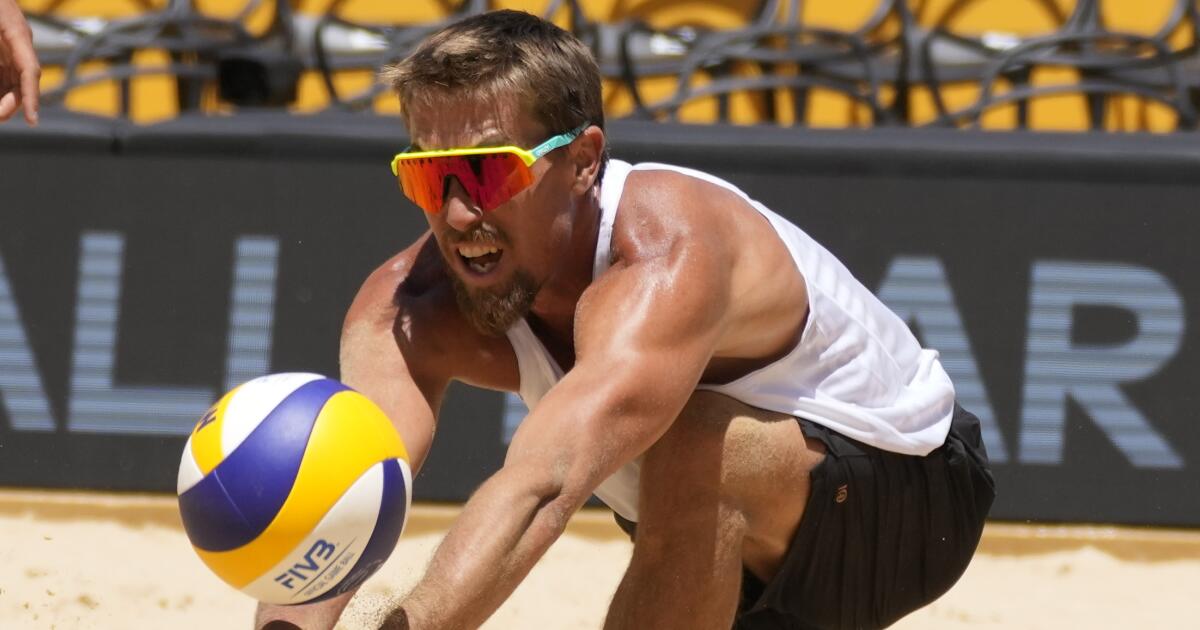
Taylor Crabb is no stranger to South California beaches. The Long Beach State alum returns home this weekend to compete in AVP League matches.
It marks the first time AVP will compete in Long Beach since 2020 and allows players to compete at the 2028 Olympics beach volleyball venue.
Crabb, 34, made his AVP debut in 2013 with his brother, Trevor, and advanced from the qualifier in Manhattan Beach before finishing 25th in his first tournament.
After years of competing with various different partners, Taylor Crabb and Andy Benesh have delivered the top performances this AVP season.
The following interview with Crabb has been edited for clarity and length.
Are you excited to compete in this weekend’s event at Long Beach?
Crabb: Very excited. A lot of my college teammates and part of the school have reached out, saying that they’re gonna come. So I’m excited to get a chance to play in front of them again.
When was the last time you were in Long Beach?
Crabb: I always try to go down there for alumni events or any big games they have. I went to UCLA against Long Beach last year, when it was No. 1 versus No. 2, so I always try to get down there and support them.
You missed out on the chance to compete in the 2020 Olympics because of COVID-19 restrictions and chose not to pursue a spot at the 2024 Olympics. Are you fired up to try to compete in the 2028 Olympics, knowing that Long Beach will host the competition?
Crabb: Yeah, it’s definitely an exciting time having the Olympics in Long Beach, and we kind of get to break it in this weekend. As you said, Tokyo didn’t go the way I wanted, but I’m going full force now. I have a great partner in Andy Benesh, who obviously went to the Paris Olympics, and if it weren’t for the Olympics being in Long Beach, and me getting a partner like Andy, I’m not even sure I’d be going for it, but because of those two things, I want to make the most of it.
You mentioned that if it wasn’t for a partner like Andy, you wouldn’t be going for it. What do you mean by that?
Crabb: I didn’t feel motivated by playing in all the international events, but now, I think, sitting out kind of lit the fire under me, and I’m really motivated now.
You’ve had different partners throughout your time. What other motivation does Andy give you?
Crabb: He’s been, in my mind, the top blocker for the U.S. the last four or five years. Seeing the professionalism he brings every day to practice, on and off the court, while traveling and when showing up to tournaments, it rubs off on you and that’s really motivating to see. And I just want to make him proud.
Why do you love volleyball?
Crabb: A lot of reasons, but it’s just a feeling I have when I’m out there on the court. It feels natural. It feels like home. I was born into a volleyball family. I had a volleyball in my hands my entire life, so I’ve always just enjoyed it.

NEWYou can now listen to Fox News articles!
CM Punk appeared on “Friday Night SmackDown” ready to take on any challenger that was ready to step to him after winning the Undisputed WWE Championship against Sami Zayn.
Punk entered the ring in Oklahoma City and called back to the “Monday Night Raw” after WrestleMania 42 when he told Cody Rhodes he’d be ready to deliver if a championship opportunity fell “out of the sky.”
COMPLETE PRO WRESTLING COVERAGE ON FOX NEWS DIGITAL
Cody Rhodes and CM Punk face off during SmackDown at Paycom Center in Oklahoma City, Okla. (Craig Ambrosio/WWE via Getty Images)
“When championship opportunities fall out of the sky, CM Punk catches them,” he said.
Punk named potential SmackDown superstars he’d think might come for the title, including Gunther, Finn Balor, Royce Keys, Damian Priest and Trick Williams. He even said that Zayn could come back around and get his rematch if he wanted. He didn’t mention Rhodes’ name, but the “American Nightmare” came out uncalled and marched his way down to the ring.
“I don’t think you and I can run away from each other anymore,” Punk told Rhodes.
Cody Rhodes looks on during SmackDown at Paycom Center in Oklahoma City, Okla., on July 10, 2026. (Craig Ambrosio/WWE via Getty Images)
Rhodes agreed and mentioned that Punk would want a match with him, just “say when.” It was a quick retort from Punk, who said, “when.” SmackDown general manager Nick Aldis, who was in the ring for the segment, booked the match for SummerSlam.
Punk will defend the Undisputed WWE Championship at SummerSlam, which takes place Aug. 1 and 2 at U.S. Bank Stadium in Minneapolis.
First, however, Punk and Rhodes will be involved in a tag team match at Saturday Night’s Main Event in New York City next week. Aldis made the match after Gunther demanded that Aldis put him in a match against Punk. Gunther was hoping it would be for the championship. Instead, Gunther will tag with Zayn.
Gunther didn’t take too kindly to that and attacked Aldis. Rhodes came back out to break up the calamity. He wanted to take on Gunther after the show went off air but Gunther walked away.
Gunther makes his entrance during SmackDown at Paycom Center in Oklahoma City, Okla., on July 10, 2026. (Rich Wade/WWE via Getty Images)
CLICK HERE TO DOWNLOAD THE FOX NEWS APP
Punk definitely has his hands full as he moves to SmackDown to become a fighting champion.
-

 San Francisco, CA8 minutes ago
Giants select Barry Bonds’ nephew Peyton in third round
-

 Dallas, TX15 minutes ago
Mark Cuban takes legal action against the Dallas Mavericks ownership over proposed arena deal
-

 Miami, FL17 minutes ago
South Florida businesses report economic boom, as FIFA officials estimate a billion dollar economic impact
-

 Boston, MA23 minutes ago
Forecast: Looking ahead to toasty temps next week
-

 Denver, CO30 minutes ago
Denver weather: Warming trend continues this weekend and into next week
-

 Seattle, WA33 minutes ago
Tech Investor Vinod Khosla to Acquire the NFL’s Seattle Seahawks for $9.6 Billion
-

 San Diego, CA38 minutes ago
Endo injury overshadows 2-0 Angel City victory over San Diego – Equalizer Soccer
-

 Milwaukee, WI45 minutes ago
IndyCar drivers make a pit stop at the Milwaukee Mile

