Sports
Suns are NBA cautionary tale, and Devin Booker trade is the only card left to play


Patience.
If I could boil down one thing that separates winners from suckers in the NBA, that’s it. The winners have it, and they prey on the chumps who don’t over and over again. The Phoenix Suns are just the latest, and most extreme, in a long line of examples, and it’s left them in a position where moving the franchise’s all-time leading scorer is about the only card left to play.
I’ll get to that latter point in a second, but first, the big picture.
Patience costs nothing. It requires no advanced degree, special relationships or analytics gurus. Yet I’d argue it’s more important to running an NBA franchise than salary-cap management, scouting or anything else. The simple ability to wait things out, rather than jump in recklessly and sacrifice future success for fleeting short-term gains, is a massive difference-maker. In my many years of covering the league and working in a front office (I was the Memphis Grizzlies’ vice president of basketball operations from 2012-19), the examples are almost too numerous to enumerate.
With the Suns, the league’s most expensive and short-term-focused team, having cratered out of Play-In Tournament contention after Wednesday’s loss to the Oklahoma City Thunder, we’re witnessing how costly impatience can be. It’s amazing to look back and realize that just three short years ago, the Suns went 64-18, and the Thunder were 24-58. What’s more amazing is that the Suns weren’t even old. Sure, they had Chris Paul, but the other four starters that season were 23, 25, 25 and 25.
What’s happened since then is almost a case study in what successful organizational patience — and failing organizational impatience — looks like.
The Thunder are set up to dominate the NBA for the next decade, while the Suns will be doormats for the foreseeable future. They won’t be strategically bad, tanking for high picks through a short window. They’ll just be … bad … year after year, while other teams net the rewards by drafting future stars with draft picks the Suns gave away.
Oklahoma City’s origin story, of course, stems from another organization’s impatience, pulling out of the tailspinning endgame of the Russell Westbrook era by acquiring a future MVP candidate and five first-round picks from the LA Clippers for Paul George; one of those firsts has already yielded another All-Star in Jalen Williams.
Since then, however, the Thunder’s patience has been even more notable. Even as the team elevated to contenders and Shai Gilgeous-Alexander to superstardom, they’ve resisted the urge to throw in their horde of future draft picks on splash trades, or to stop playing the long game on draft night. Notably, they traded down to improve their cap position in 2023 and drafted an injured Nikola Topić in 2024. They’re OK waiting for the payoff. The one time they went away from this, the since-regretted Gordon Hayward trade, was also a stealth salary dump that greased the wheels for signing Isaiah Hartenstein last summer.
You can see echoes of those choices in the success of the other two teams dominating the league right now, the Boston Celtics and Cleveland Cavaliers. The Celtics, of course, were born from the Brooklyn Nets’ catastrophic impatience, parlaying the rapidly diminishing Paul Pierce-Kevin Garnett core into Jayson Tatum and Jaylen Brown. More recently, they’ve moved picks to add core players such as Derrick White, Jrue Holiday and Kristaps Porziņģis — but have never traded more than two firsts at a time.
Yes, the Cavs jumped at the chance to get Donovan Mitchell, but their success this year owes just as much to the moves they didn’t make — not trading Jarrett Allen or Darius Garland after the last two seasons ended in playoff failure — and fortifying the bench with home-grown 20-somethings such as Dean Wade, Sam Merrill and Ty Jerome.
Meanwhile, the Suns serve as a cautionary tale for the rest of the league. Only Devin Booker remains from 2022: Chris Paul is a Spur, Cam Johnson is a Net, Mikal Bridges is a Knick, and Deandre Ayton is a Blazer.
But in 2023, new owner Mat Ishbia rushed in to overpay with four unprotected firsts for Kevin Durant — even throwing in Bridges when he, it turns out, netted five more first-round picks for Brooklyn as a result of another franchise’s impatience. Ishbia and his management team followed it up with even more egregiously bad short-term-focused decisions. The Suns have traded every single one of their own draft picks through 2031, are already pushing close to next year’s projected collective bargaining agreement second-apron threshold and are the proud owners of what is, hands down, the league’s worst contract (Bradley Beal, who has a no-trade clause and is owed more than $110 million over the next two seasons).
The Durant deal was an egregious overpay, but at least they got Kevin freakin’ Durant out of it. The Beal trade? That was the icing on the cake for this particular reign of error.
After the Washington Wizards’ own punishing lack of patience for a rebuild left them in a situation where they would have to rebuild anyway, just without the assets, Phoenix rescued the Wizards by not only taking on Beal’s unwanted contract but also sending back four pick swaps and five second-rounders. Washington would have likely done the deal for a much lower price just to be rid of Beal’s boat-anchor of a contract (“free” comes to mind), but the Suns were so impatient they couldn’t even negotiate; they just gave the Wizards everything they had.
The cherry on top of this sundae? The 39-year-old Paul — the guy Phoenix wanted to get rid of in the Beal trade and used as the matching salary — now makes one-fifth as much and is still a better player.
Bradley Beal’s still has more than $110 million remaining on his contract. (Mark J. Rebilas / USA Today)
Yes, there are times to push chips in and go for it, individual situations where a team has, say, a 40-year-old generational superstar at the very tail end of his prime. Even then, I’d argue, patience has been rewarded.
The Lakers didn’t jump on bad deals with three first-round picks burning a hole in their pocket, and as a result, they had enough left in the bank to pull off the Luka Dončić trade. Similarly, the Golden State Warriors didn’t have to trade everything to bring in Jimmy Butler for the tail end of Stephen Curry’s prime, and in the meantime, they brought along multiple younger players (most notably the recently scorching Brandin Podziemski) to help the vets along.
So now, Phoenix, here is your next test: Your team is bad right now and about to be worse, because you have no draft picks and no cap flexibility, and nearly all your best players are old. Houston Rockets fans are openly laughing as you limp to the finish line and hand them a mid-to-high lottery pick; they traded for this pick with Brooklyn in June because they were betting on your impatience to result in a faceplant, and they’re about to clean up. (Houston’s patience is another fine counterexample, by the way; the Rockets are the second seed in the Western Conference.)
There’s only one move left on the table, and it requires the one thing you’ve lacked since Ishbia bought the team: patience. The Suns have to start over, and I mean all the way over.
It’s basically assumed in league circles that the Suns will trade Durant, but in truth, that’s just the first step. Trading Durant is an essential starting point, but he’s 36 and only has one year left on his deal. Even an extend-and-trade scenario won’t net the mountainous haul in picks or young talent that would make you any more optimistic about Phoenix’s future.
That takes us to the next biggest name on the list: Booker. He loves the Valley, and the Valley loves him. But he’ll be 29 on opening day next season and has three years left on his deal. His trade value will never be higher, and at this point, he’d likely bring back more in a trade than Durant would.
What’s the alternative? Doing the Damian Lillard Special and winning 30 games with Booker next year while waiting for him to demand a trade out of a hopeless situation? And what if he either gets injured or starts showing signs of decline, and rivals blanch at paying him $171 million over the next three years? At this point, I’d argue keeping him is far riskier than trading him.
In all likelihood, there is only one truly viable exit point: The Suns have to trade Booker and Durant to the Rockets to get their picks back. Houston controls the Suns’ pick this year, as well as those in 2027 and 2029. (Again: Brilliant work, Rockets.)
Phoenix can’t do anything about the 2026 pick, but in a hypothetical deal with the Rockets, the Suns would get their lottery pick this June back from the Rockets, get Jalen Green back as a salary match and entertain the fans with some empty calories en route to a couple of 23-win seasons. They could then grab another high pick in 2027 and hope to come out on the other end of a multi-year tank job in a few years the way teams like Oklahoma City, Cleveland and Houston did.
Ditching the contracts of Booker and Durant is nearly as important as getting the draft picks back, as the Suns are in danger of having future draft picks frozen and/or pushed to the end of the first round as a result of again finishing above the second apron. (Phoenix’s 2032 first is frozen and can’t be traded and will be moved to the end of the first round if the Suns finish two or more of the next four seasons above the second apron.)
If that sounds dire, this scenario is pretty close to a best case for the Suns. No team in the last four decades has faced a situation anywhere close to this hopeless, and that’s with Donald Sterling owning a team in three of them. If the Suns instead keep Booker and try to scrape their way to the Play-In every year, they’re basically a worse, more hopeless reincarnation of Beal’s Wizards.
Unfortunately, that’s what a lack of patience gets you in today’s NBA. It’s the one resource available to management that requires no money and no talent, and yet it remains in incredibly short supply. Ishbia and his team should ponder that during the extended time off they’ll have before the league’s next transaction cycle begins.
(Illustration: Dan Goldfarb / The Athletic; top photo of Devin Booker: Brian Babineau / NBAE via Getty Images)



Sports
London descends into disorder as Morocco fans flood streets after World Cup elimination by France

NEWYou can now listen to Fox News articles!
Public unrest began in parts of London late Thursday night, and it appears Morocco’s exit from the 2026 FIFA World Cup at the hands of France is the reason.
France took down Morocco 2-0, eliminating the African country for the second consecutive tournament, this time in a quarterfinal match.
As a result, many feared Paris would erupt into riots, especially after the chaos that followed Paris Saint-Germain’s UEFA Champions League victory over Arsenal in May.
Instead, images and videos from Edgware Road in northwest London showed police clashing with large crowds as smoke billowed through the streets and debris littered the roadway.
A police vehicle is parked in a road as people from pro-Palestinian activist groups gather near the Edgware United Synagogue during a demonstration against the “Great Israeli Real Estate Event” organized by real-estate agency My Home in Israel, which markets property in Israeli settlements in the occupied West Bank, in London, Britain, June 14, 2026. (Toby Shepheard)
Riot police, equipped with shields and body armor, tried to contain the crowds as they clashed with people launching fireworks and throwing debris. One video also appeared to show an officer down.
KYLIAN MBAPPÉ, OUSMANE DEMBÉLÉ FIRE FRANCE INTO WORLD CUP SEMIFINALS WITH WIN OVER MOROCCO
It’s unknown what happened to the officer who was down on the asphalt or how he was injured.
Fans waved Moroccan flags in the middle of the streets, which held up traffic. Some even jumped on top of vehicles trying to get through the area.
Moroccan fans in the stands before a FIFA World Cup 2026 quarterfinal match between France and Morocco at Boston Stadium July 9, 2026, in Foxborough, Mass. (Richard Sellers/SportsphotoAllstar)
Similar scenes unfolded after Egypt’s World Cup exit, when Argentina rallied for a controversial 3-2 victory that featured several disputed officiating decisions.
Paris, on the other hand, looked more like a city celebrating than one on the brink of a riot. Supporters of both France and Morocco flooded the streets, slowing traffic in several parts of the city.
One video showed horns blasting from cars with French and Moroccan flags out the windows on the L’avenue des Champs-Élysées in Paris. Supporters on the side of the road, waving their own flags, joined in on the celebration.
France’s Kylian Mbappé scored his eighth goal of this World Cup, which ties him for the most with Argentina’s Lionel Messi. Ousmane Dembélé also scored in the second half for France in the 2-0 win over Morocco.
It’s the third straight semifinal appearance for France, while Morocco still made World Cup history despite the loss. After becoming the first African country to reach the quarterfinals and semifinals in World Cup history in 2022, Morocco added to that by becoming the first-ever African nation to reach more than one quarterfinal.
Moroccan fans react while attending a watch party for the World Cup round of 8 match between France and Morocco in Boston, Massachusetts, on July 9, 2026. (Joseph Prezioso/AFP)
CLICK HERE TO DOWNLOAD THE FOX NEWS APP
Morocco’s exit means there are no more African nations alive in the World Cup. France will be taking on the winner of Spain and Belgium, while England and Norway and Argentina and Switzerland face off in the quarterfinals.
Follow Fox News Digital’s sports coverage on X and subscribe to the Fox News Sports Huddle newsletter.
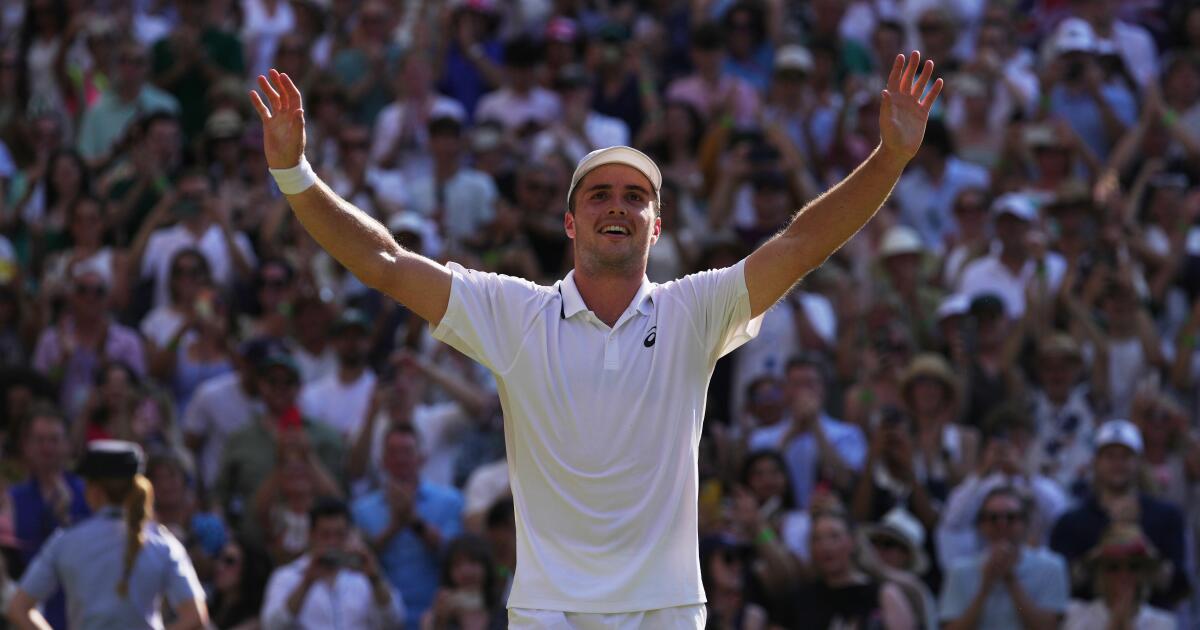
LONDON — A local boy sleeps in his own bed, plays in front of a king and queen and makes a Cinderella run to the Wimbledon semifinals. Sounds like a Hollywood script that might never see the silver screen.
But it’s no fairy tale — it’s Arthur Fery’s out-of-nowhere performance over the last 10 days.
Fery, a virtually unknown British wild card with a triple-digit ranking, has become the emotional heartbeat of Wimbledon while legitimately diverting some national attention from England’s World Cup quest.
The royal treatment at his matches across the All England Club has come in more ways than one.
Fery, who grew up five minutes from Wimbledon and is staying at home during the tournament, first played before grass-court king Roger Federer, Wimbledon’s eight-time singles champion, during Monday’s fourth-round victory. Two days later, he beat No. 9 seed and French Open runner-up Flavio Cobolli of Italy in the quarterfinals 6-4, 7-6 (4), 6-0 in front of Queen Camilla.
Ranked 114th, Fery had never reached the semifinals of an ATP Tour event, let alone a major, before his brief chat with the queen following the match.
“She just said, ‘Congratulations, keep going,’” 23-year-old Fery told reporters later. “I told her it was my birthday on Sunday, so it would be great to play the Wimbledon final on my birthday.”
That’s still a match away. To get there, Fery will have to get past one of the hottest players on tour: No. 2 seed Alexander Zverev, who is fresh off his first Grand Slam title at the French Open. Looming on the other side of the draw is a highly anticipated showdown between defending champion Jannik Sinner against 24-time major winner Novak Djokovic.
If Fery can continue his magical run to the end, he would become the first British wild card to win a Wimbledon title.
Arthur Fery reacts after defeating Flavio Cobolli in the Wimbledon quarterfinals on Wednesday.
(Maja Smiejkowska / Associated Press)
Born in France, Fery’s family moved to Wimbledon when he was an infant. His mother played professional tennis. He was a top British junior but chose to sharpen his game for three years in the U.S. collegiate system at Stanford, as many of his compatriots have done.
“I came out with a lot of hunger coming out of that, and I was ready to attack the pro circuit,” Fery said.
After struggling with bone bruising in his arm that limited him to playing mostly on the lower-tier Challenger circuit in recent years, Fery is finally healthy and playing consistently.
His path to the last four in London has been a masterclass in clutch come-from-behind performances. The Brit has stared down near-certain elimination in multiple matches, repeatedly breaking his opponents’ momentum with Houdini-like on-court acts.
At 5-foot-9, Fery possesses a skill set perfectly suited for low-bounding grass.
His compact strokes, low center of gravity, and elite movement allow him to hug the baseline, take time away from opponents, and confidently execute delicate volleys at the net, according to ESPN analyst Chris Eubanks.
“He defends well,” said Eubanks, a 2023 Wimbledon quarterfinalist. “He can scrap. He can claw. He can dig his way back into points. And when he ventures forward, he’s very, very comfortable at the net. This is a picture-perfect example of someone whose game is built for the surface.”
Still, it’s hard to fathom the multitude of milestones for Fery, who briefly reached the No. 1 ranking in college and earned 2023 Pac-12 Singles Player of the Year honors before leaving early to pursue a pro career.
He arrived at Wimbledon with just one main-draw victory at a major, a losing record as a professional, and only one previous ATP quarterfinal, at Queen’s Club last month. He’s now 11-8, won his first two five-set matches, and is the first British wild card to reach the Wimbledon men’s semifinals in the Open Era. The only other men’s wild-card semifinalist was Goran Ivanisevic, who won the title as a wild card in 2001.
Fery, who started the season ranked No. 185 and will climb to at least No. 36 after the tournament, said there were a “lot of first times” as he reflected on his unprecedented run. “First five-setter, longest match that I’ve ever played, first time breaking into the top 100, first second week in a slam, all at home, five minutes from where I grew up. It’s a great story for me,” he said.
The gap with his fellow semifinalists is understandably massive.

Entering Wimbledon, Djokovic, Sinner and Zverev’s combined records include 29 Grand Slam titles, 2,088 match wins and 155 tour-level titles. Fery was 6-8 in tour-level matches with zero titles.
But he has singlehandedly lifted the tournament for locals. With top hopes Jack Draper and Emma Raducanu withdrawing before the tournament and the rest of Britain’s singles prospects falling one by one — 18 men and women were eliminated by the third round — Fery became the nation’s last knight standing.
If his first name inevitably evokes Arthurian legend, Fery’s march through the draw gave Britain reason to believe again. No sword, no Round Table, just world-class shot-making, a lion’s heart and a Centre Court crowd thrilled to rally behind him.
“This is really quite something to see on home soil,” said Russell Fuller, the BBC’s tennis correspondent, who compared it with Raducanu’s stunning U.S. Open win in 2021 as a qualifier.
Fery earned every bit of it.
In the first round against Damir Dzumhur, Fery dropped the opening set and trailed by a break in the second before surging back. Against Zizou Bergs in the third round, he faced a 4-1 deficit with a double break in the fourth set, and again fell behind 4-1 in the fifth, before somehow surviving.
Then, stepping onto Centre Court for the first time against former top-10 stalwart Grigor Dimitrov of Bulgaria in the fourth round, Fery clawed out of a 2-sets-to-1 hole and a break down in the fourth set to clinch the victory in a fifth-set tiebreak.
“He carries himself with humility, but he’s a fierce competitor, and he’s got a ton of belief in himself,” said Stanford men’s coach and former top-60 player Paul Goldstein, who flew to England Tuesday to see his former charge compete against Cobolli.
While Fery attempts to outmaneuver Zverev on Friday, the other semifinal features a 2025 Wimbledon semifinal rematch between seven-time Wimbledon winner Djokovic and top-ranked Sinner, who defeated the Serb in straight sets on his way to the title. It’s also their second Grand Slam semifinal meeting in 2026. At January’s Australian Open on hard courts, Djokovic bested 24-year-old Sinner in five sets before falling to now-injured Carlos Alcaraz in the Melbourne final.

Arthur Fery hits a return during his Wimbledon quarterfinal win over Flavio Cobolli on Wednesday.
(Clive Brunskill / Getty Images)
Djokovic, 39, enters the match after surviving a grueling five-set, 5-hour-plus quarterfinal slugfest against No. 3 Félix Auger-Aliassime that concluded just minutes before Wimbledon’s 11 p.m. curfew. But the seventh-seeded Serb has a way of defying Father Time and he has had two days to recover on a surface where points are shorter and generally less taxing on the body.
Italy’s Sinner, who defeated Alcaraz in last year’s Wimbledon final, has been efficient if not at the level that saw him capture five consecutive titles before crashing out in the second round at the French Open. After a first-round scare here, the four-time Grand Slam champion has dominated opponents behind his improving serve, winning 80% of his first-serve points. He hasn’t dropped a set since the opening round. Sinner leads the head-to-head with Djokovic 6-5.
According to Eubanks, Djokovic must disrupt Sinner’s movement to break his rhythm, and take his chances.
“He’s got to play similar to how he played in Australia, where it was just all-out aggression,” Eubanks said.
For Sinner, he added: “His serve can be a neutralizing force for what Novak is going to try to do.”
On the other side of the ledger, Fery’s poise under pressure and deft use of the home crowd will be paramount to continue his surprise run against Germany’s Zverev, whom he called a “step up again” from his last five matches. Zverev, 29, is seeking his fifth major final and first at Wimbledon.
“I’m ready for it,” Fery said. “I have nothing to lose. I’m just going to go out there and … put my game on the court, do what I’ve done, believe in myself. We’ll see where that takes me.”
Home has never been closer to Centre Court. Nor has Arthur Fery ever been closer to tennis history.
Sports
Pirates star pitcher makes unfortunate history after being taken out in middle of perfect game bid

NEWYou can now listen to Fox News articles!
Jared Jones was flirting with Major League Baseball history on Wednesday night — he got it, but it was not what he originally envisioned.
The Pittsburgh Pirates pitcher retired the first 18 batters he faced, but he was taken out in the middle of his perfect game bid after six innings.
Now, the Pirates certainly have their reasons — the 24-year-old Jones hasn’t thrown more than 81 pitches in eight starts since returning May 20 after missing all of last season while undergoing ulnar collateral ligament internal brace surgery on May 21, 2025. He was yanked with 77 pitches and likely would have needed more than 100 pitches to record the 25th perfect game in MLB history.
Jared Jones of the Pittsburgh Pirates pitches during the first inning against the Atlanta Braves at PNC Park on July 8, 2026, in Pittsburgh, Pennsylvania. (Photo by Joe Sargent/Getty Images)
However, Jones left the game after getting zero run support, so when the Atlanta Braves tacked on three runs late for a 3-0 victory, Jones instead found himself in the wrong chapter of the history books.
According to Opta Stats, Jones became the first pitcher in the modern era (since 1920) to pitch at least six perfect innings and not record a win.
“It does suck. Something’s cool coming on, but I’m on what? My eighth start off of surgery? I completely understand it, and it is what it is,” Jones told reporters after the game.
Pittsburgh Pirates starting pitcher Jared Jones (17) makes his way to the field to warm up before pitching against the Atlanta Braves at PNC Park. (Charles LeClaire/Imagn Images)
JUSTIN VERLANDER ANNOUNCES HE WILL RETIRE AFTER THIS SEASON: ‘I’VE REALIZED THAT TIME HAS COME’
Jones said he didn’t entertain attempting to complete the perfect game.
“Not with the pitch count,” he said. “Not really ever expecting to go nine right now, so that was never in my head.”
Joey Bart, traded to the Braves from the Pirates on June 18, followed a double by Mike Yastrzemski with a 422-foot, two-run homer to left-center field off a slider from Dennis Santana. Drake Baldwin added an RBI single to center in the ninth for good measure.
It was the second time in less than a week that a pitcher was taken out of the game with a perfect bid through six innings — the Miami Marlins took Eury Perez out after seven innings in which he had 92 pitches. Perez, too, is in the midst of returning from injury and has surprisingly found himself right in the postseason mix.
He was pulled for Lake Bachar to start the eighth, and the Marlins allowed eight runs to the Athletics in the final two innings, but held on to win 9-8.
Jared Jones (17) of the Pittsburgh Pirates delivers a pitch during a MLB game against the Cincinnati Reds on June 27, 2026, at PNC Park in Pittsburgh, Pennsylvania. (Joe Robbins/Icon Sportswire via Getty Images)
CLICK HERE TO DOWNLOAD THE FOX NEWS APP
The Pirates are 4.0 games out of the final wild card spot, which is held by the Marlins.
The Associated Press contributed to this report.
Follow Fox News Digital’s sports coverage on X, and subscribe to the Fox News Sports Huddle newsletter.
-

 Texas7 minutes ago
Longhorns Daily News: Texas coach Steve Sarkisian named among Dodd Trophy watch list
-

 Utah10 minutes ago
Utah Jazz vs Washington Wizards recap: Darryn Peterson is only a man
-
Vermont15 minutes ago
VT Lottery Gimme 5, Pick 3 results for July 9, 2026
-

 Virginia22 minutes ago
Virginia cannabis budget language triggers legal confusion, political fallout
-

 Washington25 minutes ago
Trump’s proposed 250ft Washington arch clears key planning hurdle
-

 Wisconsin30 minutes ago
A Wisconsin family is suing Target after their 10-month-old died from swallowing a water bead
-

 West Virginia37 minutes ago
How midsummer wild berries connect people, wildlife, and West Virginia’s forests – West Virginia Explorer
-

 Wyoming40 minutes ago
Fourth Annual Wyoming Firearms & Outdoor Recreation Expo, Wyoming Governor’s Match returning to Casper July 18, 19

