Sports
Plaschke: How one man lost Shohei Ohtani's 40-40 home run ball and found L.A. love in return

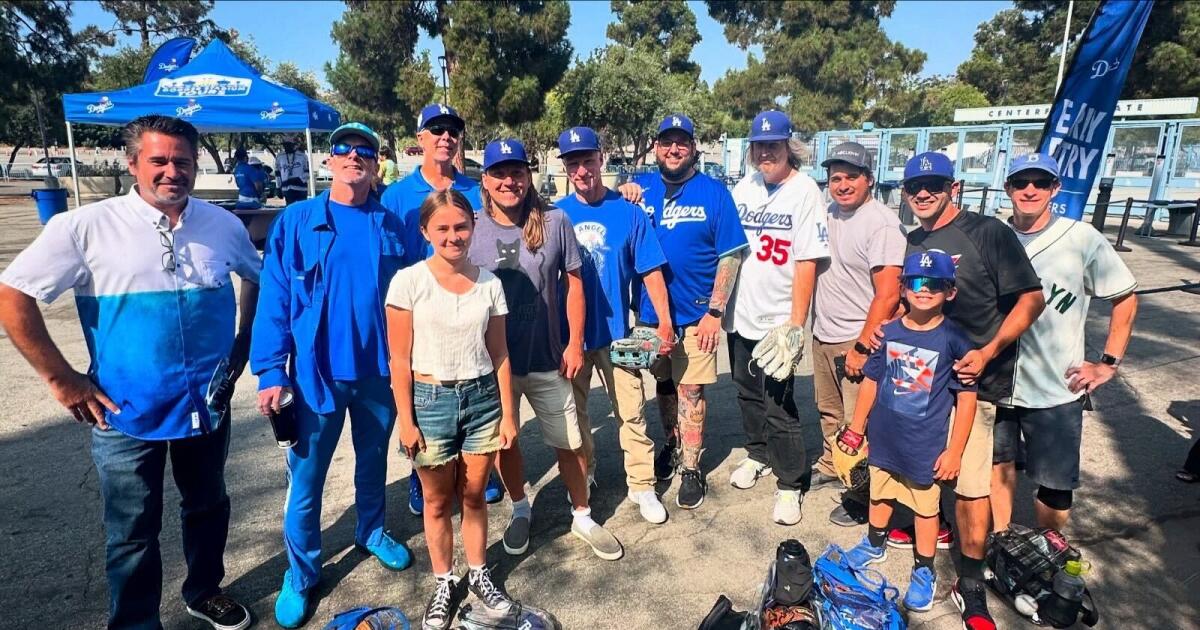
His life was changing. A winning lottery ticket was approaching. Tony Voda was ready.
He was going to be rich. He was going to be famous. Magic was happening, and as the baseball fell from the night sky, Tony Voda was ready to live a miracle.
Shohei Ohtani was in the process of entering baseball’s 40-40 club with a walk-off grand slam in the ninth inning last week at Chavez Ravine, one of the most dramatic blasts in the long history of Dodger Stadium, and this anonymous insurance analyst from Minneapolis was right in the middle of it.
“Right up until the last second against the beautiful black night sky, I can see the ball, it’s seared into my mind, this is happening, this is really happening,” Voda recalls. “The crowd is screaming but you’re not hearing it, your senses shut down, tunnel vision happens, and all you can think of is, don’t mess this up.”
Then the unthinkable occurred, an event that forever changed Tony Voda on his way to becoming a hero.
He messed it up.
Shohei Ohtani hits a walk-off grand slam for the Dodgers against the Rays to join the 40-40 club.
A gazillion video replays have chillingly shown it a gazillion times.
He messed it up.
“A life-changing event was in my hands,” he said, “and I literally dropped the ball.”
This, then, would seem to be not your usual home-run catching story of good luck and great fortune, but a tale of deep remorse and enduring regret.
Except for one twist as pronounced as Ohtani’s swing.
On a Friday night when Tony Voda figured he was cursed, he was actually blessed.
For the man who will forever be known for one of the biggest fan errors in Dodger Stadium history, it wasn’t about what he lost, it was about what he gained.
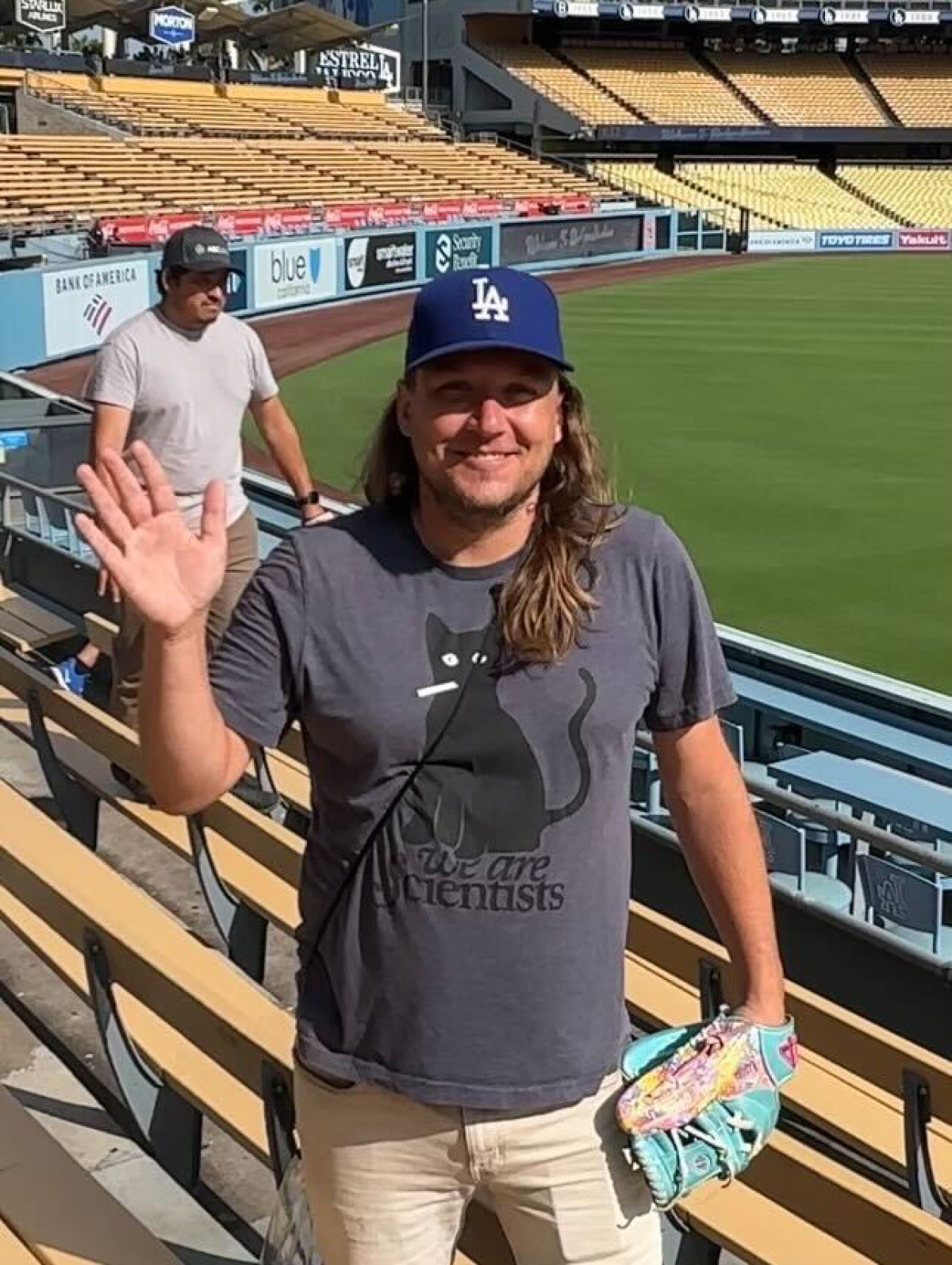
Tony Voda waves before a game between the Dodgers and Tampa Bay Rays at Dodger Stadium on Aug. 23.
(Courtesy of Tony Voda)
It looks so easy and natural on television. But in real life, catching a home-run ball is about as easy as catching a raindrop in a thunderstorm.
“The average fan has no idea,” says Matt Walker, one of a dozen members of “Dodgerhawks,” a group of season-ticket holders that gathers at Dodger Stadium in an attempt to catch homers.
It’s nearly impossible.
“Did you see it clearly off the bat because you’ve been following every pitch? Are you on your phone? Is it hooking? Drawing? Is the wind a factor?” Walker explained. “The crowd is elbow to elbow and you’re getting pushed and shoved usually. Is it going to clear the wall, are you at risk of interference, is the outfielder bearing down?”
Walker said the conditions for such a catch are frightful.
“Are you standing in spilled beer, water bottles, and loose peanut shells? Are the lights a factor? The sun?” he said. “Oh yeah, and it’s coming in at 100-plus miles-per-hour. And the whole thing takes maybe three seconds.”
Tony Voda, 40, knows these truths. He has been chasing home run balls in stadiums all over the country for 15 years and he’s caught exactly two.
“Home run balls are important to me because of that deep childhood tie to the game,” he said. “You see them going into the stands as a young kid and you not only want to be the guy who hit it, but the kid who has the souvenir.
“It’s one of the only pieces of sports that rarely makes it into the stands but is coveted by many because of how elusive it is.”
It’s so elusive, Voda paid several hundred dollars a couple of months ago for one of the Dodgers’ celebrated home-run seats lining the outfield walls. He picked a random game against the Tampa Rays as part of a longer baseball trip through California.
He had no idea Ohtani would be on the verge of becoming only the sixth player in baseball history to reach 40 home runs and 40 steals in a single season. He could never have dreamed that Ohtani would steal his 40th base in the fourth inning and then come to the plate with bases loaded into the ninth with a chance to make history.
“I would have been happy if any Dodger scrub hit it to me,” he said. “And then this happened.”
This, meaning Ohtani lofting a ball high toward the right-center field wall.
This, meaning that ball barely clearing the fence and falling directly toward Voda’s rainbow-colored glove.
This, meaning the ball bouncing off Voda’s glove and back to the field, where it is finally picked up by outfielder Jose Siri and thrown back into the stands far beyond Voda’s reach.
Grand slam. Grand boot.
“Every fan’s worst nightmare,” said Walker.
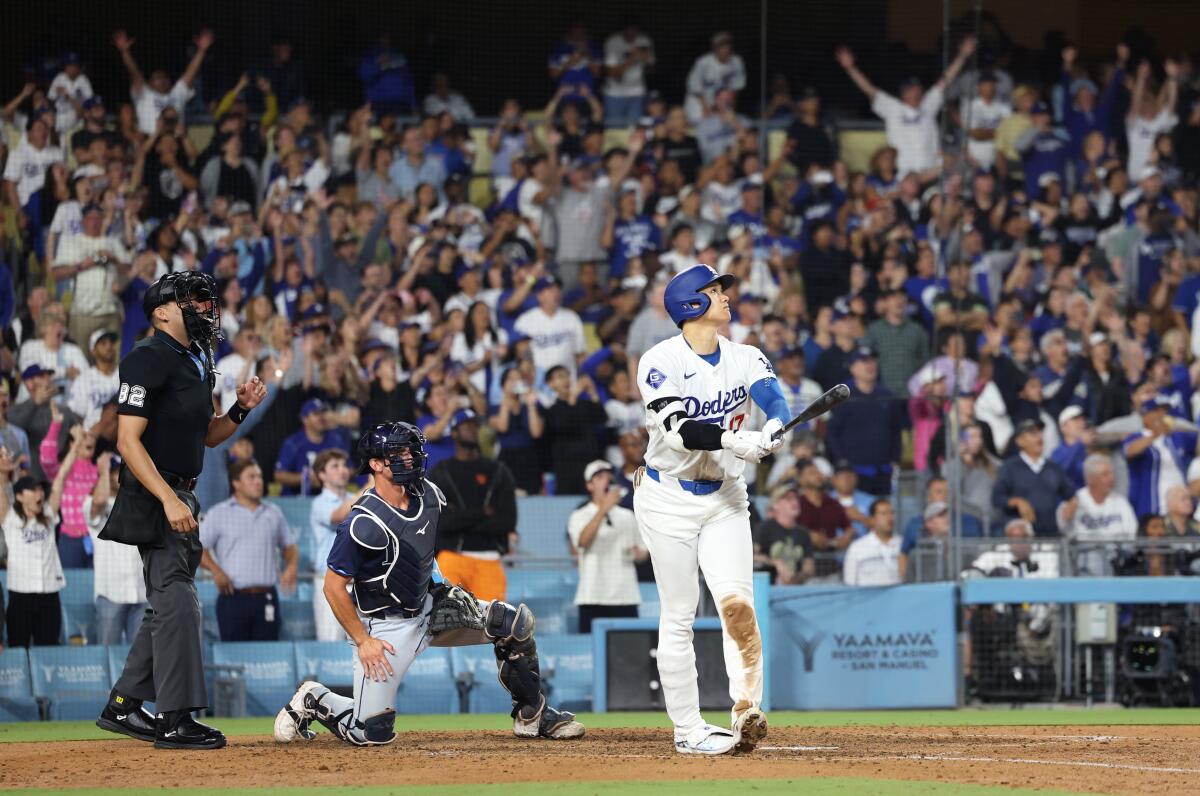
Dodgers star Shohei Ohtani hits a walk-off grand slam against the Tampa Bay Rays for his 40th home run of the season on Aug. 23.
(Wally Skalij / Los Angeles Times)
Gone was a chance to meet Ohtani and return the ball, which Voda said he would have done. Gone was a six-figure payday if Ohtani didn’t want to exchange anything for the ball. Gone was the greatest moment of Voda’s baseball life.
He knew all this, and he knew it immediately. Watch the replay and notice that the moment the ball bounces off Voda’s glove, he puts his hands on his head with an expression of deep pain.
“Pure shock, disbelief,” Voda said. “My heart sank.”
As he stood there stewing in his agony, fully expecting jeers and catcalls from the surrounding pavilion crowd, the strangest thing happened.
His phone buzzed. It was Walker, who had met Voda before the game with other Dodgerhawks. He had already watched the replay and wanted to console Voda immediately.
“What just happened? What did I do?” Voda moaned into the phone.
“You did your best,” Walker told him. “You did all you could.”
Sure enough, the replay shows a fan on Voda’s left bumping the pinky of his glove just a few inches before the ball landed, enough to prevent the ball from burrowing deep into the glove’s pocket.
“I guess it’s the ‘Minnesota Nice’ in me, I should have boxed the guy out, but I just didn’t want to interfere with another fan,” said Voda.
Also noticeable was Voda’s refusal to move to the edge of the fence, from where he might have had a cleaner shot at the ball.
“I didn’t want to get called for fan interference and see the home run taken away, are you kidding me?” said Voda. “I was being very careful.”
Too careful? Maybe. But maybe not.
The good sportsmanship with which Voda handled himself was noticed not only by Walker, but by several fans who surrounded Voda while he was accepting that initial phone call.
“You could hear people all around Tony while I was talking to him, and everybody was already consoling him,” said Walker. “It was as if, when he put his hands over his head, we all put our hands over our heads.”
The outpouring of support continued throughout the ensuing drone show, fans from all sections surrounding him and patting his back and sharing his regret, with one fan even accompanying Voda to his car afterward to commiserate on his bad luck. Then there were the words of encouragement from one stranger he’ll never forget.
“A guy came up to me and just said, ‘Next time, poppa,’” Voda recalled. “Like he was actually giving me a pep talk.”
Dodger Stadium can be a cantankerous place, particularly when a ball is hit into the stands. If a fan catches an opposing player’s home run, the verbal pressure to throw the ball back can be deafening.
But on this night, Dodger Stadium was a sympathetic, understanding place that filled Tony Voda with a warmth that no catch could match.
By the time he returned to his hotel he had received several dozen texts and many online words of support. There was no trolling. There were no insults. There was only a sense of kinship among Dodger fans who, it turns out, not only are historically forgiving of the players, but are also forgiving of each other.
“To catch the ball would have been potentially life-changing, but, so, too, were the lessons I took away from missing it,” said Voda. “I know it sounds cheesy and silly, but while I may have lost a ball, I gained more love from Dodger fans than I knew I had, more love than I thought I deserved.”
Voda is back in Minneapolis now, but he is hoping to return to Dodger Stadium again one day, hang out with the Dodgerhawks, buy another home run seat, stick out that rainbow glove on a long fly ball, pray again for a miracle while knowing full well that he has already lived one.
“I love L.A.,” he said.
Moments before Ohtani’s swing, a security guard standing next to Voda wondered out loud if this game was headed for a movie script ending.
In all ways, it was, as Ohtani wasn’t the only one who went deep.
So, too, did humanity.


NEWYou can now listen to Fox News articles!
Folarin Balogun’s teammates came to his defense after the USA World Cup star was given a red card during the team’s 2-0 win over Bosnia and Herzegovina on Wednesday night.
Balogun received the red card after he stepped on defender Tarik Muharemovic’s right ankle. Brazilian referee Raphael Claus only gave Balogun the card after a VAR review. The red card meant Balogun will not be able to play in the team’s Round of 16 match against Belgium.
ZERO BS. JUST DAKICH. TAKE THE DON’T @ ME PODCAST ON THE ROAD. DOWNLOAD NOW!
United States’ Folarin Balogun, right, stands by after being issued a red card by Referee Raphael Claus, of Brazil, as United States’ Weston McKennie (8) looks on during the World Cup round of 32 soccer match between the United States and Bosnia in Santa Clara, Calif., near San Francisco, Wednesday, July 1, 2026. (AP Photo/Martin Meissner)
A FIFA official told The Athletic a team cannot appeal against the red card or the suspension. The official pointed the outlet to a portion of the organization’s rules and regulations, which states, “A sending-off automatically incurs suspension from the subsequent match. The FIFA judicial bodies may impose additional match suspensions and other disciplinary measures.”
Balogun’s teammate, Weston McKennie, called the lack of an appeal process “bogus” and disagreed with the referee’s decision to issue the red card.
Bosnia’s Sead Kolasinac (5) talks to United States’ Folarin Balogun after Balogun was sent off, as Christian Pulisic (10) watches during the World Cup round of 32 match between the United States and Bosnia in Santa Clara, Calif., Wednesday, July 1, 2026. (Julio Cortez / AP)
“Obviously the ref made a decision that he made, but I think it’s questionable,” McKennie said. “I think there’s been many other plays like that throughout the tournament on other players that a card wasn’t given at all. It’s disappointing.”
U.S. coach Mauricio Pochettino said Balogun’s act “was never intentional.”
“It’s never a red card. Never. … If the intention is to damage the opponent, OK, I understand. But that never was. It was a normal action in football that you are fighting for the ball and your feet land,” he said.
Balogun is the third player to score in a World Cup knockout match and be sent off. He follows Brazil’s Ronaldinho in 2002’s quarterfinal match against England and France’s Zinedine Zidane in the 2006 World Cup final against Italy.
Referee Raphael Claus of Brazil shows a red card to United States’ Folarin Balogun, right, during the World Cup round of 32 soccer match between the United States and Bosnia in Santa Clara, Calif., near San Francisco, Wednesday, July 1, 2026. (AP Photo/Julio Cortez)
It’s the fifth red card handed to an American in the squad’s World Cup history.
CLICK HERE TO DOWNLOAD THE FOX NEWS APP
Eric Wynalda received one against Czechoslovakia in 1990, Fernando Clavijo got one against Brazil in 1994 and Pablo Mastroeni and Eddie Pope each received one against Italy in 2006.
The Associated Press contributed to this report.

While veterans jockey for new contracts during free agency, young players are getting their tryout opportunities with NBA summer league games beginning this week.
First-round draft pick Cameron Carr and second-year forward Adou Thiero highlight the Lakers summer league roster that was announced Wednesday. The 16-man team will be coached by Lakers assistant coach Ty Abbott and begin summer league play Friday against the Golden State Warriors at Chase Center.
The Lakers also face the Miami Heat (July 5, 1:30 p.m.) and San Antonio Spurs (July 6, 4:30 p.m.) in the California Classic before playing in the Las Vegas summer league from July 9-19. The Lakers play Oklahoma City (July 10), Dallas (July 11), the Clippers (July 14) and Chicago (July 16) in Las Vegas’ Thomas & Mack Center.
The Lakers traded up in the draft to get Carr, a 6-foot-5 guard out of Baylor, with the 24th overall pick. He will make his unofficial NBA debut, along with former Indiana State and Saint Louis star Robbie Avila. The 6-10 center became a bespectacled college basketball cult hero known affectionately as “Cream Abdul Jabbar” while leading Indiana State to the NIT championship game in 2024. He transferred to Saint Louis, where he was named Atlantic-10 player of the year as a senior when the Billikens won a school-record 29 wins.
Although he is entering his second season with the Lakers, Thiero will be playing his first summer league games. Persistent knee injuries hampered his rookie season. The athletic 6-7 forward averaged 1.9 points and 1.1 rebounds in 25 appearances last season. He said after the Lakers were eliminated from the playoffs that he wanted to improve on his three-point shooting during his second year. He attempted only five three-pointers during his rookie season, regular season and playoffs, making one.
Lakers summer league roster
Robbie Avila, C, 6-10, 240
Cameron Carr, G, 6-5, 190
Jon Elmore, G, 6-3, 190
Luke Goode, F, 6-7, 210
William Hickey, G, 6-4, 203
Arthur Kaluma, F, 6-7, 225
William Kyle III, C, 6-9, 230
Chris Mañon, G, 6-4, 212
Robert McCray V, G, 6-4, 188
AK Okereke, F, 6-7, 245
Chase Ross, G, 6-5, 210
Zhaire Smith, G, 6-4, 205
Peter Suder, G, 6-5, 215
Adou Thiero, F, 6-7, 234
Anton Watson, F, 6-8, 225
Jacari White, G, 6-3, 180

NEWYou can now listen to Fox News articles!
U.S. men’s national team star Folarin Balogun received a red card in the second half of their Round of 32 World Cup matchup against Bosnia and Herzegovina on Wednesday night.
Balogun was making a challenge on a ball when he stepped on an opposing player’s leg.
The U.S. men’s national team is down to 10 players for the rest of the match. If the U.S. holds their 1-0 lead, Balogun will have to miss the Round of 16 game.
Balogun scored for the U.S. in the first half.
This is a breaking news story. Check back for updates.
-
 News11 minutes ago
Ukraine latest / Limits of military might / Can major powers regain dominance? : Sources & Methods
-

 Los Angeles, Ca2 hours ago
Juvenile charged with murder after 4-month-old Claremont infant thrown to her death
-

 Detroit, MI2 hours ago
Silence from Jalen Duren’s camp is what the Pistons want to hear
-

 San Francisco, CA2 hours ago
Jury deadlocked on 2 counts for Golden Gate Bridge pro-Palestinian protesters
-

 Dallas, TX2 hours ago
Ross Tower hits the market as Downtown Dallas sale wave builds
-

 Miami, FL2 hours ago
FIFA World Cup Miami Host Committee lends a helping hand to people of Venezuela after deadly earthquakes
-

 Boston, MA2 hours ago
Review & setlist: It was 100 degrees in Boston, and Goose was on fire
-

 Denver, CO2 hours ago
Where to Celebrate the 4th of July in Denver This Weekend – 303 Magazine

