Sports
Novak Djokovic’s results against Jannik Sinner and Carlos Alcaraz – a small part of a big problem


Almost two decades after the last time it happened, Novak Djokovic finds himself occupying a space in men’s tennis with which he is all too familiar. He is, by a distance, the third-best player in the world.
In the summer of 2007, soon after he turned 20, Djokovic made the semifinals of the French Open and Wimbledon, before reaching the final at the U.S. Open. He was No. 3 in the world for all of that July, dropped to No. 4 for a week in the August, and then stayed at No. 3 until… May. Of 2009.
In his way were Rafael Nadal, who beat him in those French Open and Wimbledon semis, and Roger Federer, who saw him off in straight sets in New York. With the exception of his 2008 Australian Open title, losses to Nadal and Federer defined Djokovic’s career from that summer until 2011. Both defeated him a couple more times each in the closing stages of majors between 2008 and 2010, with Djokovic posting two wins of his own against them at those events.
Now, as the 2024 season draws to a close, Djokovic has Jannik Sinner and Carlos Alcaraz in front of him.
On Sunday, Sinner beat Djokovic in straight sets in the final of the Shanghai Masters — a tournament Djokovic has won four times, more than any other player, and where he has a 39-6 record. Sinner has now beaten him twice this year, three times in a row, and in four of their past five ATP meetings; in that time, Djokovic has also lost consecutive Wimbledon finals to Alcaraz. It makes Sinner only the sixth player to win three ATP-level matches in a row against Djokovic, according to Opta:
| Player | Season |
|---|---|
|
Roger Federer |
2006-07, 2010 |
|
Rafael Nadal |
2007-09, 2012-13 |
|
Jo-Wilfried Tsonga |
2008 |
|
Andy Murray |
2008-09 |
|
Andy Roddick |
2009 |
|
Jannik Sinner |
2024 |
Djokovic did beat Alcaraz 7-6(3), 7-6(2) to win Olympic gold in August, but in his five matches against the top two this year, he has won just three sets. Two of those were in that Olympic final, the other came in his otherwise straightforward four-set loss to Sinner at the Australian Open.
Sinner and Alcaraz have also shared this year’s four Grand Slams between them, leaving him without a major in a calendar year for only the second time since 2010.
Djokovic reiterated on Sunday that Grand Slam titles are what motivate him to keep going at age 37, having won everything there is to win in the game. “Right now, it’s really about Slams and about still seeing how far I can push the bar for myself,” he said in a news conference.
The Serbian needs one more major to move clear of Margaret Court’s record of 24 — nine of which she won before tennis turned professional — which he equalled by winning the U.S. Open last year. For the rest of 2024, and into 2025, he will have to balance maintaining his level and fitness for those four majors with the knowledge that, without ranking points accrued in other events, his meetings with Sinner and Alcaraz at those majors will happen in earlier and earlier rounds.
Djokovic and Alcaraz have played two definitive Wimbledon finals in two years (Charlotte Wilson / Offside via Getty Images)
Djokovic’s semifinal loss to Sinner was his first defeat at the Australian Open — where he is a 10-time champion — in six years. For only the second time in his Grand Slam career, Djokovic failed to earn a break point and his 17.2 percent of points won on first-serve return was his third-worst tally of 2024.
In Shanghai on Sunday, perhaps the finest returner in the history of the sport had similar struggles, this time winning just 34.6 per cent of second-serve return points — again his third-worst showing of 2024. And while most opponents yield to Djokovic’s greater solidity in the crucial moments, Sinner did not. It was Djokovic, not Sinner, who coughed up a decisive error in the crucial first-set tiebreak.
Against Alcaraz at Wimbledon, an admittedly not-fully-fit Djokovic again returned poorly. He won 16.1 percent of first-serve return points, his second-lowest total of the year, and said after the match that he had never seen the young Spaniard serve so well.
Djokovic also had a dreadful day serving. He won 40 percent of points behind his second serve, his second-lowest figure of 2024 and way down on his average for the year of 55.9 percent. The 6-2, 6-2, 7-6 (4) scoreline that day arguably flattered the beaten finalist, with Alcaraz obliterating Djokovic’s serve at 4-4 in the third set after largely coasting through the four previous service games played. To beat Alcaraz in the Olympic final, Djokovic played his best match of the year in the tournament that mattered most to him, raising his level in the two tiebreaks, especially the second. Alcaraz, who converted zero of eight break points in the match, dipped in both tiebreaks and on those break points.

GO DEEPER
Tennis usually passes the torch. Carlos Alcaraz is running away with it
A problem for Djokovic is that Sinner and Alcaraz are performing at such a level that there is little he can do in the way of preparing for them with match practice that doesn’t involve playing meaningful matches against them. His relatively sparse schedule has allowed him to maintain his fitness while reliably easing into majors through the first week, getting himself match-ready by winning in the early rounds. He did it at this year’s French Open, falling only to the medial meniscus tear from which he recovered to reach the Wimbledon final. He did it at the U.S. Open, too, before meeting an inspired Alexei Popyrin and failing to lift his level to meet that challenge.
Djokovic has played 12 tournaments this year, compared to 14 for Sinner and 16 for Alcaraz (counting last month’s Davis Cup qualifiers as one event rather than two separate ties). Djokovic will probably end the year with 14 events, the same as in 2023 and two more than a year earlier when he missed the Australian swing because of his Covid-19 vaccination status. Djokovic played 13 events the year before that.
This very consistent approach has generally led to consistently brilliant results, but it’s his world ranking and his points accrued from consistently winning titles that have allowed him to do this without risking facing the best players before the final stages of events.

Sinner’s defeat of Djokovic in Melbourne proved a seminal moment in 2024 (Daniel Pockett / Getty Images)
That may be about to change.
Djokovic has accrued 3,910 ranking points so far in 2024, winning just one event and zero ATP titles — his lowest tally since 2005. That puts him at No. 6 in the ‘Race to Turin,’ the Italian city where the season-ending Tour Finals are held. He is currently No. 4 in the ATP world rankings, behind Alexander Zverev, who is ahead of Djokovic in points but not on-court quality. Djokovic is defending 1,000 of those points at the Paris Masters, which starts October 28, where he is the reigning champion. He is not expected to play any further events in 2024.
His results have also declined. He has won 80 percent of his matches in 2024 (37-9), down from 89 percent (56-7) last year. It is his lowest win percentage for a calendar year since 2010, in which he won 77 percent of matches — the final season before Djokovic donned his superhero cape and went stratospheric. His 2011, in which he won a staggering 92 percent (70-6) of matches, was one of the best years for an individual in men’s tennis history.
It feels unlikely that, at 37, Djokovic will want to tweak his volume of tournaments to try to be more match-tight for the majors, but without ranking points, his ranking will drop. If his ranking drops, his seeding for Grand Slams and Masters 1000 tournaments will drop. If his seedings for Grand Slams and Masters 1000 tournaments drop, he will be meeting Alcaraz or Sinner earlier and earlier in the events he most wants to win.
Even a seeding of five to eight at the Australian Open would currently mean a possible quarterfinal against one or the other, and he’d only have to drop one place from his current ranking of fourth to be facing that scenario.
Djokovic was phlegmatic about this latest defeat to Sinner at the weekend, saying: “As long as I perform the way I performed this week, and I think I can go toe-to-toe with the big guys. As long as that’s the case, I guess I’ll still feel the need to keep on competing, and motivation to be out there, and let’s see how long that’s going to last for.”
While the chance to reel in Sinner and Alcaraz — who were aged five and four respectively when Djokovic first became the world No. 3 — should be plenty of motivation, if losses to them become chronic, that would quickly become dispiriting. Much has been made over the past week of the retirement of Rafael Nadal and what that means for Djokovic as the last one of the sport’s Big Three standing, with Federer having hung up his racket in 2022.
After hearing the Nadal news, Djokovic said in an on-court interview in Shanghai, “I still enjoy competing, but part of me left with them, a big part of me.”

Djokovic will defend 1,000 ranking points when the Paris Masters begins in late October (Zhang Lintao / Getty Images)
It’s actually the third member of the group whose experience might be more pertinent.
Between Wimbledon in 2012 and the Australian Open in 2017, Federer didn’t win a Grand Slam title. For much of that period, he found himself in a similar position to where Djokovic is now — the world’s third-best player but with a pair of rivals a level above. One of those rivals was Djokovic, who beat Federer in three Grand Slam finals between Wimbledon in 2014 and the U.S. Open the following year. Nadal, meanwhile, beat him in the 2014 Australian Open semifinal. Andy Murray and Stan Wawrinka were other complicating factors during these years.
Federer, who was in Shanghai for Sunday’s final, could offer Djokovic some advice on hanging in when younger rivals emerge — especially as he had to deal with the Big One becoming the Big Two and then the Big Three in the mid-to-late 2000s.
There have been no indications that Djokovic is yet thinking about the end.
“I don’t know what the future brings, I’ll just try to go with the flow to see how I feel in a given moment,” he said on Sunday. “I still plan to compete and play next season and, yeah, let’s see how far I go.”
Djokovic dismantled one duopoly to kickstart his career.
As he approaches his final act, he will have to repeat the trick to prolong it.
(Top photo: Clive Brunskill / Getty Images)



Sports
Golf star records lowest round in LPGA major history with astounding performance at Evian Championship

NEWYou can now listen to Fox News articles!
There are good days on the golf course, and then there is what Haeran Ryu just did on Saturday.
Ryu, 25, recorded the lowest round in LPGA major history on Saturday with an 11-under 60 at the Evian Championship. With the South Korean golfer’s historic round, she holds a three-stroke lead.
Ryu’s round comes just two weeks after winning her first major at the Women’s PGA Championship. On the 18th hole, Ryu left a 30-foot eagle putt a few inches short, and instead settled for a birdie.
CLICK HERE FOR MORE SPORTS COVERAGE ON FOXNEWS.COM
Haeran Ryu of South Korea reacts on the 18th green after the third round of The Amundi Evian Championship at Evian Resort Golf Club in Evian-les-Bains, France, on July 11, 2026. (Stuart Franklin/Getty Images)
She said after the round that she had no idea what she had done until she counted up her scorecard.
“But after the putt and I counted my score with my caddie,” she said. “Oh my God, it’s 11-under par today. It was so amazing. My caddie says, ‘Yep.’ I’m so happy right now.”
If Ryu had made the eagle putt on the 18th hole, she would have been just the second player to shoot a 59 in LPGA history.
ZERO BS. JUST DAKICH. TAKE THE DON’T @ ME PODCAST ON THE ROAD. DOWNLOAD NOW!
Haeran Ryu of South Korea celebrates a birdie on the 15th green during the third round of The Amundi Evian Championship at Evian Resort Golf Club on July 11, 2026, in Evian-les-Bains, France. (Stuart Franklin/Getty Images)
Her 60 broke the record for the lowest round in an LPGA major by one shot. Leona Maguire and Jeungeun Lee6 in 2021, and Hyo Joo Kim in 2014, each shot 61 at the Evian Championship, which was designated as an LPGA major in 2013.
The lowest round in a men’s major is 62, which is shared by four players — Branden Grace at Royal Birkdale in the 2017 British Open, Xander Schauffele and Rickie Fowler in the 2023 U.S. Open at Los Angeles Country Club, and Schauffele and Shane Lowry in the 2024 PGA Championship at Valhalla.
CLICK HERE TO DOWNLOAD THE FOX NEWS APP
Haeran Ryu of South Korea and Lottie Woad of England interact after their round on the 18th green during the third round of the Amundi Evian Championship at Evian Resort Golf Club in Evian-les-Bains, France, on July 11, 2026. (Stuart Franklin/Getty Images)
Ryu hopes her historic third round can help propel her to a second major win in three weeks.
“That is amazing, amazing dream,” Ryu said. “So I just want that one to come true, but we have one more day.”
The Associated Press contributed to this report.
Follow Fox News Digital’s sports coverage on X, and subscribe to the Fox News Sports Huddle newsletter.
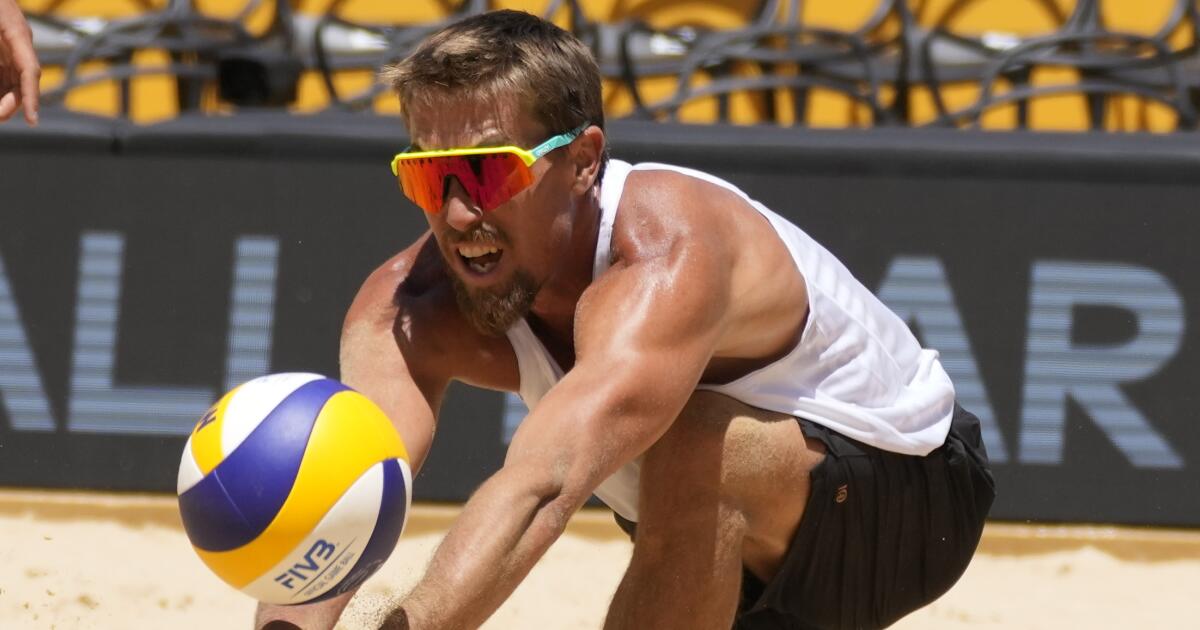
Taylor Crabb is no stranger to South California beaches. The Long Beach State alum returns home this weekend to compete in AVP League matches.
It marks the first time AVP will compete in Long Beach since 2020 and allows players to compete at the 2028 Olympics beach volleyball venue.
Crabb, 34, made his AVP debut in 2013 with his brother, Trevor, and advanced from the qualifier in Manhattan Beach before finishing 25th in his first tournament.
After years of competing with various different partners, Taylor Crabb and Andy Benesh have delivered the top performances this AVP season.
The following interview with Crabb has been edited for clarity and length.
Are you excited to compete in this weekend’s event at Long Beach?
Crabb: Very excited. A lot of my college teammates and part of the school have reached out, saying that they’re gonna come. So I’m excited to get a chance to play in front of them again.
When was the last time you were in Long Beach?
Crabb: I always try to go down there for alumni events or any big games they have. I went to UCLA against Long Beach last year, when it was No. 1 versus No. 2, so I always try to get down there and support them.
You missed out on the chance to compete in the 2020 Olympics because of COVID-19 restrictions and chose not to pursue a spot at the 2024 Olympics. Are you fired up to try to compete in the 2028 Olympics, knowing that Long Beach will host the competition?
Crabb: Yeah, it’s definitely an exciting time having the Olympics in Long Beach, and we kind of get to break it in this weekend. As you said, Tokyo didn’t go the way I wanted, but I’m going full force now. I have a great partner in Andy Benesh, who obviously went to the Paris Olympics, and if it weren’t for the Olympics being in Long Beach, and me getting a partner like Andy, I’m not even sure I’d be going for it, but because of those two things, I want to make the most of it.
You mentioned that if it wasn’t for a partner like Andy, you wouldn’t be going for it. What do you mean by that?
Crabb: I didn’t feel motivated by playing in all the international events, but now, I think, sitting out kind of lit the fire under me, and I’m really motivated now.
You’ve had different partners throughout your time. What other motivation does Andy give you?
Crabb: He’s been, in my mind, the top blocker for the U.S. the last four or five years. Seeing the professionalism he brings every day to practice, on and off the court, while traveling and when showing up to tournaments, it rubs off on you and that’s really motivating to see. And I just want to make him proud.
Why do you love volleyball?
Crabb: A lot of reasons, but it’s just a feeling I have when I’m out there on the court. It feels natural. It feels like home. I was born into a volleyball family. I had a volleyball in my hands my entire life, so I’ve always just enjoyed it.

NEWYou can now listen to Fox News articles!
CM Punk appeared on “Friday Night SmackDown” ready to take on any challenger that was ready to step to him after winning the Undisputed WWE Championship against Sami Zayn.
Punk entered the ring in Oklahoma City and called back to the “Monday Night Raw” after WrestleMania 42 when he told Cody Rhodes he’d be ready to deliver if a championship opportunity fell “out of the sky.”
COMPLETE PRO WRESTLING COVERAGE ON FOX NEWS DIGITAL
Cody Rhodes and CM Punk face off during SmackDown at Paycom Center in Oklahoma City, Okla. (Craig Ambrosio/WWE via Getty Images)
“When championship opportunities fall out of the sky, CM Punk catches them,” he said.
Punk named potential SmackDown superstars he’d think might come for the title, including Gunther, Finn Balor, Royce Keys, Damian Priest and Trick Williams. He even said that Zayn could come back around and get his rematch if he wanted. He didn’t mention Rhodes’ name, but the “American Nightmare” came out uncalled and marched his way down to the ring.
“I don’t think you and I can run away from each other anymore,” Punk told Rhodes.
Cody Rhodes looks on during SmackDown at Paycom Center in Oklahoma City, Okla., on July 10, 2026. (Craig Ambrosio/WWE via Getty Images)
Rhodes agreed and mentioned that Punk would want a match with him, just “say when.” It was a quick retort from Punk, who said, “when.” SmackDown general manager Nick Aldis, who was in the ring for the segment, booked the match for SummerSlam.
Punk will defend the Undisputed WWE Championship at SummerSlam, which takes place Aug. 1 and 2 at U.S. Bank Stadium in Minneapolis.
First, however, Punk and Rhodes will be involved in a tag team match at Saturday Night’s Main Event in New York City next week. Aldis made the match after Gunther demanded that Aldis put him in a match against Punk. Gunther was hoping it would be for the championship. Instead, Gunther will tag with Zayn.
Gunther didn’t take too kindly to that and attacked Aldis. Rhodes came back out to break up the calamity. He wanted to take on Gunther after the show went off air but Gunther walked away.
Gunther makes his entrance during SmackDown at Paycom Center in Oklahoma City, Okla., on July 10, 2026. (Rich Wade/WWE via Getty Images)
CLICK HERE TO DOWNLOAD THE FOX NEWS APP
Punk definitely has his hands full as he moves to SmackDown to become a fighting champion.
-

 Austin, TX5 minutes ago
Man shot and killed by police after pointing gun at people in Austin, Texas
-

 Alabama12 minutes ago
Alabama has Talent returns with local connection
-

 Alaska15 minutes ago
Alaska Sports Scoreboard: July 11, 2026
-

 Arizona20 minutes ago
Cardinals Mailbag: Latest on Jacoby Brissett, Carson Beck, and Arizona’s QB Future
-

 Arkansas27 minutes ago
Arkansas tips its hat to blues pioneer Larry “Totsie” Davis in England dedication
-

 California30 minutes ago
‘Explosive diarrhea’ parasite surfaces in California as health officials fear statewide surge
-

 Colorado35 minutes ago
This Quiet Colorado Town Is An Underrated Gem For Nature Lovers
-

 Connecticut42 minutes ago
Car catches fire in Trumbull

