Sports
NFL teams know the best way to draft, so why aren't they doing it?


The 2014 NFL Draft wouldn’t happen for months, but according to Steve Gera, at least one Cleveland Browns executive had his mind made up on one of its most polarizing prospects.
A special assistant to head coach Rob Chudzinski, Gera had been in the NFL for more than five years. The San Diego Chargers had hired the former Marine to “do analytics” in 2007. Gera’s qualifications included a recently obtained MBA from San Diego State and the fact that he’d read “Moneyball.” He scouted opponents and supplied data to coaches through easy-to-read narratives.
“I would just crack jokes and make fun of our offensive coaches but also include information,” Gera said recently. “Data is inherently boring and soulless. What you hear typically sounds like the first day on f—— Mars. I wanted to break it down shotgun style.”
The approach kept him around. Gera studied fourth-down attempts, timeout usage and draft strategies. Relationships made in that role helped him transition into becoming a coach.
That’s what led him to Cleveland, where, on a plane at the beginning of the 2013 season, he says he heard a Browns executive say, “The only person I’ve seen who competes harder than Johnny Manziel is Michael Jordan.”
“What makes you say that?” Gera asked.
“Tape,” the executive said. “Watch it long enough, and you’ll see it, too.”
GO DEEPER
NFL Draft 2024 ‘The Beast’ Guide: Dane Brugler’s scouting reports and player rankings
Gera left the NFL a decade ago and has since worked in the NBA and European soccer, founded data science companies and taught. Experience in different sectors helped crystallize some of Gera’s beliefs about football, and the Manziel moment epitomizes what Gera believes is one of the most faulty decision-making processes in the NFL: draft strategy.
Compare a prospect to a legend from the outset, and you — or, say, Browns owner Jimmy Haslam, who drafted Manziel No. 22 overall and then watched as the quarterback’s career imploded suddenly and spectacularly — are likely to cling to that early comparison despite evidence to the contrary.
“The draft is an absolute petri dish for every cognitive bias underneath the sun,” Gera said.
Conversations with 14 general managers, coaches, analytics staffers, scouts and executives in other sports — some of whom were granted anonymity because they were not authorized by their current organizations to speak about the highly competitive process — unearthed a messy concoction of uncertainty, overconfidence, competing incentives, pressure and impatience.
“Human dynamics writ large,” said Hall of Fame NFL executive Bill Polian.
Even Nobel Prize-winning scholars have spent decades mulling whether there is a single best way to draft.
The answer, they’ve found, is a resounding yes. But only a few teams are curious enough to think differently, and even fewer are disciplined enough to act differently.
In 2011, Kevin Meers applied for an analytics internship with the Dallas Cowboys. During his interview, Cowboys brass decided that Meers, who majored in economics and statistics at Harvard, was a worthwhile enough candidate to solicit feedback on a 63-page academic paper they found fascinating.
The paper, “Overconfidence vs. Market Efficiency in the National Football League,” had been published six years earlier by the National Bureau of Economic Research. Meers hadn’t read it, hadn’t even heard of it, but it was draft-related and he’d long been draft-interested.
Meers wasn’t your typical draftnik. Spouting opinions on prospects did not captivate him. The allure lay in the idea that you could trade picks. Should you? Why or why not? And how do you assign value to each pick?
Cowboys executives were exploring similar questions internally, and that’s how they found the paper Meers was now dissecting on their behalf.
First, he wondered, who wrote this?
Richard Thaler, an economics professor at the University of Chicago who would win a Nobel Prize in 2017, and Cade Massey, a business professor then at Duke University.
Their hypothesis?
Teams overestimate their abilities to delineate between stars and flops, and because of that they overvalue the “right to choose” in the draft.
And what were the findings after examining every draft pick and trade from 1988 to 2004?
Teams massively overestimate their abilities to delineate between stars and flops, and because of that they heavily overvalue the “right to choose” in the draft.
Meers combed through the paper and uncovered some highlights:
- The treasured No. 1 pick in the draft is actually the least valuable in the first round, according to the surplus value a team can create with each pick.
- Across all rounds, the probability that a player starts more games than the next player chosen at his position is just 53 percent.
- Teams generated a 174 percent return on trades by forgoing a pick this year for picks next year.
Thaler and Massey suggested that teams should accumulate picks by trading back and into the future more often. The more darts you have, the better your chance of eventually hitting the bull’s-eye.
The Cowboys’ interest led them to invite Thaler and Massey into their building for presentations. Jerry Jones dined with them.
Meers, whom the Cowboys ultimately hired, expected a team that understood Thaler and Massey’s research would serve as the perfect place to learn. But he would learn what so many others in professional sports have over the years: analysis is only as good as a decision-maker’s willingness to put it into action.
Thaler and Massey, specifically, understand this better than most. They’ve met with countless teams. Most, if not all, seem receptive to their findings only to toss them aside and operate the way they always have.
“I think the industry is relatively aware of Dick and Cade’s research on the draft,” one longtime NFL executive said. “But I don’t think there have been a lot of people willing to say: ‘I’m going to fully invest in doing this differently than it’s always been done.’”
The night before the 2002 NFL Draft, Indianapolis Colts owner Jim Irsay walked into the team’s draft room with a friend who, according to Polian, considered himself a bit of a draft expert.
The team’s GM since 1998, Polian had been sitting at a long, rectangular table in the front of the room with first-year coach Tony Dungy. Irsay’s friend spotted them and squinted at the 12-by-15-foot board categorizing every player by grade. The wall on the right side of the room had been prepped to show every pick throughout the draft. On the wall on the left, there were two columns headlined DNDC (do not draft, character) and DNDM (do not draft, medical).
“Look at those guys,” the friend blurted out, pointing at the board. “You mean to tell me you’re not going to draft any of those guys?”
“No,” Dungy hollered over. “We’re not interested.”
“Why?” Irsay’s friend replied. “They’re all good players.”
“Well,” Dungy said, “they don’t fit us.”
“People outside the draft rooms only know about 55 percent of what goes into making up the grade,” Polian said recently. “They do not know the personality, the security issues, the medical issues. And they shouldn’t.”
But if teams have all of this inside information, why do they still miss so often?
More than a decade ago, one NFL team commissioned a study into whether certain GMs were better than others at the draft. Though some posted better track records than others, specifically Baltimore’s Ozzie Newsome, the answer was mostly not.
This is not to say all of the league’s top personnel people are poor evaluators. In fact, there is a line of thinking that the smaller the variation in skill among competitors, the more ripe the situation is for randomness to sway the results.
Many executives and scouts, believers in their own methods of evaluation, would disagree vehemently.
The idea of trading down, in particular, consistently repulsed Polian. “I firmly do not believe you trade a high pick, which is going to be a difference-maker, in order to pick up two picks,” he said.
But that’s the issue, one former NFL executive pointed out. That logic assumes the player you’re initially picking will actually become a difference-maker.
“The problem for everyone in sports is that nobody wants to admit how random and arbitrary it is,” the former executive said. “Admitting that it’s arbitrary takes away from your specific abilities.”
Even true believers in trading down don’t hold to the dogma 100 percent of the time. Meers, who became the Browns’ director of research and strategy in 2016, said that exceptions are worth making at the quarterback position and if your team needs a star.
If you have a franchise quarterback, one longtime NFL executive said, you might want to act aggressively to show a commitment to winning.
“I don’t think Dick and Cade were suggesting that any of this is an absolute,” the executive added. “But it’s just, once you run into the realities of it, it’s there. There is absolutely a bias against or fear of admitting uncertainty and trading back time and time again.
“Which is why it’s valuable.”

Fans might not be thrilled with the idea of their team trading down in the draft. (David Eulitt / Getty Images)
Another consideration that prevents teams from accumulating more picks is the number of competing incentives among decision-makers. Teams preach collaboration, alignment and shared vision, but their end goals may conflict directly with different segments of the organization.
A general manager might be more focused on his job security over the long-term direction of the organization. A head coach may believe unreasonably in his own ability to mold a player. Coordinators and position coaches want to add talent to their groups, while scouts may quite literally pound the table for the players they unearthed during the pre-draft process.
“Everybody is spitting falsehoods about how good they think a player is because they want one more bullet in the chamber for themselves,” one longtime executive from another professional league said. “That’s reasonable and rational, that they would behave in their own self-interest, but you have to find a way to discount it as a GM.
“Is the coach in this situation 20 percent crazy? Is the offensive coordinator 40 percent crazy? Is the linebackers coach 60 percent crazy? Because they might be. They’re thinking in a way humans would think.”
The former NFL executive suggested the inherent irrationality drove him “a little crazy.”
“When you grow up, you think these teams are so good, and they’re all trying to pedal in the same direction and win,” he added. “And when you’re there, you realize that very few are really doing that. Everyone is just looking out for themselves.”
Public pressure may prevent some teams from enacting the newer approach. Make seven picks, and you’ll be judged seven times. Make three trades and 10 picks, and you’ll be judged 13 times. Watch other teams nail picks you traded — or miss on picks you traded for — and negative narratives can quickly form.
Ownership plays a pivotal role. In many cases, franchise owners are men and women who built business empires by making sound decisions over long periods of time. And yet, they struggle to duplicate this approach with their sports team.
Offer Jones $100 this year or $274 next year and his answer will unquestionably be the latter. But offer him a third-rounder this year or a second-rounder next year and he’s likely to think it over a little longer.
Jones met with Thaler and Massey and fully understood their research results. Then, during his team’s draft preparations, he listened to Cowboys executives and scouts. By draft night, Dallas was not trading down but up for players the team had barely considered.
Luke Bornn, who from 2017-20 was the vice president of strategy and analytics for the Sacramento Kings and who has since managed multiple European soccer teams alongside former Oakland A’s executive Billy Beane — of “Moneyball” fame — has thought a lot about the role of ownership.
“You have an environment in sports where there are very high-dollar decisions being made, and it’s simultaneously a very emotional playground in which to make those decisions,” Bornn said. “Those two things combined lead to bizarre behavior … which is sticky. Things happen where you might look back and say, ‘Why in the world do they do that?’”
In 2013, Thaler and Massey published another paper, “The loser’s curse: Decision making and market efficiency in the National Football League draft,” finding that some teams had adapted their processes, but “slowly and insufficiently.”
In 2017, Mike Band, a master’s student at the University of Chicago, wrote that the “trade market is becoming more efficient.” In 2021, Tucker Boynton and Ella Papanek, two Harvard students, referenced the New England Patriots and Baltimore Ravens as teams that traded frequently and maintained consistent returns in the draft.
Coincidentally, around that time, Ravens GM Eric DeCosta said the following on a podcast: “There was a really seminal article written in 2005. It was really about the draft and how teams should trade back and always acquire picks — and never trade up.”
Ravens GM Eric DeCosta talking to former Falcons GM Thomas Dimitroff on FA, comp picks and draft philosophy.
We get a great mention of what DeCosta learned from the seminal “Loser’s Curse” paper from @bcmassey & @R_Thaler pic.twitter.com/Kzl1W0fitr
— Kevin Cole (@KevinCole___) April 14, 2022
DeCosta doubled down in 2021 when a reporter mentioned the Ravens as one of the top drafting teams in the NFL. “We’ve probably had the most picks over that span,” he said. “That goes back to a philosophy that I think Ozzie started back in 1996.”
Other teams have tried to garner more picks with varying success.
The Minnesota Vikings’ analytics staff recommended that GM Rick Spielman amass more picks, so he tried, completing 37 draft-pick trades from 2011 to 2020. Results were mixed, and fans constantly dinged Spielman for moving down.
“I’ve been told that if I could trade my mother for a seventh-round pick, I would do that,” Spielman said. “I always thought that the more opportunities you had, the better odds you had.”
Colts GM Chris Ballard once ended a news conference by saying, “I love ‘dem picks,” teasing reporters about the possibility that they’d sit through the entire first round for no reason. Later on, he explained the thought process behind his comment: “I think we’re pretty good at what we do, but there needs to be a little luck involved, and the more picks you have, the more chances of luck are going to show up.”
Other teams eschew this type of thinking. Jones and New Orleans Saints GM Mickey Loomis both tend to trade future picks, while Miami Dolphins GM Chris Grier and Jacksonville Jaguars GM Trent Baalke tend to trade up.
Thinking back to his time with the Browns, especially during the draft process, Gera is not surprised to hear that teams are still operating so inefficiently nearly 20 years after Thaler and Massey published their paper. During his season with Cleveland, Gera was not even sure who was making the final selection on each pick.
“The thing here that I would tell you is the way the sausage is made is not always pretty or very organized,” Gera said. “And I think it would blow away most fans.”
(Illustration: Sean Reilly / The Athletic; photos: Tom Pennington, Marlin Levison, Harold Hoch / Getty Images)



NEWYou can now listen to Fox News articles!
Los Angeles Rams star Puka Nacua has been sued for alleged assault and battery by a woman who alleges he bit her on the shoulder on New Year’s Eve and made an antisemitic remark.
The lawsuit was filed this week in Los Angeles, according to TMZ. The suit also cites gender violence and negligence.
Plaintiff Madison Atiabi and her attorney, Joseph Kar, claim Nacua made an antisemitic exclamation that emotionally distressed her when they were together in Century City.
She says Nacua bit her and left teeth marks on her shoulder when they were in a van together later in the night, and she claims Nacua also bit her friend’s thumb.
Puka Nacua of the Los Angeles Rams celebrates after a touchdown during the fourth quarter against the Indianapolis Colts at SoFi Stadium on Sept. 28, 2025 in Inglewood, California. (Sean M. Haffey/Getty Images)
Nacua’s attorney, Levi McCathern, has already strongly denied Nacua made any antisemitic statements. He described the bites as “horseplay.”
McCathern, said “the whole claim is nothing more than a shakedown attempt” and that the bite “left nothing more than a temporary mark,” according to TMZ.
Nacua previously apologized for performing an “antisemitic” act on a YouTube stream in December. Nacua discussed touchdown celebrations on YouTuber Adin Ross’ stream.
RAMS STAR PUKA NACUA ACCUSED OF BITING WOMAN, MAKING ANTISEMITIC REMARKS: REPORT
NFL Network reporter Jamie Erdahl interviews Los Angeles Rams wide receiver Puka Nacua after a game against the Arizona Cardinals at SoFi Stadium Dec. 28, 2024, in Inglewood, Calif. (Kirby Lee/Imagn Images)
Many, however, believed the celebration perpetuated a harmful anti-Jewish stereotype.
In the video, Ross instructed Nacua to spike the ball, flex and then rub his hands together. Ross, who is Jewish, has referred to the movement as his own “dance” or “emote.”
Nacua received pushback and issued an apology.
CLICK HERE TO DOWNLOAD THE FOX NEWS APP
Puka Nacua of the Los Angeles Rams runs downfield during the second half against the San Francisco 49ers at SoFi Stadium Oct. 2, 2025, in Inglewood, Calif. (Brooke Sutton/Getty Images)
“When I appeared the other day on a social media livestream, it was suggested to me to perform a specific movement as part of my next touchdown celebration. At the time, I had no idea this act was antisemitic in nature and perpetuated harmful stereotypes against Jewish people,” Nacua said in a “Stand Up to Jewish Hate” graphic.
“I deeply apologize to anyone who was offended by my actions as I do not stand for any form of racism, bigotry or hate of another group of people.”
The Associated Press contributed to this report.
Follow Fox News Digital’s sports coverage on X, and subscribe to the Fox News Sports Huddle newsletter.
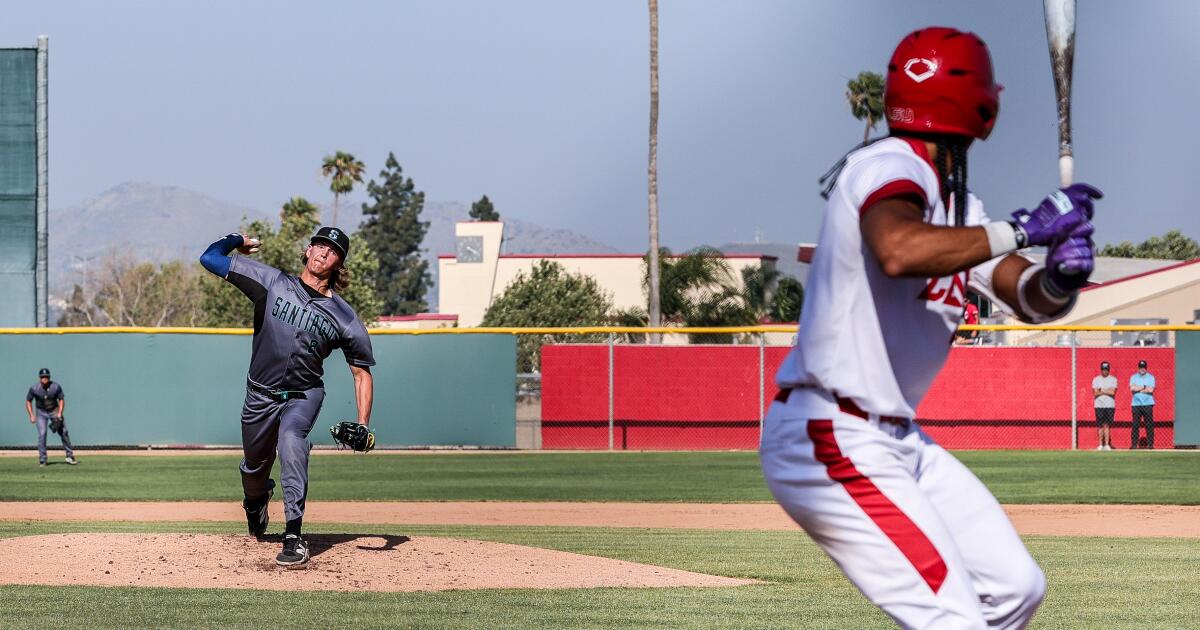
Two future high major-league draft picks, Anthony Murphy of Corona and Striker Pence of Corona Santiago, showed off their talents Wednesday. Corona rallied for a 9-7 victory.
Pence, who touched 99 mph, struck out Murphy for one of his six strikeouts in 3 2/3 innings. He left the game with a 3-2 lead. Then Murphy hit a home run off Pence’s replacement, Thomas Padilla, to tie the score. Murphy was on the mound in the seventh to strike out Pence and get the save. Pence finished with two RBI singles.
“Those are two amazing baseball players and what a treat for them to get after it,” Corona coach Andy Wise said.
Striker Pence of Corona Santiago gets excited against Corona.
(Craig Weston)
The two attended middle school together. Murphy, a senior center fielder, is shaping up as a potential first-round pick. Pence, a sophomore, might reclassify to be eligible for the 2027 draft.
Errors played a big part in the game. Corona committed three errors, making it 20 errors in its last three games. An error by Santiago opened the door for a six-run sixth by the Panthers. Danny De La Torre had the big hit, a two-run double. He had two doubles on the day.
Corona’s defense is expected to get a lot better come Friday when infielders Joseph Flores and Kobee Finnikin become eligible after the sit-out transfer period ends.
Southern California teams got their first chance to show how good Southern California baseball is during Wednesday’s opening games of the National High School Invitational in Cary, N.C. Three came away with dominant wins. Aquinas was the only local school to come up short, losing to Tennessee Baylor 9-6.
Orange Lutheran received 16 strikeouts from Gary Morse, tying a tournament record, in a 3-0 win over Colorado Regis.
Unbeaten St. John Bosco (8-0) got two hits and two RBIs from Jack Champlin in a 14-1 win over Tennessee Nolensville.
Harvard-Westlake took care of North Carolina Wakefield 16-0 in five innings. Justin Kirchner struck out 10 and Ethan Price had three hits.
In the quarterfinals on Thursday, Harvard-Westlake will play Florida Venice, Orange Lutheran will face Florida Trinity Christian Academy and St. John Bosco will take on Arizona Casteel.
Servite 11, Santa Margarita 2: Eli Rubel had a triple, double and three RBIs for the Friars.
Tesoro 2, Aliso Niguel 1: Corwin Allard threw a complete game with six strikeouts and one walk for Tesoro.
Newport Harbor 8, Edison 2: Keaton Anderson struck out four in six innings. Grant Horsley had two hits.
Huntington Beach 8, Edison 4: Dane Cunningham, Ely Mason and Jaxon Greer hit home runs for Huntington Beach. Cunningham had three hits.
Villa Park 13, Foothill 0: Aiden Young went four for four with five RBIs and Logan Hoppie threw the shutout.
Sherman Oaks Notre Dame 11, Crespi 1: AJ LaSota struck out five, walked none and gave up two hits in five scoreless innings. Troy Trejo and Benett Pace each had two hits and two RBIs. Freshman Anthony Daniel had three hits.
Bishop Alemany 5, St. Francis 1: Matthew Serrano gave up two hits in six innings and Alex Noble contributed three hits for the Warriors.
Sierra Canyon 11, Chaminade 2: Brayden Goldstein went three for three with three RBIs.
Hart 3, Ventura 2: Jaiden Chan had the walk-off hit for Hart. Malachi Wobrock threw a complete game.
West Ranch 11, Canyon 1: Blake Johnson hit a three-run home run for West Ranch. Josh Price had two hits and four RBIs.
Saugus 11, Valencia 2: Joey Nuttall finished with three hits for Saugus. Logan Feldman added four RBIs.
Simi Valley 11, Camarillo 1: Ryan Whitson and Kai Stones each had three RBIs for Simi Valley.
Rancho Christian 3, Valley View 2: Jake Brande struck out 10 in a complete game.
South Torrance 5, El Segundo 3: Leadoff hitter Owen Rhodes finished with three hits for South Torrance.
Monroe 2, Vaughn 0: The Vikings improved to 12-0 behind pitcher Miguel Gonzalez.
Ayala 9, Glendora 1: Caleb Trugman struck out 11 for Ayala.

NEWYou can now listen to Fox News articles!
The New Orleans Saints have reportedly made an addition to their quarterback room.
The team signed Zach Wilson to a one-year contract, according to multiple reports.
Wilson, 26, spent last season with the Miami Dolphins and will serve as the backup quarterback to Tyler Shough.
Miami Dolphins quarterback Zach Wilson looks to throw a pass against the New England Patriots during the fourth quarter at Gillette Stadium in Foxborough, Massachusetts, on Jan. 4, 2026. (Brian Fluharty/Imagn Images)
The Saints will be Wilson’s fourth team in four seasons. He spent the first three years of his career with the New York Jets after being selected with the No. 2 overall pick of the 2021 NFL Draft.
After three disappointing seasons with the Jets, they traded him to the Denver Broncos in April 2024. The Broncos declined Wilson’s fifth-year option, and after the season he signed with the Dolphins.
Wilson has seen little game action over the last two seasons, not playing at all with the Broncos in 2024. With the Dolphins last season, he appeared in four games, completing 6 of 11 passes for 32 yards.
COWBOYS STAR DAK PRESCOTT’S EX POSTS ABOUT ‘GROWTH’ DAYS AFTER COUPLE SPLIT BEFORE WEDDING
Miami Dolphins quarterbacks Zach Wilson and Tua Tagovailoa talk on the field before the game against the Pittsburgh Steelers at Acrisure Stadium in Pittsburgh, Pennsylvania, on Dec. 15, 2025. (Charles LeClaire/Imagn Images)
With the Jets, Wilson started 33 games, going 12-21 while completing 57% of his passes for 6,293 yards with 23 touchdowns and 25 interceptions.
Wilson will join Shough and 2024 fourth-round pick Spencer Rattler in the quarterback room.
Shough impressed in his nine starts last season. The Saints went 5-4 in his starts while Shough completed 67.6% of his passes for 2,384 yards with 10 touchdowns with six interceptions, while rushing for 186 yards and three touchdowns.
CLICK HERE TO DOWNLOAD THE FOX NEWS APP
Miami Dolphins quarterback Zach Wilson looks to throw a pass against the New England Patriots during the fourth quarter at Gillette Stadium in Foxborough, Massachusetts, on Jan. 4, 2026. (Brian Fluharty/Imagn Images)
However, Shough battled numerous injuries throughout his college career. He sustained a broken left collarbone in 2021, re-injured that same collarbone in 2022, and broke his fibula in 2023.
The Saints hope he remains healthy as they look to win the NFC South next season and return to the playoffs for the first time since 2020.
Follow Fox News Digital’s sports coverage on X, and subscribe to the Fox News Sports Huddle newsletter.

DHS shutdown live updates as Senate holds test vote on funding bill

Fangirl Culture is Front and Center as Detroit Mercy Theatre Company Presents a Zany Y2K Comedy

Authors gathering in San Francisco to raise awareness and money for the National Kidney Foundation

3 takeaways as the Mavericks lose a fun one, 142-135, at the Denver Nuggets

Jannik Sinner’s Girlfriend Laila Hasanovic Stuns in Ab-Revealing Post Amid Miami Open

Florida High School Football Rankings: Top 25 teams – Oct. 21

How old is Bo Nix? What to know about Oregon quarterback ahead of 2024 NFL Draft

Cleary's 21 help Le Moyne down Central Connecticut State 69-64 in OT

99th annual Pony Swim held in Virginia

Indiana Members Credit Union announced as new anchor tenant at Bottleworks District
DHS shutdown live updates as Senate holds test vote on funding bill

Video: Jury Rules Against Meta and YouTube for Addictive Features

New Jersey Gov Sherrill signs law barring ICE agents from wearing face coverings to shield identities

Escalation in the Middle East – Not Europe’s war? MEPs in the Ring

War with Iran disrupts fertilizer exports as U.S. farmers prepare for planting season
-

 Detroit, MI1 week ago
Drummer Brian Pastoria, longtime Detroit music advocate, dies at 68
-

 Science1 week ago
How a Melting Glacier in Antarctica Could Affect Tens of Millions Around the Globe
-

 Culture1 week ago
Test Your Memory of Great Lines From Classic Irish Poems
-

 Movie Reviews1 week ago
‘Youth’ Twitter review: Ken Karunaas impresses audiences; Suraj Venjaramoodu adds charm; music wins praise | – The Times of India
-

 Sports5 days ago
IOC addresses execution of 19-year-old Iranian wrestler Saleh Mohammadi
-
 Science1 week ago
I had to man up and get a mammogram
-

 New Mexico4 days ago
Clovis shooting leaves one dead, four injured
-

 Texas6 days ago
How to buy Houston vs. Texas A&M 2026 March Madness tickets