Sports
Like it or not, the A’s have a new home, and it's a win for this scrappy city


WEST SACRAMENTO, Calif. — The arrival of a major league team to this decidedly minor league city last week was not, as they say in baseball, error free.
Players for the A’s, formerly of Oakland and eventually to be of Las Vegas, were unfamiliar with the layout of their temporary home, Sutter Health Park. There was “a lot of chaos,” manager Mark Kotsay told the Sacramento Bee, as the team tried to figure out how to navigate the much smaller footprint of a triple-A ballpark.
The Wi-Fi went down. The radio broadcast cut out numerous times. The beer line was epic. The game was paused after someone snuck a drone over the field in the seventh inning. Many die-hard Oakland fans in attendance were still roiled by a sense of betrayal at the manner in which the team departed Oakland. And then there was the score: The A’s lost to the Cubs, 18-3.
Summing it all up, the website SFist pulled no punches with its headline: “A’s first game in Sacramento was a complete debacle, and losing 18-3 was probably the least embarrassing part.”
But for boosters of the unsung city of West Sacramento — a scrappy town of 54,000 that many people, even in the wider region, don’t realize is a city — none of that mattered.
Excitement has been running high ever since team officials announced that the A’s would alight at the 14,000-seat stadium of the minor league River Cats — the triple-A affiliate of the San Francisco Giants — for three years while the A’s future home on the Las Vegas Strip is constructed.
This has been widely described in the national press as a move to the city of Sacramento, California’s capital, which is across the river from West Sacramento and in a different county. Most of the news organizations that crowded in to cover the season opener, and the players they quoted, didn’t seem to register the existence of West Sacramento.
A’s relief pitcher T.J. McFarland’s comments were typical. “It’s a nice city, the state capital,” he told the Sacramento Bee, standing in the heart of West Sacramento’s most treasured civic landmark.
West Sacramento took it all in stride. City officials are used to living in Sacramento’s shadow, and they are confident that bringing the A’s here — even if no one seems to know the team is here — will be a boon.
After all, it’s not the first time that the magic of baseball has lifted this town’s fortunes.
“I couldn’t be happier to share the limelight with our neighbors across the river,” said state Sen. Christopher Cabaldon (D-Yolo), who served two decades as West Sacramento’s mayor before being elected to the Senate last year.
Still, Martha Guerrero, the city’s mayor, made one thing clear: “We prefer West Sacramento. That is the official location.”
West Sacramento has long been the region’s scrawny stepchild of a municipality. The city of Sacramento, population 526,000, with its luminous Capitol dome, graceful tree canopy and Gold Rush-era prominence, was incorporated in 1850. Across the Sacramento River and the county line, the other major towns in Yolo County followed not too long after. Woodland dates to 1871. Winters was incorporated in 1898. And even relative newcomer Davis became an official city in 1917. Woodland was known for its stately Victorian homes; Winters for its picturesque downtown and miles of walnut orchards, velvet green against the purple Vaca Mountains; and Davis for its bustling University of California campus.
But for most of the 20th century, what is now called West Sacramento was a collection of small communities known, in many ways, as a dumping ground for people and pets the city of Sacramento didn’t want.
Back in the day, Sacramento authorities “escorted their criminals, morphine addicts and alcoholics” to the area, according to a historian quoted in the Sacramento Bee in 1984. During Prohibition, the area was known as “Sin City” because it did not embrace the era’s no-alcohol edict. During the Depression, one longtime resident told a local newspaper, it was common practice for Sacramentans to dump dogs and cats they could no longer afford to feed on the West Sacramento side of the river.
By the early 1980s, the area was known as a hub for drugs and prostitution, particularly along a strip of rundown motels that lined West Capital Avenue.
Still, local leaders always had big dreams. In the 1940s, Congress authorized construction of a deep water channel that connected the community with Suisun Bay. In the 1960s, the Port of West Sacramento (originally the Port of Sacramento) became operational, hosting big cargo ships and giving rise to a thriving industrial base.
In the 1980s, developers saw the area’s potential as an affordable bedroom community for legislative aides and other state employees working just a short drive or bike ride away in Sacramento’s downtown, on the other side of the landmark Tower Bridge. Single-family homes started going up on what had been vast acres of cropland sprouting corn, tomatoes, melons and rice.
And in 1987, voters in the area finally voted to incorporate.
The Tower Bridge spans the Sacramento River, connecting West Sacramento with the glittering downtown of its higher-profile neighbor, the city of Sacramento.
(Christina House / Los Angeles Times)
It was shortly after this that Cabaldon moved to town.
“I accidentally ended up in West Sacramento,” he said. The year was 1993, and he was starting work as a legislative staffer. A real estate agent took him to a “great neighborhood” that was “unusually affordable” and promised that exciting shops, restaurants, parks and other amenities were coming soon. Cabaldon was sold. “I didn’t realize it was the other side of the tracks, and no one wanted to go there at night,” he said.
Cabaldon grew to love his little city. He admired its gorgeous riverfront — mostly underused land, but so much potential. Still, he noticed that many of the amenities the real estate agent had promised were nowhere on the horizon. And he gathered, too, that the city had long felt like an underdog.
Instead of moving, he ran for City Council. He lost, but ran again and won in 1996. By 1998, he was mayor. Shortly thereafter, he recalled, he was approached by developers who wanted to build a minor league ballpark in the city.
“We kind of ran with it,” he said. “It really changed the notion that we were the armpit of the region.”
The park was built, and by 2001, the River Cats had moved in (originally as a farm team for the Oakland A’s before becoming the Giants’ triple-A affiliate in 2015). The ballpark, which is a stone’s throw from the Sacramento River and about a mile from the Capitol, quickly became a draw for people across the region.
Sure, the team took the name the Sacramento River Cats, but their presence in West Sacramento helped spur a whole new wave of development: affordable condos, apartments and townhomes geared toward young workers and, finally, the long-promised restaurants and big-box stores so that all these new residents had places to eat and shop without crossing the river. Parcel by parcel, the land along the city’s waterfront was transformed into entertainment venues, parks and trails.
“We’ve done so many ribbon cuttings,” said Guerrero, the mayor.
West Sacramento was on its way, even before the A’s very bad breakup with Oakland.
The Oakland Coliseum, the A’s longtime home, was widely considered one of the most run-down stadiums in the major leagues — baseball’s last dive bar, as the Guardian newspaper put it. There were, famously, feral cats roaming the complex. Dead mice where they didn’t belong. Sewage issues. Barbed wire. And so much concrete.
“It’s a giant concrete toilet bowl,” said baseball analyst Eric Byrnes, who played six seasons for the A’s. “But it’s their toilet bowl, and it’s a special toilet bowl.”
The A’s owner, John Fisher, made no secret of his desire to get out, and when he finally did, hatching a plan to move to a $1.5-billion stadium on the Las Vegas Strip, residents of Oakland — and a host of nostalgic sportswriters — erupted with fury and heartbreak.

In a 2023 photo, fans at Oakland Coliseum protest the A’s plans to relocate.
(Jed Jacobsohn / Associated Press)
“The argument could be made that the A’s departure from their run-down home for the riches of Las Vegas is a large part of what’s wrong with American professional sports today,” the New York Times said.
“The Oakland A’s were so much to so many of us, for so long, and now they are nothing at all,” wrote Ellen Cushing in the Atlantic.
At the last game in the Coliseum, desperate fans assailed the owner with loud chants of “Sell the Team.” Then they waited in line to collect dirt from the old diamond.
It is said there are two sides to every breakup. But in this divorce, it seemed almost everyone took the side of Oakland and its fans.

The A’s season opener in West Sacramento was marked by operational glitches as the team figured out how to navigate the much smaller footprint of a triple-A ballpark.
(Scott Marshall / Associated Press)
All these months later, West Sacramento officials emphasize they played no part in stealing the team from Oakland. But they also don’t hide their pride in being the A’s rebound city — even if it’s just for three years.
They spent the off-season making upgrades to the stadium, including a new clubhouse and expanded locker room facilities. They came up with a parking plan to accommodate what are expected to be bigger crowds. They added premium seating.
The dream, Guerrero said, is that the A’s short-term relationship with West Sacramento is such a success that Major League Baseball considers the region for an expansion team. And all the dreamier if they put that team in her town — and not that stepsister city across the river.
“West Sacramento has a strong fan base,” Guerrero said. “We’re a baseball city.”



Sports
NBA player calls for Hawks to cancel their ‘Magic City’ strip club promotional night out of respect for women

NEWYou can now listen to Fox News articles!
An NBA player has taken exception to an Atlanta Hawks promotional night, which is a nod to a famed strip club in the city.
The Hawks have “Magic City Night” scheduled for March 16 against the Orlando Magic, but a player for neither team isn’t too fond of paying tribute to a strip club, which has been famed for its late-night stories involving athletes, celebrities and more.
While the Hawks call it an ode to a “cultural institution,” San Antonio Spurs center Luke Kornet shared his displeasure in a letter posted on Medium.
Luke Kornet of the San Antonio Spurs reaches for the ball during the third quarter against the Brooklyn Nets at Barclays Center on Feb. 26, 2026 in the Brooklyn borough of New York City. (Ishika Samant/Getty Images)
Kornet, a nine-year veteran and 2024 NBA champion with the Boston Celtics, called for the Hawks’ promotional night to be canceled later this month, saying that it is disrespectful to women to honor the strip club.
“In its press release, the Hawks failed to acknowledge that this place is, as the business itself boasts, “Atlanta’s premier strip club.” Given this fact, I would like to respectfully ask that the Atlanta Hawks cancel this promotional night with Magic City,” Kornet wrote in his post.
“The NBA should desire to protect and esteem women, many of whom work diligently every day to make this the best basketball league in the world. We should promote an atmosphere that is protective and respectful of the daughters, wives, sisters, mothers, and partners that we know and love.”
The Hawks boasted about the theme night in its press release, including a live performance by famous Atlanta rapper T.I., a co-branded, limited-edition hoodie and even the establishment’s “World Famous” lemon-pepper chicken wings in the arena.
A general view of signage with the State Farm Arena logo on Nov. 14, 2025, outside State Farm Arena, in Atlanta, GA. (Erica Denhoff/Icon Sportswire)
“This collaboration and theme night is very meaningful to me after all the work that we did to put together ’Magic City: An American Fantasy’,” said Hawks principal owner, filmmaker and actor, Jami Gertz, said in a press release. “The iconic Atlanta institution has made such an incredible impact on our city and its unique culture.”
Kornet wrote that allowing the night to continue “without protest would reflect poorly on us as an NBA community, “specifically in being complicit in the potential objectification and mistreatment of women in our society.”
Kornet wrote that “others throughout the league” were surprised by the Hawks’ decision to have this promotional night.
“We desire to provide an environment where fans of all ages can safely come and enjoy the game of basketball and where we can celebrate the history and culture of communities in good conscience. The celebration of a strip club is not conduct aligned with that vision,” he wrote.
Luke Kornet of the San Antonio Spurs defends against the Charlotte Hornets during their game at Spectrum Center on Jan. 31, 2026 in Charlotte, North Carolina. (Jacob Kupferman/Getty Images)
The Hawks have seen good reception for the promotional night, as Tick Pick reported a get-in price was initially $10 for the game and has since skyrocketed to $94.
Kornet is in his first season with the Spurs, his sixth NBA team, where he has played mainly in a bench role. He averages 7.1 points and 6.5 rebounds per game across 50 contests.
Follow Fox News Digital’s sports coverage on X and subscribe to the Fox News Sports Huddle newsletter.
Related Article


SCOTTSDALE, Ariz. — How do you improve on the perfect ending?
Clayton Kershaw stood in the desert heat Monday, wearing a far darker shade of blue than the Dodgers do. He does not need a medal, or a chance to fail. His election to the Hall of Fame will be a formality.
In his farewell year, the Dodgers won the World Series, becoming baseball’s first back-to-back champions in 25 years. He secured a critical out. He bathed in adoration at the championship rally, and he told the fans he would be one of them this year.
“I’m going to watch,” he hollered that day, “just like all of you.”
Four months later, he was back in uniform.
He wore a dark blue jersey with red-and-white piping. As Team USA ran through its first World Baseball Classic workout, Kershaw participated in pitchers’ fielding practice and shagged fly balls during batting practice. He could have been home with his five kids, and instead he was rushing off the mound to take a throw at first base.
That November night in Toronto, as it turned out, was not the last time we would see him in uniform.
“Feels good,” he said Monday. “I wouldn’t put on a uniform for anything else. This is a special thing.”
He put the World Baseball Classic into red, white and blue perspective.
“It’s a bucket list thing for me,” he said.
He is either self-deprecating or painfully honest about his capabilities right now, or perhaps a little of both.
The last World Baseball Classic came down to Shohei Ohtani pitching to Mike Trout. This one could come down to Kershaw pitching to Ohtani.
“I think, for our country’s sake, it’s probably better if I don’t,” Kershaw said.
Former Dodgers pitcher Clayton Kershaw fields a ground ball during a workout at Papago Park Sports Complex on Monday.
(Chris Coduto / Getty Images)
Never say never. Team USA planned to run a tremendous rotation of Tarik Skubal, Paul Skenes, Joe Ryan and Logan Webb, but now Skubal says he will pitch just once in the tournament. Skenes says he’ll pitch twice. Ryan says he won’t pitch in the first round, at least.
Kershaw might be needed beyond the role he was promised: save the team from using the current major league pitchers in blowouts or extra innings.
In 11 career at-bats against Kershaw, Ohtani has no hits. Kershaw won’t duck the assignment if gets it, but he considers it so unlikely he is happy to share his game plan publicly.
“It’s throw it, pitch away, play away, hope he flies out to left,” Kershaw said. “Don’t throw it in his barrel.
“I can’t imagine, if it comes down to USA versus Japan, with the arms that we have, that I’ll be needed. But I’ll be ready.”
Kershaw’s average fastball velocity dropped to 89 mph last season, but he led the majors in winning percentage. He could eat innings for some team — maybe even the Dodgers, with Blake Snell and Gavin Stone all but certain to be unavailable on opening day.
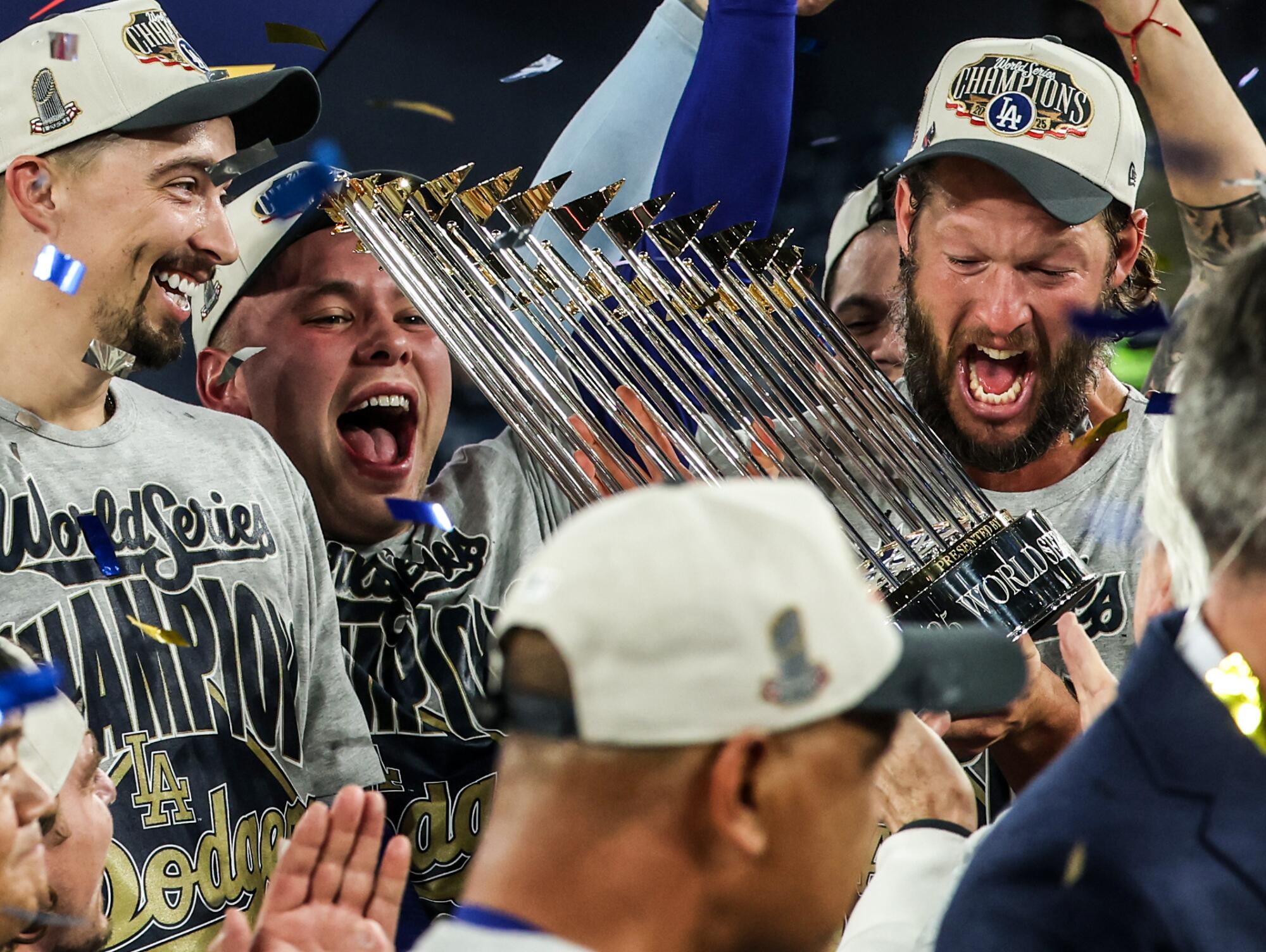
Dodgers pitcher Clayton Kershaw, right, celebrates with teammates after the Dodgers defeated the Toronto Blue Jays for the 2025 World Series title.
(Robert Gauthier / Los Angeles Times)
But, even with his success last year and even with the joy of wearing a uniform once again, he insists he isn’t interested in pitching beyond the WBC.
“I don’t want to,” he said. “You can’t end it better than I did last year. I had a great time last year. It was an absolute blast and honor to be on that team. I think that was the perfect way to end it. Honestly, I don’t know if I would have enough in the tank to pitch for a full season again. I’m really at peace with that decision.
“This is kind of a weird one-off thing, but you can’t really turn down this opportunity. It wasn’t easy to get ready for this, with no motivation for a season, but I actually am in a pretty good spot with my arm. I’ll be fine. If they need me, I’ll be ready.”
Kershaw said he has kept in touch with his old Dodgers teammates, with some connecting on video calls from the weight room or clubhouse at Camelback Ranch. He arrived in the Phoenix area two days before the workout, but he skipped a trip to Camelback Ranch.
“I’ve thought about it,” he said. “I miss the guys. I think it’s probably just better, at least for this first year, for me mentally to just stay away, just for spring training.”
Kershaw said he would be at Dodger Stadium for the championship ring ceremony March 27.
He is content with what he calls “Dad life.” He and his wife, Ellen, just welcomed their fifth child, and Dad life includes lots of shuttles to baseball and basketball practice.
“I run an Uber service,” Kershaw said.
This wouldn’t be a Dodgers story these days without some reference to the team’s big spending so, for what it’s worth, Kershaw spent some time Tuesday chatting with Skubal, who will be the grand prize on the free-agent market next winter, or whenever the likely lockout might end.
That’s a rational explanation, Kershaw says, for Skubal pitching just once in the WBC.
“Everybody knows the situation he is in, contract-wise,” Kershaw said. “Any innings we can get out of him is a huge bonus to this team. He’s great. Super competitive. We’re honored to have him.”
Should we assume Skubal will be pitching for the Dodgers next season? Kershaw laughed.
“No comment,” he said, then walked away to get ready for the first game of his post-retirement life.

NEWYou can now listen to Fox News articles!
Basketball Hall of Famer Charles Barkley sounded off on the frenzied reactions to the U.S. men’s hockey team getting invited to the White House by President Donald Trump.
Trump talked to the Olympic gold medal-winning team immediately after they defeated Canada in overtime last weekend. He said they would be invited to his State of the Union address and added that he needed to invite the women’s team as well or he would be “impeached.”
Charles Barkley sits courtside against the Minnesota Timberwolves during an NBA Cup game at Mortgage Matchup Center on Nov. 21, 2025. (Mark J. Rebilas/Imagn Images)
Trump critics took the joke as a shot at the women’s team, which sparked questions from NHL and Professional Women’s Hockey League reporters as the players returned to their respective club teams.
“I’m proud of the United States men. I’m proud of the United States women. You should have invited both of them to the White House, but it shouldn’t have been disrespect, misogyny,” Barkley said on the “Steam Room” podcast. “Like, yo, man, why do y’all have to mess everything up? Everything isn’t Democrat, Republican, conservative, liberal. That’s why we got this divided, screwed up country. Stop it man. Because, you know, the public, they’re idiots. They’re fools. They can’t think for themselves. I know y’all say stuff to trigger them. Y’all say stuff and y’all know they’re going to be fools.”
Barkley lamented that the average person would get riled up over the supposed controversy.
The U.S. team poses for a group photo after defeating Canada in the men’s ice hockey gold medal game at the 2026 Winter Olympics. Milan, Italy, on Feb. 22, 2026. (Luca Bruno/AP Photo)
“We don’t have to fall for stupidity. But we do – that’s my point. These people out here are stupid. They need something to trigger them. Just because they want us to be stupid. We don’t have to be stupid. He should have invited both teams to the White House. Simple as that. Guys who didn’t want to go shouldn’t have to explain why they didn’t go.”
The former Philadelphia 76ers, Houston Rockets and Phoenix Suns star made clear he would go to the White House regardless of whether Trump was in office.
“I’ve said this before, I’m not a Trump guy. But if I got invited to the White House, I would go. I’m not a Trump guy – I want to make that clear. But I respect the office,” Barkley said. “He’s the president of the United States. But if guys don’t want to go, I understand that too. It doesn’t have to be a talking point. It doesn’t have to be un-American.
Megan Keller (5) celebrates with a flag alongside Cayla Barnes (3) of Team United States after scoring the game-winning goal in overtime during the women’s gold medal match against Canada on Day 13 of the Milan Cortina 2026 Winter Olympic Games at Milan Santagiulia Ice Hockey Arena in Milan, Italy, on Feb. 19, 2026. (Sarah Stier/Getty Images)
CLICK HERE TO DOWNLOAD THE FOX NEWS APP
“I just wish y’all would stop falling for the stupidity.”
Follow Fox News Digital’s sports coverage on X and subscribe to the Fox News Sports Huddle newsletter.
Related Article

North Texas voters flood polls early, boosting turnout in both parties

Utah snowpack numbers looking dismal with not much time to catch up

In Vermont, small town meetings grapple with debate on big issues

Del. Dan Helmer on Virginia redistricting and congressional run

Sister Bay, Wisconsin: 2026 USA TODAY 10BEST Readers’ Choice Awards

Florida High School Football Rankings: Top 25 teams – Oct. 21

Cleary's 21 help Le Moyne down Central Connecticut State 69-64 in OT

How old is Bo Nix? What to know about Oregon quarterback ahead of 2024 NFL Draft

99th annual Pony Swim held in Virginia

Indiana Members Credit Union announced as new anchor tenant at Bottleworks District

Trump sends official notification to Congress on strikes against Iran

Unexpected birth brings hope to near-extinct Amazon tribe

Supreme Court blocks redrawing of New York congressional map, dealing a win for GOP

Map: Earthquake Shakes Central California

Gas prices could jump as Middle East tensions threaten global oil supply
-

 World5 days ago
Exclusive: DeepSeek withholds latest AI model from US chipmakers including Nvidia, sources say
-

 Massachusetts5 days ago
Mother and daughter injured in Taunton house explosion
-

 Denver, CO5 days ago
10 acres charred, 5 injured in Thornton grass fire, evacuation orders lifted
-

 Louisiana1 week ago
Wildfire near Gum Swamp Road in Livingston Parish now under control; more than 200 acres burned
-

 Technology1 week ago
YouTube TV billing scam emails are hitting inboxes
-

 Politics1 week ago
OpenAI didn’t contact police despite employees flagging mass shooter’s concerning chatbot interactions: REPORT
-

 Technology1 week ago
Stellantis is in a crisis of its own making
-

 News1 week ago
World reacts as US top court limits Trump’s tariff powers