Sports
Jim Whittaker, first American climber to scale Mount Everest, has died

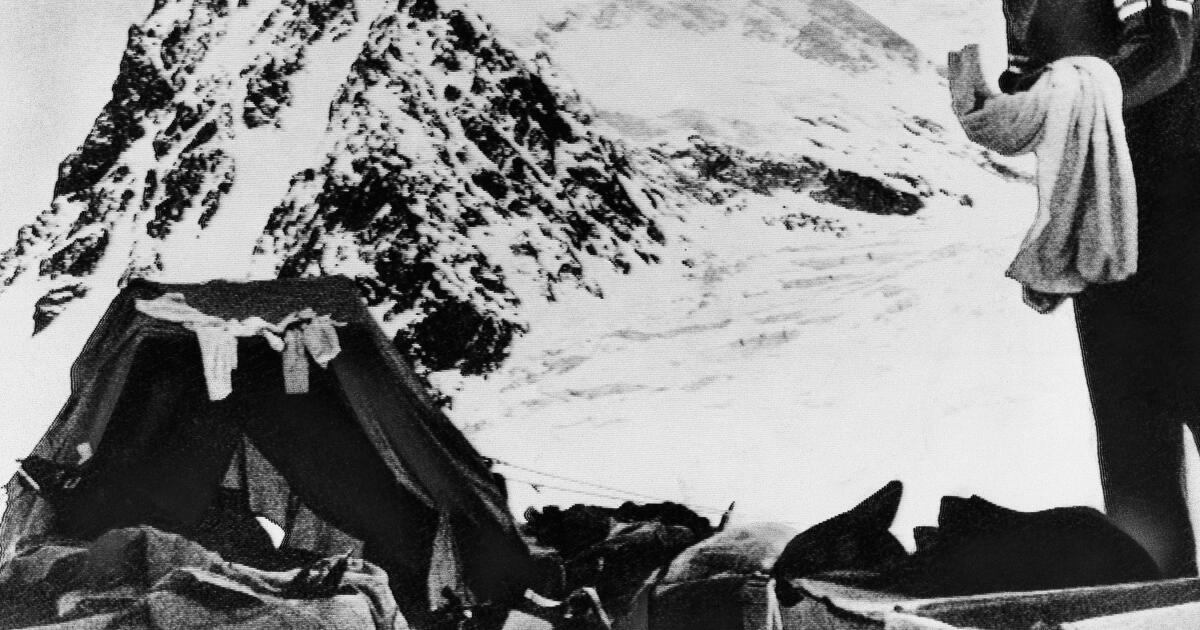
For 20 minutes of his life, Jim Whittaker was on top of the world.
He was the first American to summit Mt. Everest, reaching the highest point on Earth on May 1, 1963, with Sherpa Nawang Gombu.
“We were standing in the jet stream, on the edge of space,” Whittaker wrote in his 1999 memoir, “A Life on the Edge.”
He returned home a hero, with his picture on the cover of Life magazine, a White House fete and unexpected celebrity. And though life off the mountain didn’t always go smoothly, he disdained regret.
“If you stick your neck out, whether it’s by climbing mountains or speaking up for something you believe in, your odds of winning are at least fifty-fifty,” he wrote. “On the other hand, if you never stick your neck out, your odds of losing are pretty close to 100%.”
An adventurer until the end, Whittaker died Tuesday at his home in Port Townsend, Wash., his son Leif confirmed to the New York Times. Whittaker was 97. .
On March 24, 1965, Robert F. Kennedy, left, stands atop Mt. Kennedy in Canada after placing a black flag in memorial to his late brother, President John F. Kennedy. With him were Jim Whittaker; William Allard, a National Geographic Society photographer; and George Senner, a ranger.
(Doug Wilson / Associated Press)
He was 34 when he scaled Everest, a feat that shaped much of the rest of his life. His Washington state license plate read 29028, the generally accepted height of Everest when he climbed it. (GPS surveys later put it at about 29,035 feet.)
He was chosen for the expedition by its leader, Swiss mountaineer Norman Dyhrenfurth, because of his experience in climbing under icy conditions, including numerous summits of Mt. Rainier near his Seattle-area home.
But Everest, first scaled in 1953 by New Zealander Edmund Hillary and Nepalese Sherpa Tenzing Norgay, was a far more formidable and dangerous beast. And even if the Dyhrenfurth expedition was successful, only a chosen few of its 19 team members would reach the top. Still, Whittaker thought his chances were good.
“I’d trained hard, put 60 pounds of bricks in my backpack,” he told National Geographic Adventure magazine in 2003. “I swam in Lake Sammamish in winter to build up to the cold we would encounter.
“I didn’t know anyone who was in better shape.”
On only the second day of the group’s climb from base camp, tragedy struck when a giant section of an icefall — a glacier formation resembling a frozen waterfall — shifted, crushing team member Jake Breitenbach.
“I had told everyone back home that Everest was not a difficult climb technically; the only problem was the lack of oxygen and the weather,” Whittaker wrote in “Life on the Edge.” “Now it had killed one of us, and we’d only just begun.”
Because the only way to get back to base camp was via that icefall, Whittaker chose to stay above it on the mountain for five steady weeks as more camps were established up Everest. He lost 25 pounds and a considerable amount of strength due to the thin air.
Still, he was in better condition than many of the other climbers, and Dyhrenfurth chose him for the final assault. He and Gombu left the last camp in the middle of a windstorm, with a scant supply of oxygen.
How hard was it to breathe? “Put a pillow on your face, run around the block, and try and suck oxygen through that pillow,” he said. It was so cold, one of his eyeballs froze, making it unusable.
Reaching the summit after several hours, they stayed only long enough to take pictures and plant flags as 50-mph winds whipped around them.
“When you are up there, you are not ecstatic, you are not afraid,” he told the Los Angeles Times in 2013. “You’re really not anything. But in the back of your mind, you know one thing: You gotta get off. Half of the climb is getting up, the other half is getting down.”
James Whittaker was born on Feb. 10, 1929, in Seattle, about 10 minutes before the birth of Louie, his twin brother. As the boys grew up, they took to roughhousing around the house, much to the chagrin of their mother.
“I believe that command to ‘Go outside and play’ is what started Louie and me on the path we have taken ever since,” Whittaker wrote.
He was active in Boy Scouts and as a teenager joined a mountaineering club that sponsored climbs on the nearby Olympic and Cascade ranges. He tested himself on increasingly higher peaks, relishing moments such as breaking through cloud layers.
“I think nature is a great teacher,” he told the Seattle Times in 2013. “Being in nature that way is a good way to find out who the hell you are.”
After finishing West Seattle High School, Whittaker went on to Seattle University, graduating in 1952. He was promptly drafted into the Army, but his mountaineering experience led him to be assigned to the Mountain and Cold Weather Training Command in Colorado instead of combat duty in Korea.
In 1955, he became the first full-time employee of the Recreational Equipment Cooperative (later called REI) when it was housed in a 20-by-30-foot space above a Seattle restaurant. In his first year, he expanded the co-op’s offerings into ski equipment and introduced new concepts — such as opening on Saturday mornings so customers could pick up equipment for weekend trips — that boosted sales.

Whittaker, pictured on April 12, 1975, in Seattle, shows some of the gear he would be taking for an expedition to climb K2 on the China-Pakistan border.
(Associated Press)
Because of his connection to the co-op, he was appointed equipment coordinator of the Everest climb, and REI agreed to keep him on the payroll during the expedition.
In July 1963, he and other members of the Everest team, including Gombu, were presented the Hubbard Medal of the National Geographic Society — which partially sponsored the expedition — by President Kennedy, four months before the president was assassinated.
Two years later, Whittaker led a climb up Mt. Kennedy, a nearly 14,000-foot Canadian peak named for JFK, with Sen. Robert F. Kennedy in the climbing party. The two men forged a close friendship that extended to the wider Kennedy clan. In subsequent years, Whittaker went on ski vacations with the Kennedys, was a guest at the family compound in Hyannis Port, Mass., and hosted gatherings in Seattle that included mountain climbing.
Whittaker organized Robert Kennedy’s 1968 presidential campaign efforts in the Pacific Northwest and spoke to him by phone only minutes before the candidate was fatally shot in Los Angeles. Whittaker caught a flight to L.A. and was at the senator’s hospital bedside when he died and then served as a pallbearer at the funeral.
In mountaineering, Whittaker was closely involved in more high-profile ventures. He led a 1975 expedition up the world’s second-highest mountain, K2, that failed to reach the top. His return expedition in 1978 was successful, though he chose not to go to the summit himself.
That same year, he decided to quit REI, partly because of friction with the co-op’s board. He had been president and chief executive since 1971, and when he left, the co-op was a $46-million business with more than 700 employees.

Whittaker throws the ceremonial first pitch before a baseball game between the Mariners and the Angels in 2013.
(Elaine Thompson / Associated Press)
Income from an endorsement agreement helped keep him financially sound, but an investment in a new outdoor gear company proved to be a disaster. The financial irregularities of a partner, who was convicted of felony bank fraud, doomed the venture, and Whittaker was left holding the financial bag.
He was nearly wiped out but got back on his financial footing when a venture capitalist asked him in 1986 to be chairman of the board, with stock options, of a new company called Magellan. It was a pioneer in GPS consumer electronics and holds numerous patents in the field.
Appropriately, Whittaker called one of the chapters midway through his book “Roller Coaster.” But he finished it with “Life Well Lived.”
“If you aren’t living on the edge,” he wrote, “you’re taking up too much space.”
Whittaker is survived by his wife, Dianne Roberts, and children Bobby, Joss and Leif.
Colker is a former Times staff writer.


Reaching the summit is a dream. But staying there? That’s an altogether different challenge.
Maja Stark has a special appreciation for that now, a year after winning the U.S. Women’s Open at Erin Hills and feeling the hefty weight of expectation that came along with it.
For her, the aftermath of that victory brought heightened anxiety, and searing criticism from outsiders when the Swedish professional’s play took a dip.
“You get comments and stuff saying, ‘What happened? You just won a major; why do you suck all of a sudden?‘” Stark said at the Chevron Championship in April. “That does take some energy and just makes you focus on the wrong things. Then I got even more stressed and anxious.”
Maja Stark plays a shot from a bunker on the 17th hole during the third round of the Chevron Championship on April 25.
(Alex Slitz / Getty Images)
Stark said she sought professional help in the form of a mental coach, sports psychologist and therapist and now believes she’s better able to withstand the scrutiny that comes with winning at the highest tier.
That career-shaping pressure will be on display again this week when the USGA brings the U.S. Women’s Open to Riviera Country Club for the first time, merging the game’s most prestigious women’s championship with a historic venue celebrating its centennial year. The tournament takes place Thursday through Sunday.
Riviera is a theater, sitting low beneath high hillsides that almost serve as balconies. Players have described the course as a stage because it can feel as if you’re being watched even when you’re alone.
“I think there’s something very nostalgic about the facility,” said Jim Richerson, Riviera’s general manager. “The golf course has never had any major renovations or changes. The clubhouse is the exact same footprint today as it was when it was built in the 1920s.”
The U.S. Women’s Open is the oldest of the LPGA Tour’s five majors, and has long served as the standard by which women’s golf measures itself. It’s open to professionals and elite amateurs through a qualifying process, and the tournament is known for identifying the player who can withstand the most pressure under the most demanding conditions.
NBC will televise the championship and although Mike Tirico will not call the event, he knows the significance of holding it at Riviera.
“Without there being a Masters for women’s golf, that tournament really is the crown jewel of the sport,” Tirico said. “It has become the event people dream of winning. … It’s just appropriate that it’s contested at a place like Riviera that for so many generations has come to define a great championship test of golf.”
A look at some of the players to watch:
Nelly Korda
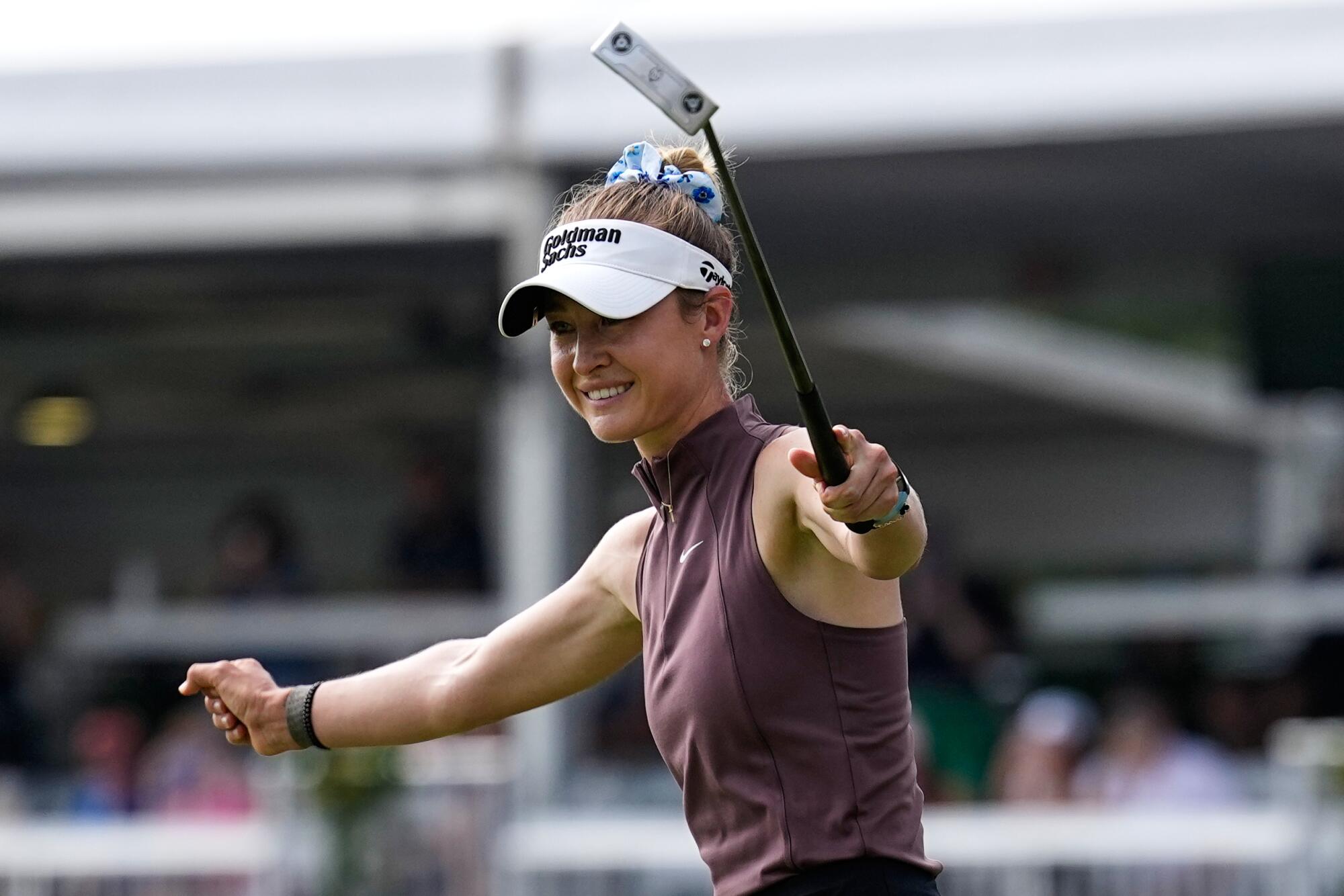
Nelly Korda celebrates after winning the Chevron Championship on April 26.
(David J. Phillip / Associated Press)
The world’s No. 1 player is a major needle mover for women’s golf and is a significant source of ratings when she’s in contention. She had a record five consecutive victories last season and seven overall. Her missing major is the U.S. Women’s Open. She finished in a runner-up spot last year and left Erin Hills firmly believing a win was within reach.
Jeeno Thitikul

Jeeno Thitikul plays a shot from the fairway during the first round of the Queen City Championship on May 14.
(Jeff Dean / Associated Press)
The former World No. 1 is still in pursuit of her first major championship. She’s a big question mark in the field.
Lydia Ko

Lydia Ko hits from the fairway during the second round of the LPGA Honda Thailand on Feb. 22.
(Kittinun Rodsupan / Associated Press)
This Hall of Fame player is the only golfer in modern Olympic history to win a complete set of medals — gold, silver and bronze — across three different Olympic Games. She’s still looking for her first U.S. Women’s Open win.
Charley Hull

Charley Hull hits off the 16th tee during the first round of the Mizuho Americas Open on May 7.
(Seth Wenig / Associated Press)
A colorful character who went viral during the 2024 Open for smoking a cigarette while signing autographs and playing. She was among a cluster who finished second in that tournament. She has three victories on the LPGA Tour but has yet to win a major.
Rose Zhang

Rose Zhang hits from the ninth tee during the final round of the Queen City Championship on May 17.
(Dylan Buell / Getty Images)
Zhang, who has been splitting time between Stanford and the LPGA, amassed a remarkable collection of victories as an amateur and three years ago, became the first player in 72 years to win an LPGA Tour event in her professional debut.
Minjee Lee

Minjee Lee prepares to putt during the third round of the Chevron Championship on April 25.
(Sarah Stier / Getty Images)
Lee, an Australian star, has won three majors including the U.S. Women’s Open in 2022. Her younger brother, Min Woo, won the 2016 U.S. Junior Amateur, making them the first brother-sister tandem to win the USGA’s junior championships.
Yuka Saso

Yuka Saso lines up a putt during the first round of the Mizuho Americas Open on May 7.
(Seth Wenig / Associated Press)
She is the anomaly of anomalies, with zero wins on the LPGA Tour with the exception of two U.S. Women’s Open victories. She won the first of those at 19 years, 11 months and seven days — astoundingly tying her for the youngest player to win the Open with Inbee Park, who was precisely that old when she won in 2008.
Lilia Vu

Lilia Vu watches her shot from the seventh tee during the third round of the Queen City Championship on May 16.
(Dylan Buell / Getty Images)
Vu grew up in Fountain Valley and was a standout at UCLA. She won two majors in 2023 but lately has been battling back problems.
Michelle Wie West

Michelle Wie West of the United States hits from the third tee during the first round of the Mizuho Americas Open on May 7.
(Sarah Stier / Getty Images)
Wie West retired three years ago after the Open at Pebble Beach, but is coming out of retirement to use her last year of exemption to play at Riviera. Her husband, Jonnie West, son of late NBA icon Jerry West, will be caddying for her.
Sports
Tomas Hertl scores game-winner as Golden Knights rally to beat Hurricanes in Game 1 of Stanley Cup Final

NEWYou can now listen to Fox News articles!
The Vegas Golden Knights have taken Game 1 of the Stanley Cup Final, erasing the Carolina Hurricanes’ early 2-0 lead to win a thrilling 5-4 game in Raleigh and set the tone for this best-of-seven series.
It’s a seven-game win streak for Vegas now, as they haven’t lost since Game 4 of the Western Conference Semifinals against the Anaheim Ducks. They surprisingly swept the Colorado Avalanche to win the West, and they kept that momentum going on the road.
Tomas Hertl was the hero for the Golden Knights in Game 1, as he scored the game-winning goal on a snipe with 3:25 left in the third period.
Tomas Hertl of the Vegas Golden Knights celebrates a goal during the second period against the Carolina Hurricanes in Game One of the 2026 Stanley Cup Final at Lenovo Center in Raleigh, North Carolina, on June 2, 2026. (Josh Lavallee/NHLI via Getty Images)
But it wasn’t easy for Vegas in the first period when the Hurricanes were quick to assert their home-ice advantage just 25 seconds into the game.
It was the first shot on goal for either side when Nikolaj Ehlers poked a puck past an aggressive Shea Theodore for Vegas, and he sprinted down ice toward Carter Hart, who mans the Golden Knights’ net. Ehlers, though, had the perfect shot, ringing the post and sending the Hurricanes faithful into a frenzy with the 1-0 lead before some could even get to their seats.
DESPITE POTENTIAL RATINGS NIGHTMARE FOR NHL, VEGAS-CAROLINA STANLEY CUP FINAL STILL HAS PLENTY OF INTRIGUE
Then, midway through the period, Ehlers found himself in yet another breakaway scenario, and he didn’t squander the opportunity to take advantage. He put a nifty move on Hart, and his backhand found the net to make it 2-0.
Jalen Chatfield also had his eye down ice, recognizing that Ehlers was uncovered and quickly turned Jack Eichel’s turnover into the opportunity.
But if there’s anything the Golden Knights have proved in these Stanley Cup Playoffs, it’s to never count them out. Another example of that was seen on Tuesday night.
Theodore made up for his mishap to start the game with an absolute rocket off his stick on a one-timer that saw its way through traffic and past Frederik Anderson in net to get Vegas on the board shortly after Ehlers’ second goal.
Then, as the second period got underway, it was Ivan Barbashev who decided to return the favor of scoring in 30 seconds or less. As Vegas entered the offensive zone with speed, the puck found Jack Eichel’s stick. He quickly spotted Ivan Barbashev cutting through the slot, and Barbashev fired a shot over Frederik Andersen’s right shoulder before the goalie could react.
Nikolaj Ehlers of the Carolina Hurricanes scores his second goal against the Vegas Golden Knights during the first period in Game One of the 2026 Stanley Cup Final at Lenovo Center in Raleigh, N.C., on June 2, 2026. (Bruce Bennett/Getty Images)
With that, the Golden Knights tied this game up, but they didn’t let the momentum go. William Karlsson, who already has a cup under his belt for Vegas, did his part in seeking the next trophy. Mitch Marner had a tremendous backhand pass from behind the net that found Karlsson’s stick all alone out in front, and Anderson had no chance as Vegas took a 3-2 lead.
At that moment, the air in the Lenovo Center was taken right out of the fans’ sails, but a trusty veteran restored that later in the period. Jordan Staal, who watched his brother and 2006 Stanley Cup champion with the Hurricanes, Eric Staal, get the crowd going with the siren at puck drop, potted his third goal of these playoffs.
Jordan Staal snapped a wrister past Hart thanks to a heads-up play by K’Andre Miller to keep the puck onside and find his teammate fast for the grade-A chance.
The bleeding was stopped, but the third period was bound to be a thriller based on how these two teams were finding clear chances to score. Who broke the tie first was the major question, and Brett Howden had the answer just 1:21 into the period.
The playoff leader in goals, Howden had a beautiful tip on a shot by Theodore for his 11th of the playoffs and perhaps his most important in Game 1. The scoreboard remained silent for some time after that, with both teams trying to set up solid forechecks, but to no avail. The Hurricanes even had a power play, but they couldn’t find the back of the net.
William Karlsson of the Vegas Golden Knights celebrates his goal with teammates during the second period of Game One of the Stanley Cup Final against the Carolina Hurricanes at Lenovo Center in Raleigh, N.C., on June 2, 2026. (Jeff Bottari/NHLI via Getty Images)
CLICK HERE TO DOWNLOAD THE FOX NEWS APP
Then, with 8:41 left, some puck luck found the Hurricanes, as defenseman Shayne Gostisbehere saw an offensive zone face-off biscuit fall right into his lap with no one around. He secured the puck on his stick blade and wristed it past Hart for the 4-4 tie.
However, the rollercoaster ride for the Hurricanes didn’t have a happy ending when they got off, with Hertl’s goal, assisted on a crafty Sissons’ pass following a face-off, being the final say in this one.
Game 2 of this series will be played once more in Raleigh on Thursday night at 8 p.m. ET.
Follow Fox News Digital’s sports coverage on X and subscribe to the Fox News Sports Huddle newsletter.

Jared Grindlinger is not ready to say goodbye to his friends at Huntington Beach High. The likely first-round draft pick didn’t have to play for the Oilers in the Southern California Division I regional playoffs, let alone pitch. But he did both to help Huntington Beach knock off San Diego Open Division champion Patrick Henry 10-3 on Tuesday.
Grindlinger went four for four, including a home run, and finished with three RBIs. He also struck out five in three innings on the mound. Dane Cunningham had a three-run home run. Huntington Beach advances to play the winner of Wednesday’s game between Corona and Chula Vista Eastlake on Thursday.
Cathedral Catholic 4, St. John Bosco 2: The impressive two-year run of St. John Bosco’s baseball team has come to an end. The Braves had the bases loaded with one out in the bottom of the seventh but couldn’t push across any runs and were eliminated in a first-round Division I game. They won the Southern Section Division 1 title the last two seasons and the regional title last season.
La Mirada 7, Liberty 6: A three-run seventh inning helped the Matadores enjoy their bus ride home from Bakersfield. The big hit was a three-run home run by Justin Torres. La Mirada will face Cathedral Catholic on Thursday in the semifinals.
Arroyo Grande 4, Loyola 3: An RBI single in the eighth inning by Colton Gotchal pushed Arroyo Grande to victory over top-seeded Loyola in Division 2. Jack Murray had a home run and two RBIs for Loyola.
Newport Harbor 2, Madison 0: Gavin Guy threw the shutout with seven strikeouts.
South El Monte 3, Brentwood 2: South El Monte went on the road and pulled off the upset of Division 6 champion Brentwood. Anthony Mata had an RBI single and Gabriel Canchola limited the Eagles to four hits while striking out nine in six innings.
Westview 7, Carson 1: Leadoff hitter Eli Irvine had three hits for the winners.
North Torrance 2, Bell 0: Seth Narasaki and Joey Banuelos combined for the shutout.
Verdugo Hills 11, Rolling Hills Prep 2: Cutlor Fannon finished with three hits and three RBIs for the Dons.
-
 Entertainment5 minutes ago
Two of music’s most powerful executives maxed out donations to Spencer Pratt
-
 Lifestyle8 minutes ago
Vintage-obsessed millennial parents are driving L.A.’s booming kids’ clothing resale market
-
 Politics13 minutes ago
Early returns indicate L.A. County voters have doubts about healthcare sales tax measure
-
Sports23 minutes ago
Nelly Korda, Michelle Wie West and more: Who to watch at U.S. Women’s Open
-

 World35 minutes ago
EU launches major tech push to break US and China dependence
-
 News58 minutes ago
California’s primary for governor is undecided as candidates vie to be in the top two
-

 Los Angeles, Ca2 hours ago
California primary election results: governor and L.A. mayor races
-

 Detroit, MI3 hours ago
Another bribery scandal hits Detroit. It involves the People Mover

