Sports
Inside California horse racing's complex problems that could hurt the sport nationwide


As the wildfires devastated parts of the San Gabriel Valley, Santa Anita Park did what locals always have counted on the 80-year-old track to do. It stepped up and fulfilled its role as a community citizen.
It canceled racing the first week after the fires so that the track’s expansive space could be used as a center for donation collection and distribution, staging utility vehicles that were helping fight the fires and housing large animals that could not be accommodated at animal shelters. The track was unaffected by the fires and the air quality was well within the range for safe racing.
Santa Anita did what was best for Arcadia, Altadena, Pasadena and other areas that were affected by the worst fire disaster in L.A. history.
It’s not the first time Santa Anita has stepped up. It donated the land at the corner of Huntington and Baldwin for a fire station. It also gave away the land near the track that houses the Arcadia City Hall and police department.
But these charitable gestures are getting harder to pull off. The sport is decades past the days when cars would back up onto Baldwin Avenue after leaving the 210 freeway, spectators just trying to get into the Santa Anita parking lot. The Santa Anita Handicap is no longer a must-attend event for horsemen nationally. Gone are competitive purses because of the lack of a secondary source of income such as casino gambling. Field sizes are so small that it cripples wagering. And attendance is a fraction of what it was years ago.
The unfathomable idea that the track may soon close or be sold is closer to reality than ever.
The Stronach Group, owner of Santa Anita and Gulfstream Park in Florida, has hired Keith Brackpool, a former TSG executive and chairman of the California Horse Racing Board, to kick the tires on a possible sale of the company’s 1/ST Racing division and the tracks, according to two people with knowledge of the situation not authorized to speak publicly.
While they publicly are saying Santa Anita is not for sale, Brackpool met with at least one investor about the sale, according to the two people with knowledge of the situation not authorized to discuss it publicly. The understanding is if the track were sold, whoever buys it would continue racing at least in the short term.
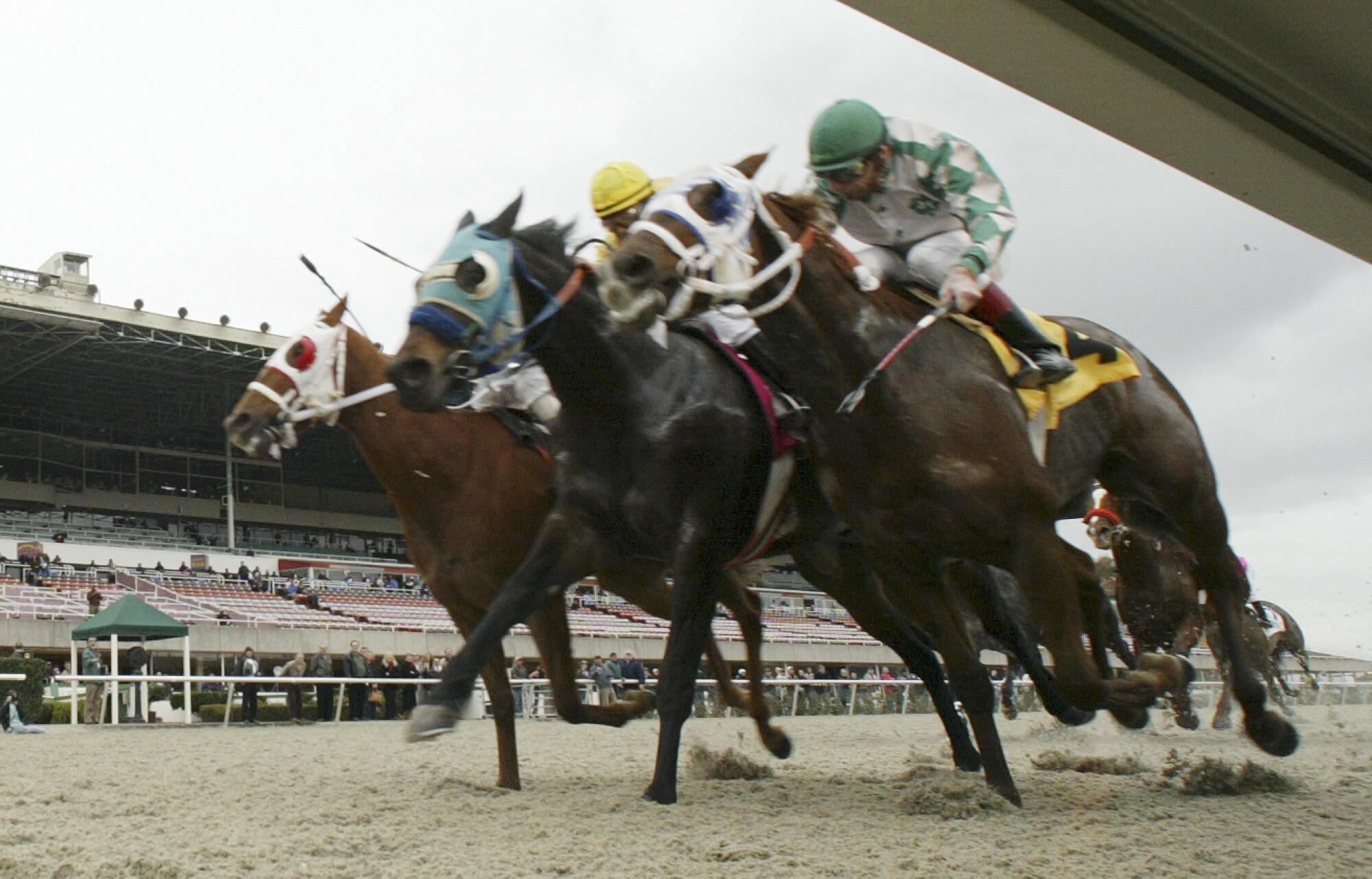
Jockey Tiago Pereira guides Katonah to a win in the Grade II $200,000 San Pasqual Stakes horse race on Jan. 25 at Santa Anita Park in Arcadia.
(AP)
The price tag of $2 billion was thought to be too high for at least one prospective buyer who was more in the look-and-see mode, the people said. The land the two properties sit on is easily worth more than $2 billion, but as race tracks, not so much.
TSG denied a Times request for an interview with Brackpool and he did not return a phone message.
While neither confirming nor denying the details, TSG issued a statement that read: “Racing in California is facing challenging economic circumstances. This is not an easy problem to solve. We are continuously thinking about solutions and in discussions with various stakeholders about the best way forward. Those discussions remain ongoing.”
The threat to racing in California is existential. And if racing in the state were to go away, it isn’t just a California problem. The branches of the sport are intertwined nationally despite the territoriality that exists between racing organizations. Racing is a four-legged stool, with one of the legs being Kentucky; another New York; tracks that hold boutique meets such as Keeneland in Kentucky, Oaklawn in Arkansas and the winter meets at Gulfstream and Tampa Bay in Florida; and finally there is California.
If racing becomes a three-legged stool, the chances of collapse are major.
Santa Anita has been there when the community needed help. But now, it’s the track that needs help. And by extension, so does horse racing in the United States.
The bigger question: Is anybody willing to help them?
In order to find out what racing executives think about the future of racing in California and the U.S., The Times spent several days at the 50th Global Symposium on Racing in Tucson in December.
About two dozen industry people painted a picture laced with shreds of optimism, but only if California can get Historical Horse Racing (HHR), an electronic gaming product, to supplement purses. Without it, few see hope of survival. The tracks say they are working toward a solution but offer little public evidence of success as it likely would take an agreement with Native American tribes, which control non-pari-mutuel gambling in California.

Jockey Hector I. Berrios steers El Potente to a win in the Grade III $100,000 Thunder Road Stakes horse race on Feb. 1 at Santa Anita Park in Arcadia.
(Uncredited / Associated Press)
The problems with racing did not just crop up. The decline has been going on for quite some time.
Sal Sinatra, 60, has been around horses since he was 12 years old. He grew up in the business and was the vice president of racing at Parx Racing in Pennsylvania, president and general manager of the Maryland Jockey Club and chief executive of Equibase, a company that supplies racing statistics.
He’s currently a consultant for the Horseracing Integrity and Safety Authority.
“I play fantasy sports,” Sinatra said, speaking as a horse owner, not as a HISA consultant. “Last night I was up all night because I played in a lousy $10 tournament and I won $10,000. I have more enjoyment doing that. I live in Lexington [Ky.] and every bar has [FanDuel] on, I have a [betting] account. I don’t even look up at the track or bet anything.”
Now, don’t mistake Sinatra as someone who has abandoned the sport. He had just finished a workshop with many of the country’s racing secretaries, offering ideas on how to make the sport more attractive to customers. He really wants horse racing to thrive, he’s just not sure how.
“I have two mares at home, and I’m not sure what I’m doing because I don’t know what it’s going to be like in three or four years,” Sinatra said. “We move like snails in this industry. If we do not protect the small outfits [trainers and owners], whether it’s by ratings classifications rather than claiming [races], the sport is limited.
“It’s the people who used to breed and race for joy, the people who protected horse racing now see it as time to retire, they’re out of the game. I think it’s very important to look at that sector. I really believe there’s a lot of purse money out there that is not being paid properly to keep the economic engine flowing.”
Sinatra was quick to recall tales of his time on the front line of racing, especially running the Maryland Jockey Club, whose marquee race is the Preakness Stakes.
He painted a picture of dysfunction that included exaggerated attendance numbers, a former boss’ obsession with mutuel handle (going so far as to give Sinatra wads of money to bet to give the mutuel pool a good head start), and deficits in his racing budget because of having to move money from racing to support big-name musical talent at the Preakness.
He suggested the roots of the problems extend beyond Maryland and have been around racing for decades.
“Simulcasting has destroyed us,” he said, referring to the practice of broadcasting races on TV or at other tracks where betting can take place. “We all thought we had found money and then the simulcasters were in our own state and our own backyard. We just poached our own bettors away. That’s all we did, for less money. It’s just insane.”
Sinatra also believes the influx of money through casino gambling has been a problem for the industry.
“The casinos do better when we race as if we’re a sideshow for them,” Sinatra said. “So, they want us to run and don’t care if you run five-horse fields and make no handle. When my budget comes out, I’ve lost $3 million and I want to cut days but I can’t.
“When the subsidies came in, we did the wrong thing. We just said, ‘OK, here’s your millions of dollars, horsemen, increase purses.’ And a lot of things were wrong.”
Sinatra thinks there should be coordination between track organizations, which historically has been as achievable as detente between the Hatfields and McCoys. A very old analogy for entrenched rivalries in a sport that is aging not so gracefully.
“When I was first at Parx and it went from $125,000 [in purses] a day to $250,000 a day, and I had all this extra money for stakes,” Sinatra said, “I called The Jockey Club, and I said, ‘Before I do this, I should contact the graded stakes committee and suggest what races I’m going to add money to’ and the group says ‘No, there are already three in that category.’
“You have to either increase distances or put them on different surfaces. That’s what they should have to do. But they say they can’t do that. I’m like, well, otherwise, everybody’s going to have million-dollar races all over the place and there’s no planning, there’s nothing.
“This is insanity, what we do.”
So, does Sinatra have any hope for California?
“Under the current domain, I’d say no,” he said. “Horses aren’t coming to California. In my estimation as an East Coaster, they killed off the north, which is where most of your farms are. So now, what are you going to do? Supply California with horses bought from Kentucky? It doesn’t seem right.”
California did not get to this position overnight. Some of the wounds are self-inflicted. Other problems, and the most difficult to solve, deal with the changing sports landscape and the gulf between people who view horses as pets and those who view them as livestock.
TSG, driven by racing interests in Southern California, played a game of Sophie’s Choice, deciding it needed to kill racing in Northern California to save racing to the south.
Hall of Fame jockey Russell Baze crosses the finish line to win at Golden Gate Fields in Albany on Jan. 1, 2008. Golden Gate Fields closed in 2023.
(Eric Risberg / Associated Press)
TSG clumsily announced the planned closure of its Northern California mainstay, Golden Gate Fields, at the end of 2023 without consulting its stakeholders. It agreed — some might say was forced — to keep the track open another six months if there was no protest about a planned legislative amendment that the simulcast money normally targeted for the north would go to the south if there is no racing in the north.
The north capitulated and even planned its own circuit, calling it Golden State Racing. It ran for 25 days, failed to meet any of its financial goals and pulled its license application for this year.
TSG may have been the architect of the closure of Northern California racing, but the Thoroughbred Owners of California was driving the getaway car, primarily supporting racing only in Southern California. It drew up benchmarks for success in the north that even Santa Anita would have had difficulty executing. Several Northern California board members quit in protest.
At one point in dealing with the California Horse Racing Board, Craig Fravel, the former chief executive of 1/ST Racing, sent a letter threatening the board with closing Santa Anita if it didn’t get its way.
TSG recently went to the same playbook in regard to Gulfstream Park. The track’s operators are pushing for something called “decoupling,” which would mean it could operate its slot-based casino without having to run horse racing. The same decoupling happened to dog racing, harness racing, quarter-horse racing and jai alai a few years ago. Dog racing was killed by ballot initiative in Florida and the other sports are, for all intents and purposes, nonexistent.
At a recent meeting with Florida horsemen, Brackpool and TSG executive Stephen Screnci said if horsemen don’t oppose decoupling, they will promise racing for at least three more years. If they oppose it, the track could close sooner.
The horsemen took it as a threat as one might expect, leading to a fistfight after the meeting.
TSG chief executive Belinda Stronach poured gasoline on the situation in an interview on NBC during coverage of the Pegasus World Championship last week when she said: “The fact is that Gulfstream Park is now in a very dense, urban setting, and that’s not great for horses, ultimately.”
Not mentioned is that all three Triple Crown races — the Kentucky Derby (Louisville, Ky.), the Preakness (Baltimore) and the Belmont Stakes (soon to be back in Long Island after a rebuild) — are in urban areas.
Jerry Bailey, a Hall of Fame jockey and NBC commentator, stated after the segment that Gulfstream Park would be gone in 10 years.
Any way you look at it, the decoupling move makes a potential sale of the track a lot easier.
Blackpool, a controversial figure in California who has settled lawsuits he filed against Stronach, is playing a significant role leading discussions about the future of racing. Missing from the Florida meeting with horsemen was Aidan Butler, the current chief executive of 1/ST Racing. Butler, when reached by The Times, declined to discuss any aspect of company business, instead referring to the statement issued by TSG.
The one thing that most agree on is that there is too much racing. The problem is that contraction is great as long as it’s not your business that is contracting. And therein lies another problem racing hasn’t fixed.
“I guess there’s a difference between contraction and a sport dying,” said Robert Hartman, chair of the prestigious Race Track Industry Program at the University of Arizona and host of the annual global symposium.
“Let’s say that healthy contraction could be good for an industry. You see what’s going on in California. Some determined that one racing circuit could make racing healthy and bolster that circuit. The fear is two unhealthy racing circuits may lead to them both dying.
“That type of contraction could be beneficial to the industry. It’s not just racing, it happens in food products or automobile manufacturing or other industries [where contraction] makes that industry healthier.”

Martin Garcia rides Citizen Bull to victory in the Breeders’ Cup Juvenile horse race in Del Mar on Nov. 1.
(Gregory Bull / Associated Press)
Craig Dado, who was a Del Mar marketing executive for two decades and is currently the president of Sports Injury Central, draws an analogy to professional sports.
“We’ve always argued [there is too much racing] from a marketing perspective,” Dado said. “You’ve got 18 NFL games a year per team. You’ve got 162 baseball games. If you run four days a week, 52 weeks a year, my goodness, that might be too much.
“Maybe the market is telling you there is too much. Maybe we need breaks. Every idea like that comes with a whole set of negatives as to why it doesn’t work. So, there’s no easy answer in California, but I’m praying that they figure it out, because I am a horse owner and I still love going to the gate, going to the tracks, so I hope it works out.”
The racing landscape in California changed in 2013 when Hollywood Park closed and eventually became SoFi Stadium. The sport believed it needed year-round racing. Santa Anita increased its signature meet to about six months, not including its fall meeting. Del Mar added a monthlong fall meeting to its summer meet. And Los Alamitos, a quarter-horse track, was the real hero, reconfiguring its track to a mile and adding about six weeks of daytime thoroughbred racing to fill the gaps.
But was that the right move?
“There’s no question that the less you run, the more demand there is for your product,” Dado said. “It’s old-school Economics 101, supply and demand. The more you run, the less demand there’s going to be. However, when you add in all those additional dates, even though you’re not as big per day, it still may make a better business platform. Especially when your state is basically saying, ‘If you don’t do it, we’re not going to make it.’ Then they forced Del Mar’s hands.
“Did we want to add the fall dates? There was a lot of consternation over that, but one of the reasons we really agreed to do it is because we thought we’d get the Breeders’ Cup by doing it. That was the feather in the cap of that discussion.”

Flavien Prat celebrates after riding Sierra Leone to victory in the Breeders’ Cup Classic horse race in Del Mar on Nov. 2.
(Gregory Bull/AP)
This year Del Mar will host the Breeders’ Cup for the third time and second year in a row.
“Let’s say Del Mar adds three more weeks [if Santa Anita were to stop racing],” Dado said. “Would Del Mar want to do it? Probably not because it’s going to make those days that they already have less special. But if the industry is saying they need to do it, then Del Mar’s going to have to step up.”
Joe Morris, the former head of West Coast racing for TSG and currently the senior vice-president of racing for Caesars Entertainment, points to a particular problem.
“The formula to building handle and having a successful meet is you need the stock,” Morris said. “I don’t think they can fix the problem. Thirty years ago, there were 20 to 25 major farms in California. Now there are just a handful. So, where are you going to get the product? The cost of living is such that it is hard to go out there if you are a trainer and put your help up and things like that.”
When Santa Anita’s owners closed Golden Gate, one of their plans was to start rebuilding all the barns at Santa Anita. Nineteen months after the announcement, there has been no appreciable construction on the barns.
“I don’t see them ever getting the product,” Morris said. “Can Del Mar get enough to ship in? I don’t know. If you don’t have product, you don’t have racing. So now you’re racing short fields and less races and the gamblers know that’s not what they need. They want more races and full fields.”
In 1990, there were 44,143 horses foaled in North America, which includes Canada and Puerto Rico. In 2023, it was down to an estimated 18,500. The foal crop has declined the last eight years.
Marshall Gramm, 51, is a numbers guy. He’s a professor of economics at Rhodes College in Memphis who has published several papers about gambling and horse racing. He teaches a class in the economics of wagering. Gramm is a regular participant in the National Horseplayers Championship.
It’s an odd spot for someone who was not exposed to racing as a child. But Gramm, who is also a horse owner, is addicted to the data and the handicapping game.
“Kentucky and Arkansas look pretty safe, and we have this new commitment to Maryland and New York, so I think that there’s probably more optimism now about what the future could bring overall in the landscape than what it was a couple of years ago,” Gramm said.
“What happens in Florida, what happens in Texas, what happens with HISA, what happens in California, those are different questions. Everyone I’ve talked to believes that California will be gone in a couple of years. I’m not as pessimistic, but maybe it’s because I’m naive.”
Gramm ran horses at Golden Gate and acknowledges his trainer is struggling with the closure. He also believes the success of some trainers, while creating stars for the sport, also may be hurting the industry.
“The reality with closing Golden Gate is none of those horses could really race in Southern California,” Gramm said. “I don’t know what they can do to attract horses. They have some trainers and owners who are really committed to racing there, and I think that’s good. But the downside is the product isn’t as strong because as we have consolidation, you get races being dominated by two or three trainers.
“Every turf race is dominated by [Phil] D’Amato and every dirt race is [Bob] Baffert. If you have a baby there and they’re all running against three Bafferts, that’s not a good consumer product, right? That’s the problem everywhere.”
Gramm fears the solution to racing’s problems also may be its eventual downfall.
“I’m not in love with alternative gaming supporting our industry,” Gramm said. “I’m not in love with the fact that to make our industry go, we have to have some sort of manufactured monopoly and other gambling.
“It turns the racetrack and racetrack operators into people who end up seeking government aid. They care less about their customers in building a good product than they do about the government. And ultimately the tail wags the dog, the casino matters more and then they don’t even care about racing.”
Gramm also notes subsidies only help trainers and owners and not the average horse player.
“The slots players are Band-Aids because they’re not going to be horse players,” Gramm said. “And the days of the numbers players coming and playing the horses or dogs doesn’t exist anymore. Maybe if it can tip the scales in the right direction and help turn those subsidies into helping horse players and making a better product, then I still think it’s a tough long-run proposition unless you get people playing the product.”
Gramm understands predicting the future is a fool’s game.
“Five years is short, but what will the sport look like in 20 years, 25 years?” he said. “Are we just racing in Kentucky and Arkansas? Are we just racing in red states? I don’t know, and that’s what worries me with everything that we want to try to do. I don’t know if minds can be changed with the prevailing direction that we’re going. So much about everything can change, I mean, are people going to be eating meat in 30 years?”
It’s difficult to find someone honestly bullish about the sport. Even those most positive about the future have some trepidation.
“I can’t imagine a racing world without California,” said Lisa Lazarus, chief executive of HISA, an organization that is facing legal challenges to its constitutionality that also could put it out of business in five years or less. Two U.S. appeals courts ruled differently on the constitutionality of HISA, leaving its future in a state of flux. The U.S. Supreme Court did not include the issue on its docket for the current session.
“Everybody believes California is critical to the ecosystem,” Lazarus said. “There are some very smart people out there, so I have full confidence that they’re going to find a way to bring in supplemental income.”
Lazarus is not the first to offer a suggestion based on cooperation among the tracks and states, who typically are interested only in benefiting their own interests. Occasionally they get together, such as recently when the New York Racing Assn. and Churchill Downs Inc. combined to sue HISA over the costs it charges states. NYRA recently settled; CDI did not.

Jockey Brian Hernandez Jr. celebrates in the winner’s circle after riding Mystik Dan to win the 150th running of the Kentucky Derby horse race at Churchill Downs on May 4 in Louisville, Ky.
(Jeff Roberson/AP)
“Everyone knows that things can’t stay the way they are, just fighting for survival,” Lazarus said. “I don’t think it’s currently possible under Kentucky law now, but I think it’s so important to the ecosystem that you could potentially see some other jurisdictions sort of stepping in to supplement California.
“This is all theoretical because right now the KTDF [Kentucky Thoroughbred Development Fund] is restricted to Kentucky. But if there was flexibility to send purse money elsewhere, then they could consider it because they have so much purse money in there.”
Donna Barton Brothers, a former jockey and currently an NBC analyst who is always the first person to interview the winning jockey of the Kentucky Derby from her horse, sees both sides to the argument for Kentucky bailing out California purses.
“You’ve got legislators in Kentucky, like state Sen. Damon Thayer and House Speaker David Osborne, who have fought really hard for where Kentucky is right now,” Brothers said. “And then they look at California and go, ‘What are the legislators doing there? What are the lobbyists doing there? What are the racetracks doing to work with the lobbyists to work with the legislators to make that happen in California?’ So why does all the stuff that we’ve worked for now have to be used to subsidize California racing?’
“On the flip side, is Keeneland going to be able to have a $1.46-billion economic impact if you don’t have people in California interested in buying horses from the Keeneland sales?”
Brothers’ hypothetical about the California legislature does bear a second look. For the most part, politicians in California have done little to support the racing industry, instead focusing more on horse safety than horse racing.
Gov. Gavin Newsom and the late Sen. Dianne Feinstein both were outspoken during the 2019 crisis of horse deaths at Santa Anita.
“How are we going to get Sacramento to like horse racing?” trainer Bob Baffert asked rhetorically while speaking on a panel in Tucson with fellow Hall of Famer Todd Pletcher.
“It’s such a big state and that question is something I wish I had the answer to. Unless we can find some other way to increase the purses, like Churchill Downs, Oaklawn, New York, [we’ve got difficulties]. What California has to offer is the weather, it’s a great place to get horses ready and it comes down to how can we get California to like horse racing?”
So, here everyone in California horse racing sits. A series of identifiable problems with some potential solutions but seemingly not enough action to solve those problems. Racing executives in the state say they are working on it but decline to speak publicly about it, leaving the horsemen shaking their heads in frustration.
“We need as an industry for California to succeed,” said Pletcher, the trainer who spoke on a panel alongside Baffert. “It’s great what’s going on in Kentucky with the purses but it’s having a negative effect on the other states because the purse structure is so high in some places yet in California they don’t have those advantages with a declining horse population.”
Louis Cella and his family are behind one of racing’s most successful stories. The owners of Arkansas’ Oaklawn Park were the first to put historical horse racing machines at their track. The facility does a great local business and holds prominent races. But even Cella sees the opportunity for success in California as limited.
“You look at California and unless they come with a solution to increase purses, I don’t think they survive in five years,” Cella said. “I don’t see how that happens or at least on the level they are currently running at. I think they have a tremendous headwind in front of them.”
Racing leaders in California, under the guise of the Horse Power Coalition, funded a survey about the impact of horses on the state economy. The survey was sent out shortly after it was announced that Golden Gate was closing.
It was timed to be a complement to the national American Horse Council Economic Impact Study. A news conference was scheduled in the paddock of Santa Anita to boast about the alleged $11.6-billion economic impact, as determined by the self-funded study.
The news conference was hastily canceled when no media showed up to cover the announcement.
Is that event emblematic of the state of and interest in horse racing in California, or just bad marketing?



Sports
Anthony Richardson free to seek trade after injury setbacks amid Colts’ shift to Daniel Jones

NEWYou can now listen to Fox News articles!
Anthony Richardson Sr.’s future in Indianapolis faces more uncertainty than ever.
The Indianapolis Colts granted Anthony Richardson, the team that used the fourth overall pick in the 2023 NFL Draft on the quarterback, permission to explore a trade. His agent, Deiric Jackson, confirmed the latest development in the 23-year-old’s tumultuous career to ESPN on Thursday.
Veteran quarterback Daniel Jones beat out Richardson in a preseason competition for the starting job. Jones made the most of another opportunity as an NFL starter, helping the Colts win eight of their first 10 games of the 2025 regular season.
Indianapolis Colts quarterback Anthony Richardson heads off the field after an NFL football game against the Denver Broncos on Sunday, Dec. 15, 2024 in Denver, Colorado. (AP Photo/David Zalubowski)
However, his season was ultimately derailed by an Achilles injury. The setback came two years after he tore an ACL with the New York Giants. The Colts appear ready to move forward with Jones, clouding Richardson’s future in Indianapolis.
Jones is set to become a free agent in March, meaning the Colts must either use the franchise tag or sign him to a new deal. Richardson has started just 15 games in three seasons with the Colts, his tenure largely shaped by injuries.
A shoulder surgery limited Richardson to four games during his rookie campaign, while a series of setbacks cost him four games in 2024.
Indianapolis Colts quarterback Anthony Richardson (5) looks for an open receiver during the game against the Houston Texans at NRG Stadium. (Troy Taormina/Imagn Images)
Richardson suffered what was described as a “freak pregame incident” during warmups last season, landing him on injured reserve after attempting just two passes in two games in 2025. He has thrown 11 touchdowns against 13 interceptions in his NFL career.
Colts general manager Chris Ballard said Tuesday that the vision problems stemming from Richardson’s orbital fracture last October are “trending in the right direction.” He added that Richardson has been “cleared to play.”
Indianapolis Colts quarterback Anthony Richardson (5) celebrates his touchdown against the New York Jets during the fourth quarter at MetLife Stadium in East Rutherford, New Jersey. (Brad Penner/Imagn Images)
Riley Leonard, a sixth-round pick in the 2025 NFL Draft, is expected to return to the Colts next season.
When asked about Richardson’s standing with the Colts moving ahead, Ballard replied, “I still believe in Anthony.”
Follow Fox News Digital’s sports coverage on X, and subscribe to the Fox News Sports Huddle newsletter.
Related Article

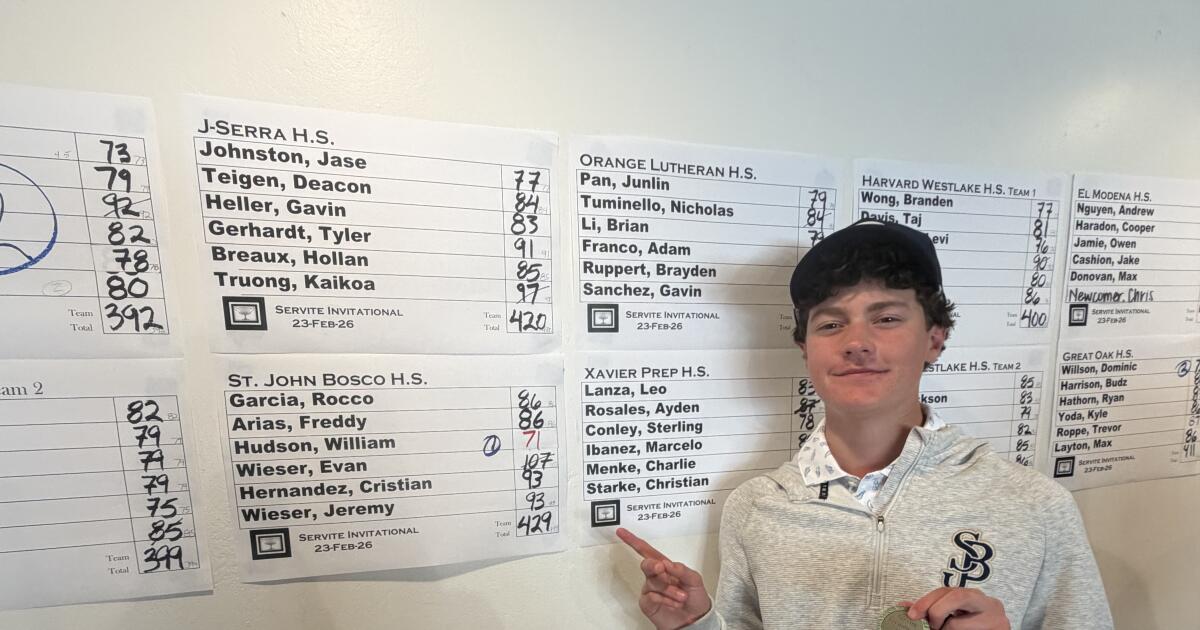
William Hudson, a 14-year-old freshman golfer, shot 71 on Monday at Western Hills Country Club in Chino Hills to win the Servite Invitational.
“It was very important to me and my school,” Hudson said.
Some think it’s the first time a St. John Bosco student won an invitational title.
Hudson is a straight-A student who picked up his first golf club when he was 3. He has a daily routine involving practicing at 6 a.m. before heading to school. He’s also enrolled in a school entrepreneur program that involves taking classes at a junior college that will qualify for college credits.
“They are long days, but I get through it,” Hudson said.
He comes from a family that enjoys golf. His great-grandfather played until his death at 98 last year.
“I love how it can take me to interesting places and meet interesting people,” Hudson said. “I can play for the rest of my life. It’s a lifelong sport.”
It’s looking like another strong year for golfers in Southern California, with several individual champions returning, including Jaden Soong of St. Francis and Grant Leary of Crespi.
Now Hudson has thrust himself into the conversation.
This is a daily look at the positive happenings in high school sports. To submit any news, please email eric.sondheimer@latimes.com.
Sports
Dashcam video shows former WWE executive Vince McMahon rear-ending vehicle on Connecticut highway

NEWYou can now listen to Fox News articles!
Police have released new video showing former WWE Chairman Vince McMahon speeding before crashing his 2024 Bentley Continental GT into another luxury car on a Connecticut highway last summer.
McMahon appeared to be followed by a state trooper in Westport moments ahead of the eventual collision. McMahon’s vehicle reached speeds of more than 100 mph, state police said.
A trooper’s dashcam video showed McMahon accelerating and then braking too late to avoid rear-ending a BMW. The car McMahon was driving then swerved into a guardrail and careened back across the highway. A cloud of dirt, apparently mixed with vehicle debris, was visible in the immediate area of the crash.
WWE owner Vince McMahon enters the arena during WrestleMania at AT&T Stadium on Apr 3, 2022 in Arlington, Texas. (Joe Camporeale/USA Today Sports)
“Why were you driving all over 100 mph?” a state trooper asked McMahon after catching up to the wrecked Bentley.
“I got my granddaughter’s birthday,” McMahon replied, explaining he was on his way to see her. The encounter was recorded on police bodycam video.
No serious injuries were reported in the July 24 crash, which happened the same day former professional wrestler Hulk Hogan died of a heart attack in Florida.
In an image taken from Connecticut State Police police bodycam video, Vince McMahon is questioned in his car after an accident on July 24, 2025, in Westport, Connecticut. (Connecticut State Police via The Associated Press)
Aside from the damage to the rear of the BMW, another vehicle driving on the opposite side of the parkway was struck by flying debris. The driver of that third car happened to be wearing a WWE shirt, police video suggested.
McMahon was cited for reckless driving and following too closely. In October, a state judge allowed him to enter a pretrial probation program that could erase the charges if he completes it successfully.
He was also ordered to make a $1,000 charitable contribution. His attorney, Mark Sherman, called the crash simply an “accident.”
“Not every car accident is a crime,” Sherman said. “Vince’s primary concern during this case was for the other drivers and is appreciative that the court saw this more of an accident than a crime that needed to be prosecuted.”
Vince McMahon attends a press conference to announce that WWE Wrestlemania 29 will be held at MetLife Stadium in 2013 at MetLife Stadium on Feb. 16, 2012 in East Rutherford, New Jersey. (Michael N. Todaro/Getty Images)
State police said a trooper was trying to catch up to McMahon on the parkway and clock his speed before pulling him over. They said the incident was not a pursuit, which happens when police chase someone trying to flee officers. They also said it did not appear McMahon was trying to escape.
“I’m trying to catch up to you, and you keep taking off,” State Police Det. Maxwell Robins said in the video.
“No, no no. I’m not trying to outrun you,” McMahon clarified.
An accident information summary provided to the media shortly after the crash did not mention that a trooper was following McMahon.
The trooper’s bodycam video also shows him asking McMahon whether he was looking at his phone when the crash happened. McMahon said he was not and added he hadn’t driven his car in a long time.
After Robins tells McMahon that his car is fast, McMahon replies, “Yeah, too (expletive) fast.”
Fox News Digital submitted a public records request to obtain the police video, which was first acquired by The Sun.
McMahon stepped down as WWE’s CEO in 2022 amid a company investigation into sexual misconduct allegations. He also resigned as executive chairman of the board of directors of TKO Group Holdings, the parent company of WWE, in 2024, a day after a former WWE employee filed a sexual abuse lawsuit against him. McMahon has denied the allegations. The lawsuit remains pending.
The Associated Press contributed to this report.
Follow Fox News Digital’s sports coverage on X, and subscribe to the Fox News Sports Huddle newsletter.
Related Article

House explosion in Cleveland’s Slavic Village neighborhood catches neighboring houses on fire

A total lunar eclipse will turn the moon blood red on Tuesday

Alabama ‘Fully Aware’ of Losing Streak to Tennessee Ahead of Road Rematch

Over $150K worth of drugs seized from man in Juneau, police say

Warmer temps increase rattlesnake risks: Arizona Game and Fish

Florida High School Football Rankings: Top 25 teams – Oct. 21

Cleary's 21 help Le Moyne down Central Connecticut State 69-64 in OT

How old is Bo Nix? What to know about Oregon quarterback ahead of 2024 NFL Draft

99th annual Pony Swim held in Virginia

Indiana Members Credit Union announced as new anchor tenant at Bottleworks District

Where Iran’s ballistic missiles can reach — and how close they are to the US

Has India’s influence in Afghanistan grown under the Taliban?

Bill Clinton to testify before House committee investigating Epstein links

Read Judge Schiltz’s Order

Vulnerable House Dem lashes out at Trump’s ‘racist’ SOTU challenge: ‘That was uncomfortable’
-

 World2 days ago
Exclusive: DeepSeek withholds latest AI model from US chipmakers including Nvidia, sources say
-

 Massachusetts2 days ago
Mother and daughter injured in Taunton house explosion
-

 Montana1 week ago
2026 MHSA Montana Wrestling State Championship Brackets And Results – FloWrestling
-

 Oklahoma1 week ago
Wildfires rage in Oklahoma as thousands urged to evacuate a small city
-

 Louisiana5 days ago
Wildfire near Gum Swamp Road in Livingston Parish now under control; more than 200 acres burned
-

 Denver, CO2 days ago
10 acres charred, 5 injured in Thornton grass fire, evacuation orders lifted
-

 Technology6 days ago
YouTube TV billing scam emails are hitting inboxes
-

 Technology6 days ago
Stellantis is in a crisis of its own making