Sports
In search of Kerlon and his seal dribble


This was going to be about the search.
It was going to be one of those pieces with an absence at its heart, a kind of magical mystery write-around, Frank Sinatra Has A Cold for the Brazilian football heads.
Sometimes you get the interview. Sometimes you just have to shrug and tell the story without it. A version of the story, anyway.
That is how it was shaping up with Kerlon Moura Souza. It was going to be a long-distance profile, the story of one of the game’s strangest parlour tricks and its creator, told through the hazy prism of memory. I had dug out the videos of the dribble that made him famous and watched them countless times. Maybe it was better this way, I told myself. Nothing ruins a folk tale like interrogating the logic of its plot points.
It wasn’t that I hadn’t tried. No, the trying was going to be a big part of it. The plan was to really ham things up, to make a fruitless and objectively quite dull pursuit sound something like spycraft.
I was going to reference the pleading emails I had sent him across a period of years; the time spent tracking his whereabouts from my bedroom; the Instagram messages to his personal and business accounts; the hopeful enquiry to one of his employers. All of which yielded a grand total of… nada. A big old nothing sandwich with a side of radio silence.
As time went on, I often imagined what the title might be. ‘The Hunt for the Seal Dribbler’, perhaps. Or, if that oblique reference to his trademark move didn’t cut it with my editor, something a little more on-the-nose. ‘Kerlon: An Unrequited Love Story’ would have worked just fine.
Earlier this year, I decided the moment had come. Enough waiting, enough frustration. I was going to do it, going to write the piece, going to finally tick it off my list and forget about it.
Then I found him.
Once upon a time, there was a boy. The boy was a talented footballer. He was nippy, skilful and strong. People thought he was going to be a star one day. In many cases, that is as far as the fable goes. It is normally enough to suck people in.
This particular boy, though, also had something else. He had a special move, an invention all of his own. He could make the ball stick to his forehead. He could flick it up and just… keep it there, gravity be damned. It went with him wherever he went. He could run, even change direction, and still it stayed there, just above his eyeline, a little round pet.
Some people loved the boy, loved his trick. It was fun and it was funny in the way that unusual things can be. If anyone had thought to do it before, they had given up long before showing it off. But the boy wasn’t embarrassed and he wasn’t scared. He did the trick even when he knew it would end in tears, even after it had begun to turn strangers into enemies.
The trick made the boy famous. It also made him a target.
The kids are leaving when I arrive. They shuffle off with their parents into cars and trucks, exhausted but happy. Day two of their week-long summer football camp is over.
It is just after midday in Hemby Bridge, a commuter town just southeast of Charlotte, North Carolina. The air is hot and heavy with moisture; my T-shirt begins to stick to my back soon after I step out of the taxi. It doesn’t help that I am jogging, frantically plotting a path to the rear of the local elementary school, trying to get to the sports pitches before Kerlon leaves.
He is not expecting me. I don’t know what to expect of him.
As I approach across the grass, a man is packing the last bag of footballs into the boot of his car. He wears a bucket hat and a black training shirt. He is tanned and stocky, facial hair cropped into a neat goatee. It’s him.
I shout out his name. A grin spreads across his face.
He is gracious and friendly. He says he has lunch planned with his family, but that he will talk if I come back tomorrow, bright and early, before training. I tell him he has a deal.
Kerlon was famous before he had even played first-team football. It was an inevitability: the trick — first dusted off at youth level for Cruzeiro, then for Brazil’s under-17 side — was always destined to make waves.
For one thing, it was just so odd, so wilfully off-kilter. There are a thousand ways to dribble past an opponent, but until Kerlon came along, they pretty much all involved the feet. To watch him set off on a run, ball bobbling up and down on his brow, was to be forced to resolve what instinctively felt like a category error. Little wonder that defenders did not seem to know what to do with him in the early days; it’s hard to counteract something you can barely even understand.
The element of surprise did not last. This was the mid-2000s, probably slightly too early for the trick to be called a viral sensation, but clips of it soon started doing the rounds. One, originally posted on YouTube in December 2005, has been watched over 3.7million times since. The seal dribble, people called the move, a name that conjured colourful circus images. Kerlon swiftly became O Foquinha — The Little Seal — and it wasn’t long before his club were selling seal toys, looking to cash in on his name.
Kerlon became O Foquinha — The Little Seal (Daniel de Cerqueira/AFP via Getty Images)
There was more to Kerlon’s game than his trademark move. He was top scorer for Brazil at the South American Under-17 Championship in Venezuela, outshining future senior internationals Marcelo, Renato Augusto and Anderson. The title of another popular YouTube video compared him to Ronaldinho and while that was certainly on the generous side, Kerlon could be similarly effervescent on his day. He could hurt opposition teams with his passing, with his finishing and with his dead-ball ability. Still, everything always came back to the dribble.
Brazil went loopy for Kerlon’s dribble in a way that maybe only Brazil could. This was football as improvisational theatre, as streetwise problem-solving and, above all, as unrefined play. The seal dribble was experimental, naive curiosity supercharged by technique. It was ludic and it was ludicrous — not the thing itself, necessarily, although it did have a certain came-up-with-this-after-six-beers energy. No, the ludicrous part was that Kerlon would do it in actual matches.
He did it in the South American Championship against Colombia and Uruguay. Later, he did it for Cruzeiro in a local derby, sparking a mass brawl and a moral panic. But we’ll get to that later.

Kerlon performing his signature skill (AP Photo/Ana Maria Otero)
Beneath trees that sway in the morning breeze, Kerlon gets as comfy as the wooden bench will allow. We’re a little behind schedule — training starts in 20 minutes — so there is no great preamble, no backlift. Slowly but confidently, Kerlon just launches into the story of the trick that changed his life.
“When I was a very young kid, I would train a lot with my dad,” he says. “Just us two. One day he kicked the ball up high for me. It bounced on the floor and came up to my head. I did four or five little headers in a row, keeping the ball up. My dad stopped. He asked, ‘If you ran with the ball on your head like that, would it be a free kick?’. I said that I didn’t know but that we should find out. My dad looked up the rules and saw that it was legal. There was no issue with it.”
Kerlon’s father, Silvino, asked him to keep practising the move. At first, he would do it on the spot. Later, he tried it while walking in a straight line. “Then I would keep it up while running and finally I did it with cones, dribbling around them like they were opposition players,” explains Kerlon. “We worked on it every day in order to perfect it. It was a real process.”
When Kerlon had nailed the technique, Silvino began to think about how his son might use it in games. He bought a book on peripheral vision and incorporated that into the training regime, the idea being that Kerlon would be able to see opponents approaching even when he had the ball up high.
“It was the product of great dedication on his part,” says Kerlon. “It was easy for me to keep the ball up, but he worked out how it would work on the pitch. The strategy was all his.”
Kerlon was 13 when he first did the trick around other people. He had just joined Cruzeiro and was playing in midfield in an academy match.
“At one point, the opposition goalkeeper took a goal kick and it was just like it was in training with my dad,” he says. “My dad would hit the ball long and I would control it on my chest, lifting it into the air. The same happened in the game and off I went. The other kids just stopped. I kept going and kept going, from the middle of the field to the edge of the box. When I got to the penalty spot, I brought the ball down and scored. It was all so automatic.”
It was also proof of concept. Now that Kerlon and Silvino knew that the dribble could work, they doubled down on it. Kerlon kept practising the trick and often brought it out in matches — although never, he insists, just for the sake of it. He strongly rejects the notion that the seal dribble was some kind of gimmick.
“I think it was a solution I had available to me, a way of getting out of a tricky situation,” he says. “I never walked out onto the field planning to do it. It was just something that would happen naturally.”
It was predictable that certain people would come to view the move as a provocation. Dribbling is a blood sport at the best of times; this felt to some like an attempt to humiliate. At youth level, Kerlon would get tripped and kicked. By the time he was playing with adults, the worst challenges had started to look quite a lot like sucker punches.
Case in point: the Belo Horizonte derby in September 2007. Cruzeiro were beating Atletico Mineiro 4-3 with 10 minutes to play when Kerlon — a second-half substitute — flicked the ball onto his head following a short corner.
One, two, three touches later, Atletico full-back Coelho came along and shoulder-charged him into another dimension, making Kerlon’s head snap back with the impact. It was an awful, cynical challenge. A few seconds later, as players from both sides piled in, the scene looked like something from a martial arts movie.
The incident provoked a good deal of hand-wringing on both sides. Many thought Kerlon — the victim, by any sensible measure — was somehow to blame for the rough treatment.
“In the future, he could miss a lot of football,” said Atletico’s coach, Emerson Leao. “Maybe one day he does that, gets kicked in the face and never plays again.”
Luiz Alberto, the captain of rival club Fluminense, was even more explicit: “It’s disrespectful to his opponents. They are professionals, too. He wouldn’t get past me. I would use capoeira (an Afro-Brazilian martial art) moves if I had to. I would take the ball, his head and everything else.”
Kerlon, at least, was able to defend himself with eloquence beyond his years. “Fans go to the stadium to see a spectacle,” he said. “We need to decide what the main idea of Brazilian football is — art or violence.”

(AP Photo/Fernando Llano)
His advocates included, bizarrely, Atletico midfielder Maicosuel, as well as a number of readers of Placar magazine. “It brings people to the stadium in the same way Garrincha’s feints once did,” read one message of support, published on the letters page. “No-holds-barred fighters like that troglodyte Coelho must be punished.”
The best part of two decades later, Kerlon sees the funny side of it all. He says he realised early on that the seal dribble would be divisive.
“There was a lot of support for me in the youth sides,” he says, “but at senior level, even my own team-mates thought I shouldn’t do it. They would say I was asking for trouble. I had a few issues with the older ones. They really didn’t like it.”
What about his opponents? Did their violence get to him? Kerlon laughs. “No,” he says. “I liked it. When you love to play with freedom, when you love to dribble and beat your man, it feels good to get kicked. As long as you don’t get injured, it’s brilliant. It’s not a bad thing. It drives you on.
“You see that the other guy is pissed off with you, but you do it anyway because it’s part of your game. I think that’s cool. Look at Neymar. He feels good when he beats his man and gets fouled, when he can be a bit dramatic. That’s part of the Brazilian style.”

When it came to his coaches, some were more open to the trick than others. “A few of them thought it was unnecessary; others thought it put our team at risk,” he says. “I was always clear that I would never do the move in my own penalty area. I said I would only do it near the opposition box, where we might win a dangerous free kick or a penalty. The idea was to come up with something for the team, not for me.”
Even when he did get the green light, other issues emerged. Kerlon says one manager asked him to do the seal dribble straight from kick-off. “This is when I was playing for Sliema Wanderers in Malta,” he says. “The coach wanted Rafael Ledesma, the other Brazilian on the team, to flick the ball up for me as soon as the referee started the match. He explained this in a team talk before a match. All the other players just looked at me, as if to say, ‘Really?’.
“I said, ‘How am I going to do that? I’ll have 11 opposition players in front of me. What’s the point? What chance do I have?’. He said that I could win us a free kick. In the end, I told Ledesma to flick the ball up and I’d give it a go. But it was impossible. I took a couple of touches and then the other team just smashed into me. I injured my leg and had to go off. I didn’t even make it out of the centre circle.”
It is here that the other strand of Kerlon’s story — the diminishing returns, the gradual tumble down the slopes of the football pyramid — comes into focus.

(AP Photo/Fernando Llano)
The tide of early fanfare carried Kerlon to Italy — he moved to Inter Milan via Chievo and was represented by the late super agent Mino Raiola — but not much further. He never played a competitive match for Inter or for Ajax during a loan stint there. His next full-time employers were Fujieda MYFC in Japan. There was a fleeting spell in the U.S. with Miami Dade FC. After a handful of games in Malta and a few more in Slovakia, he retired in 2017, aged 29.
It would be easy to glance at that confounding CV and assume that Kerlon was never actually that good — that the seal dribble had written cheques that the rest of his game couldn’t cash. There may be a degree of truth to that, but the reality is that his body never allowed him to fully test the limits of his ability.
There were six ACL injuries — two of them while he was still in his teens — and a pair of serious ankle problems. Each one slowed him down. It was impossible to build up any semblance of momentum.
“I gradually lost my love for football,” he says. “After every surgery, I took six or seven months to fully recover. When I came back, it was hard to keep up, physically. Then I’d get injured again. I looked at other players and they would run up and down constantly. I tried to keep up but some muscle would go and I’d be out for three weeks.”
He endured it for as long as he could, but there was a limit. “Everything hurt by the end,” he says. “It was so bad. It wasn’t that I didn’t love football. It was that I didn’t want to be in pain anymore. That’s why I stopped.”
There is no bitterness in Kerlon’s voice. It helps that he is content with life in the U.S., his home for the last few years. He first moved to Connecticut, seeking job opportunities he felt were lacking in Brazil, then came down to North Carolina during the Covid pandemic. His family is happy and work is good: he is the technical director of the local soccer school and also puts on private sessions. “I love being involved in the game,” he says. “It’s what I know best.”
The American kids have a vague sense of his story, he says, but don’t get too excited by it. The relative anonymity suits him fine. He is happy with his legacy and has no huge desire to burnish it. He has done a couple of short interviews with Brazilian websites since retiring, but he ignores most requests. He got enough attention in those early years to last a lifetime.
“Today, I prefer a quiet life,” he says. “People tell me I have to get my name out there. No. The story is already there and people do remember. Whenever a player does a little header to himself in a game, commentators in Brazil start talking about me. ‘The Little Seal! Remember Kerlon?’. People do remember.”
I don’t mention all the messages and emails. It is always a little uncomfortable when your interviewee details his or her aversion to interviews. Perhaps sensing this, Kerlon explains why he agreed to talk.
“When you came here to find me, I felt proud,” he says. “Look at us here now: you’re from England and you found me, hidden away here. Do you understand? Look how far my dribble travelled.
“If you had just called me, I would have said I wasn’t interested. But you found me. Thank you for coming. This was nice.”
The first boys and girls are now making their way onto the training pitch. A couple look over, quizzically. I thank Kerlon for his time; he poses for a couple of photos.
There is, however, one more question. I don’t know how he’ll react to it, but I feel obliged to ask it anyway.
Can he still do the seal dribble now?
He smiles. “Easy,” he says, grabbing a ball. He throws it to me and asks me to kick it to him at chest height.
A second or two later, he’s running across the turf, his old partner in crime dancing on his forehead, the decades and the injuries and all of it fading away until only the gentle tap-tap-tap of leather on skin remains.
(Top photos: Getty Images; design: Eamonn Dalton)



Sports
Golf star records lowest round in LPGA major history with astounding performance at Evian Championship

NEWYou can now listen to Fox News articles!
There are good days on the golf course, and then there is what Haeran Ryu just did on Saturday.
Ryu, 25, recorded the lowest round in LPGA major history on Saturday with an 11-under 60 at the Evian Championship. With the South Korean golfer’s historic round, she holds a three-stroke lead.
Ryu’s round comes just two weeks after winning her first major at the Women’s PGA Championship. On the 18th hole, Ryu left a 30-foot eagle putt a few inches short, and instead settled for a birdie.
CLICK HERE FOR MORE SPORTS COVERAGE ON FOXNEWS.COM
Haeran Ryu of South Korea reacts on the 18th green after the third round of The Amundi Evian Championship at Evian Resort Golf Club in Evian-les-Bains, France, on July 11, 2026. (Stuart Franklin/Getty Images)
She said after the round that she had no idea what she had done until she counted up her scorecard.
“But after the putt and I counted my score with my caddie,” she said. “Oh my God, it’s 11-under par today. It was so amazing. My caddie says, ‘Yep.’ I’m so happy right now.”
If Ryu had made the eagle putt on the 18th hole, she would have been just the second player to shoot a 59 in LPGA history.
ZERO BS. JUST DAKICH. TAKE THE DON’T @ ME PODCAST ON THE ROAD. DOWNLOAD NOW!
Haeran Ryu of South Korea celebrates a birdie on the 15th green during the third round of The Amundi Evian Championship at Evian Resort Golf Club on July 11, 2026, in Evian-les-Bains, France. (Stuart Franklin/Getty Images)
Her 60 broke the record for the lowest round in an LPGA major by one shot. Leona Maguire and Jeungeun Lee6 in 2021, and Hyo Joo Kim in 2014, each shot 61 at the Evian Championship, which was designated as an LPGA major in 2013.
The lowest round in a men’s major is 62, which is shared by four players — Branden Grace at Royal Birkdale in the 2017 British Open, Xander Schauffele and Rickie Fowler in the 2023 U.S. Open at Los Angeles Country Club, and Schauffele and Shane Lowry in the 2024 PGA Championship at Valhalla.
CLICK HERE TO DOWNLOAD THE FOX NEWS APP
Haeran Ryu of South Korea and Lottie Woad of England interact after their round on the 18th green during the third round of the Amundi Evian Championship at Evian Resort Golf Club in Evian-les-Bains, France, on July 11, 2026. (Stuart Franklin/Getty Images)
Ryu hopes her historic third round can help propel her to a second major win in three weeks.
“That is amazing, amazing dream,” Ryu said. “So I just want that one to come true, but we have one more day.”
The Associated Press contributed to this report.
Follow Fox News Digital’s sports coverage on X, and subscribe to the Fox News Sports Huddle newsletter.
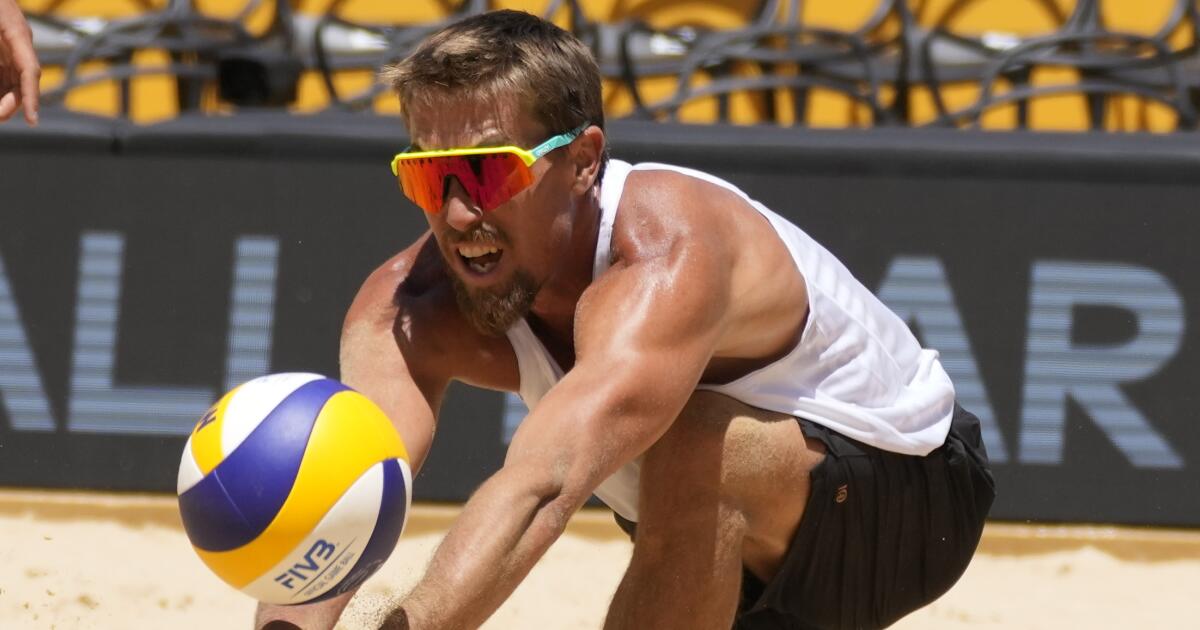
Taylor Crabb is no stranger to South California beaches. The Long Beach State alum returns home this weekend to compete in AVP League matches.
It marks the first time AVP will compete in Long Beach since 2020 and allows players to compete at the 2028 Olympics beach volleyball venue.
Crabb, 34, made his AVP debut in 2013 with his brother, Trevor, and advanced from the qualifier in Manhattan Beach before finishing 25th in his first tournament.
After years of competing with various different partners, Taylor Crabb and Andy Benesh have delivered the top performances this AVP season.
The following interview with Crabb has been edited for clarity and length.
Are you excited to compete in this weekend’s event at Long Beach?
Crabb: Very excited. A lot of my college teammates and part of the school have reached out, saying that they’re gonna come. So I’m excited to get a chance to play in front of them again.
When was the last time you were in Long Beach?
Crabb: I always try to go down there for alumni events or any big games they have. I went to UCLA against Long Beach last year, when it was No. 1 versus No. 2, so I always try to get down there and support them.
You missed out on the chance to compete in the 2020 Olympics because of COVID-19 restrictions and chose not to pursue a spot at the 2024 Olympics. Are you fired up to try to compete in the 2028 Olympics, knowing that Long Beach will host the competition?
Crabb: Yeah, it’s definitely an exciting time having the Olympics in Long Beach, and we kind of get to break it in this weekend. As you said, Tokyo didn’t go the way I wanted, but I’m going full force now. I have a great partner in Andy Benesh, who obviously went to the Paris Olympics, and if it weren’t for the Olympics being in Long Beach, and me getting a partner like Andy, I’m not even sure I’d be going for it, but because of those two things, I want to make the most of it.
You mentioned that if it wasn’t for a partner like Andy, you wouldn’t be going for it. What do you mean by that?
Crabb: I didn’t feel motivated by playing in all the international events, but now, I think, sitting out kind of lit the fire under me, and I’m really motivated now.
You’ve had different partners throughout your time. What other motivation does Andy give you?
Crabb: He’s been, in my mind, the top blocker for the U.S. the last four or five years. Seeing the professionalism he brings every day to practice, on and off the court, while traveling and when showing up to tournaments, it rubs off on you and that’s really motivating to see. And I just want to make him proud.
Why do you love volleyball?
Crabb: A lot of reasons, but it’s just a feeling I have when I’m out there on the court. It feels natural. It feels like home. I was born into a volleyball family. I had a volleyball in my hands my entire life, so I’ve always just enjoyed it.

NEWYou can now listen to Fox News articles!
CM Punk appeared on “Friday Night SmackDown” ready to take on any challenger that was ready to step to him after winning the Undisputed WWE Championship against Sami Zayn.
Punk entered the ring in Oklahoma City and called back to the “Monday Night Raw” after WrestleMania 42 when he told Cody Rhodes he’d be ready to deliver if a championship opportunity fell “out of the sky.”
COMPLETE PRO WRESTLING COVERAGE ON FOX NEWS DIGITAL
Cody Rhodes and CM Punk face off during SmackDown at Paycom Center in Oklahoma City, Okla. (Craig Ambrosio/WWE via Getty Images)
“When championship opportunities fall out of the sky, CM Punk catches them,” he said.
Punk named potential SmackDown superstars he’d think might come for the title, including Gunther, Finn Balor, Royce Keys, Damian Priest and Trick Williams. He even said that Zayn could come back around and get his rematch if he wanted. He didn’t mention Rhodes’ name, but the “American Nightmare” came out uncalled and marched his way down to the ring.
“I don’t think you and I can run away from each other anymore,” Punk told Rhodes.
Cody Rhodes looks on during SmackDown at Paycom Center in Oklahoma City, Okla., on July 10, 2026. (Craig Ambrosio/WWE via Getty Images)
Rhodes agreed and mentioned that Punk would want a match with him, just “say when.” It was a quick retort from Punk, who said, “when.” SmackDown general manager Nick Aldis, who was in the ring for the segment, booked the match for SummerSlam.
Punk will defend the Undisputed WWE Championship at SummerSlam, which takes place Aug. 1 and 2 at U.S. Bank Stadium in Minneapolis.
First, however, Punk and Rhodes will be involved in a tag team match at Saturday Night’s Main Event in New York City next week. Aldis made the match after Gunther demanded that Aldis put him in a match against Punk. Gunther was hoping it would be for the championship. Instead, Gunther will tag with Zayn.
Gunther didn’t take too kindly to that and attacked Aldis. Rhodes came back out to break up the calamity. He wanted to take on Gunther after the show went off air but Gunther walked away.
Gunther makes his entrance during SmackDown at Paycom Center in Oklahoma City, Okla., on July 10, 2026. (Rich Wade/WWE via Getty Images)
CLICK HERE TO DOWNLOAD THE FOX NEWS APP
Punk definitely has his hands full as he moves to SmackDown to become a fighting champion.
-
World1 minute ago
Iranians Bury Slain Leader Amid Renewed Fighting
-
 Lifestyle42 minutes ago
Azar Nafisi on the movie adaptation of ‘Reading Lolita in Tehran’
-

 Technology54 minutes ago
After years of teasing, the viral Nopia synth is ‘basically finished’
-

 World56 minutes ago
Beloved musicians among victims in deadly Bahamas plane crash; aviation authority grounds flights
-

 Politics1 hour ago
Trump-aligned House holdouts accused of holding ‘life-saving’ veterans bill ‘hostage’ over SAVE America Act
-

 Health1 hour ago
Simple sitting change linked to lower risk of cancer death, study finds
-

 Sports1 hour ago
Golf star records lowest round in LPGA major history with astounding performance at Evian Championship
-

 Technology1 hour ago
Meta Verified scam threatens Facebook deletion

