Sports
In Ippei Mizuhara's text messages, problem gamblers see a painfully familiar obsession


As Astros fan Saul Malek read the criminal complaint alleging interpreter Ippei Mizuhara stole more than $16 million from Dodgers superstar Shohei Ohtani to pay his gambling debts, Malek was less stunned by the enormity of Mizuhara’s sports betting habit than by how familiar his behavior felt.
Malek, 26, is a recovering gambling addict. The rush he first chased with fantasy sports became problematic in college when he was connected with a bookie. Malek put $10 on the Royals to beat the Blue Jays. The Royals won, 15-5. Easy money. Malek won a $20 bet that weekend, underdog Bears over Steelers in overtime. Soon Malek started betting bigger — $50, then $100 — and losing. The wary voice in his head was drowned out by a more confident one claiming a big win was around the corner.
“Even if I were down thousands of dollars,” Malek said, “each game felt like the start of a new streak for me of getting back positive.”
That sort of sentiment is found throughout the 37-page criminal complaint against Mizuhara, who is charged with felony bank fraud and has been court-ordered to attend a program to treat gambling addiction. While the sums in Mizuhara’s case may be remarkable — nearly 25 bets per day, averaging $12,800, and a net loss of $40 million over two years — the behaviors exhibited are unfortunately universal, according to several problem gambling experts.
“I’d like to say it’s uncommon, but I’d be lying,” said Lia Nower, director of the Center for Gambling Studies at Rutgers University, “It’s becoming more and more common, actually.”
Nower, like the other experts interviewed, spoke generally about gambling trends because she is not involved in Mizuhara’s treatment. While the last national survey regarding the prevalence of problem gambling was released in 1999 (“At that point, we’re looking at riverboat casino and lottery,” Nower said), a Rutgers study conducted in 2021 found a prevalence rate of high-risk problem gambling of about 6 percent.
The gambling environment has changed drastically since a 2018 Supreme Court ruling struck down a federal law prohibiting sports gambling in most states. Sports betting is now legal in 38 states. It’s often just a click away, with more options than ever to bet on with in-game wagering. The commercial gaming industry is setting revenue records year after year.
Keith Whyte, executive director of the National Council on Problem Gambling, which commissioned three surveys on gambling attitudes and experiences, said the risk of problem gambling has risen significantly since 2018.
“We think both the rate and severity of gambling problems are increasing in the United States,” Whyte said, adding, “That increase is mainly due to the massive growth of online sports betting.”
It’s unclear what betting experience Mizuhara had prior to meeting bookie Mathew Bowyer, but one of the more jarring parts of the Mizuhara criminal complaint is how quickly he started losing substantial sums. About a month after first using the illegal sports book, Mizuhara requested to pay his losses in smaller denominations — $15,000 on consecutive days — due to wiring restrictions. Two weeks later, he allegedly impersonated Ohtani to bank employees and sent his first payment, for $40,010, from Ohtani’s account.
Experts refer to the phenomenon of a new gambler almost immediately getting in over their heads as “telescoping,” and young men betting online are believed to be especially vulnerable.
“They’re playing in a lot more high-risk ways, with little experience,” Whyte said, “and there’s that telescoping effect where they seem to be going from initiation to problems in a very, very rapid timeframe.”
Within a few months of his first $10 bet, Malek had a conversation with his parents, who’d noticed the bank transfers leaving his account. They talked about the risks of sports betting, and Malek stopped for a bit — mostly because he’d run out of money to pay bookies. Then, one week, he realized his credit line with a bookie had reloaded despite not making a payment. He saw that as his chance to win it all back. He lost it all instead. That was Malek’s introduction to playing on credit. He started betting money he didn’t have. When Malek ran out of credit with one bookie, he’d block their phone number and find another bookie, hoping he’d win enough to pay back the previous bookie. When he ran out of bookies, he made a dating profile with photos of a woman he knew and used it to ask would-be suitors if they knew any bookies.
“It sped up pretty quickly,” he said.
Compulsive bettors often operate under the illusion of control, thinking that in sports betting, compared to a game of chance like slot machines, their expertise will give them an upper hand. Nower said problem gamblers, some of whom will have pre-existing vulnerabilities, will confront operant conditioning — the interval ratio reinforcement schedule tells them a win is coming, but they don’t know when — and develop erroneous cognition.
“You start to think you can control the outcome of random chance, which of course you can’t,” Nower said.
“The step of going from betting in a controlled manner and with resources you have and can afford to lose, versus tipping over into a loss of control, is very individual,” said Rachel Volberg, an epidemiology professor at the University of Massachusetts-Amherst who studies problem gambling. “When we consider things like slot machines, the trigger there can often be a very large win early on in your gambling career. That seems to set your brain up to expect that it may happen again. You end up chasing after that and losing a great deal.”
Chasing losses — increasing bets to win back money — is, in theory, a way to make up ground quickly. In practice, it is a great way to get deeper in the hole. A tendency to chase losses requires access to more and more money or credit. Mizuhara had both. Aside from allegedly stealing from Ohtani’s account, Mizuhara regularly asked his bookie to “bump” (or extend) his line of credit.
Jan. 15, 2022: F— I lost it all lol … can you ask (Bowyer) if he can bump me 50k? That will be my last one for a while if I lose it.
Nov. 14, 2022: I’m terrible at this sport betting thing huh? Lol . . . Any chance u can bump me again?? As you know, you don’t have to worry about me not paying!!
Dec. 9, 2022: Can u bump me last 200? I swear on my mom this will be the last ask before I pay it off once I get back to the states. Sorry for keep on asking. . . .
June 23, 2023: I’m the worst lol . . . can’t catch a break. . . . Can I get one last bump? I swear this is gonna be my last until I get the balance down significantly . . . . I promise this will be the last bump for a while.
June 24, 2023: I have a problem lol. . . . Can I get one last last last bump? This one is for real. . . . Last one for real
“I would imagine that if someone has access to a large amount of money, they may believe that they can borrow the money, win it back and put it back in,” said Dr. Marc Potenza, a psychiatrist at the Yale School of Medicine. “Then when that doesn’t happen and they get deeper into a hole, they believe that they can win back that money and things spiral increasingly out of control.”
In many cases, a compulsive gambler is not necessarily satisfied by just breaking even; they’re chasing the thrill of the action. As with other addictions, gamblers build tolerance, Whyte said, so they start to bet bigger. Our bodies haven’t developed a physical defense to compulsive gambling. “There’s not enough money in the world to overdose somebody with a gambling problem,” Whyte said. “It is infinitely scalable, it seems, which is really tough if that’s the high you’re chasing.”
On March 10, 2022, two years before his gambling became public, Mizuhara messaged Bowyer asking to lower his line of credit from $300,000 to $100,000. “I’ll get too reckless with 300,” Mizuhara wrote. But this attempt to put a guardrail in place, to minimize the harm his habit could do, didn’t last long. Mizuhara owed his bookie more than a million dollars in May 2022, according to investigators, and he continued to receive betting-limit bumps — some at his request, other times offered by Bowyer.
“(Problem gambling) is rarely linear,” Whyte said. “There are a lot of stops and starts. People try to cut back, or they have a huge loss or big win. Even though the downward spiral is still pretty consistent, it’s not a smooth curve. There’s lots of bumps along the road.”
“These are all really, really sad stories,” added Volberg. “I’ve sat in Gamblers Anonymous meetings and listened to some horrific stuff. Mizuhara’s (story) is really a tragedy.”
Reporters follow Mizuhara’s attorney, Michael J. Freedman, after he left federal court last week following Mizuhara’s hearing. (APU GOMES/AFP via Getty Images)
There are some safeguards available, but they are not mandatory across the United States. Bettors can set limits on their bank accounts. They can install bet-blocking software on their phone or computer. If they are betting with a regulated book like DraftKings or FanDuel, they can implement limit-setting features in betting apps to cap how much they can bet in a given timeframe. “A very small percentage of people — we’re talking 4 percent to 6 percent at the most — even use these features,” Nower said. “It’s really unfortunate.” (Mizuhara was betting with an illegal bookie, which lacked any protections like the self-regulating options often required of legal sportsbooks.)
Several experts have called for increased federal support regarding problem gambling. Nower has lobbied for a federal regulatory agency to set minimal standards in several gambling areas, and for regulators from different states to put together uniform best practices across states. Whyte said gambling policy needs to begin with educating kids long before they place a bet, and it’ll take will and funding to build that framework. Given how much the gambling environment has changed recently, Dr. Potenza said, “We have to collect the information to make sure that we protect vulnerable individuals and promote public health.”
Mizuhara appeared in federal court last week, one day after prosecutors charged him with felony bank fraud, which carries a sentence of up to 30 years in prison. He surrendered to authorities and was released on a $25,000 bond. He was also barred from gambling or entering casinos and was ordered to enter a gambling addiction treatment program.
Whyte’s advice for any compulsive gambler: install limit-setting tools, then tell a friend. “Addiction breeds in shame, stigma and silence,” he said. The National Council on Problem Gambling fielded over 325,000 calls and texts to their 1-800-GAMBLER national helpline last year. “It’s still only a fraction of the 9 million people we think have (gambling) problems,” Whyte said. “But for some of those 325,000, that’s the first time they’ve told anybody in the world. It’s an anonymous person on the other end of the phone, but with that one step everything else becomes possible.”
Malek started going to Gamblers Anonymous meetings at his parents’ urging before his junior year of college. He owed somewhere between $20,000 and $25,000 across eight bookies and he had run out of bookies. “I was like how people describe a dry drunk, just white-knuckling. I didn’t have any access.”
After a breakup, Malek confided in a Gamblers Anonymous mentor about how betting had upended his life. He was suicidal. He couldn’t sleep. He was lying and cheating. “I had no real hope in life with the way I was going,” he said.
He tried the Gamblers Anonymous 12-step program, and he stuck to it.
Almost six years later, Malek is still paying off some of his debt. But he is now a public speaker, traveling the country talking about gambling addiction. He reads Mizuhara’s account and it brings back conversations he had with bookies, the way he spoke with them like old friends, like he was just a light-hearted, easy-going guy who was dealing just fine with the fact he was losing money he didn’t have.
(Top photo of Ohtani and Mizuhara: Dustin Bradford / Getty Images)



NEWYou can now listen to Fox News articles!
Football fans are airing their frustrations about the continuing rise in the costs of watching the NFL.
As the league has continued to strike new media deals with different streaming services, fans are left scrambling to figure out not only which channel or streaming service the game is on, but also whether they subscribe to that service. OutKick’s Davey Hudson took to the streets of Nashville and New York City to talk to aggrieved football fans.
“I think it’s frustrating when you just want to watch a game, and you have to figure out what app it’s on. And then you’re paying for multiple apps all the time,” one fan said.
New England Patriots fans look upset as the Patriots lose in the second half of an NFL game against the Chicago Bears at Gillette Stadium in Boston, Massachusetts, on Oct. 24, 2022. (Matt Stone/MediaNews Group/Boston Herald via Getty Images)
Another fan was blunt, calling the current system of watching games “f—ing stupid.”
“Well, it’s f—king stupid, you have to get five different platforms to watch all of the games that you want to, and still you have to pay on top. It’s ridiculous at this point,” the fan said.
One fan called it a “pain in the a–” to keep track of where and when the games are being streamed.
A different fan called it a “money grab,” citing Netflix as the latest streaming service the NFL brought in to start broadcasting its games.
One fan, who said he is a New York Jets season ticket holder and has the NFL package, lamented that he still does not have access to every game.
FCC TAKES NOTICE AS AMERICA’S MOST POPULAR SPORT BECOMES INCREASINGLY COSTLY, FRUSTRATING TO CONSUME
NFL fans walk outside the Super Bowl Experience at the Moscone Center in San Francisco, California, on Feb. 6, 2026. (Ronald Martinez/Getty Images)
“I can’t tell you how frustrating it is when I feel like I have every service, I have Jets season tickets, I have the NFL package, and then there is still games on top of that that I don’t have access to. It gets very frustrating,” the fan said.
Multiple fans said they pay for at least three, if not four streaming services. Numerous other fans said they pay for five or six different services at this point.
The fan who called the current system “f—king stupid,” said that she thinks that the NFL is taking the long way around to returning to satellite TV.
“Well, I think what’s actually going to happen is we are just taking the long way around going back to like satellite TV, and we are in the last stages of this part of it. It’s all going to conglomerate at one point,” she said.
CLICK HERE TO DOWNLOAD THE FOX NEWS APP
Denver Broncos fans cheer during a game against the New England Patriots in the fourth quarter of the Patriots’ 10-7 win in the AFC Championship Game at Empower Field at Mile High in Denver, Colorado, on Jan. 25, 2026. (Aaron Ontiveroz/The Denver Post/Getty Images)
NFL fans who want access to every game need to purchase YouTube TV for “NFL Sunday Ticket,” in addition to the costly subscriptions for all the streaming services the NFL broadcasts on. Those streaming services are Amazon Prime, Peacock and Netflix. The combination of those respective services is over $1,500 a year, and that doesn’t include the fees that come with basic cable packages or high-speed Wi-Fi that is needed to accommodate the platforms.
Federal Communications Commission (FCC) Chairman Brendan Carr said he was concerned that the rising prices of streaming games are maddening for sports fans, and it appears his concerns are valid.
Fox News’ Brian Flood contributed to this report.
Follow Fox News Digital’s sports coverage on X, and subscribe to the Fox News Sports Huddle newsletter.
Sports
Tom Brady’s calculated trash talk connects WrestleMania to Fanatics Flag Football to Las Vegas
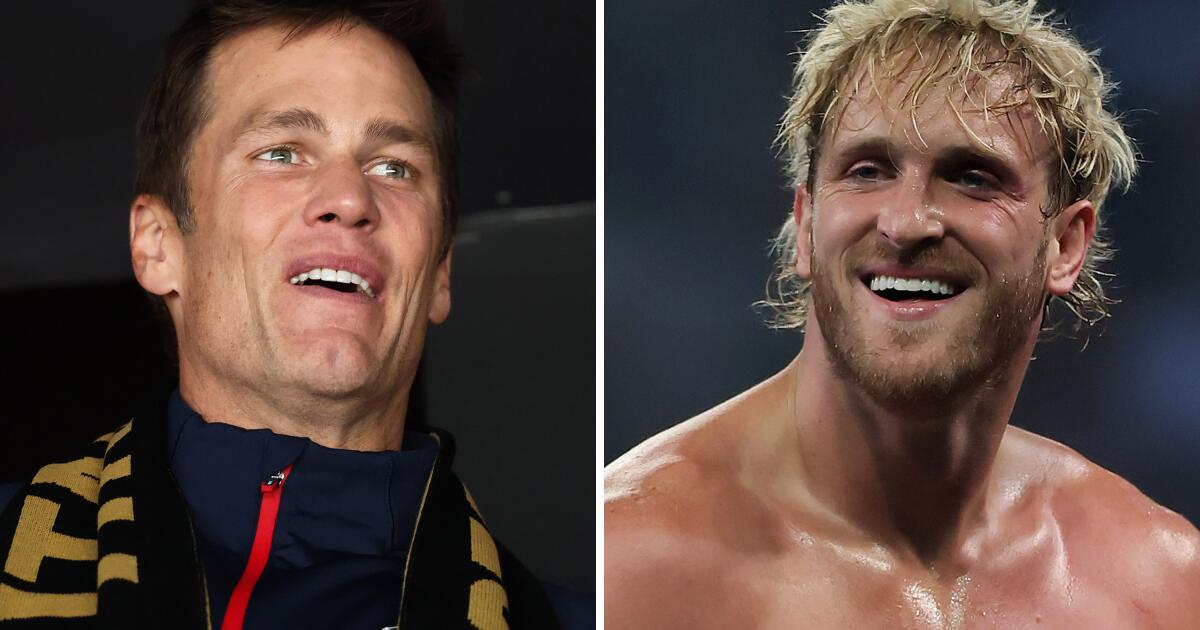
Fake is the operative word. Tom Brady’s beef with Logan Paul, Paul’s beef with Rob Gronkowski and Brady’s beef with World Wrestling Entertainment all are as fake as plant-based meat.
It’s also so much fun.
That’s the consensus opinion of fans and participants alike to the promotional shenanigans ahead of this weekend’s Fanatics Flag Football Classic at BMO Stadium in Los Angeles and next month’s WWE WrestleMania 42 at Allegiant Stadium in Las Vegas.
Brady used the word himself, calling wrestling “fake B.S.” Wednesday night at the Flag Football Classic draft at a Beverly Hills hotel. The comments came shortly after Brady went on Paul’s “Impaulsive” podcast and told the WWE star in no uncertain terms that he was not on the same athletic level as NFL players.
Paul took exception, pointing out that he played linebacker in high school. He is on the flag football roster of Team Wildcats alongside NFL quarterbacks and captains Joe Burrow and Jayden Daniels, so inquiring minds can evaluate Paul’s gridiron bona fides during the three-team flag fun televised at 1 p.m. PDT Sunday on Fox Sports.
In addition to Team Wildcats, the inaugural flag football event features a team led by Brady and Jalen Hurts called Founders and another consisting of the U.S. men’s national flag football roster.
In promoting the venture, Brady poked the enormously popular WWE organization, telling Paul, “You know, I love WWE. It’s very cute. But honestly, this is like real football. This is just real competition.
“I’m glad you’re going to be there and finally participate in a competition that matters.”
Brady upped the ante after Sports Illustrated playfully asked how many WWE wrestlers it would take to sack him.
“They wouldn’t even get near me,” he replied. “Plus, if I had a good offensive line, they’d punch those guys right in the throat and they’d probably be crying.”
All a deft segue to WrestleMania 42, which many followers suspect is positioning Brady to be some sort of scripted villain during the WWE’s annual five-day extravaganza. Last year WrestleMania 41 attracted more than 100,000 fans to Allegiant Stadium, generating roughly $65 million in ticket revenue and reaching a global audience with more than a billion social media views.
Adding the greatest quarterback of all time would only boost those numbers. Introducing a surprise antagonist has long been a key ingredient of the WWE recipe, and at this point Brady surfacing is all but expected.
The seven-time Super Bowl champion has morphed into a glue guy, whose employment as a Fox Sports NFL television analyst, part owner of the Las Vegas Raiders and key partner with Fanatics binds him with almost every major stakeholder in the Flag Football Classic and WrestleMania 42. Every stakeholder except the WWE.
That gives Brady license to take good-natured shots at wrestling for now and positions him to become a high-profile heel at WrestleMania 42.
It’s no coincidence that both events are in partnership with Fanatics, the outfit that has grown from designing and manufacturing licensed fan gear into a ubiquitous global digital sports platform and e-commerce company.
That leaves only the feigned feud between Paul and Gronkowski — Brady’s longtime pal and New England Patriots teammate. It started when Gronkowski labeled Paul a “flake” on a podcast a few days ago after Paul made a $1-million boxing challenge to NFL players and subsequently backed out of a fight with former running back Le’Veon Bell.
The tongue-in-cheek beef culminated in a verbal volley at the flag football draft with Gronkowski jawing at Paul while balancing a paper plate stacked with hors d’oeuvres and Paul shouting back over the head of 5-foot-5 comedian Kevin Hart, who somehow found himself in the role of peacemaker.
“No one can tackle me. So if Logan Paul wants a piece of me, I’m down to throw it down on the field and even throw my fist and just go at it, an all-out brawl on the flag football field,” Gronkowski said with an impish grin.
Crazy how Fanatics posted a video of the exchange so quickly. It had racked up 250,000 views as of Friday morning. Just Gronkowski and Paul following Brady’s lead, knowing their job descriptions include promotion as well as performance.

NEWYou can now listen to Fox News articles!
Venezuela defeated Team USA, 3-2, in the World Baseball Classic (WBC) final Tuesday, and the game was historic in more ways than one.
Venezuela won its first-ever WBC title, and players flooded the field with emotion and pride as they celebrated the thrilling victory.
History was also made during the telecast when 10,784,000 viewers watched the final on FOX and FOX Deportes.
It became the most-watched WBC telecast of all time.
Fox Sports broadcaster Tom Verducci interviews MVP Maikel Garcia of Venezuela and his translator after a 3-2 victory against the United States at loanDepot Park March 17, 2026, in Miami, Fla. (Al Bello/Getty Images)
The telecast averaged 10,228,000 viewers, while hitting its peak at 12,148,000 from 10:30-10:45 p.m. ET on FOX.
This number was up 128% from the Team USA-Japan WBC final on FS1 during the 2023 tournament, when Shohei Ohtani struck out Mike Trout to seal a third WBC win for his country.
TRUMP RAISES EYEBROWS WITH ‘STATEHOOD’ COMMENT AFTER VENEZUELA BEATS THE US IN WORLD BASEBALL CLASSIC
While this game had all the thrills, the WBC turned out to be an exciting tournament from the very start with pool play.
Whether it was feel-good stories like Ondřej Satoria’s standing ovation from Japanese fans at the Tokyo Dome during his final outing for Czechia or Italy’s espresso machine home run celebration, viewers from all over were tuning in to watch magic happen on the diamond.
Fox Sports broadcaster Tom Verducci interviews manager Omar López Team Venezuela after a 3-2 victory against the United States at loanDepot park March 17, 2026, in Miami, Fla. (Megan Briggs/Getty Images)
The tournament averaged 1,294,000 viewers across FOX, FS1 and FS2, making it the most-watched WBC in its 20-year history on English language networks.
It looked like Venezuela was going to shut out Team USA, which had just two hits and four base runners in the bottom of the eighth inning when Bryce Harper walked to the plate.
The game turned on its head when Harper belted a two-run homer to tie the game during the peak viewing window.
Venezuela, though, never blinked. Eugenio Suarez hit a rope to left-center field, scoring the game-winning run with a double.
Members of Team Venezuela celebrate with their gold medals after defeating the United States 3-2 at loanDepot Park March 17, 2026, in Miami, Fla. (Al Bello/Getty Images)
Daniel Palencia closed things out for Venezuela, sealing the win with a strikeout of Roman Anthony. The party ensued for Venezuela at loanDepot Park.
Follow Fox News Digital’s sports coverage on X and subscribe to the Fox News Sports Huddle newsletter.

Farmington, Farmington Hills push for revitalization of Grand River

Elderly driver sentenced to probation in West Portal crash that killed family of 4

Dallas Police tweak off-duty job rule after saying man impersonated police

Fire tears through longtime Miami Gardens home of retired teacher

National Park Service removes historic films about mill workers in Lowell

Florida High School Football Rankings: Top 25 teams – Oct. 21

How old is Bo Nix? What to know about Oregon quarterback ahead of 2024 NFL Draft

Cleary's 21 help Le Moyne down Central Connecticut State 69-64 in OT

99th annual Pony Swim held in Virginia

Indiana Members Credit Union announced as new anchor tenant at Bottleworks District

Pritzker pushes prosecutions of Trump officials as part of Dem ‘Project 2029’ agenda

Iran’s Khamenei says enemy ‘defeated’ in written Nowruz message

Gold Trump coin moves forward after Treasury invokes rare authority

Meet the longtime biz partner of Ilhan Omar’s husband as questions swirl over her skyrocketing net worth

‘Nobody can blackmail us’: Leaders excoriate Orbán’s veto
-

 Detroit, MI2 days ago
Drummer Brian Pastoria, longtime Detroit music advocate, dies at 68
-

 Oklahoma6 days ago
Family rallies around Oklahoma father after head-on crash
-

 Nebraska1 week ago
Wildfire forces immediate evacuation order for Farnam residents
-

 Georgia5 days ago
How ICE plans for a detention warehouse pushed a Georgia town to fight back | CNN Politics
-

 Massachusetts1 week ago
Massachusetts community colleges to launch apprenticeship degree programs – The Boston Globe
-

 Alaska6 days ago
Police looking for man considered ‘armed and dangerous’
-

 Colorado1 week ago
‘It’s Not a Penalty’: Bednar Rips Officials For MacKinnon Ejection | Colorado Hockey Now
-
 Southwest1 week ago
Talarico reportedly knew Colbert interview wouldn’t air on TV before he left to film it