Sports
If Nick Saban wants to help NIL and college football, he should be realistic about it


Nick Saban has been an excellent addition to ESPN’s “College GameDay,” adding deep and digestible film analysis, well-prepared insight on teams around the country and a sense of humor that may surprise some — culminating in Saturday’s back and forth with the show’s “celebrity guest picker” from Tuscaloosa, his wife, Terry.
But he has a lot of work to do on what’s actually happening with the economics of college football, which is disappointing because he should be an important voice on player compensation and movement. On Saturday he was a disingenuous voice, painting a picture of the past that insults the intelligence of anyone who follows the sport and pining for a future that would amount to going backward.
The panel got into a discussion of the big story of the past week, UNLV quarterback Matthew Sluka’s announcement that he’s done for the season because promised financial obligations weren’t met. Sluka’s agent told ESPN he was “verbally promised” at least $100,000 and Sluka’s father, Bob, told The Athletic’s David Ubben that the negotiation happened in February — and that the family didn’t ask for more during UNLV’s 3-0 start to become a College Football Playoff contender.
That’s been disputed, and absolute truth on this story is unlikely. “College GameDay” host Rece Davis said, appropriately, of the situation: “If the promise was made, let’s not let (whoever made it) off the hook either. That’s despicable, that’s sleazy, to try to get a kid like that.”
Saban, unfortunately, was eager to interject.
“But at the end of the day, what kind of value did that young man create for himself by making this decision?” Saban said. “Being put in this situation and then making this decision. What kind of real value does he create for his future by doing this? And that’s the unfortunate thing about all this.”
“Yeah, chasing short-term money, affecting their future,” Kirk Herbstreit added.
So let’s try to answer that question, regardless of what exactly happened with Sluka and UNLV. If he were promised this money and didn’t get it, he wasn’t trying to “create value” for himself — he was understandably frustrated about being wronged despite demonstrating value. If his camp is lying about the promise, that’s obviously wrong of them — but if he’s received just $3,000 for his work at UNLV, which has not been disputed, that’s ridiculous and unacceptable in today’s market.
The market is hazy, sure, but we know enough about it to know that a quarterback of Sluka’s quality joining an FBS program — which has millions of dollars at stake as a viable candidate for the 12-team Playoff — should have five figures in the bank before he completes a pass.
So if I’m hearing correctly, pay for play started with NIL. Per the former Alabama coach who had a lot of amazing players over the years who were all fine with tuition, room, board, books, etc.
— Joe Rexrode (@joerexrode) September 28, 2024
The answer to Saban’s question is that Sluka has already created value, by graduating from Holy Cross, by starring there and earning an opportunity to play at a higher level, and then by excelling at that level. This means he should and will have another college opportunity next season, and he should be paid market value for it.
It’s almost as if Saban thinks everyone is an NFL prospect — Sluka likely isn’t — or as if having millions of dollars makes it difficult to understand what $100,000 can do for the life of a young person who is not destined for millions.
It’s disappointing. Because Saban should offer a lot of value to this discussion and has made other points that resonate.
He has said he retired from coaching in part because the discussion from his players after last season ended in the CFB semifinals was all about money, and I believe him. He’s right that there can be a benefit to sticking out tough times when things don’t go well early for a player. He’s right about the high value of having a university and program as a home base, with enduring connections, long after playing.
He would have been better off Saturday talking about locker-room dynamics in this era, as opposed to advocating for a future with a combination of revenue sharing — which is, of course, court-mandated and inevitable — and a “true NIL” based solely on marketing opportunities.
This remains an apparent NCAA fantasy as well, though the richest programs in college football will continue to pursue the best players so they can win and profit as a result. Which will always create a market beyond obligatory compensation. Which isn’t new.
It’s just that a lot more money is going to players, in tandem with constant player movement, which means some form of players organizing and signing standardized contracts must come next. There will be unintended consequences as with any major change, but it’s necessary and inevitable. I’d like Saban to embrace that reality and talk about how that will affect his previous profession.
Instead, he said this: “We’ve turned it into pay for play, because we have donor-raised funds to be able to pay people. So that system does not create value long-term for players. I mean you’re supposed to go to college to create value for your future. Now we have guys making decisions about how much money they’re gonna make. Which I’m not sure that’s what we want the college experience to be.”
Did he seriously suggest that just now we’re getting to “donor-raised funds to be able to pay people?” Is he seriously claiming such funds weren’t pooled in the past, by the very richest programs, to pay the very best prospects to help those programs win and profit? After decades of thinly disguised — and in some cases reported and NCAA-punished — bidding wars for some of those players leading up to signing days, is he really saying that just now guys are making decisions based on money?
Anyone who cares about college football should be insulted by that. Just as I’m sure Saban was when he saw the guy who helped run his Alabama recruiting operation from 2007-09, Jeremy Pruitt, cheat in such a brazen, sloppy way at Tennessee that his coaching career evaporated over it in 2021.
No one really cares about that stuff anymore, now that we’ve taken the amateurism mask off college football. Also, no one is expecting coaches to start writing tell-all books about where the bags of cash were hidden.
But we can have more honest, less disingenuous, conversations about the past, present and future. Saban talks about “value” a lot, and he knows it well — Forbes estimated he made $150 million in his coaching career. He shouldn’t devalue what a free market can and must mean to the labor force of an industry like college football.
And he should whisper one of the all-time great Saban-isms — “Don’t waste a failure” — to himself before he tackles this topic in front of millions of viewers again.
(Photo: Ken Ruinard / USA Today Network via Imagn Images)



NEWYou can now listen to Fox News articles!
With the largest World Cup field in the history of the tournament, 32 of the 48 teams will be fighting for a spot in the knockout stage.
66.6% of nations will advance out of the group stage this summer, which is a massive upgrade from 50% in past World Cups. Because of this, sportsbooks have adjusted with less favorable odds.
Prior to the start of the tournament, Spain, Argentina, Brazil, England, and Germany entered with the strongest odds to advance from the group stage, supported by recent major-tournament success and talent-rich rosters.
All five nations are heavily favored at -10000 to advance to the knockout round.
The Spaniards are the defending European Champions while the Argentinians are looking to win back-to-back titles. Germany has not made it out of the group stage in the last two World Cups, but has always been a perennial contender— having won four titles in its history. And then of course there’s Brazil, which has more titles than any country with five.
Now, after the conclusion of the first day of the World Cup, Mexico has joined the group at the top. El Tri has surged to -10000 to advance to the knockout stage after initially being just -1400. Mexico’s huge leap up the oddsboard is a direct result of its dominating 2-0 win over South Africa.
With that in mind, let’s dive into the odds for each team to advance to the knockout stage of the 2026 FIFA World Cup as of June 12.
This page may contain affiliate links to legal sports betting partners. If you sign up or place a wager, FOX Sports may be compensated. Read more about Sports Betting on FOX Sports.
Odds to Advance to Knockout Stage
Spain: -10000 (bet $10 to win $10.10 total)
Argentina: -10000 (bet $10 to win $10.10 total)
Brazil: -10000 (bet $10 to win $10.10 total)
England: -10000 (bet $10 to win $10.10 total)
Mexico: -10000 (bet $10 to win $10.10 total)
Germany: -10000 (bet $10 to win $10.10 total)
Portugal: -5000 (bet $10 to win $10.20 total)
France: -5000 (bet $10 to win $10.20 total)
Belgium:-3500 (bet $10 to win $10.29 total)
South Korea: -2500 (bet $10 to win $10.40 total)
Switzerland: -1800 (bet $10 to win $10.56 total)
Netherlands: -1400 (bet $10 to win $10.71 total)
Morocco: -1000 (bet $10 to win $11 total)
Colombia: -1000 (bet $10 to win $11 total)
Uruguay: -1000 (bet $10 to win $11 total)
Canada: -1000 (bet $10 to win $11 total)
Ecuador: -900 (bet $10 to win $11.11 total)
Norway: -900 (bet $10 to win $11.11 total)
United States: -750 (bet $10 to win $11.33 total)
The U.S. men’s national team is currently -750 to advance from Group D (Photo by Omar Vega/USSF/Getty Images).
Croatia: -500 (bet $10 to win $12 total)
Austria: -500 (bet $10 to win $12 total)
Türkiye: -500 (bet $10 to win $12 total)
Ivory Coast: -500 (bet $10 to win $12 total)
Japan: -500 (bet $10 to win $12 total)
Egypt: -340 (bet $10 to win $12.94 total)
Algeria: -310 (bet $10 to win $13.23 total)
Scotland: -310 (bet $10 to win $13.23 total)
Senegal: -230 (bet $10 to win $14.35 total)
Sweden: -230 (bet $10 to win $1435 total)
Bosnia and Herzegovina: -220 (bet $10 to win $14.55 total)
Paraguay: -205 (bet $10 to win $14.88 total)
Iran: -200 (bet $10 to win $15 total)
Czechia: -165 (bet $10 to win $16.06 total)
Ghana: -140 (bet $10 to win $17.14 total)
Australia: -110 (bet $10 to win $19.09 total)
DR Congo: +100 (bet $10 to win $20 total)
Raúl Jiménez helped propel Mexico to a 2-0 win over South Africa in the opening match of the 2026 FIFA World Cup (Photo by Yair Gonzalez/Jam Media/Getty Images).
Saudi Arabia: +105 (bet $10 to win $20.50 total)
Tunisia: +140 (bet $10 to win $24 total)
New Zealand: +150 (bet $10 to win $25 total)
Uzbekistan: +180 (bet $10 to win $28 total)
Cape Verde: +200 (bet $10 to win $30 total)
Panama: +200 (bet $10 to win $30 total)
Qatar: +275 (bet $10 to win $37.50 total)
South Africa: +320 (bet $10 to win $42 total)
Jordan +350 (bet $10 to win $45 total)
Iraq: +450 (bet $10 to win $55 total)
Haiti: +800 (bet $10 to win $90 total)
Curaçao: +1000 (bet $10 to win $110 total)
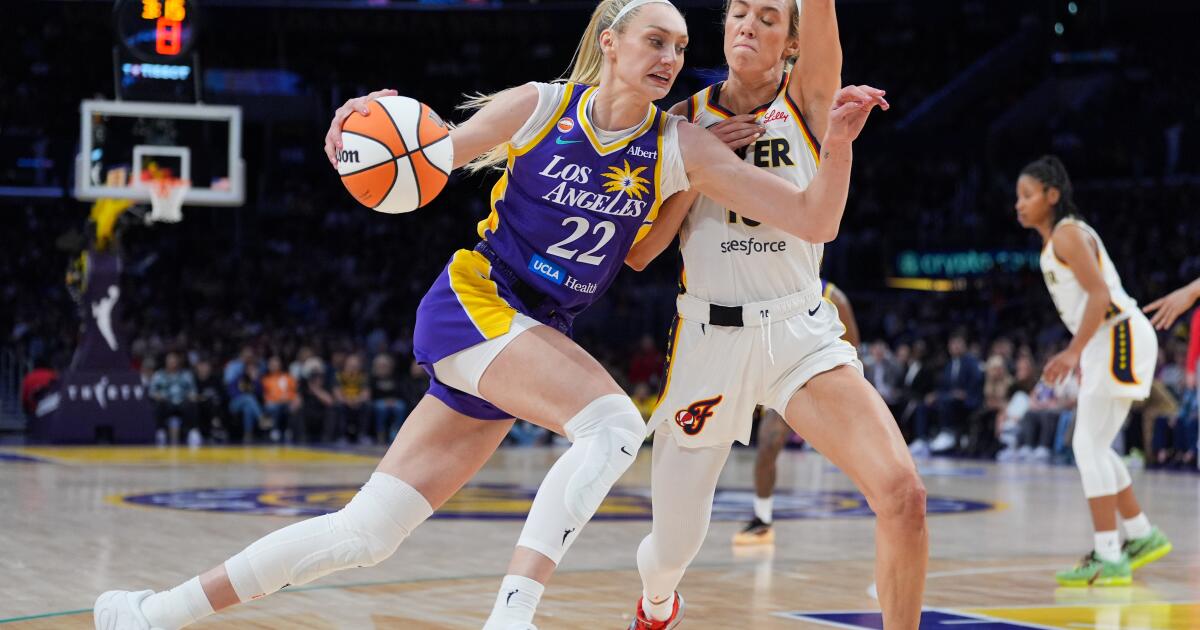
Cameron Brink said she’d appreciate some grace. She really would.
Sparks fans should give her some, because where else is she going to get it?
Certainly not from WNBA refs. Not from opponents with more to play for than ever. Certainly not from the game itself; basketball moves fast, and a bummer can become a bust in a blink.
But Brink, 24, is not on the brink of bust territory, no. Block that thought. Technically, it’s Year 3, but after a torn ACL derailed her as a rookie two summers ago, it’s practically like Year 2 for the former Stanford star. And by design, the WNBA is testing her confidence, her decision-making and her patience as she tries to reestablish herself as one of the WNBA’s best young players.
So, grace.
The recognizable 6-foot-4 forward — she’s the long-blond-haired hooper in the New Balance ads — was the No. 2 overall pick in 2024.
Now she’s her team’s No. 3 option in the post. She’s coming off the bench behind Nneka Ogwumike and Dearica Hamby for the Sparks, who are a modest 6-6 after wins this week over the expansion Portland Fire and the struggling Seattle Storm.
Against the Fire, Brink scored two points and picked up four fouls in nine minutes. Then she went to Seattle and had 15 points in 18 minutes but was pulled with more than five minutes left in the fourth quarter after getting her third, fourth and fifth fouls in 86 seconds. (WNBA players get six fouls before being disqualified.)
For the season, Brink has been called for 49 fouls in 208 minutes. A foul about every four minutes!
They’re silly fouls and they’re phantom calls. Egregious and ticky-tack. Costly and common. A real fouled-up buffet. She sets screens that get scrutinized as if by the most vigilant TSA agent. And sometimes, yes, she’s doing the accidental tripping. Other times, the officials are.
Her reputation precedes her, so everyone gets a superstar’s whistle when being defended by Brink. Opponents bake it into their game plans.
That can’t continue.
All that fouling is hindering Brink’s development because it’s robbing her of important in-game reps — which she needs, foremost, to figure out how to stop fouling.
Sparks forward Cameron Brink, left, blocks the shot of the Tempo’s Laura Juskaite during a game last month.
(Jeff Lewis / Associated Press)
“At the pro level,” said Tara VanDerveer, Brink’s coach at Stanford, “every young player always has a lot of work to do. And I saw her make a three. I see her block shots. She rebounds, she can handle the ball, she’s unselfish, she’s a terrific talent. But there’s always things players need to work on.”
We know what Brink’s thing is.
“She has to be disciplined,” VanDerveer said. “And if you want something so badly, if you want to be an All-Star someday or make the Olympic team, you’ve got to be dependable … and I think anyone can change, if it’s behavior they recognize is not in their best interests or not in their team’s best interests. It’s hard, but it’s something I think people can do.
“That’s what Cam is working on.”
And, VanDerveer added, “I’m really so excited that Nneka is there, because she will give her such great guidance and mentorship.”
And grace. Brink is getting that from Ogwumike — also a former Stanford star, the Sparks legend returned to L.A. this season after two seasons in Seattle — and her other teammates.
“I just do my best to lead by example,” Ogwumike, 35, said. “But then also let [Brink] know that she’s very capable, that she’s more than capable, which is exactly why she’s here with us and it’s exactly why we need her on this team.”

Sparks forward Cameron Brink, wearing a facemask, controls the ball while defended by Sun forward Raegan Beers.
(Joe Buglewicz / Getty Images)
But how long will Brink get grace from the Sparks in the what-have-you-done-for-me-lately business of basketball?
The foul trouble tells us why a win-now team wouldn’t trust her, why the Sparks would give meaningful minutes to two veteran post players ahead of her. Why they wouldn’t prioritize Brink’s development alongside winning as they strive to snap a previously unthinkable five-year playoff drought.
And what about fans? How patient will you all be with a player who was drafted immediately after Caitlin Clark and five spots in front of Angel Reese?
These days, that might depend on what the parlay calls for.
Or, preferably, whether you remember Brink’s first 15 WNBA games. All starts, all signs pointing to stardom. She showed up in 2024 throwing lavish block parties. Her 2.3 blocks per game were message-sending spikes, like what Lisa Leslie used to enthrall Sparks crowds with.
From the jump, she had guys coming to games at Crypto.com Arena wearing her No. 22 jersey and little girls arriving in groups with No. 22 painted on their cheeks and “I love Cam Brink” signs in hand.
And then the torn ACL cost her 25 games of her rookie season and another 25 last season, plus her spot on the United States’ Olympic 3×3 women’s basketball team in Paris in 2024.
She had to start over. Lost a lot of ground. But you see that masked woman stuck on the Sparks’ bench for all but 17 minutes per game?
You can’t miss her. She’s looking uncomfortable in protective facial gear that either hinders her breathing or her peripheral vision, her only options to protect the torn septum she suffered in a victory over the Las Vegas Aces last month.
She’s the one with the 6-8 wingspan who’s averaging 9.2 points, 4.3 rebounds and 1.5 blocks while shooting 52.1% from the field in her limited minutes.
She’s still Cameron Brink. Between fouls, she’s fluid and fast and covers more of the court than almost anyone in the WNBA, able to leap from defending guards to centers in a single bound.
“It’s just looking at every day as a new opportunity to learn and grow and not getting too bogged down when things don’t go exactly as you planned,” Brink told me. “Because more times than not, things are not going to go how you want them to. And that’s life. So I just want to be able to put my best effort out there every single night.
She knows what the Sparks need from her: “To perform, just come on the floor and compete.”
To prove she can stay on the floor to compete.

NEWYou can now listen to Fox News articles!
When will Team USA lose in the 2026 FIFA World Cup? Or, will it not lose at all?
Let’s check out the odds for the Americans’ stage of elimination at FanDuel Sportsbook, as of June 11.
Team USA — Stage of elimination odds
Last 32: +170 (bet $10 to win $27 total)
Last 16: +220 (bet $10 to win $32 total)
Group stage: +500 (bet $10 to win $60 total)
Quarterfinals: +500 (bet $10 to win $60 total)
Semifinals: +1200 (bet $10 to win $130 total)
Runner-up: +2800 (bet $10 to win $290 total)
Outright winner: +6000 (bet $10 to win $610 total)
This page may contain affiliate links to legal sports betting partners. If you sign up or place a wager, FOX Sports may be compensated. Read more about Sports Betting on FOX Sports.
The outlook appears to be … ho-hum?
If the odds ring true, the Americans are expected to make it out of the group stage but fall in the first knockout stage game.
How would that result stack up against previous results? Well, at the 2022 World Cup, Team USA made it to the Round of 16, which was viewed as a stellar accomplishment.
The U.S. men’s national team currently has 60-1 odds to lift the 2026 FIFA World Cup trophy this summer (Photo by Omar Vega/USSF/Getty Images).
In 2018, the USA did not qualify for the World Cup, and in 2014 and 2010, the Americans also made it to the Round of 16. Their best result this century occurred in 2002, when the Americans made it all the way to the quarterfinals before being eliminated.
In 1998, Team USA lost in the group stage, in 1994, it fell in the Round of 16, and in 1990, it also fell in the group stage.
With the expanded World Cup format, 32 teams will advance to the knockout stage (out of 48), giving teams a much better chance of getting out of the group stage than in previous tournaments. In past years, only 50% of the field advanced to the knockout round, but now 66.6% of teams will move on.
With that being said, anything less than a knockout round appearance on home soil would be viewed as a major failure this summer for Team USA.
The second result on the oddsboard is the “Last 16,” meaning the USA would make it out of the group stage and win one knockout stage game, before falling in the second knockout stage game. The third result is that the Americans failed to make it out of the group stage, and the fourth is that they made it to the quarterfinals, meaning they won two knockout stage games.
Making the semis, losing in the championship game and winning the championship are the three results with the longest odds.
The U.S. begins its World Cup journey on Friday as the Stars and Stripes face Paraguay at Los Angeles Stadium. Getting off to a fast start in the group is crucial for the team’s World Cup dreams of making a deep run this summer.
-

 North Carolina8 seconds ago
NC Governor Josh Stein declares June 14 as Flag Day
-

 North Dakota5 minutes ago
Refugee day event in Grand Forks will not feature refugee participation amid safety concerns
-

 Ohio12 minutes ago
Why is Ohio is seeing so much rain, severe weather? El Niño one reason
-

 Oklahoma15 minutes ago
Star-studded cast announced for Will Rogers-inspired Oklahoma film
-

 Oregon20 minutes ago
Farm groups oppose Oregon recycling fees with ‘no public oversight’ | Capital Press
-

 Pennsylvania27 minutes ago
Pa. Senate votes down proposal to create independent cannabis regulatory board
-

 Rhode Island30 minutes ago
Grow Smart Rhode Island leader reflects on decades of change in Rhode Island development – The Boston Globe
-
South-Carolina35 minutes ago
Miss Charleston Lindsay Jones set to compete for Miss South Carolina title June 16-20


