Sports
Footballers’ shin pads – the piece of equipment some pros prefer not to wear


Michael Olise does not like shin pads.
So much so that when the France winger was being brought on for Leroy Sane during Bayern Munich’s 1-0 win over Paris Saint-Germain in the Champions League in November, he was not wearing any.
This was spotted by the game’s fourth official Florin Andrei, who instructed the 23-year-old to put some on. Olise reluctantly tucked some into his socks before slinging them out again when officials looked away.
As Michael Olise prepared to come off the bench for Bayern in their Champions League game vs. PSG, he appeared to have a brief exchange with the fourth official.
Moments later, Olise was seen putting his shinpads into his socks, but then slyly removed his left guard and tossed… pic.twitter.com/ep0mqMLG79
— ESPN FC (@ESPNFC) November 28, 2024
The International Football Association Board (IFAB) laws of the game state that shin pads must be worn by all players. There are no specific rules regarding size but Law 4 states that they “must be made of a suitable material and be of an appropriate size to provide reasonable protection, and be covered by the socks”.
For years, many footballers have been playing fast and loose with their interpretation of the rules. The low socks and micro shin pads trend made cool by the likes of Manchester City’s Jack Grealish and Chelsea’s Lauren James has become vastly popular in recent years.
GO DEEPER
The art of the football sock
“I don’t wear shin pads,” Olise told a fan who tried to gift him a pair recently, although the PSG incident may have been a one-off, with the 23-year-old usually spotted wearing shin protection in matches.
The former Crystal Palace player is not the only professional footballer who would prefer to enter games shin pad free if it was up to him.
“I don’t really like wearing shin pads — we never wear shin pads in the training,” former Sheffield United striker Oli McBurnie told The Athletic in November. “I want to feel how I train every day, so I wear normal socks. I cut my socks and roll them down, and then have little bits of foam that I put in like padding just to feel as comfortable.”

Manchester City’s Jack Grealish is an infamous tiny shin pad wearer (Robbie Jay Barratt – AMA/Getty Images)
Sam Weller Widdowson is credited with inventing shin pads back in 1874. He was a cricketer as well as a footballer for Nottingham Forest, later becoming the club’s chairman and a player once capped by England. It is said that Weller Widdowson cut down a pair of cricket pads and started wearing them to protect him during football matches, and that his idea soon caught on.
Shin guards in sport have been heavily influenced by greaves, an ancient armour fashioned by soldiers dating back to the Bronze Age that protected the shinbone, which has little but skin to protect it.
It was in 1990 when FIFA (making use of IFAB’s laws) ruled that shin guards must be worn by all players in every game. Before that, players could pick and choose whether they protected their shins and ankles. Back then, shin guards were clunky and protected both a player’s ankle as well as their shin.

Custom-made Diadora shin pads made for Roma’s Francesco Totti in 2006, which now appear thoroughly retro by modern standards (Giuseppe Cacace/Getty Images)
They have slimmed down somewhat in the past three decades. Now players can source credit card — or, if you like, biscuit-sized shin guards. This trend has become a worry for grassroots football clubs, some of whom have now sought to enforce bans on young players wearing them.
Penistone Church, a team from Barnsley in South Yorkshire, made headlines last August when they put a ban in place after a 15-year-old player named Alfie suffered a double leg break when getting into a challenge while wearing miniature shin pads.
“It’s not worth the extra bit of speed to have you knocked out of football for months and months. It’s not worth the risk,” Alfie told the BBC after a 50-50 tackle left him nursing a broken tibia and fibular. The shin pads the teen was wearing at the time of the tackle measured just 3cm (1.1in) by 9cm (3.5in).
@officialbhafc The world’s smallest shin pad… 🤣 #BHAFC #AFC #PL ♬ original sound – Brighton & Hove Albion FC
Warrington Town defender Peter Clarke is 25 games away from reaching his 1,000th senior appearance since his Everton debut in the Premier League in January 2001. At 42 years of age, he says he can remember the cumbersome and bulky shin pads of the late 80s, 90s and early 2000s, with their built-in ankle protectors and velcro straps. And while he wears smaller guards than the ones he started his career with, plenty of on-pitch experiences have ensured that he has never downsized too much.
“The ones I wear now are carbon fibre and they have chips and scratches in which, when I look at them, I’m glad to be wearing them,” the centre-back, who also played for Huddersfield Town, Oldham Athletic and Tranmere Rovers, says.
“Twenty years ago, tackles would fly in a lot more. I remember going into a full-blown tackle and getting hit on the shin. As the game wore on, I realised there was blood on my sock — the studs had gone right through the shin pad and left a two-inch cut down my shin. It is a contact sport and it is wise to be well protected rather than wearing the smallest shin pads possible.”

Shin pads are designed to protect players’ legs during moments of impact (VI Images via Getty Images)
His longevity means Clarke is playing in the National League North alongside team-mates at Warrington who were born after he made his first professional appearance. What does he think is the reason that more players are opting for tiny shin pads these days?
“I don’t like the feel of them slipping around, so I wear sleeves to prevent that,” Clarke says. “Whether it is that or whether it is how an individual looks when they are playing; but I’m not sure a seven-inch piece of plastic or carbon fibre is going to slow an individual down that much. I’m not entirely sure but things have certainly changed and it is not for the best in terms of player safety.”
Clarke estimates he has used five or six pairs of shin pads throughout a career that has spanned more than 25 years and saw him defend against Thierry Henry (then of Arsenal) and Cristiano Ronaldo (then of Manchester United). He makes sure his daughter and son wear adequately-sized shin pads for their own protection when playing and encourages others to do the same.
While he has opted for plainer efforts, his children have customised guards with pictures of themselves and their family on. That is something a lot of players at all levels are opting for now, with some elite players even having pictures of just themselves on their own shin pads.

Cristiano Ronaldo wore shin pads at Euro 2024 featuring images of his nearest and dearest (Marcus Brandt/picture alliance via Getty Images)
Manchester City and Brazil goalkeeper Ederson, and Crystal Palace and France striker Jean-Philippe Mateta are among those who do take to the pitch with images of their own faces tucked inside their socks.
For every Luka Modric, who wears one with photos of himself playing for Croatia and winning the Champions League with Real Madrid and the other of his wife and children, which he often kisses before stepping onto the pitch, there’s a Declan Rice who prefers to keep things simple with plain shock-absorbing material guards.

Luka Modric gives his shin pad a kiss for luck (David S. Bustamante/Soccrates/Getty Images)
England and Arsenal striker Alessia Russo has a selfie with her parents printed at the bottom of hers and above is an image of her iconic backheel nutmeg goal against Sweden at the European Championship in 2022, which was nominated for the Puskas award that same year.

Arsenal and England striker Alessia Russo’s shin pads (Molly Darlington – UEFA/UEFA via Getty Images)
For players, shin pads can serve not just as protection but as positive homages to help psych themselves up before a game.

Former Real Madrid striker Joselu wore a picture of a dog on his shin guards for a Champions League quarter-final last season (Gonzalo Arroyo – UEFA/UEFA via Getty Images)
Some footballers opt to have their shin guards specially fitted. When former Wales international Gareth Bale was at Real Madrid, he wore a pair made by Podoactiva, a Biotechnology company that specialises in podiatry and biomechanics. It also designs custom-fitted insoles for players’ boots.
Ultimately, shin pads are there to protect players from serious injury but have also become a fashion statement — and, believe it or not, some shin pads are now supporting some players in sourcing moves in the transfer window.
Italy and Lazio striker Martina Piemonte moved from AC Milan to Everton in 2023 and put the transfer to the Women’s Super League in part down to the data her XSEED shin guards, created by Italian analytics company Soccerment, helped her collect during matches.
Aldo Comi is co-founder and CEO of the wearable technology company who have been fine-tuning their artificially intelligent shin guards since the product’s official launch in 2022. They now have approximately 3,000 players wearing XSEED and using the adjacent app, which allows players to interpret their own data. As brand ambassador, Inter Milan full-back Federico Dimarco is one of the more high-profile male footballers wearing the shin guards.
“We try to give the player ownership of their data so that they can use it to improve, to be faster and better, but then also to gain visibility,” Comi says. Soccerment’s shin pads measure a player’s speed, sprints, shots, crosses, passes and more. They also became the first wearable technology to provide expected goals (xG) metrics.

Soccerment’s ‘connected’ shin pads on display at the Consumer Electronics Show (CES) in Las Vegas in 2020 (Robyn Beck/AFP via Getty Images)
Soccerment recently spent six days in California at the Major League Soccer youth tournament MLS NEXT Fest. “For six days, we datafied the 35 matches and more than 220 players,” Comi explains. “And basically, what we did there was create a scouting platform at the event.”
Comi says they were able to create a data breakdown in order to scout players (one of their goals is to create a worldwide scouting platform from this data) who outperformed their peers in various areas. The company has noticed the recent trend in shrinking shin guards, though, particularly among youth players — and are already reacting to it.
“The past two years, the trend has been having smaller and smaller shin guards. In some cases, players don’t even wear them,” he says. “You can see a lot of professional footballers are faking it by using these little sponges underneath their socks which, in my view, is dangerous. What we need to do (at Soccerment) is respond to this trend, which is why we are working on resizing our shin guards and making them smaller and lighter.”

Former Blackpool inside forward Allan Brown, pictured in 1953, shows shin pads as they once were (Allsport UK/Getty Images)
But Soccerment is first off focused on creating shin guards that — before capturing data and protecting the technology within each pad — protect the player.
“We wanted to have them certified as a protective equipment and that is why we had to select the premium materials. For example, we went for a copolymer, which is also used in the aerospace sector for its ability to absorb shocks. It’s been expensive for us but it makes the shin guards really protective.
“And that should be the main purpose of a shin guard: to protect your shins.”
(Top photo: Pau Barrena/Getty Images; design: Dan Goldfarb)



Sports
Pirates star pitcher makes unfortunate history after being taken out in middle of perfect game bid

NEWYou can now listen to Fox News articles!
Jared Jones was flirting with Major League Baseball history on Wednesday night — he got it, but it was not what he originally envisioned.
The Pittsburgh Pirates pitcher retired the first 18 batters he faced, but he was taken out in the middle of his perfect game bid after six innings.
Now, the Pirates certainly have their reasons — the 24-year-old Jones hasn’t thrown more than 81 pitches in eight starts since returning May 20 after missing all of last season while undergoing ulnar collateral ligament internal brace surgery on May 21, 2025. He was yanked with 77 pitches and likely would have needed more than 100 pitches to record the 25th perfect game in MLB history.
Jared Jones of the Pittsburgh Pirates pitches during the first inning against the Atlanta Braves at PNC Park on July 8, 2026, in Pittsburgh, Pennsylvania. (Photo by Joe Sargent/Getty Images)
However, Jones left the game after getting zero run support, so when the Atlanta Braves tacked on three runs late for a 3-0 victory, Jones instead found himself in the wrong chapter of the history books.
According to Opta Stats, Jones became the first pitcher in the modern era (since 1920) to pitch at least six perfect innings and not record a win.
“It does suck. Something’s cool coming on, but I’m on what? My eighth start off of surgery? I completely understand it, and it is what it is,” Jones told reporters after the game.
Pittsburgh Pirates starting pitcher Jared Jones (17) makes his way to the field to warm up before pitching against the Atlanta Braves at PNC Park. (Charles LeClaire/Imagn Images)
JUSTIN VERLANDER ANNOUNCES HE WILL RETIRE AFTER THIS SEASON: ‘I’VE REALIZED THAT TIME HAS COME’
Jones said he didn’t entertain attempting to complete the perfect game.
“Not with the pitch count,” he said. “Not really ever expecting to go nine right now, so that was never in my head.”
Joey Bart, traded to the Braves from the Pirates on June 18, followed a double by Mike Yastrzemski with a 422-foot, two-run homer to left-center field off a slider from Dennis Santana. Drake Baldwin added an RBI single to center in the ninth for good measure.
It was the second time in less than a week that a pitcher was taken out of the game with a perfect bid through six innings — the Miami Marlins took Eury Perez out after seven innings in which he had 92 pitches. Perez, too, is in the midst of returning from injury and has surprisingly found himself right in the postseason mix.
He was pulled for Lake Bachar to start the eighth, and the Marlins allowed eight runs to the Athletics in the final two innings, but held on to win 9-8.
Jared Jones (17) of the Pittsburgh Pirates delivers a pitch during a MLB game against the Cincinnati Reds on June 27, 2026, at PNC Park in Pittsburgh, Pennsylvania. (Joe Robbins/Icon Sportswire via Getty Images)
CLICK HERE TO DOWNLOAD THE FOX NEWS APP
The Pirates are 4.0 games out of the final wild card spot, which is held by the Marlins.
The Associated Press contributed to this report.
Follow Fox News Digital’s sports coverage on X, and subscribe to the Fox News Sports Huddle newsletter.
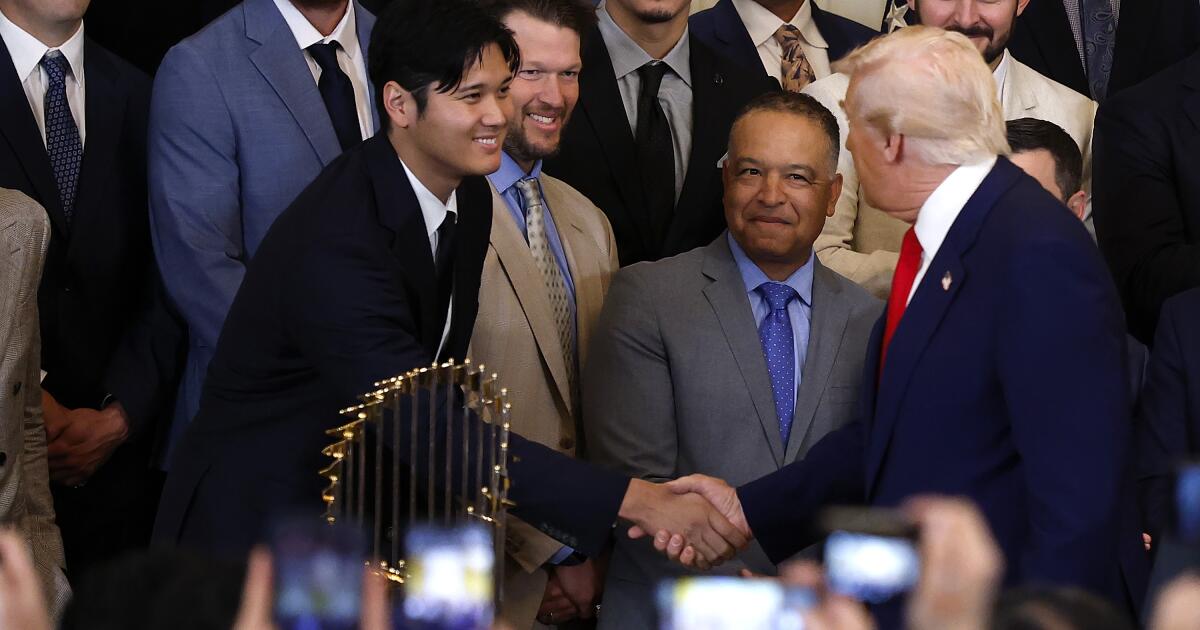
WASHINGTON — The Dodgers are scheduled to visit the White House on July 23 to celebrate their latest World Series title.
“President Trump is excited to welcome the Los Angeles Dodgers BACK to the White House to celebrate their World Series championship!,” White House spokesperson Taylor Rogers said in a statement to The Times.
The date falls on a scheduled off day in the middle of a nine-game East Coast road trip for the Dodgers. The team will play three games in Philadelphia against the Phillies July 20-22 before ending the trip with a three-game series against the New York Mets July 24 to 26.
The visit continues a tradition from the Dodgers’ two previous World Series championships. They were hosted by President Biden in 2021 and President Trump in April 2025.
After the Dodgers claimed their second consecutive World Series title with a dramatic Game 7 victory over the Toronto Blue Jays, a visit to the White House was planned, but it wasn’t until Thursday that a date was officially booked and confirmed.
Questions swirled around whether players would decline the visit this year after it did not happen during a scheduled visit to Washington in April.
Kiké Hernández said in 2018 he was unsure he would have gone had the Dodgers won the World Series the previous year. Mookie Betts said he was undecided and needed to talk it over with his family when last year’s visit was announced. After winning his first World Series with the Boston Red Sox in 2018, Betts skipped their trip to the White House the following year during Trump’s first term.
Both players, along with every returning member of the 2024 team who was with the team during its road trip, participated in the visit. The only notable absence was first baseman Freddie Freeman, who remained in Los Angeles to nurse an ankle injury.
Manager Dave Roberts, who indicated in comments to The Times in 2019 he might not go to the White House if Trump was president, also participated in last year’s ceremony.
Asked at the Dodgers’ fan festival in January about the possibility of returning to the White House, Roberts told The Times’ Bill Shaikin: “For me, I stand by: I’m a baseball manager. That’s my job.”
“I was raised — by a man who served our country for 30 years — to respect the highest office in our country,” Roberts said. “For me, it doesn’t matter who is in the office, I’m going to go to the White House. I’ve never tried to be political. … For me, I am going to continue to try to do what tradition says and not try to make political statements, because I am not a politician.”
Clayton Kershaw, who retired after last season but was on Team USA for this year’s World Baseball Classic, told The Times in the spring that he was aware Dodgers fans are split over whether the team should visit the White House again this year, but he said he is looking forward to it.
“I went when President Biden was in office. I’m going to go when President Trump is in office,” Kershaw said. “To me, it’s just about getting to go to the White House. You don’t get that opportunity every day, so I’m excited to go.”
Times deputy sports editor Ed Guzman contributed to this report.

NEWYou can now listen to Fox News articles!
All eyes were on Caitlin Clark on Wednesday night as she made her anticipated return from injury in a road matchup in Los Angeles.
But instead of a triumphant comeback, the Fever spent the entire night chasing the Sparks as Clark’s rough return fueled a 106-92 rout.
The superstar never found a groove, looking completely out of sync in her return from a back injury.
STEPHANIE WHITE GIVES CAITLIN CLARK STATUS UPDATE AHEAD OF FEVER-SPARKS, BUT HER NEXT MOVE RAISES QUESTIONS
Caitlin Clark huddles with teammates as the Indiana Fever battle the Sparks. (Photo by Katelyn Mulcahy/Getty Images) ((Photo by Katelyn Mulcahy/Getty Images))
Much of that disjointed performance falls squarely on head coach Stephanie White, who kept Clark on a ridiculously tight leash by limiting her to just 16 minutes. The stop-and-go approach could have sabotaged any chance for the phenom to establish a rhythm.
Clark finished with just 9 points, 4 rebounds and 3 assists. Her minus-16 plus-minus told the story.
The Los Angeles Sparks were severely shorthanded, taking the floor without stars Kelsey Plum and Cameron Brink.
MERCURY’S NOW-DELETED SOCIAL MEDIA POST MOCKING CAITLIN CLARK DRAWS SCRUTINY AFTER STAR’S INJURY
Yet while a depleted Sparks roster played to win, Indiana spent the night over-managing its biggest asset.
With Clark on a minutes restriction and Aliyah Boston out of the lineup, Kelsey Mitchell was forced to shoulder the entire offensive burden.
Mitchell did her part, pouring in 29 points while shooting 5-of-9 from beyond the arc.
Caitlin Clark orchestrates the Fever offense as Indiana battles the Los Angeles Sparks in primetime action. (Photo by Katelyn Mulcahy/Getty Images) ((Photo by Katelyn Mulcahy/Getty Images))
But one hot hand couldn’t stop an efficient LA squad.
The Sparks shot 45% from three-point range, going 9-of-20 from deep to cruise to the 106-92 victory.
White’s next move is to sit Clark against the Mercury on Thursday while Boston returns.
CLICK HERE TO DOWNLOAD THE FOX NEWS APP
After Wednesday’s loss to a shorthanded Sparks team, it’s fair to question whether Indiana’s cautious approach is working. The Fever dropped to 12-9.
Caitlin Clark and Dearica Hamby face off as Fever and Sparks battle at Crypto.com Arena in Los Angeles. (Photo by Tyler Ross/NBAE via Getty Images) ((Photo by Tyler Ross/NBAE via Getty Images))
Send us your thoughts: alejandro.avila@outkick.com / Follow along on X: @alejandroaveela
-

 Michigan5 minutes ago
Menominee, Michigan man arrested on sexual assault charges involving a minor
-

 Massachusetts12 minutes ago
Healey administration vows to appeal as Trump rejects Massachusetts blizzard aid request – The Boston Globe
-

 Minnesota15 minutes ago
Minnesota Looks to Add 1,100 Child Care Slots, With Melrose Among the 11 Funded Communities
-

 Mississippi20 minutes ago
Death of Mississippi teen Nolan Wells under investigation
-

 Missouri27 minutes ago
Missouri realtors hold statewide rally to vote no on Amendments 4 & 5
-

 Montana30 minutes ago
District court judge blocks new Montana GOP bylaws – WTOP News
-

 Nebraska35 minutes ago
Nebraska ag experts say early detection for livestock parasites, illnesses will be important during summer show season
-

 Nevada42 minutes ago
Local artists on Northern Nevada stages, now through Labor Day weekend

