Sports
Explained: The rules for under-18s competing in the Paris Olympics


As the eyes of the sporting world turn to host city Paris, extra focus will fall on the hundreds of children competing at the 2024 Olympic Games.
While some sports — including diving, gymnastics, wrestling and boxing — have minimum ages for when athletes can take part, others, such as skateboarding, surfing and table tennis, have no restrictions.
Skateboarding, which made its Olympics debut at the Tokyo Games in 2021 (delayed a year because of the Covid-19 pandemic), attracts a particularly young field, with Finland’s Heili Sirvio and Hasegawa Mizuho of Japan, who are 13, and Zheng Haohao, a Chinese athlete who is just 11 years old, appearing in the French capital.
So what are the rules on under-18s performing at the Games? How do these differ between various sports? Where do these children stay and how are they looked after?
What is the minimum age requirement for the Olympics?
There is no specific age limit to compete at the Games. Age restrictions are set by the international federations in charge of each sport, rather than the International Olympic Committee (IOC).
Arguably the most famous performance by a child at the Olympics was Romanian gymnast Nadia Comaneci receiving a series of perfect 10 scores from the judges at the 1976 Montreal Games when she was 14.
Comaneci was 14 when received a perfect score at the 1976 Olympics (AFP via Getty Images)
Several Olympic sports have no age restrictions, at either end of the scale. In skateboarding at these Games, for example, Great Britain & Northern Ireland have 16-year-olds Sky Brown and Lola Tambling competing alongside Andy Macdonald, who turns 51 next week.
However, for most other sports, there is a minimum age. For example, female gymnasts must now be at least 16 — and there have been growing calls for that to be raised to 18, in line with their male equivalents — while divers must be at least 14, as was the case with Team GB’s Tom Daley at the 2008 Olympics in Beijing, China. In judo, it’s 14, and in wrestling it’s 18.
In boxing, the minimum age is 19 and the maximum is 39. Special permission was given to Finland’s Mira Potkonen who was 40 in Tokyo after the Olympics were delayed by a year due to the pandemic. She went on to finish third in the women’s lightweight category, becoming the oldest boxer to win a medal at the Games.
The men’s football event is essentially an under-23s competition, but each 18-strong squad is allowed three overage members.
In the UK, athletes have to be at least 20 for marathons/race-walking and 18 to take part in throwing events, the heptathlon and decathlon and the 10,000m. Athletes as young as 16 can appear in other track events so long as they have “demonstrated a consistent level of performance, as well as previous experience at major international competition, which suggests that selection for senior competition is appropriate for their long-term development”.
In Paris, this is set to include 17-year-old Phoebe Gill in the women’s 800m. She could become the youngest British track athlete at an Olympics for more than 40 years.
How are child athletes protected at the Games?
At the Tokyo Olympics, the IOC brought in chaperones for under-16 athletes.
This time, the IOC is encouraging each national team to have a safeguarding officer and is offering two extra accreditations for welfare officers.
Athletes aged under 18 are allowed to stay at the Olympic Village, home to around 10,000 competitors across the Games, situated in the Saint-Denis area of northern Paris, near the Stade de France. However, whether they actually do so is down to each individual country.

Athletes under 18 will have to pair up with a buddy when they walk around the Olympic Village (Maja Hitij/Getty Images)
Scott Field, director of communications for Team GB, explained how careful attention is being paid to who their youngest athletes share a room with.
“We have a welfare plan that dictates how sports should manage where and who athletes room with, in the Olympic Village or other accommodation,” Field told The Athletic. “Under-16s would have a chaperone with them, who must also accompany them when outside of the Olympic Village/their satellite accommodation.
“We have an extensive welfare guide that supports young people in their stay at the Olympics. We also have a dedicated group of designated safeguarding officers who are on hand to provide welfare support throughout the Games.”
Australia has decided the three youngest athletes in its 460-strong team — Arisa Trew and Chloe Covell, both 14, and 15-year-old Ruby Trew, who are all skateboarders — will stay in a hotel rather than the athletes’ village, UK newspaper The Guardian has reported.
Those under-18s who are in the Olympic village will not share a bedroom with an adult. The apartments will have a supervisor, and the under-18s will have to pair up with a buddy when they walk around the athletes’ village. They will have a supervisor with them for any trips outside the village (requiring consent from parents), or they can be checked out by their parents.
The IOC added this year’s Olympics will have “the most comprehensive package of mental health and safeguarding tools, initiatives and services than any other sporting or Olympic event in history”. This includes having more than 160 accredited welfare officers from 87 national Olympic committees at the Games, a new AI-powered monitoring service to protect athletes from online hate, and two safeguarding officers in the Olympic Village.
What concerns has this led to?
In recent years, sexual-abuse cases, doping scandals and faking ages have shone a light on the concerns around the exploitation of child athletes.
This was seen most recently with the doping case involving Russian figure skater Kamila Valieva, who was 15 when she won gold at the 2022 Winter Olympics in Beijing. It emerged she had previously tested positive for trimetazidine, a heart medication banned by the World Anti-Doping Agency (WADA), and Valieva received a four-year ban, backdated to her positive result in December 2021.
Her young age fuelled a debate as to why only she had been punished, and not the Russian doctors who gave her the drugs. The Court of Arbitration for Sport revealed Valieva had been given 56 different medications and supplements between the ages of 13 and 15.
Travis Tygart, the United States’ anti-doping chief, said the number of medications given to her was “sickening”. Olivier Niggli, the director general of the WADA, described it as “shocking”, and said Valieva was “sacrificed” to protect those responsible.

Valieva won gold in Beijing but was later banned for four years (Lintao Zhang/Getty Images)
Under WADA’s code, under-16s are “protected persons”, which means they are subjected to lighter penalties, adding to the fears around exploitation.
Valieva’s case led to the International Skating Union raising the minimum age for athletes in its most high-profile competitions from 15 to 17, a change that would be phased in over three years before the next Winter Olympics in Italy in early 2026.
Meanwhile, the U.S. gymnastics sex abuse scandal saw Larry Nassar, a former doctor for USA Gymnastics, convicted and sentenced to over 300 years in prison in 2018 after being accused of abuse by more than 250 athletes, including four-time Olympic gold medallist Simone Biles. In the UK, a report into gymnastics in 2022 found there had been an epidemic of abuse, which included young athletes being starved and made to hang from the rings used in one of the sport’s events as punishment.
Going further back, X-ray bone analysis in 2009 revealed 3,000 young Chinese athletes had faked their ages — giving them an unfair advantage in competition.
Former WADA deputy director general Rob Koehler is now director general of Global Athlete, a group that has concerns about children competing at the Olympics at all.
“If you look at the Valieva case, it clearly indicated that young kids should not be going to the Games,” Koehler told The Athletic. “In any other professional sport, and this is professional sport, there are age limits — for example, in the NHL (the top ice-hockey league in the U.S. and Canada), before you can be drafted. They should use the Youth Olympics for youth athletes. That’s where there’s extra attention, time spent on education and time spent on culture.
“The WADA code also treats under-16s differently. That alone means you lose all the harmonisation and the quality.
“Do you want a 15-year-old child to have that much pressure on them at the Olympic Games? It’s a tough place to be.
“We think there needs to be age limits and they should be put in straight away.”
(Top photo: Skateboarder Zheng Haohao will compete in the Paris Olympics at age 11; He Canling/Xinhua via Getty Images)



NEWYou can now listen to Fox News articles!
CM Punk appeared on “Friday Night SmackDown” ready to take on any challenger that was ready to step to him after winning the Undisputed WWE Championship against Sami Zayn.
Punk entered the ring in Oklahoma City and called back to the “Monday Night Raw” after WrestleMania 42 when he told Cody Rhodes he’d be ready to deliver if a championship opportunity fell “out of the sky.”
COMPLETE PRO WRESTLING COVERAGE ON FOX NEWS DIGITAL
Cody Rhodes and CM Punk face off during SmackDown at Paycom Center in Oklahoma City, Okla. (Craig Ambrosio/WWE via Getty Images)
“When championship opportunities fall out of the sky, CM Punk catches them,” he said.
Punk named potential SmackDown superstars he’d think might come for the title, including Gunther, Finn Balor, Royce Keys, Damian Priest and Trick Williams. He even said that Zayn could come back around and get his rematch if he wanted. He didn’t mention Rhodes’ name, but the “American Nightmare” came out uncalled and marched his way down to the ring.
“I don’t think you and I can run away from each other anymore,” Punk told Rhodes.
Cody Rhodes looks on during SmackDown at Paycom Center in Oklahoma City, Okla., on July 10, 2026. (Craig Ambrosio/WWE via Getty Images)
Rhodes agreed and mentioned that Punk would want a match with him, just “say when.” It was a quick retort from Punk, who said, “when.” SmackDown general manager Nick Aldis, who was in the ring for the segment, booked the match for SummerSlam.
Punk will defend the Undisputed WWE Championship at SummerSlam, which takes place Aug. 1 and 2 at U.S. Bank Stadium in Minneapolis.
First, however, Punk and Rhodes will be involved in a tag team match at Saturday Night’s Main Event in New York City next week. Aldis made the match after Gunther demanded that Aldis put him in a match against Punk. Gunther was hoping it would be for the championship. Instead, Gunther will tag with Zayn.
Gunther didn’t take too kindly to that and attacked Aldis. Rhodes came back out to break up the calamity. He wanted to take on Gunther after the show went off air but Gunther walked away.
Gunther makes his entrance during SmackDown at Paycom Center in Oklahoma City, Okla., on July 10, 2026. (Rich Wade/WWE via Getty Images)
CLICK HERE TO DOWNLOAD THE FOX NEWS APP
Punk definitely has his hands full as he moves to SmackDown to become a fighting champion.
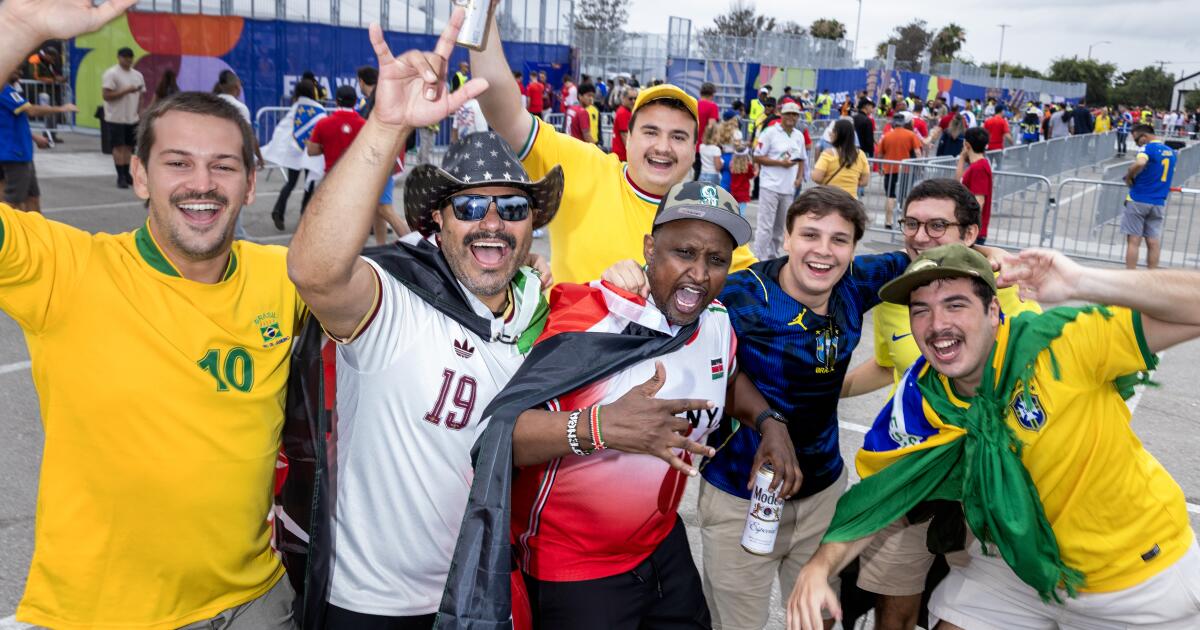
World Cup tourists are coming to L.A. for the soccer, but they’re staying for the $21 smoothies and Double-Doubles.
As the last Los Angeles FIFA World Cup event ended Friday, soccer fans were eating like locals and famous chains from the region were cashing in.
In the weeks that L.A. has hosted the World Cup, international soccer enthusiasts have flocked to big brands from the area, often in large groups wearing their countries’ jerseys.
It is a phenomenon seen at many of the host cities. In Dallas, giant gas station Buc-ee’s is the main attraction. For people visiting New Jersey, deli shops have been a hot ticket. In L.A., the place to be between matches was Erewhon.
Thirsty international sports fans gathered for pictures outside different Erewhons, wandered their aisles smiling, and, of course, picked up pricey smoothies.
While Erewhon would not comment on its business, mobility data company Arity, which uses phone data to track consumers, said Erewhon visits at the outlets around SoFi Stadium were quadruple what they were a week earlier on June 12, the day of the U.S. national soccer team’s opening match there.
Arity looked at what stores people visited within a 10-mile radius of SoFi that day and also found surges in visitors to nearby El Pollo Loco and Trader Joe’s.
Locals have spotted groups of people in Korea jerseys huddled together, trying to decide what to order at In-N-Out.
Some complained on social media that international tourists at Trader Joe’s were buying up all the mini canvas tote bags.
Soon after the Belgium vs. Spain quarterfinal ended Friday, the In-N-Out near SoFi had a long line of soccer fans stretching out the door in bright red and yellow and black jerseys and matching striped hats and scarves.
One of the workers said he had to explain “spread” and “animal style” to foreign football fans.
“I didn’t know this place existed,” a fan from Romania said while waiting in line.
Los Angeles and other cities and states that have hosted the event need the soccer fans to spend money to make the event worth all the time, effort and money it requires.
A rosy 2024 report projected the World Cup could bring more than $800 million to the L.A. region as 180,000 people converge on the area to sleep, eat and spend.
There were early concerns people weren’t turning up for the event because of the high ticket prices and the difficulty of obtaining visas for citizens of some countries.
However, at least for some L.A. hotels, there was a surge of last-minute visitors which pushed up occupancy and room rates.
While sports fans are not in the region to shop, they do make time for it.
World Cup customer spending is also apparent in beer sales. Andrew Heritage, the chief economist at the Beer Institute said beer purchases at entertainment and attractions in L.A. – outside of World Cup spaces – were up around 10% from normal.
“That tells me that fans in the L.A. area have decided to extend their stay and take in all the other things that the area has to offer, rather than just the match itself,” he said.
On social media, the purpose of these shoppers is clear: grab a quick souvenir or local specialty and take a selfie.
The data from Arity suggests that fans are very efficient when they spend at local spots, diving in, getting what they want and getting out as soon as possible, said Jeff Schlitt, a director at the company.
“Normally you’re there for an hour. They’re going to be there for 15, 18 minutes,” he said. “Why is that? Because they were purpose-driven shoppers.”
For some travelers, the more popular American chains aren’t unfamiliar. But some of the native L.A. fare still comes as a surprise.
As one Belgium-Spain matchgoer from the Netherlands stood taking a picture of the In-N-Out sign after the game, he said he’d never had a burger like the one he’d just tried.
“We only have McDonald’s and Burger King,” he said. “It’s way better.”

NEWYou can now listen to Fox News articles!
The face of baseball will not be at Tuesday’s All-Star Game.
Shohei Ohtani was scratched from his start on Friday as the Los Angeles Dodgers said he will also miss the Midsummer Classic with what the team called left knee irritation.
Ohtani, for obvious reasons, has become an All-Star Game fixture. He has earned the honor in each of the past five seasons and made his first start in 2021.
Starting pitcher Shohei Ohtani #17 of the Los Angeles Dodgers warms up before the MLB game against the Arizona Diamondbacks at Chase Field on June 03, 2026 in Phoenix, Arizona. (Photo by Christian Petersen/Getty Images) (Christian Petersen/Getty Images)
The two-way phenom is on his way to winning his fifth MVP award in his last six seasons as he is hitting .290 with a .939 OPS and pitching to a minuscule 1.79 ERA, the second-lowest in the sport among pitchers with 80-plus innings. His OPS is also the seventh-best mark in the league.
The Dodgers said Ohtani will be the team’s designated hitter up until the break, but he will “have some interventions on his knee to put him in the best position for the second half of the season.”
Ohtani dealt with knee issues earlier in the season.
It is certainly a big hit for the game as the other face of the sport, Aaron Judge, will miss the game due to a fractured rib that has kept him out since late May.
Shohei Ohtani #17 of the Los Angeles Dodgers gets ready in the on deck circle against the Arizona Diamondbacks at Chase Field on June 01, 2026 in Phoenix, Arizona. (Photo by Norm Hall/Getty Images) (Norm Hall/Getty Images)
DODGERS WILL AGAIN VISIT WHITE HOUSE TO CELEBRATE WORLD SERIES CHAMPIONSHIP, OFFICIAL SAYS
Ohtani hit 99 home runs combined in 2024 and 2025, leading the National League with a 1.025 OPS in that span. Ohtani did not pitch in 2024 after elbow surgery but returned to the bump last year and owned a 2.87 ERA and 11.9 K/9, a figure he also put up in 2022 that led the American League.
The “Japanese Babe Ruth” is the only player in MLB history to have 300-plus plate appearances and 40-plus innings in six separate seasons (Ruth only did it twice and never stole 50 bases), and he has more than excelled at both.
Shohei Ohtani pitches for the Los Angeles Dodgers against the San Francisco Giants at Dodger Stadium in Los Angeles, California, on May 13, 2026. (Gary A. Vasquez/Imagn Images)
CLICK HERE TO DOWNLOAD THE FOX NEWS APP
Ohtani is not hitting like he has in the past, but certainly the best pitching performance of his career will make up for it. He “only” has 20 homers and 56 RBI this season.
Follow Fox News Digital’s sports coverage on X, and subscribe to the Fox News Sports Huddle newsletter.
-

 Arizona4 minutes ago
2026 MLB Draft: Arizona likely to be minimally impacted after down season
-

 Arkansas11 minutes ago
ARKANSAS A-Z: Band formed by faculty members of what is now UCA | Arkansas Democrat Gazette
-
 California13 minutes ago
Disneyland turns to cheaper evening passes and the internet speculation explodes
-

 Colorado19 minutes ago
Colorado mountains could see near-record temperatures as heat dome develops over the West
-
Connecticut26 minutes ago
I moved from Connecticut to the South chasing a cheaper, simpler life. It wasn’t at all what I expected, so I moved back.
-

 Delaware26 minutes ago
New information on “sophisticated cybercriminal attack” against Delaware County
-

 Florida34 minutes ago
NW Florida authorities make two more arrests in murder case
-

 Georgia41 minutes ago
How Georgia football can make sure they are the defining program of the 2020s


