Sports
Emma Raducanu and Leylah Fernandez, the teen stars of 2021 who are starting all over again


There may come a time when Leylah Fernandez and Emma Raducanu are in the draw of a major tournament and one of their names does not immediately follow the other in the tennis consciousness.
Maybe, but not yet.
One of them has been grinding her way up and down and back up the ever-shifting ladder that is women’s professional tennis.
The other struggled for a year and a half to string wins together, then called it a season and had three surgeries — on each wrist and one of her ankles — on one grim day last spring. That was not long before the other one realized she needed to hit her own career restart button, too.
One is the daughter of finance executives, the product of a Chinese father and a Romanian mother, raised in Great Britain with plenty of advantages and the chance to choose among the finest universities had she gone down that path.
The other grew up in Canada and then on the hot hard courts of Florida, driven by desire and her father, a former Ecuadorian soccer player, to make a living with a tennis racket.
Other than being born in Canada nine weeks apart, Emma Raducanu and Leylah Fernandez do not share much in common. They aren’t any more than professional acquaintances.
Inevitably, they will always be more than that and always be linked because of those magical two weeks a little more than two years ago, when they were still teenagers co-starring in the zaniest Grand Slam tennis tournament that will ever happen. When nearly three weeks of competition had ended, Raducanu, a relative unknown outside of Great Britain, had won 10 straight matches, including the qualifying tournament, and 20 straight sets, and defeated Fernandez, the world’s 73rd-ranked player but the second-most unlikely finalist that day, for the championship.
Raducanu celebrates her U.S. Open win, aged 18, in 2021 (Getty Images)
There has been plenty of frustration for both of them since. Hard losses and early-round exits, hard lessons about life in the spotlight, and strings of injuries that sometimes felt like they would never cease. Raducanu, especially, looked mostly miserable with each tournament and each loss, especially during the final months when she was playing in constant pain.
But here they are this week in Melbourne, into the second round on opposite sides of the draw, getting busy with the next phase of their tennis lives at an age when most players are still trying to get their teeth into the first one.
For Raducanu, 21, that meant a first-round win on Tuesday evening over the American veteran Shelby Rogers that was as solid as it needed to be. Rogers, 31, was searching for form after an injury-induced six-month layoff, but for long stretches, Raducanu showcased so much of the style that sent her to those lofty heights — the easy, deceptively fast movement, the low, whipping and curling power off the ground, even a feathery backhand drop shot and, most importantly, the ability to not beat herself with careless errors.
The final score was 6-3, 6-2 and it wasn’t really that close. More of that and Raducanu will be ranked much higher than 296th in the world before long.
“All aspects of my life are calming down and settled,” Raducanu said. “When you come back after eight months, have experienced three surgeries, you’re just really grateful to move freely.”

Raducanu is fit again after three surgeries (James D Morgan/Getty Images)
This all went down a couple of days after Fernandez won one of the first matches of the tournament, a straight-sets win over Sara Bejlek of the Czech Republic. Sure, Bejlek was just a 17-year-old qualifier, but this was a different Fernandez who wasn’t just staying in points and chasing down balls in the corners like she always has, but also sprinting to the net to finish them off like she rarely has before.
“I can’t always be a grinder or just a returner,” Fernandez said as she sat in a soft chair in a Melbourne Park corridor a little while after her match. “Everybody on tour is a grinder. You see the top players, they run for every ball.”
For Fernandez, the restart began just after the French Open following her three-set loss in the second round, a winnable match against world No 127 Clara Tauson of Denmark. Even as Fernandez and Taylor Townsend cruised into the doubles final at Roland Garros, her father suggested they have a formal sit-down to discuss her future. Her singles ranking was about to drop to 95, her lowest since 2020.
He told her she could listen to 100 per cent of what he was going to say and finish the season in the top 20, or less than 100 per cent and maybe finish in the top 40.
“Of course, I didn’t listen to him 100 per cent,” she said. “That comes with maturity and I own up to it.”

Fernandez is back on the up (Kelly Defina/Getty Images)
But she did listen to a lot of what he told her and signed on to his plan to start from scratch with a mini-pre-season in the weeks leading up to Wimbledon, leaving the rackets on the side of the court at times and focusing on her fitness. She had been one of the quickest players in the game but had somehow become slower, or the game had got quicker, with women moving forward more or playing drop shots and taking time away from her.
She needed to be faster for longer and the only way to do that was to build endurance.
“You kind of see Novak Djokovic every single year, he’s trying to improve something,” Fernandez, who faces the American Alycia Parks in the second round, said. “He changed his whole diet. He started doing yoga. It’s very basic. The fundamentals of an athlete’s body. We wanted to see what can we improve in my fitness because if my fitness level is high and I’m confident with that, my game will follow afterwards.”

Her summer, which included another mini-pre-season after Wimbledon, was up and down, including a first-round loss in the U.S. Open. In September, she was playing qualifying matches, but in October, she won the Hong Kong Open, then made the semi-finals of the Jiangxi Open.
It’s taken a while, but Fernandez, 21, is finally beginning to experience all the attention and the crowds that have followed her since the 2021 U.S. Open as support rather than pressure.
“It just took time to understand what was happening,” she said, “to understand what I was feeling and work through that… just find ways to get back to the little girl who would just want to get on court and to hit and hit and have fun and put on a show for everybody.”
Raducanu wants to do that, too. She said she was shocked to see thousands of fans packing the cozy 1573 Arena when she walked onto the court. She tried not to focus on a potential result, which just three matches into her comeback could go either way, and that’s going to have to be her life for now.
“The difference between me losing first round or doing really well at a tournament is really, really slim,” she said. “It’s just in the way that I move, in the way I do things physically. Not being so drastic, I would say, because I know it’s not far away at all. The more I practice consistently, it will come up.”
She lingered long after the win, soaking in the adulation, signing autographs and posing for selfies all around the stadium, her restart officially now underway. Next up for Raducanu is a second round against China’s Yafan Wang.
“The time away made me very hungry,” Raducanu said. “I’m just happy to be healthy again and pain-free.”
(Top photo: James D Morgan/Getty Images)



Sports
Golf star records lowest round in LPGA major history with astounding performance at Evian Championship

NEWYou can now listen to Fox News articles!
There are good days on the golf course, and then there is what Haeran Ryu just did on Saturday.
Ryu, 25, recorded the lowest round in LPGA major history on Saturday with an 11-under 60 at the Evian Championship. With the South Korean golfer’s historic round, she holds a three-stroke lead.
Ryu’s round comes just two weeks after winning her first major at the Women’s PGA Championship. On the 18th hole, Ryu left a 30-foot eagle putt a few inches short, and instead settled for a birdie.
CLICK HERE FOR MORE SPORTS COVERAGE ON FOXNEWS.COM
Haeran Ryu of South Korea reacts on the 18th green after the third round of The Amundi Evian Championship at Evian Resort Golf Club in Evian-les-Bains, France, on July 11, 2026. (Stuart Franklin/Getty Images)
She said after the round that she had no idea what she had done until she counted up her scorecard.
“But after the putt and I counted my score with my caddie,” she said. “Oh my God, it’s 11-under par today. It was so amazing. My caddie says, ‘Yep.’ I’m so happy right now.”
If Ryu had made the eagle putt on the 18th hole, she would have been just the second player to shoot a 59 in LPGA history.
ZERO BS. JUST DAKICH. TAKE THE DON’T @ ME PODCAST ON THE ROAD. DOWNLOAD NOW!
Haeran Ryu of South Korea celebrates a birdie on the 15th green during the third round of The Amundi Evian Championship at Evian Resort Golf Club on July 11, 2026, in Evian-les-Bains, France. (Stuart Franklin/Getty Images)
Her 60 broke the record for the lowest round in an LPGA major by one shot. Leona Maguire and Jeungeun Lee6 in 2021, and Hyo Joo Kim in 2014, each shot 61 at the Evian Championship, which was designated as an LPGA major in 2013.
The lowest round in a men’s major is 62, which is shared by four players — Branden Grace at Royal Birkdale in the 2017 British Open, Xander Schauffele and Rickie Fowler in the 2023 U.S. Open at Los Angeles Country Club, and Schauffele and Shane Lowry in the 2024 PGA Championship at Valhalla.
CLICK HERE TO DOWNLOAD THE FOX NEWS APP
Haeran Ryu of South Korea and Lottie Woad of England interact after their round on the 18th green during the third round of the Amundi Evian Championship at Evian Resort Golf Club in Evian-les-Bains, France, on July 11, 2026. (Stuart Franklin/Getty Images)
Ryu hopes her historic third round can help propel her to a second major win in three weeks.
“That is amazing, amazing dream,” Ryu said. “So I just want that one to come true, but we have one more day.”
The Associated Press contributed to this report.
Follow Fox News Digital’s sports coverage on X, and subscribe to the Fox News Sports Huddle newsletter.
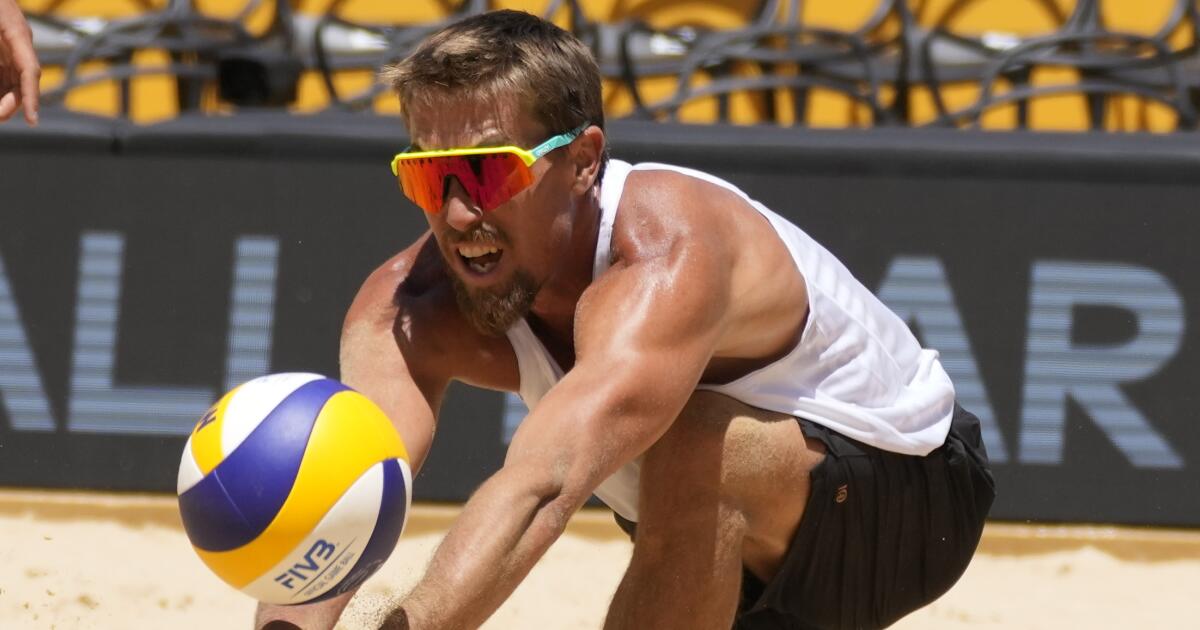
Taylor Crabb is no stranger to South California beaches. The Long Beach State alum returns home this weekend to compete in AVP League matches.
It marks the first time AVP will compete in Long Beach since 2020 and allows players to compete at the 2028 Olympics beach volleyball venue.
Crabb, 34, made his AVP debut in 2013 with his brother, Trevor, and advanced from the qualifier in Manhattan Beach before finishing 25th in his first tournament.
After years of competing with various different partners, Taylor Crabb and Andy Benesh have delivered the top performances this AVP season.
The following interview with Crabb has been edited for clarity and length.
Are you excited to compete in this weekend’s event at Long Beach?
Crabb: Very excited. A lot of my college teammates and part of the school have reached out, saying that they’re gonna come. So I’m excited to get a chance to play in front of them again.
When was the last time you were in Long Beach?
Crabb: I always try to go down there for alumni events or any big games they have. I went to UCLA against Long Beach last year, when it was No. 1 versus No. 2, so I always try to get down there and support them.
You missed out on the chance to compete in the 2020 Olympics because of COVID-19 restrictions and chose not to pursue a spot at the 2024 Olympics. Are you fired up to try to compete in the 2028 Olympics, knowing that Long Beach will host the competition?
Crabb: Yeah, it’s definitely an exciting time having the Olympics in Long Beach, and we kind of get to break it in this weekend. As you said, Tokyo didn’t go the way I wanted, but I’m going full force now. I have a great partner in Andy Benesh, who obviously went to the Paris Olympics, and if it weren’t for the Olympics being in Long Beach, and me getting a partner like Andy, I’m not even sure I’d be going for it, but because of those two things, I want to make the most of it.
You mentioned that if it wasn’t for a partner like Andy, you wouldn’t be going for it. What do you mean by that?
Crabb: I didn’t feel motivated by playing in all the international events, but now, I think, sitting out kind of lit the fire under me, and I’m really motivated now.
You’ve had different partners throughout your time. What other motivation does Andy give you?
Crabb: He’s been, in my mind, the top blocker for the U.S. the last four or five years. Seeing the professionalism he brings every day to practice, on and off the court, while traveling and when showing up to tournaments, it rubs off on you and that’s really motivating to see. And I just want to make him proud.
Why do you love volleyball?
Crabb: A lot of reasons, but it’s just a feeling I have when I’m out there on the court. It feels natural. It feels like home. I was born into a volleyball family. I had a volleyball in my hands my entire life, so I’ve always just enjoyed it.

NEWYou can now listen to Fox News articles!
CM Punk appeared on “Friday Night SmackDown” ready to take on any challenger that was ready to step to him after winning the Undisputed WWE Championship against Sami Zayn.
Punk entered the ring in Oklahoma City and called back to the “Monday Night Raw” after WrestleMania 42 when he told Cody Rhodes he’d be ready to deliver if a championship opportunity fell “out of the sky.”
COMPLETE PRO WRESTLING COVERAGE ON FOX NEWS DIGITAL
Cody Rhodes and CM Punk face off during SmackDown at Paycom Center in Oklahoma City, Okla. (Craig Ambrosio/WWE via Getty Images)
“When championship opportunities fall out of the sky, CM Punk catches them,” he said.
Punk named potential SmackDown superstars he’d think might come for the title, including Gunther, Finn Balor, Royce Keys, Damian Priest and Trick Williams. He even said that Zayn could come back around and get his rematch if he wanted. He didn’t mention Rhodes’ name, but the “American Nightmare” came out uncalled and marched his way down to the ring.
“I don’t think you and I can run away from each other anymore,” Punk told Rhodes.
Cody Rhodes looks on during SmackDown at Paycom Center in Oklahoma City, Okla., on July 10, 2026. (Craig Ambrosio/WWE via Getty Images)
Rhodes agreed and mentioned that Punk would want a match with him, just “say when.” It was a quick retort from Punk, who said, “when.” SmackDown general manager Nick Aldis, who was in the ring for the segment, booked the match for SummerSlam.
Punk will defend the Undisputed WWE Championship at SummerSlam, which takes place Aug. 1 and 2 at U.S. Bank Stadium in Minneapolis.
First, however, Punk and Rhodes will be involved in a tag team match at Saturday Night’s Main Event in New York City next week. Aldis made the match after Gunther demanded that Aldis put him in a match against Punk. Gunther was hoping it would be for the championship. Instead, Gunther will tag with Zayn.
Gunther didn’t take too kindly to that and attacked Aldis. Rhodes came back out to break up the calamity. He wanted to take on Gunther after the show went off air but Gunther walked away.
Gunther makes his entrance during SmackDown at Paycom Center in Oklahoma City, Okla., on July 10, 2026. (Rich Wade/WWE via Getty Images)
CLICK HERE TO DOWNLOAD THE FOX NEWS APP
Punk definitely has his hands full as he moves to SmackDown to become a fighting champion.
-
 Cleveland, OH18 seconds ago
Wanted sex offender arrested at home where Tennessee woman’s body found
-

 Austin, TX6 minutes ago
Man shot and killed by police after pointing gun at people in Austin, Texas
-

 Alabama13 minutes ago
Alabama has Talent returns with local connection
-

 Alaska16 minutes ago
Alaska Sports Scoreboard: July 11, 2026
-

 Arizona21 minutes ago
Cardinals Mailbag: Latest on Jacoby Brissett, Carson Beck, and Arizona’s QB Future
-

 Arkansas28 minutes ago
Arkansas tips its hat to blues pioneer Larry “Totsie” Davis in England dedication
-

 California30 minutes ago
‘Explosive diarrhea’ parasite surfaces in California as health officials fear statewide surge
-

 Colorado36 minutes ago
This Quiet Colorado Town Is An Underrated Gem For Nature Lovers

