Sports
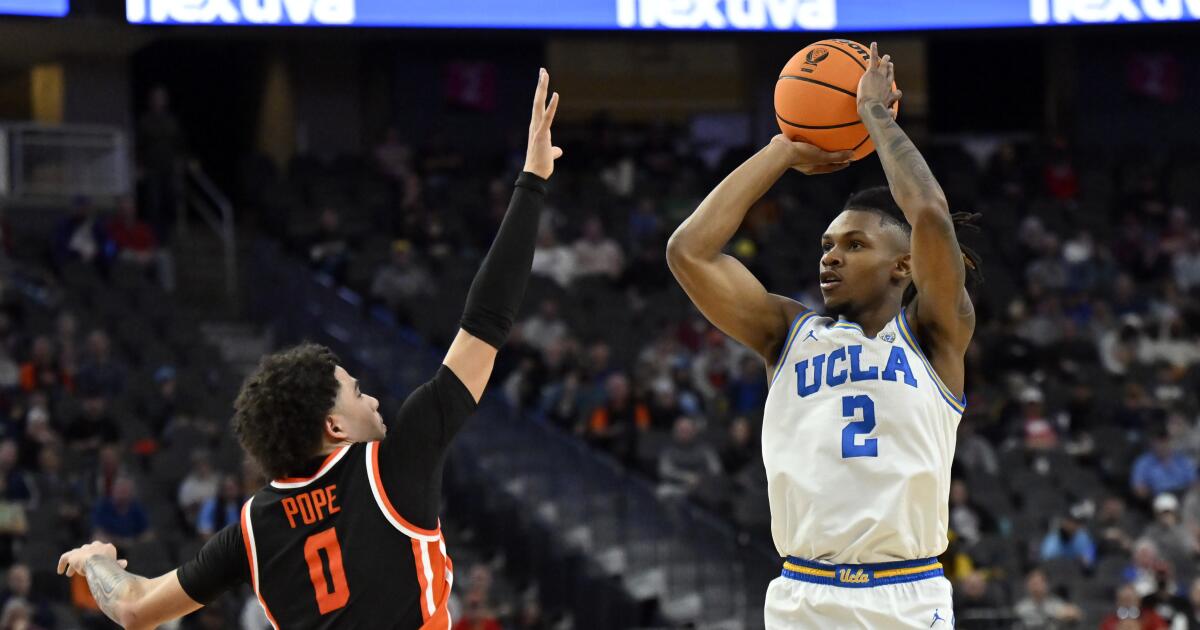
Dylan Andrews' hot shooting lifts UCLA to a Pac-12 tournament win over Oregon State

For half a season, he was disparaged as not being a true point guard.
Find somebody else to run UCLA’s offense, the criticism went. Get busy in the transfer portal.
Dylan Andrews offered his rebuttal with feathery jumpers and precise passes, even if it wasn’t enough to satisfy some observers. Left off the Pac-12’s first and second teams, Andrews continued to make his case for being perhaps the conference’s most overlooked player Wednesday afternoon.
The sophomore was a sight to behold every time the fifth-seeded Bruins needed him during a 67-57 victory over 12th-seeded Oregon State at T-Mobile Arena.
Burying one big shot after another, Andrews finished with a career-high 31 points while adding to his late-season haul of highlights. He made 11 of 15 shots, including seven of nine three-pointers, every one of them needed on a day that fellow starters Lazar Stefanovic and Sebastian Mack combined for only six points.
“It was good to have the offense come,” Andrews said, ‘but our main focus was stopping Jordan Pope and [Tyler] Bilodeau.”
The Bruins prevailed in that category as well. Pope scored 16 points but made only six of 16 shots, and Bilodeau scored most of his 13 points as part of a futile comeback after being a nonfactor in the first half with foul trouble.
UCLA (16-16) advanced to face fourth-seeded Oregon in a quarterfinal on Thursday afternoon. The teams split their two meetings in the regular season, each winning on its home court.
The Bruins would be headed home were it not for Andrews.
With UCLA teetering midway through the second half, a onetime 15-point lead down to seven, Oregon State had the ball and a chance to make things even tighter. That’s when Andrews came up with a steal that he followed with a three-pointer that restored the Bruins’ advantage to double figures.
Later, after the Beavers had pulled to within 46-42 on back-to-back three-pointers, Andrews countered with one of his own.
Center Adem Bona added 17 points and six rebounds for the Bruins while also freeing Andrews for open jumpers as the focus of an Oregon State defense that fouled him 10 times.
Defense was the big issue in the final Pac-12 game for Oregon State (13-19), which is bound for the West Coast Conference alongside Washington State next season. The Beavers allowed the Bruins to make 52.2% of their shots, including nine of 15 three-pointers (60%).
UCLA coach Mick Cronin credited Andrews for persevering during his first season as the team’s full-time point guard after playing sparingly behind Tyger Campbell as a freshman. Cronin also lamented his inability to surround Andrews with a veteran transfer who could have lessened the need for him to log a heavy workload as he did against the Beavers, when Andrews played 39 minutes.
“He and I have been on a journey all year to replace Tyger and figure out how he can be him instead of Tyger — and just getting used to playing a lot of minutes,” Cronin said. “And he’s gotten really comfortable in the last month, outside of the USC game [when Andrews was held scoreless].”
Said Andrews of the challenges he’s faced: “It’s different being the point guard at UCLA. You’re going to go through adversity. But Coach trusts me, my teammates trust me, and I trust them.”
UCLA is trying to fashion a different ending on the court where not much has gone right. About the only highlight here was a victory over Ohio State during the Lonzo Ball season, the rest of the memories not bound for any scrapbook. The Bruins have not won a Pac-12 tournament title here while also logging losses to North Carolina, Illinois and Baylor.
There was also a dreary blowout against Gonzaga in November 2021 before the heartbreaker against the Bulldogs during the Sweet 16 last year.
The first half was a study in contrasts for Bona, who committed five turnovers while struggling against the Beavers’ 2-3 zone. Bona was so frustrated after dribbling off his body for his fifth turnover that he placed both hands on his head before doubling over in anguish. Stefanovic came over to console him with a pat on the back going into a timeout.
But Bona also flashed dual dominance by driving past Oregon State counterpart Michael Rataj for a dunk and forcing a five-second violation with relentless defense on Dexter Akanno.
Andrews also continued to be a two-way force, making five of seven shots on the way to 13 points by halftime while also holding Pope to five points on two-for-seven shooting.
His best was yet to come for a team that needed every bit of it.




NEWYou can now listen to Fox News articles!
Miami Heat star Bam Adebayo made NBA history on Tuesday night.
Adebayo scored 83 points, all while setting league marks for free throws made and attempted in a game for the Miami Heat in a 150-129 win over the Washington Wizards. It is the second-highest scoring game for a player ever, only to Wilt Chamberlain’s famed 100-point game.
“An absolutely surreal night,” Heat coach Erik Spoelstra told reporters after the game.
Adebayo started with a 31-point first quarter. He was up to 43 at halftime, 62 by the end of the third quarter. And then came the fourth, when the milestones kept falling despite facing double-, triple- and what once appeared to be a quadruple-team from a Wizards defense that kept sending him to the foul line.
He finished 20 of 43 from the field, 36 of 43 from the foul line, 7 for 22 from 3-point range.
After the game, he was seen in tears while he hugged his mother, Marilyn Blount, before leaving the floor after the game.
“Welp won’t have the highest career high in the house anymore,” Adebayo’s girlfriend, four-time WNBA MVP A’ja Wilson, wrote on social media, “but at least it gives me something to go after.”
MAGIC’S ANTHONY BLACK MAKES INCREDIBLE DUNK OVER FOUR DEFENDERS IN HISTORIC NBA GAME
Bam Adebayo #13 of the Miami Heat celebrates during the fourth quarter of the game against the Washington Wizards at Kaseya Center on March 10, 2026, in Miami, Florida. (Megan Briggs/Getty Images)
The NBA’s previous best this season was 56, by Nikola Jokic for Denver against Minnesota on Christmas night. The last player to have 62 points through three quarters: one of Adebayo’s basketball heroes, Kobe Bryant, who had exactly that many through three quarters for the Los Angeles Lakers against Dallas on Dec. 20, 2005.
He wound up passing Bryant for single-game scoring as well. Bryant’s career-best was 81 — a game that was the second-best on the NBA scoring list for two decades.
Adebayo scored 31 points in the opening quarter against the Wizards, breaking the Heat record for points in any quarter — and tying the team record for points in a first half before the second quarter even started.
He finished the first half with 43 points, a team record for any half and two points better than his previous career high — for a full game, that is — of 41, set Jan. 23, 2021, against Brooklyn.
CLICK HERE TO DOWNLOAD THE FOX NEWS APP
Adebayo’s season high entering Tuesday was 32. He matched that with a free throw with 5:53 left in the second quarter, breaking the Heat first-half scoring record.
Adebayo’s 43-point first half was the NBA’s second-best in at least the last 30 seasons — going back to the start of the digital play-by-play era that began in the 1996-97 season.
The Associated Press contributed to this report.
Follow Fox News Digital’s sports coverage on X, and subscribe to the Fox News Sports Huddle newsletter.
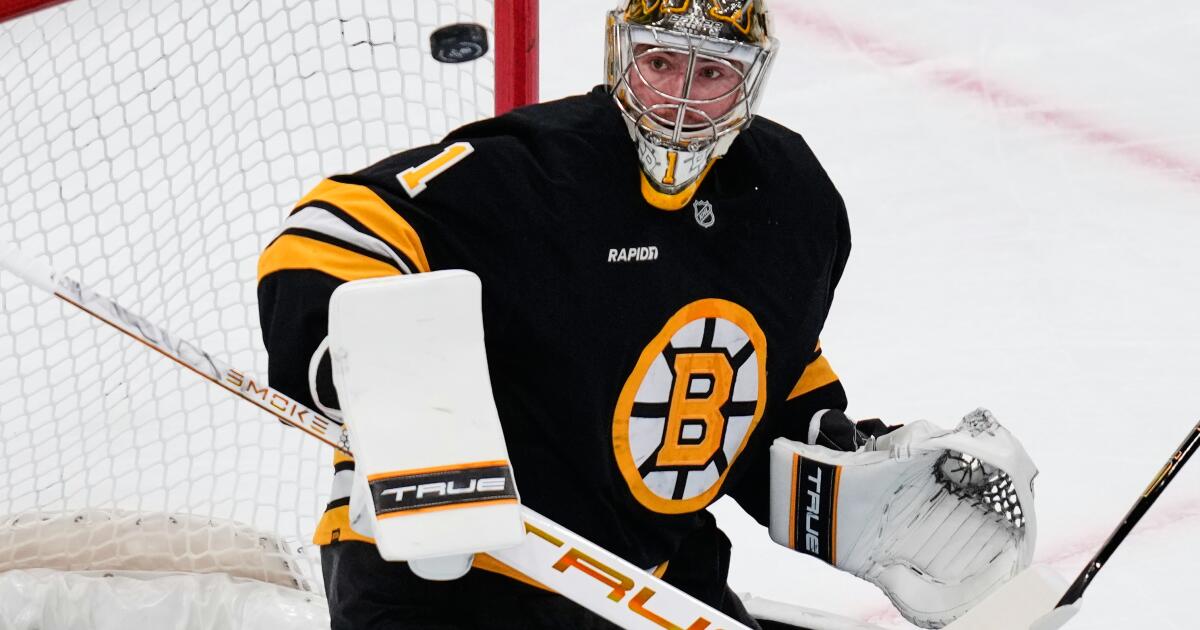
BOSTON — Charlie McAvoy scored 39 seconds into overtime and Jeremy Swayman stopped 14 shots on Tuesday night to earn the Boston Bruins their 13th straight victory at home, 2-1 over the Kings.
Mason Lohrei scored midway through the third period to break a scoreless tie. But the Kings tied it five minutes later when Drew Doughty’s shot from the blue line deflected off the heel of Bruins forward Elias Lindholm and into the net.
It was the seventh straight time the teams had gone to overtime in Boston.
In the overtime, Mark Kastelic blocked a shot in the defensive zone and made a long pass to David Pastrnak, who waited for McAvoy to come into the zone. The Bruins’ defenseman and U.S. Olympian, who went to the locker room at the end of the second period after taking a puck off his mouth, skated in on Darcy Kuemper and went to his backhand for the winner.
Kuemper stopped 21 shots for the Kings, who entered the night one point out of the second wild-card spot in the Western Conference. The victory kept Boston in possession of the East’s second wild-card spot.
Swayman tied his career high with his 25th win of the season. The Bruins haven’t lost at the TD Garden since before Christmas.
After the game, Kings forward and future Hall of Famer Anze Kopitar stayed on the ice to shake hands with the Bruins after what is expected to be his last game in Boston.
Sports
Jon Jones requests UFC release after Dana White says legend was ‘never’ considered him for White House card

NEWYou can now listen to Fox News articles!
Mixed martial arts legend Jon Jones ended his retirement from UFC simply because he wanted a spot on the “Freedom 250” fight card at the White House in June.
But, when UFC CEO Dana White announced the card during UFC 326 this past weekend, Jones wasn’t among the fighters. As a result, he has requested a release from his UFC contract.
White was candid when asked about Jones following the UFC 326 card.
Jon Jones of the United States of America reacts after his TKO victory against Stipe Miocic of the United States of America in the UFC heavyweight championship fight during the UFC 309 event at Madison Square Garden on Nov. 16, 2024 in New York City. ((Photo by Sarah Stier/Getty Images))
“Never, ever, ever, which I told you guys a hundred thousands times, was Jon Jones ever even remotely in my mind to fight at the White House,” White explained, per CBS Sports. “Some guy with Meta Glasses filmed him talking about his hips – that his hips are so bad. And I don’t know if you guys saw that flag football game where he can barely run. Jon Jones retired because of his hips. He’s got arthritis in his hips. Apparently, doctors say he should have a hip replacement.”
White added that “the Jon Jones thing is bulls—,” saying that he texted the fighter’s lawyer saying he would never be on the White House card despite Jones saying he was in negotiations for it.
UFC ANNOUNCES CARD FOR WHITE HOUSE EVENT
The Meta Glasses incident White is referring to came from a viral video, where Jones, unaware he was being filmed, discussed issues with his hips to a fan.
On Monday, Jones composed a thorough response to White’s comments about him and the White House Card. He previously posted and deleted social media explanations, but Monday’s appeared to be his final statement on the matter.
UFC President Dana White speaks after UFC Fight Night at Toyota Center on Feb. 21, 2026. (Troy Taormina/Imagn Images)
“Yes, I have arthritis in my hip and it’s painful, but that doesn’t mean I can’t fight,” Jones, who retired a heavyweight champion in 2025, said. “So let me get this straight, if I had accepted the lowball offer, suddenly my hip would be fine and I’d be on the White House card? That doesn’t make sense. I even received stem cell treatment last week to get ready for the White House card, and training camp was scheduled to start today. I was preparing to be ready.
“I understand business deals fall through sometimes, but going out publicly and saying things that aren’t true isn’t right. After everything I’ve given to the UFC, the years, the title defenses, the fights, hearing that I’m ‘done’ is disappointing. Especially when as recently as Friday UFC was calling me trying to get me on that White House card for a much lower number.”
Jones finished his statement by saying he “respectfully” asks to be released from his UFC contract.
Jon Jones enters the ring before facing Stipe Miocic in the UFC heavyweight championship fight during the UFC 309 event at Madison Square Garden on November 16, 2024 in New York City, New York. (Chris Unger/Zuffa LLC)
“No more spins, no more games. Thank you to the real fans who know what’s up,” he wrote.
The UFC did not immediately respond to a request for comment by Fox News Digital.
Jones is considered one of the best UFC fighters of all time, owning a 28-1-1 record, which includes his last bout with Stipe Miocic, knocking him out to take the heavyweight title belt. He is also a two-time light heavyweight champion.
Follow Fox News Digital’s sports coverage on X and subscribe to the Fox News Sports Huddle newsletter.

WATCH: Walz, Ellison, Omar refuse to answer when pressed on fraud after contentious fraud hearing

Texas Gov Abbott issues warning of Chinese spying in medical tech

Wife of teacher killed in senior prank makes unexpected request for charged students

Officials confirm devices recovered at NYC protest near Gracie Mansion were both IEDs

4Warn Weather Alert issued for Wednesday morning in Metro Detroit — What this means

Florida High School Football Rankings: Top 25 teams – Oct. 21

Cleary's 21 help Le Moyne down Central Connecticut State 69-64 in OT

How old is Bo Nix? What to know about Oregon quarterback ahead of 2024 NFL Draft

99th annual Pony Swim held in Virginia

Indiana Members Credit Union announced as new anchor tenant at Bottleworks District

EXCLUSIVE: ICE says El Paso detention facility will stay open under new contractor after $1.2B deal scrapped

Von der Leyen ‘acting outside of competence,’ Araud tells Euronews

Wheelchair curler Steve Emt’s path from drunk driver to three-time Paralympian

Map: 2.3-Magnitude Earthquake Reported North of New York City

Trump stirs GOP primary drama with visit to Massie’s Kentucky home turf
-

 Wisconsin1 week ago
Setting sail on iceboats across a frozen lake in Wisconsin
-

 Massachusetts1 week ago
Massachusetts man awaits word from family in Iran after attacks
-

 Detroit, MI5 days ago
U.S. Postal Service could run out of money within a year
-

 Pennsylvania6 days ago
Pa. man found guilty of raping teen girl who he took to Mexico
-

 Miami, FL7 days ago
City of Miami celebrates reopening of Flagler Street as part of beautification project
-

 Sports7 days ago
Keith Olbermann under fire for calling Lou Holtz a ‘scumbag’ after legendary coach’s death
-

 Virginia7 days ago
Giants will hold 2026 training camp in West Virginia
-

 Culture1 week ago
Try This Quiz on the Real Locations in These Magical and Mysterious Novels