Sports
Cowboys Hall of Fame offensive lineman Larry Allen dies suddenly at age 52

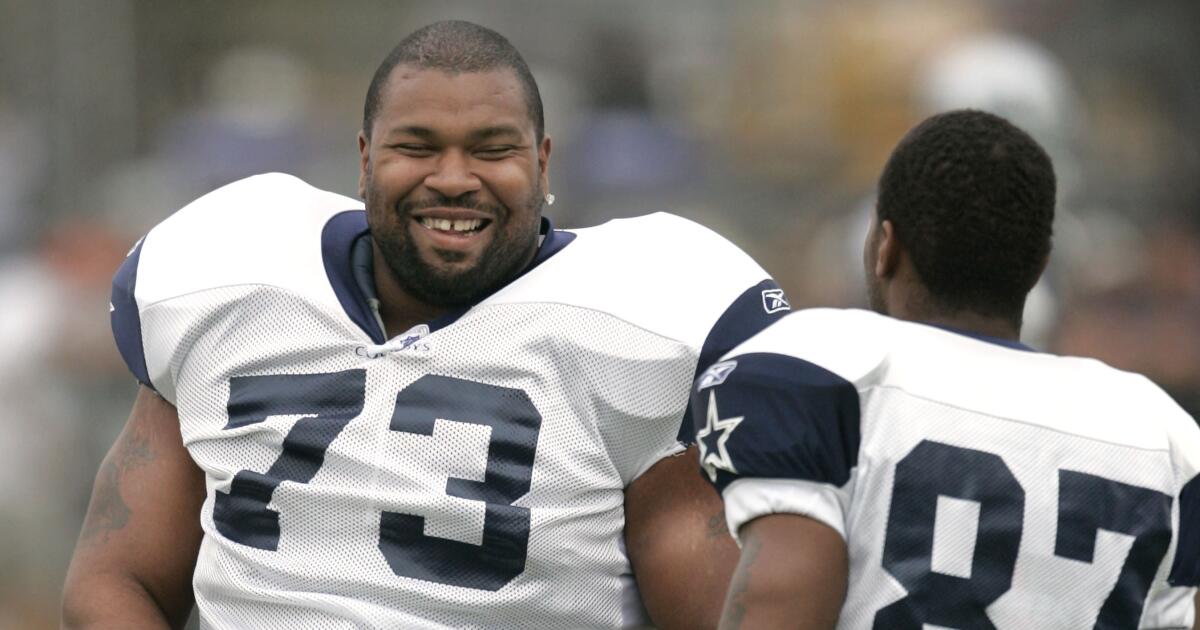
Larry Allen was an enormous man with unsurpassed talent and a ferocious demeanor on the football field. In 14 NFL seasons — 12 with the Dallas Cowboys, two with the San Francisco 49ers — he was a six-time All-Pro and 11-time Pro Bowl offensive lineman.
“I hear people say Larry was the best offensive lineman in the game, and that’s just not right,” Cowboys teammate and fellow Hall of Famer Michael Irvin once said. “Larry was the best player in the league, and it wasn’t even close.”
Yet Allen, who died suddenly Sunday at age 52 while on vacation with his family in Mexico, had fears rooted in his upbringing in Compton. At age 9, he was stabbed 12 times in the head and shoulder while defending his younger brother, Von, from an older boy whose mother had given him a knife.
After enduring painful stitching of the wounds, Allen became so frightened of needles that he even refused Novocain before his dentist filled a cavity. As for the kid with the knife, though, Allen found him three months after the stabbing.
“My mother said, ‘I’m not raising any punks, so she made me fight this guy,’ ” Allen said during his Hall of Fame induction speech in 2013. “She said, ‘You will fight him until you win.’ First day I lost. Second day I lost. The third day I finally won. That was one of the most valuable lessons I learned in my life, never to back down from anybody.”
Allen’s mother, Vera, was his guiding force.
“We would hear the gunfire outside our house, we would automatically roll out of the bed, lay on the floor until the shooting stopped, then get back in bed and go to sleep,” she told The Times in 1994. “After a while, we got pretty good at that.”
She moved with her two sons to Northern California a few years later. Allen attended four high schools and didn’t play football until his junior year, when the family returned to Southern California and he enrolled at Compton Centennial.
A year later Allen again bolted because of gang activity and drug dealing near his family’s home, playing his senior year at Vintage High in Napa while staying with the family of a friend, Steve Hagland. Allen didn’t graduate and drifted to tiny Butte Junior College in Chico, where he dominated on the field but didn’t earn the grades to transfer to a Division I program.
He moved back to his mom’s house in Compton, played pickup basketball and worked odd jobs. Football became an afterthought until Frank Scalercio, an assistant coach at Division II Sonoma State, tracked him down and hauled him back to Northern California.
While trying to convince Sonoma head coach Tim Walsh that Allen was worth recruiting, Scalercio repeated a rumor he’d heard that the lineman could dunk a basketball. Walsh rolled his eyes when Allen — all 325 pounds of him — arrived on campus.
“I was bragging about this kid for months, and would always include the fact he could dunk,” Scalercio told Star magazine. “So here we were, the basketball team is in the gym, a few football players, just all watching him. And he throws down this two-handed slam like none of us had ever seen. The ball was just bouncing on the floor for like 10 seconds and no one said a word. I have never heard silence like that in my life.”
Two years later, Allen wasn’t quiet when he got a call from Cowboys owner Jerry Jones on NFL draft day.
Jones: “Son, would you like to be a Cowboy?”
Allen: “Yes, sir!”
The kid from Compton who’d bounced around four high schools, a junior college and a Division II program was a second-round pick of the reigning Super Bowl champions.
“I ran out of my apartment and jumped into the swimming pool with all my clothes on,” Allen said.
Soon thereafter, he bought Vera a house in Sacramento.
“Everything she gave and did for my brother and me, that was the one gift I was able to give to her,” Allen said. “She did everything for my brother and me. My life could’ve ended up much differently.”
Yet sadly, his life ended prematurely. Allen left his wife, Janelle, daughters Jayla and Loriana and son Larry III.
“Larry, known for his great athleticism and incredible strength, was one of the most respected, accomplished offensive linemen to ever play in the NFL,” the Cowboys said in a statement. “His versatility and dependability were also signature parts of his career. Through that, he continued to serve as inspiration for many other players, defining what it meant to be a great teammate, competitor and winner.
“The Jones family and the Cowboys extend their deepest condolences, thoughts and prayers to the Allen family and grieve along with the many other friends and Cowboys teammates that also loved Larry.”
Just received the heartbreaking news of the passing of our beloved teammate Larry Allen. He was a HOF offensive lineman that dominated opponents regardless of the position played. Off the field, he was a gentle giant that loved his family. Rest in Peace LA💔🙏🏼
— Troy Aikman (@TroyAikman) June 3, 2024
Allen’s exploits on the field are legendary. He excelled at guard and at tackle, ran a 4.8-second 40-yard dash and was astonishing in the weight room — even though he famously didn’t enjoy lifting.
Social media sites Monday were filled with tributes to Allen that included his most memorable feats, such as the time he bench-pressed 700 pounds — 300 pounds more than any teammate — and withstood Rocket Ismail falling on Allen’s chest in jubilation.
And the time he bench-pressed 225 pounds 43 times.
And the time he chased down New Orleans Saints linebacker Darion Conner 50 yards downfield following an interception.
Allen apparently also was responsible for opponents contracting a unique malady.
“Players will watch him on film during the week and then pull up with some mysterious injury or flu or something,” New York Giants All-Pro defensive end Michael Strahan said. “We call that catching ‘Allen-itis.’ ”
Allen, who was called for holding only 13 times in 14 seasons, helped the Cowboys win Super Bowl XXX after the 1995 season in a 27-17 win over the Pittsburgh Steelers. Six years after he retired in 2007, he rattled off the names of many teammates, coaches and family members during his Hall of Fame induction speech in Canton, Ohio.
“My goal was simple, to earn a seven-letter word called respect,” he said. “The respect of my teammates, opponents and the NFL. Today, my mission is complete. I also played hard, whistle to whistle, to make my opponents submit. And today, I’m submitting to you. I just can’t wait to see my buddies.
“I’ve been blessed to play the game I love. And remember this, it has never been about me, Larry Allen, but the many, many people that helped me out.”



Sports
ESPN analyst Paul Finebaum questions Trump’s college sports reform meeting as potential ‘circus’

NEWYou can now listen to Fox News articles!
President Donald Trump will host a White House roundtable regarding college athletics reform later this week.
The panel is expected to include prominent coaches, college sports and pro sports league commissioners, and other professional athletes, according to OutKick.
The group will meet March 6 to examine solutions to key challenges, including NCAA authority; name, image and likeness issues (NIL); collective bargaining; and governance concerns.
President Donald Trump holds a football presented to him during a ceremony to present the Commander-in-Chief’s Trophy to the US Naval Academy football team, the Navy Midshipmen, in the East Room of the White House on April 15, 2025 in Washington, D.C. (BRENDAN SMIALOWSKI/AFP via Getty Images)
The meeting Friday will include big names like Nick Saban, Urban Meyer, Adam Silver and Tiger Woods. Trump has been adamant about “saving college sports,” even signing an executive order setting new restrictions on payments to college athletes back in July.
However, ESPN college analyst Paul Finebaum, who has previously hinted at a congressional run as a Republican, remains a bit skeptical.
“The easiest thing, guys, is just to say this is ridiculous,” Finebaum said to Greg McElroy and Cole Cubelic on WJOX. “And I read the other day, ‘Why is Nick Saban going?’ Why is anybody going? The bottom line is this. If something doesn’t happen very quickly, and I mean in the next short period of time, we’re talking about weeks, not years, then this thing could blow up.
“However it came about, I’m in favor of. The question now becomes, with some of the most powerful people in Washington in the same room, including the most powerful person in the country, can anything get done, or will it be a circus? Will it be just another show?”
U.S. President Donald Trump shakes hands with former Alabama Crimson Tide football coach Nick Saban as Trump takes the stage to address graduating students at Coleman Coliseum at the University of Alabama on May 01, 2025 in Tuscaloosa, Alabama. (Anna Moneymaker/Getty Images)
Trump’s order prohibits athletes from receiving pay-to-play payments from third-party sources. However, the order did not impose any restrictions on NIL payments to college athletes by third-party sources.
A House vote on the SCORE Act (Student Compensation and Opportunity through Rights and Endorsements), which would regulate name, image, and likeness deals, was canceled shortly before it was set to be brought to the floor in December.
The White House endorsed the act, but three Republicans, Byron Donalds, Fla., Scott Perry, Pa., and Chip Roy, Texas, voted with Democrats not to bring the act to the floor. Democrats have largely opposed the bill, urging members of the House to vote “no.”
President Donald Trump looks on before the college football game between the US Army and Navy at the M&T Bank Stadium in Baltimore, Maryland, on Dec. 13, 2025. (Alex WROBLEWSKI / AFP via Getty Images)
The SCORE Act would give the NCAA a limited antitrust exemption in hopes of protecting the NCAA from potential lawsuits over eligibility rules and would prohibit athletes from becoming employees of their schools. It prohibits schools from using student fees to fund NIL payments.
Fox News’ Chantz Martin and Ryan Gaydos contributed to this report.
Follow Fox News Digital’s sports coverage on X, and subscribe to the Fox News Sports Huddle newsletter
Related Article

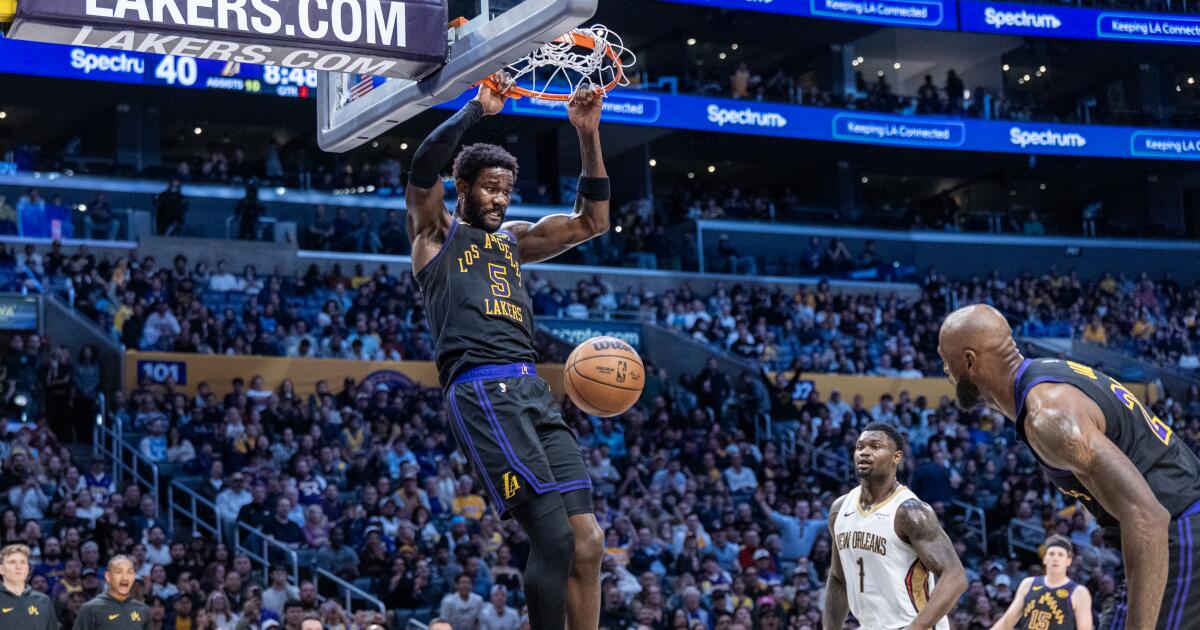
Lakers center Jaxson Hayes falls after Pelicans forward Zion Williamson commits an offensive foul as Lakers guard Austin Reaves watches at at Crypto.com Arena on Tuesday.
(Allen J. Schaben/Los Angeles Times)
Matching the physicality of Pelicans forwards Zion Williamson and Saddiq Bey was on the top of the Lakers’ scouting report. But the task is easier said than done.
Reaves admitted to being “terrified” of stepping in front of a driving Williamson to draw a charge. The 6-foot-6, 284-pound Pelicans forward is just as physical as he is athletic, creating a fearsome combination for defenders. Healthy for the first time in two seasons, Williamson led the Pelicans with 24 points on 10-for-18 shooting.
“We haven’t seen somebody like that in a long time, right?” Smart said. “[With] his ability. But [being] willing to put your body there, take a charge, take an elbow to the face, box him out, go vertical, is definitely something that you got to be willing to do, and not everybody’s willing to do it. And that’s the difference in the game.”
Center Jaxson Hayes was up to the task. He absorbed a Williamson elbow in the fourth quarter and ended up in the front row of the stands holding his jaw. But the knock was worth it for the offensive foul that helped maintain the Lakers’ 14-0 run that quickly erased the Pelicans’ eight-point lead. The scoring streak started immediately after Hayes subbed back into the game with 7:20 remaining after he scored on his first possession, cutting to the basket for a dunk off an assist from Doncic.
Hayes had eight points, six rebounds and two blocks, playing nearly 23 minutes off the bench in his biggest workload as a substitute since Jan. 20 against Denver. After playing with Hayes in New Orleans during the center’s first two years in the league, Redick lauded the seven-year pro’s improvement. Hayes is sinking touch shots around the rim now. He has improved his decision making in the pocket. After getting benched for his defensive lapses last season, Hayes has impressed coaches with his consistent ability to stay vertical while protecting the rim. And he still brings the same trademark athleticism that made him the eighth overall pick in 2019.
“He consistently injects energy into the group when he runs the floor, blocks a shot, or he gets those dunks,” Redick said.
Sports
Eileen Gu reflects on decision to leave Team USA for China: ‘A lot of people just don’t understand’

NEWYou can now listen to Fox News articles!
Eileen Gu released a statement on social media Monday, reflecting on her controversial decision to compete for Team China despite being born and raised in the U.S.
Gu’s statement tied the decision back to her passion for promoting women’s sports, and encouraging young girls to pursue sports.
“I gave my first speech on women in sports and title IX when I was 11 years old. I talked about being the only girl on my ski team, and, despite attending an all-girls’ school from Monday through Friday, becoming best friends with my teammates on the weekends through the common language of sport,” Gu wrote on Instagram.
Silver medalist Eileen Gu of China poses for photos after the awarding ceremony of the freestyle skiing women’s freeski big air event at the Milan-Cortina 2026 Olympic Winter Games in Livigno, Italy, Feb. 16, 2026. (Photo by Wang Peng/Xinhua via Getty Images) (Wang Peng/Xinhua via Getty Images)
“At the same time, I was made painfully aware of the lack of representation – at age 9, I felt that I was somehow representing all women every time I stepped in the terrain park. Landing tricks was about more than progression … it was about disproving the derisive implication of what it meant to ‘ski like a girl.’”
Gu went on to express gratitude for the one season in which she did compete for the U.S.
“When I was 15, I announced my decision to compete for China. At the time, I had spent one season on the US team, and had been lucky enough to meet my heroes in person. I am forever grateful for that season, and continue to maintain a close relationship with the team. I had spent every summer in China since I was 8 setting up summer camps on trampoline and dry slope for kids and adults, ranging from 7 to 47 years old, so I knew the industry was tiny. I felt like I knew everyone,” she added.
“Skiing for Team China meant the opportunity to uplift others through the universal culture of sport, and to introduce freeskiing to hundreds of millions of people who had never heard of it, especially with the Beijing 2022 Winter Olympics around the corner.”
Gu’s statement concluded by acknowledging that certain people “don’t understand” her decision to compete for China over the U.S., while insisting the choice maximized the impact she would have.
“I can look back now, at 22, and tell 12 year old Eileen that there are now terrain parks full of little girls, who will never doubt their place in the sport. I can tell 15 year old me that there are now millions of girls who have started skiing since then, in China and worldwide,” Gu wrote.
“A lot of people won’t understand or believe that I made a decision to create the greatest amount of positive impact on the world stage that I could, at this age, given my interests and passions. Three golds and six medals later, I can confidently say was once a dream is now a reality.”
Gu has become a target for global criticism this Olympics for her decision to represent China while remaining silent on the country’s alleged human rights abuses.
In an interview with Time magazine, Gu was asked her thoughts on China’s alleged persecution of Uyghurs and other Turkic Muslim minorities in Xinjiang.
“I haven’t done the research. I don’t think it’s my business. I’m not going to make big claims on my social media,” Gu answered.
“I’m just more of a skeptic when it comes to data in general. … So, it’s not like I can read an article and be like, ‘Oh, well, this must be the truth.’ I need to have a ton of evidence. I need to maybe go to the place, maybe talk to 10 primary source people who are in a location and have experienced life there.
“Then I need to go see images. I need to listen to recordings. I need to think about how history affects it. Then I need to read books on how politics affects it. This is a lifelong search. It’s irresponsible to ask me to be the mouthpiece for any agenda.”
More controversy surrounding Gu erupted after The Wall Street Journal reported that Gu and another American-born athlete who now competes for China, were paid a combined $6.6 million by the Beijing Municipal Sports Bureau in 2025.
Gu is the highest-paid Winter Olympics athlete in the world, making an estimated $23 million in 2025 alone due to partnerships with Chinese companies, including the Bank of China and western companies.
Her alignment with China prompted criticism from many Americans this Olympics, including Vice President J.D. Vance.
“I certainly think that someone who grew up in the United States of America who benefited from our education system, from the freedoms and liberties that makes this country a great place, I would hope they want to compete with the United States of America,” Vance said in an interview on Fox News’ “The Story with Martha MacCallum.”
Later, when Gu was asked if she feels “like a bit of a punching bag for a certain strand of American politics at the moment,” she said she does.
“I do,” she said. “So many athletes compete for a different country. … People only have a problem with me doing it because they kind of lump China into this monolithic entity, and they just hate China. So, it’s not really about what they think it’s about.
“And, also, because I win. Like, if I wasn’t doing well, I think that they probably wouldn’t care as much, and that’s OK for me. People are entitled to their opinions.”
CLICK HERE TO DOWNLOAD THE FOX NEWS APP
Silver medalist Eileen Gu of China attends the awarding ceremony of the freestyle skiing women’s freeski big air event at the Milan-Cortina 2026 Olympic Winter Games in Livigno, Italy, Feb. 16, 2026. (Hongxiang/Xinhua via Getty Images)
Gu has claimed she was “physically assaulted” for the decision.
“The police were called. I’ve had death threats. I’ve had my dorm robbed,” Gu told The Athletic.
“I’ve gone through some things as a 22-year-old that I really think no one should ever have to endure, ever.”
Follow Fox News Digital’s sports coverage on X, and subscribe to the Fox News Sports Huddle newsletter.
Related Article

Report: Lions tender K Jake Bates ERFA offer

SF scientists build robotic storm samplers to track pollutants before they reach the Bay

Public frustration grows as Dallas leaders debate billion‑dollar City Hall fix or relocation

City of Miami celebrates reopening of Flagler Street as part of beautification project

Each mile is for her miracle: This Granby mom is running the Boston Marathon with her daughter in mind

Florida High School Football Rankings: Top 25 teams – Oct. 21

Cleary's 21 help Le Moyne down Central Connecticut State 69-64 in OT

How old is Bo Nix? What to know about Oregon quarterback ahead of 2024 NFL Draft

99th annual Pony Swim held in Virginia

Indiana Members Credit Union announced as new anchor tenant at Bottleworks District

US submarine sinks Iranian warship by torpedo in a first since World War II

Which oil and gas facilities in the Gulf have been attacked?

Mojtaba Khamenei, son of former supreme leader, tipped to become Iran’s next head of state

Video: Senators Question Kristi Noem on ICE Immigration Tactics

Combustible Republican Senate primary in Texas heading into overtime
-

 World7 days ago
Exclusive: DeepSeek withholds latest AI model from US chipmakers including Nvidia, sources say
-

 Massachusetts1 week ago
Mother and daughter injured in Taunton house explosion
-

 Wisconsin3 days ago
Setting sail on iceboats across a frozen lake in Wisconsin
-

 Denver, CO1 week ago
10 acres charred, 5 injured in Thornton grass fire, evacuation orders lifted
-

 Louisiana1 week ago
Wildfire near Gum Swamp Road in Livingston Parish now under control; more than 200 acres burned
-

 Maryland4 days ago
AM showers Sunday in Maryland
-

 Florida4 days ago
Florida man rescued after being stuck in shoulder-deep mud for days
-

 Oregon5 days ago
2026 OSAA Oregon Wrestling State Championship Results And Brackets – FloWrestling