Sports
Column: Reparations for Chavez Ravine families? Not so fast, say some descendants

Larry Herrera-Cabrera’s email to me in May was as polite as it was challenging.
He reached out shortly after The Times editorial board wrote about proposed state legislation that would attempt to right the wrong of Chavez Ravine.
Sponsored by Assemblymember Wendy Carrillo, the bill would require the city of Los Angeles to erect a monument to the families, most of them Latino, who were pushed out in the 1950s to make way for Dodger Stadium. The city would also have to create a task force to study reparations for the “large, long-lasting disparities” faced by those families and their descendants.
Bemoaning what happened in Chavez Ravine is part of the modern L.A. gospel. I’ve read essays by former residents decrying what happened, read books and seen plays and documentaries that captured their plight and enjoyed Ry Cooder’s 2005 concept album, “Chávez Ravine,” which gathered Chicano music legends — Little Willie G, Lalo Guerrero, Ersi Arviz and Don Totsi, among others — to sing about the sordid saga from beginning to end.
That’s why I found Herrera-Cabrera’s email so fascinating.
“My wife and I are both descendants of three families that lived in Chavez Ravine up to 1950,” he began. “Despite the legislative findings in [Carrillo’s bill], and fables on the Internet and elsewhere, our families were neither left destitute, nor were they bitter about moving.”
He went on to offer an alternative narrative I had never considered — one where Chavez Ravine families took the money the city gave them, bought homes elsewhere and went on with their lives. Where descendants feel insulted at the insinuation in Carrillo’s bill that they need help. Herrera-Cabrera’s note added nuance to a tale long considered an open-and-shut, black-and-white case of municipal racism.
Priscilla Leiva, professor of Chicana/o and Latina/o studies at Loyola Marymount University, has spoken with Herrera-Cabrera as part of “Chavez Ravine: An Unfinished Story,” a multidisciplinary project she’s leading with former resident Carol Jacques that includes hundreds of photos and dozens of oral histories. She wasn’t surprised that I was, well, surprised.
“Latino narratives are always flattened, but especially with [the Chavez Ravine] population, because the displacement was so egregious,” Leiva said.
The public long ago stopped paying attention to “what happened before and what happened after,” she noted, which means “a lot of people don’t want to recognize or acknowledge any nuance.”
I visited Herrera-Cabrera and his wife, Katherine, at their spacious San Juan Capistrano home earlier this month. It’s nestled on a hill resembling the neighborhoods where their parents grew up, except this is upper-middle-class suburbia instead of the “poor man’s Shangri-La,” as a photographer famously described Chavez Ravine and as Cooder titled a song.
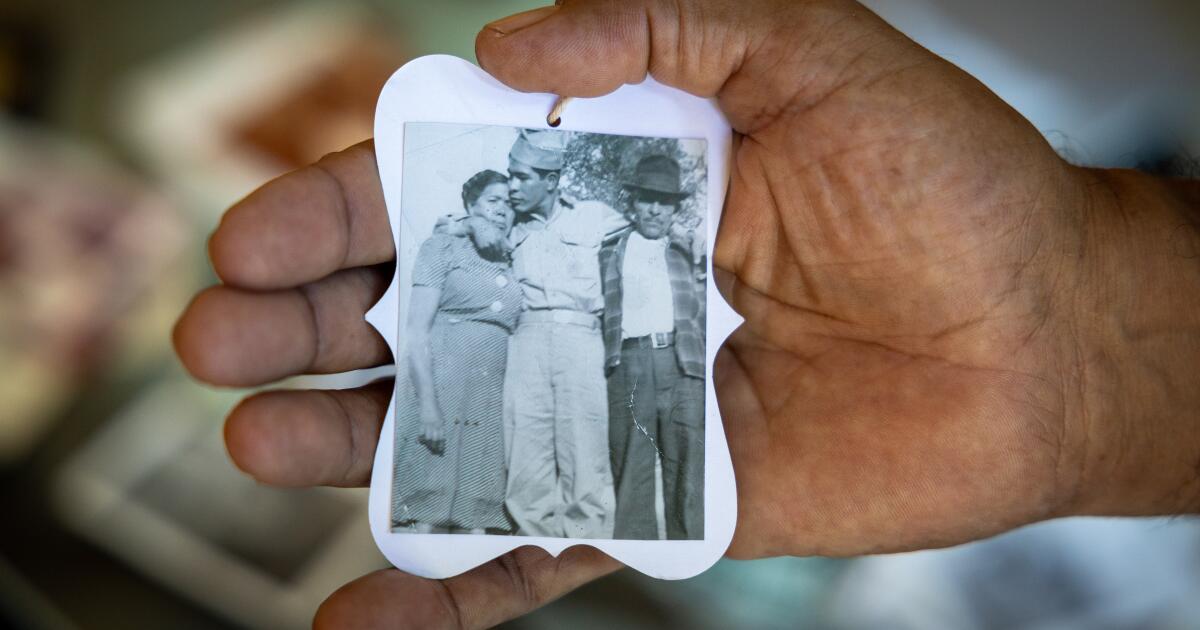
Larry Herrera-Cabrera, shown holding a photo of his Uncle Henry, killed in combat during World War II.
(Allen J. Schaben / Los Angeles Times)
In Herrera-Cabrera’s study, a Biden-Harris sticker was wedged above a photo of his late mother Sally, alongside photos of his biological father and maternal uncles in their World War II uniforms. He described his decades in city and county government as a “progressive bureaucrat,” proudly remembering how he stood up to racist politicos in Santa Barbara County in the 1980s and officiated same-sex marriages as Long Beach city clerk after the Supreme Court legalized them in 2013, two years before he retired.
“Having that connection to [helping] the community was really important to me,” he said as we stood over a kitchen table to look at family photos shot around Chavez Ravine in the 1940s. Three of his maternal uncles in Army uniforms around their mother at a park. His mother and her sisters, wearing sunglasses and bobby soxer skirts and sweaters. A group of unidentified young pachucos.
“Our family’s history gave us strength,” the 71-year-old continued. He’s tall, with bright eyes that make his glasses shine even more. “I know they suffered hardship. Things don’t always work out, but you gotta keep pushing.”
His grandparents used the money from the city of L.A. to buy a home in nearby Lincoln Heights, where Herrera-Cabrera was born in 1952. Nine years later, his mother and stepfather moved to Rosemead but frequently visited his Uncle Joe in Solano Canyon at the base of Dodger Stadium, where some Chavez Ravine families had relocated. City officials had promised them a spot in a public housing project to be built over their bulldozed homes. The stadium went up instead.
“In the early days, you could sit on a hill and watch the games for free,” Herrera-Cabrera said. He and his family sometimes went to games, but he preferred playing with cousins outside Uncle Joe’s house while their elders listened to the game on the radio and reminisced about Chavez Ravine. “They spoke fondly of those days. No one complained about having to move.”
He can’t remember when he learned of the prevailing narrative casting the Chavez Ravine families as pitiable, but he “didn’t care for it.” Nor did Katherine, who eventually joined us in the kitchen.
“Who wants to admit that they’re downtrodden?” she said before referencing the Arechiga family, one of the last holdouts in Chavez Ravine before L.A. County sheriff’s deputies forcibly evicted them. They had lived at their condemned home without paying property taxes for years, according to newspaper accounts at the time.
“Now they come back saying they want reparations?” she said.
“[Chavez Ravine] is more than just the photos of people being dragged out,” Larry Herrera-Cabrera added, referring to the infamous 1959 photo of four L.A. County sheriff’s deputies dragging a member of the Arechiga clan from her home. “It’s their accomplishments.”
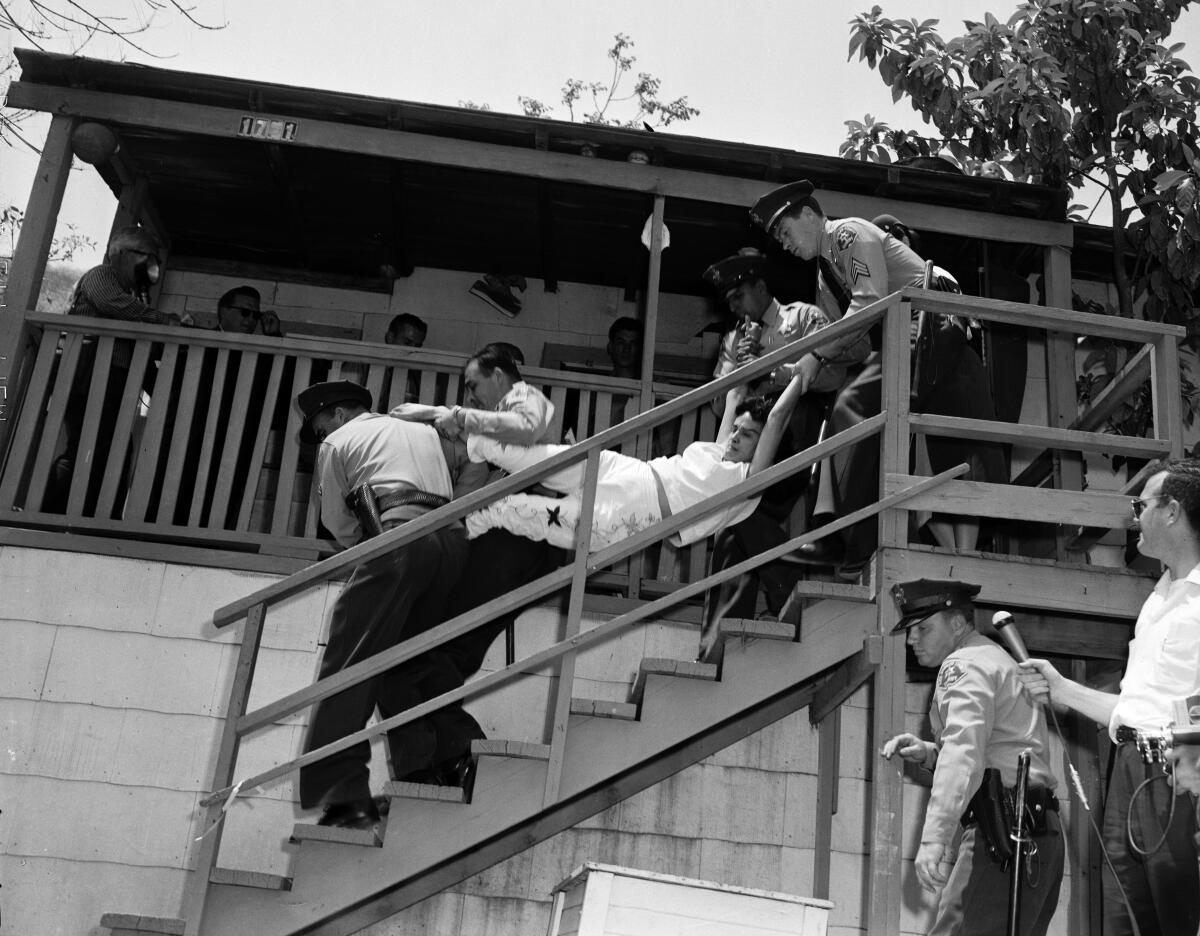
Aurora Vargas is carried by Los Angeles County sheriff’s deputies in 1959 after her family refused to leave their house in Chavez Ravine.
(Hugh Arnott / Los Angeles Times Archive/UCLA)
His perspective about what Chavez Ravine should mean changed in 2019, after a trip to the Ardennes American Cemetery in Belgium to fulfill a promise to his mother. There lies the grave of his maternal uncle, Henry Rivas, an Army private who died in the Battle of Hürtgen Forest at 19. Between them, Larry and Katherine have at least a dozen relatives who served in World War II.
“To think they thought that fascism was worse than what they faced at home was telling,” she said.
“And then they returned and became successful,” Larry added. “I had one uncle who worked in aerospace, and my Uncle Joe worked in the post office. Another uncle opened a restaurant. My dad Domingo did construction. My Uncle Ted — Teodoro — he started a men’s fashion line.”
Last year for the first time, the couple attended an annual reunion of Chavez Ravine families who call themselves Los Desterrados (The Uprooted). There, Larry displayed poster boards of his uncles’ World War II service.
“If I could talk to Wendy [Carrillo], I’d tell her those stories,” he proclaimed. “To me, they were successes. That’s part of the story. As difficult as it was, they still prospered.”
He sent a letter to the state Senate opposing Carrillo’s bill, which is being considered by a Senate appropriations committee, describing it as “hypothetical” and bad policy.
“If people were truly ripped off, that’s one thing. But why would I, as a descendant, be entitled to anything?” he said.
“The bill says people were left destitute,” Katherine said. “Who?”
Vincent Montalvo is a co-founder of Buried Under the Blue, a nonprofit that has long pushed for an apology from the Dodgers and reparations from L.A. County and city while urging people not to use the term “Chavez Ravine” for the neighborhoods of Bishop, La Loma and Palo Verde that were bulldozed to make way for Dodger Stadium.
But they had nothing to do with Carrillo’s bill, which he said he “85% agrees with.” His group also wants three community centers to be built and named after Bishop, La Loma and Palo Verde. The land should be given back to the Gabrieleño Band of Mission Indians, Kizh Nation, and all the parties involved in the displacement should issue a public apology, according to Buried Under the Blue.
Montalvo, who grew up in Echo Park and whose grandparents owned a home in Palo Verde, said former residents have accused him “of wanting a handout.”
“These things hurt,” he said. “But the older generation couldn’t even talk about what happened for forever. But I’ve told them, ‘With respect, you guys do what you’re going to do, and we’re going to do what we’re going to do. And some of you are going to jump back on the wagon, and that’s OK.’ ”
Carrillo, whose district includes Dodger Stadium, told me, “I’ve learned that when advancing policy ideas, some will say it goes too far, while others may say it doesn’t go far enough. But ultimately, we move the needle toward justice, and we try to do as much good for as many people as possible.”
On the criticism that her bill casts Chavez Ravine families as perpetual victims, the Assembly member was more straightforward: “There are no victims, but there are survivors.”
Larry agrees with her and Montalvo on one thing: a monument. But he wants it to focus on the good of his elders, as much as the bad that happened to them.
“My family wasn’t dragged out of Chavez Ravine. Most families weren’t. Like my Uncle Joe would say, let it go like water off a duck’s back.”
He teared up.
“If there were reparations, well, bring them back,” he said, referring to his uncles. “Bring back their stories. I didn’t suffer. It should be about what they did. That is Chavez Ravine’s legacy.”

Sports
Knicks guard nearly wipes out Michael Bloomberg diving for loose ball during NBA Finals Game 3

Trump’s attendance at Knicks-Spurs Game 3 triggers enhanced security
Massive security preparations are underway for NBA Finals Game 3 in New York City due to Donald Trump’s planned attendance. House Minority Leader Hakeem Jeffries criticized Trump’s visit. The NYPD and Secret Service have implemented a “frozen zone” around Madison Square Garden, leading to fan advisories and a no-bag policy. Former FBI agent James Gagliano discusses these heightened security measures following a recent Penn Station stabbing.
NEWYou can now listen to Fox News articles!
Sitting courtside at a basketball game brings its own inherent danger, and former New York City Mayor Michael Bloomberg nearly found out the hard way on Monday night.
The loose ball bounced toward the 84-year-old billionaire during Game 3 between the New York Knicks and San Antonio Spurs. Knicks guard Jose Alvarado dove into the stands and nearly crushed Bloomberg in the process.
ZERO BS. JUST DAKICH. TAKE THE DON’T @ ME PODCAST ON THE ROAD. DOWNLOAD NOW!
New York Knicks guard Jose Alvarado speaks with former New York City Mayor Michael Bloomberg after falling into him during the second half of Game 3 of the NBA Finals in New York on June 8, 2026. (Yuki Iwamura/AP)
Alvarado checked to make sure Bloomberg was fine – and he was. Bloomberg appeared to wave off any help from personnel on the sideline. Even comedian Dave Chappelle came over to check on the former politician.
The Spurs led by four points with 10:36 left in the game. San Antonio picked up the 115-111 win and finally got on the board in the series. Victor Wembanyama led the team with 32 points, eight rebounds, six assists, three blocks and two steals.
NBA Commissioner Adam Silver greets former New York City Mayor Michael Bloomberg before game three of the 2026 NBA Finals between the San Antonio Spurs and New York Knicks at Madison Square Garden in New York, N.Y., on June 8, 2026. (Geoff Burke/Imagn Images)
“I really tried to relax,” Wembanyama said. “The playoffs is like a whirlwind. It’s hard to put your head out of the water, and sometimes it’s like I don’t even (have) to watch the game back, by the way.
“I just need a little time off, let my brain cool down and recover — recover as much for the body as for the mind.”
Knicks star Jalen Brunson led New York with 32 points, five assists and five rebounds. Alvarado had four points in 12 minutes off the bench.
Jose Alvarado of the New York Knicks keeps the ball inbounds during the fourth quarter against the San Antonio Spurs in Game Three of the 2026 NBA Finals at Madison Square Garden in New York City on June 8, 2026. (Dustin Satloff/Getty Images)
CLICK HERE TO DOWNLOAD THE FOX NEWS APP
Game 4 is set for Wednesday night back in Madison Square Garden.
The Associated Press contributed to this report.

History tends to repeat itself at the World Cup. Such is the case with Mexico and South Africa, two teams that will face off in the World Cup opening match for the second time in history, just as they did in Johannesburg on June 11, 2010. The score that night was 1-1.
Many still remember Siphiwe Tshabalala and his powerful shot into the top corner that beat Mexican goalkeeper Óscar Pérez, and a celebration that remains etched in the collective memory of the soccer world. Unfortunately for the South African team that night, Rafa Márquez equalized for El Tri with 11 minutes remaining during what turned out to be a disappointing World Cup for the host nation.
Sixteen years later, the 2026 World Cup kicks off, curiously enough, with the same matchup, but with the roles reversed. Mexico is now the host at Azteca Stadium, known during this competition as Mexico City Stadium, at 7,216 feet above sea level. It will be the third World Cup the venue has hosted.
“It won’t be easy at all,” South Africa coach Hugo Broos said last December upon learning his team would debut against one of the hosts. “It’s a great thing to play in front of 80,000 people. We have nothing to lose.”
Mexico’s Giovani Dos Santos jumps on the back of Rafael Marquez after Mexico scored against South Africa during a World Cup group match on June 11, 2010, in Johannesburg, South Africa.
(Michael Steele / Getty Images)
On the Mexican side, the similarities to 2010 are striking — and not necessarily for the right reasons. Coach Javier Aguirre is back on El Tri’s bench — the same coach who led that campaign in South Africa — which, at first glance, might seem curious, though in practice it reflects the stagnation of a soccer team that has gone eight consecutive World Cups without advancing past the round of 16.
Former Barcelona player Márquez, who scored the equalizer, also remains connected to the national team, now as an assistant coach, with the mandate to take the reins of the team once the Aguirre era concludes after the World Cup. The squad has seen more than a dozen coaches come and go since 2010, including a qualification for Brazil 2014 that nearly ended in tragedy before a goal by the United States rescued the Mexican team and sealed its admission into the tournament.
“Javier [Aguirre] was a firefighter in 2002, he was a firefighter in 2010 and he stepped in as a firefighter again then — it’s the same old story,” said John Sutcliff, a journalist who has covered Mexico for more than 36 years. “[The federation officials] aren’t working in the best interest of the national team. There’s a lot of interest in bringing in foreigners [to the Mexican league] for business purposes and we don’t have players in Europe’s top leagues.”
Mexico’s recent record speaks for itself. It was eliminated in the World Cup round of 16 in 2010 by Argentina, by the Netherlands in 2014, by Brazil in 2018 and failed to even advance past the group stage in Qatar in 2022. Considered the “Giant of CONCACAF,” Mexico has remained dominant in its region since 2010, with five Gold Cups, although it has lost ground to the United States in the Nations League.
Outside the region, its participation in 2010 has been limited mainly to two editions of the Copa América held on U.S. soil, in which it has failed in both, reaching the quarterfinals in 2016 and being eliminated in the group stage in 2024.
“I think it’s been a roller coaster ride over these 16 years; for a moment it seemed like it was making progress, but then there were spectacular crashes,” said Gibrán Araige, a journalist who has followed El Tri through several World Cup cycles.

Mexico’s Raúl Jiménez celebrates with teammates after scoring against Serbia during a friendly at Nemesio Diez Stadium on June 4 in Toluca, Mexico.
(Agustin Cuevas / Getty Images)
For Araige, the level of the 2010 squad is similar to the current one, with players who are not yet established but have solid European experience.
Of the 26 players called up by Aguirre, 10 play in Europe, but few play for elite clubs or get significant playing time on their teams, mostly hampered by injuries, as is the case with Santi Giménez (AC Milan, Italy), César Huerta (Anderlecht, Belgium), Luis Chávez (Dinamo, Russia) and Edson Álvarez (Fenerbahçe, Turkey).
For its part, South Africa has not made significant progress since 2010.
After being eliminated in the group stage, finishing behind Uruguay and Mexico in a tournament held in its own country, it became the first host nation in a World Cup to fail to advance past that stage — a record that Qatar matched in 2022.
Bafana Bafana failed to qualify for the next three World Cups. In fact, this is the first time they have qualified since 2002, as they did not have to qualify in 2010, having hosted the tournament.
They were eliminated as group runners-up behind Ethiopia on the road to Brazil in 2014, they finished last in their group on the road to Russia in 2018 and finished second behind Ghana in the qualifiers for Qatar in 2022.

South African players run during a World Cup training session at Estadio Hidalgo on June 3 in Pachuca, Mexico.
(Manuel Velasquez / Getty Images)
They have also lacked consistency in the Africa Cup of Nations, missing the 2012 and 2017 editions.
Broos, who took over as South Africa’s head coach in 2021, sought to instill discipline and relied on local talent, which was vital in securing a spot in this year’s World Cup. During the qualifying round, South Africa won its group by finishing ahead of Nigeria and advanced despite starting the campaign with a loss due to an ineligible player used in a match against Lesotho.
Broos faced criticism for strategic errors early on, but ultimately built a competitive team that achieved historic qualification, aided by nine direct World Cup spots in the expanded tournament field.
“It’s a truly excellent group of players. We got through a very tough qualifying phase, which I think helped polish the team,” said Mark Gleeson, a journalist specializing in African soccer.
For Gleeson, South Africa missed a major opportunity to strengthen its league by failing to retain investors and wealthy clients after the 2010 World Cup and continued to operate in the same way — a trend reflected in the league’s stagnation and the scarcity of talent playing abroad.
Lwethu Makhanya (Philadelphia Union, USA), Ime Okon (Hannover 96, Germany), Mbekezeli Mbokazi (Chicago Fire, USA), Sphephelo Sithole (CD Tondela, Portugal) and Lyle Foster (Burnley, England) are among the few South African players competing abroad for a national team reliant on domestic soccer.

South Africa huddle during a training session at Estadio Hidalgo on June 3 in Pachuca, Mexico.
(Manuel Velasquez / Getty Images)
However, with the World Cup’s new 48-team format, the task of advancing proved less daunting for teams in the qualifying phase and at the World Cup, there will also be more opportunities to advance beyond the group stage because the best third-place finishers move on. That math could benefit South Africa even if it loses its opening match.
Should Bafana Bafana lose to Mexico, they would have to beat the Czech Republic in their second match on June 18 in Atlanta and would likely play for qualification on June 24 against South Korea in Monterrey.
“The Czechs are among the weakest in Europe, and there’s a good chance of beating them. Furthermore, South Korea is well below its own historical standards, as was evident in March with very poor results in high-pressure matches,” Gleeson said.
To prepare for the altitude in Mexico City, Broos, a former Belgian player who competed in the 1986 World Cup in Mexico, brought his team in early and, starting May 30, held training camp in Pachuca, a city at higher in elevation than the capital. Several of his players are already accustomed to some altitude from playing for clubs in Johannesburg, at 5,751 feet.
“South Africa has a chance; we can compete,” Tshabalala said in an interview after the draw. “I think the pressure will be on Mexico because they’re the hosts. That gives us a real opportunity to pull off an upset.”
A scoreless draw against Nicaragua in Johannesburg days before the World Cup isn’t exactly encouraging, but it also fits with the team’s expectations and the mindset of “having everything to gain and little to lose.”
“We have to enjoy it, and when you enjoy something, you can achieve great things,” said Broos.
Sports
Victor Wembanyama puts hand on Jalen Brunson’s head, pushes him down as refs look the other way in Game 3

NEWYou can now listen to Fox News articles!
Victor Wembanyama’s aggression on the court was once again called into question as the San Antonio Spurs and New York Knicks played Game 3 of the NBA Finals at Madison Square Garden.
During the first half, Knicks All-Star guard Jalen Brunson was trying to guard Wembanyama near the free throw line when the 7-foot-4 center put his hand on the back of Brunson’s head and shoved him to the court.
However, Wembanyama was never called for the foul and play continued with the Knicks in possession of the ball.
Jalen Brunson of the New York Knicks works against Dylan Harper and Victor Wembanyama of the San Antonio Spurs during the third quarter in Game Three of the 2026 NBA Finals at Madison Square Garden in New York City on June 8, 2026. (Al Bello/Getty Images)
Brunson immediately got into Wembanyama’s face, and it appeared the Frenchman was smiling before the point guard got back to business.
The incident was similar to one that occurred in Game 2’s win for the Knicks on the road, when Brunson’s backup, Jose Alvarado, went to box out Wembanyama. Alvarado, who has comparable stature to Brunson, was wrapped up by Wembanyama and thrown away from the play.
NBA RESCINDS MITCHELL ROBINSON’S TECHNICAL FOUL FROM GAME 2 OF FINALS AFTER REVIEWING SHOVING MATCH
Once again, no foul call was made.
The Spurs are known for their physicality, but many believed that Wemby should’ve been called for fouls in these cases.
Jalen Brunson of the New York Knicks shoots a three-point basket over Victor Wembanyama of the San Antonio Spurs during the second quarter of Game Three in the 2026 NBA Finals at Madison Square Garden in New York City on June 8, 2026. (Dustin Satloff/Getty Images)
San Antonio started this game red-hot, owning an 11-point lead after the first quarter, 33-22. But these Knicks have consistently shown their ability to come back no matter the deficit.
After a second quarter run, the Knicks ended the locker room with a seven-point lead at halftime.
Brunson was a main reason why that was the case, going 5-of-11 from the field for 15 points with three assists and one rebound.
New York Knicks guard Jalen Brunson reacts as San Antonio Spurs forward Victor Wembanyama looks on during the second quarter of game three of the 2026 NBA Finals at Madison Square Garden in New York on June 8, 2026. (Vincent Carchietta/Imagn Images)
CLICK HERE TO DOWNLOAD THE FOX NEWS APP
As for Wembanyama, he was an efficient 6-of-10 from the field for 15 points of his own, while hauling in four rebounds and dishing out three assists.
The Spurs are trying to avoid a brutal 3-0 deficit in the best-of-seven series, while the Knicks are hoping they can keep momentum in the second half to have the chance at a sweep in their own building on Wednesday night in Game 4.
Follow Fox News Digital’s sports coverage on X and subscribe to the Fox News Sports Huddle newsletter.
-

 Missouri51 seconds ago
Paragould woman airlifted after rollover crash in Missouri
-

 Montana6 minutes ago
Expanded Great Northwest Challenge set for Montana This Weekend
-

 Nebraska13 minutes ago
Nebraska officials warn of downside to CWS crowds, urge lookout for human trafficking
-

 Nevada16 minutes ago
Nevada House District 2 Primary Election Live Results 2026 – NBC News
-

 New Hampshire21 minutes ago
Woman Claims Forced Marriage During Road Trip from NH to Maine
-

 New Jersey28 minutes ago
Sherrill, FIFA World Cup 2026™ New York New Jersey Host Committee Chief Executive Officer Alex Lasry Announce Over 750 Free Tickets for New Jerseyans for FIFA World Cup Matches – Insider NJ
-

 New Mexico31 minutes ago
Pecos Zone Type 3 Team to Take Command of Seven Cabins Fire on Wednesday
-

 North Carolina36 minutes ago
These Western NC towns ranked among best places to live in NC in 2026

