Sports
College sports on verge of seismic shift with revenue sharing


College athletics as we know it could be on the brink of change, thanks in large part to an upcoming antitrust lawsuit that is set to go to trial in January 2025.
The most talked about subject in college athletics at the moment centers around revenue sharing for student athletes, along with former players involved in the House vs. NCAA lawsuit. As we currently stand, the lawsuit filed against the NCAA by current and former players could lead to a judgment of nearly $4 billion to the plaintiffs.
Most experts agree the NCAA will end up having to pay these athletes, with a judgment that could rule in the plaintiffs favor and change the landscape of college athletics when it comes to revenue sharing. According to a report from Pete Thamel and Dan Murphy, the lawsuits have been at the forefront of conversations by conference commissioners and NCAA leaders, which led to ‘deep discussions’ regarding the matter last week in Dallas, where CFP leaders held their Spring summit.
SEC Commissioner Greg Sankey speaks during Day One of 2023 SEC Media Days at Grand Hyatt Nashville on July 17, 2023 in Nashville, Tennessee. (Johnnie Izquierdo/Getty Images)
Besides having to classify athletes as employees of a particular university, the NCAA is trying its hardest to stay away from this classification. One of the more difficult conversations being had besides revenue sharing with current student athletes centers around the NCAA being forced to backpay athletes, which could lead to around $1 billion in settlement figures.
The ongoing settlement discussions would keep all sides out of a court room. One of the bigger components of this upcoming trial is to reach a settlement that is worth the fight. The talk of creating a revenue sharing model with athletes has led to a sense of urgency to come up with a plan that will be smart enough to last.
The antitrust lawsuit at the center of this significant shift in the current landscape in college sports is seeking retro-pay for damages that have occurred due to former athletes not being able to cash-in on their name, image and likeness.
It is important to note that the ongoing lawsuits and revenue sharing are two different entities, though the NCAA and conference leaders are trying to agree on a plan that could take care of both issues, almost at the same time.
In reality, the House vs. NCAA lawsuit might be the biggest moment in the history of college athletics, especially if you consider the ramifications of not coming up with a settlement that would make the lawsuit go away. As part of the ongoing discussions about where the NCAA will go, it should be noted that revenue sharing with student-athletes might be the most logical route.
One thing to remember in the midst of all of this commotion is that athletic departments across the country are currently discussing ways to make life sustainable when revenue sharing is introduced. Even with the amount of money schools in the SEC and Big Ten are making from television contracts, there will still be the need to manage budgets across the country.
Over the course of the last few months, a number of conference commissioners, spearheaded by the SEC and Big Ten, have quietly agreed that creating a new model for revenue sharing is the right move, though it will cost conferences and the NCAA a good chunk of money.
Miami Hurricanes women’s basketball players Haley Cavinder (14) and Hanna Cavinder (15) have more than $1 million in endorsements and have been at the forefront of the college sports NIL movement. (Al Diaz/Miami Herald/Tribune News Service via Getty Images)
According to figures that have been reported over the past month, that figure could end up being anywhere between $13-20 million annually for each school in revenue sharing. This would also lead to an NFL like salary cap for colleges. Though this will likely be the case for most Power-4 schools, it will be interesting to see how this works for Group of Five institutions, who do not carry the same weight financially as others.
‘CAVINDER TWINS’ REVEAL HOW SOCIAL MEDIA SHAPED THEIR FUTURE AFTER GAINING $1.7M IN NIL: ‘IT’S A 40 YEAR PLAN’
But, just like any deal, there are many obstacles and negotiations still have a long ways to go.
Power-4 Conferences Lead The Way In Terms Of Potential Revenue Share
LSU Tigers gymnast Olivia Dunne walks on to the floor before the NCAA Women’s National Gymnastics Tournament Championship at Dickies Arena. (Jerome Miron-USA TODAY Sports)
The most obvious part of this whole conversation and negotiations regarding potential revenue-sharing in college sports is centered around the Power-4 conferences. For schools in the Big Ten, SEC, Big 12 and ACC, the idea of having to split its revenue with athletes will come a bit easier than the commissioners running the AAC or Sun-Belt conference.
If you break it down to a simple form, all of this can be tied to the massive amounts of revenue gained from non-television routes. For most of these schools in Power-4, they have ticket sales, merchandise, booster donations and conference payouts. Yes, a majority of the revenue distributed every year comes from massive contracts with the likes of ESPN, FOX, CBS and NBC, but the schools that have the backing of their powerful conference have much more wiggle-room when it comes to expenses.
Could the addition of revenue sharing force some schools to halt certain construction or projects on the docket? Sure, but this might only be for a short term period, as schools figure out a path to make sure their student-athletes get a cut of the potential revenue sharing model.
Also, we cannot forget the non-revenue sports in these discussions. For sports like softball, baseball and even basketball, a majority of schools do not turn a profit, and that’s not even factoring in the Olympic sports. So, what does revenue sharing look like under Title IX, or for a majority of the sports that are losing money on a yearly basis? This will certainly be a major talking point over the next year, as the NCAA cannot afford any more lawsuits to be filed against them.
We Are Certainly At A Crossroads For The Future Of College Athletics
Arch Manning #16 of the Texas Longhorns warms up prior to playing against the Washington Huskies during the CFP Semifinal Allstate Sugar Bowl at Caesars Superdome on January 01, 2024 in New Orleans, Louisiana. (Chris Graythen/Getty Images)
If you were looking for the turning point in the world of college athletics, we are at the fork in the road. As the pending litigation nears, conference commissioners are working on a deadline, and this is moving at a high-rate of speed.
We are approaching spring meetings for every conference around the country, with the SEC set to meet in Destin during Memorial Day week. The ACC and Big Ten will also hold their annual meetings around this time as well, and the conversations will certainly ramp-up during this period. School administrators want to know what type of funding they will need to be looking towards, and a lot of questions will need to be answered by commissioners.
Jim Cavale, who is the founder of Athletes.org and now represents the UAB football team as their player’s association representative, had this to say about the upcoming change in collegiate sports.
“The NCAA and its power conferences cannot create a sustainable model without their respective college athletes speaking into and co-creating that solution,” Cavale mentioned. “This is why we’re organizing college athletes into their own players association through to empower them to play an active role in negotiating any new deal. We’re encouraged that more and more college athletics leaders acknowledge that revenue sharing is part of the future of college athletics. The NCAA potentially settling pending lawsuits is a positive signal but this will not complete the creation of a sustainable, new solution that current college athletes will have negotiated or agreed to.”
Obviously, this affects all sports, so you can expect athletic directors to have plenty of questions, and will be looking for answers. This time last year, we were discussing the effects of NIL and how it was being handled on different campuses around the country, along with transfer rules and how student-athletes could negotiate future earnings.
Now, we’re headed towards two months of meetings that could shape the future of college athletics. Times have certainly changed, and it’s happening at a rapid pace.


NEWYou can now listen to Fox News articles!
Russell Wilson has had his share of ups and downs in his NFL career.
He helped the Seattle Seahawks to a Super Bowl championship in 2013 and was named to the Pro Bowl four times. But the last few years of his career arguably did some damage to his legacy as he’s spent the last three seasons with three different teams.
ZERO BS. JUST DAKICH. TAKE THE DON’T @ ME PODCAST ON THE ROAD. DOWNLOAD NOW!
New York Giants quarterback Russell Wilson watches from the sidelines during the second quarter against the Philadelphia Eagles at MetLife Stadium in East Rutherford, N.J., on Oct. 9, 2025. (Brad Penner/Imagn Images)
Wilson is still on the free-agent market as he looks to latch on to a new team for 2026. However, former NFL star Aqib Talib implored Wilson to hang up the cleats.
“Do your TV thing, Russ. It’s over with, man. Once you’ve got to decide, do I even want to play?” Talib said on “The Arena: Gridiron.” “I think you don’t really want to play. I hate when guys get to the later part of their career and then they start doing the bounce-around thing and they’re not going to win. There was no chip in New York. That’s just going to be another stop on your resume.”
Wilson reportedly garnered some interest from NFL teams.
New York Giants quarterback Russell Wilson stands on the field before a game against the Philadelphia Eagles at Lincoln Financial Field in Philadelphia, PA on Oct. 26, 2025. (Bill Streicher/Imagn Images)
He told the New York Post that the New York Jets were one of them.
Wilson also was reportedly a candidate to take Matt Ryan’s spot on CBS’ “The NFL Today” after Ryan left to take a front office job with the Atlanta Falcons.
Wilson has 46,966 passing yards and 353 passing touchdowns in 205 career games, but the 2025 season with the New York Giants was one to forget.
Wilson started three games and made some bizarre decisions in a loss against the Chiefs. Jaxson Dart was named the starting quarterback. As he came in to take a few snaps while Dart was being checked for a concussion, Wilson was booed.
New York Giants quarterback Russell Wilson watches from the sidelines during the second half against the Denver Broncos at Empower Field at Mile High in Denver, Colo., on Oct. 19, 2025. (Ron Chenoy/Imagn Images)
CLICK HERE TO DOWNLOAD THE FOX NEWS APP
Should he end up signing with another team, Wilson will be entering his age-38 season.
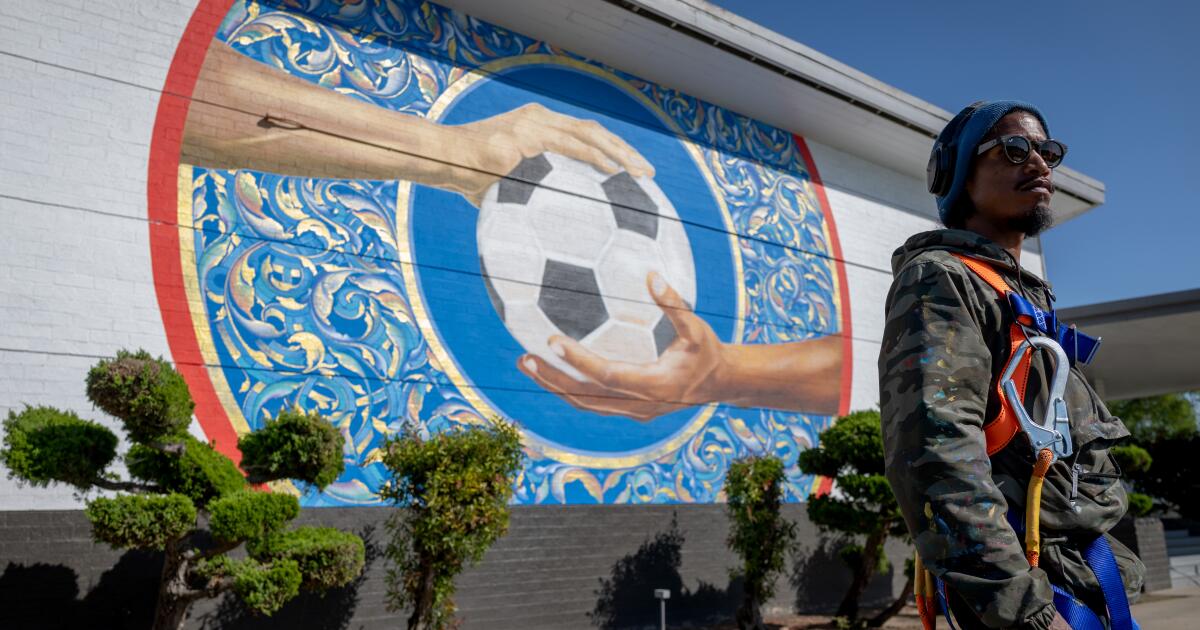
A lot has changed since Jacori Perry attended Morningside High School.
Perry is now a renowned artist who goes by the names Mr. Ace and AiseBorn.
The school is now known as Inglewood High School United.
And the lecture hall on that campus now features a large, ornate mural of a soccer ball being grasped by the hands of two people — freshly painted by the 2004 Morningside graduate as the city of Inglewood prepares to host eight World Cup games at SoFi Stadium starting next month.
Local artist Mr. Ace works on his mural at Inglewood High School United on May 11. The artists, whose real name is Jacori Perry, attended the school when it was known as Morningside High more than two decades ago.
(Eric Thayer/Los Angeles Times)
“If you told me that I would be back here painting one of the walls on this campus when I was in high school, I don’t think that I necessarily would have foreseen it,” Mr. Ace said as he was putting the finishing touches on his mural last week. “So I’m a little in amazement about just the way life works in that sense.”
He was one of several Los Angeles-based artists to participate in a Road to World Cup Community Day last month at Inglewood High United. Many of the artists — including Juan Pablo Reyes (“JP murals”), Michelle Ruby Guerrero (“Mr. B Baby”) and Angel Acordagoitia — sketched designs on portable panels (12-feet by 8-feet) and picnic tables for community members to paint.
The picnic tables will remain at the high school in front of Mr. Ace’s mural. The mobile murals will be placed throughout LAX to welcome visitors arriving for the World Cup.
Kathryn Schloessman, CEO of the Los Angeles World Cup 2026 Host Committee, said in a news release that the event was “just one example of how the energy of the World Cup can be felt in neighborhoods across our region.”
“Students, artists, and volunteers came together to create a work of art that will live on well beyond the end of the tournament,” Schloessman said. “It’s a reflection of the creativity, diversity, and community pride that makes our region so special as we prepare to host the world for FIFA World Cup 2026.”
Community members were encouraged to take part in the painting process, no matter their skill level.
“We made it easy enough for people that have zero experience to a proficient level of experience, for them to all be involved,” said Reyes, who designed and helped paint two mural panels and three tables. “We did the sketch, and then I tried to dab a little bit of color — whatever color is supposed to be there, I dabbed a little bit of color right there, so they would have a guide. …
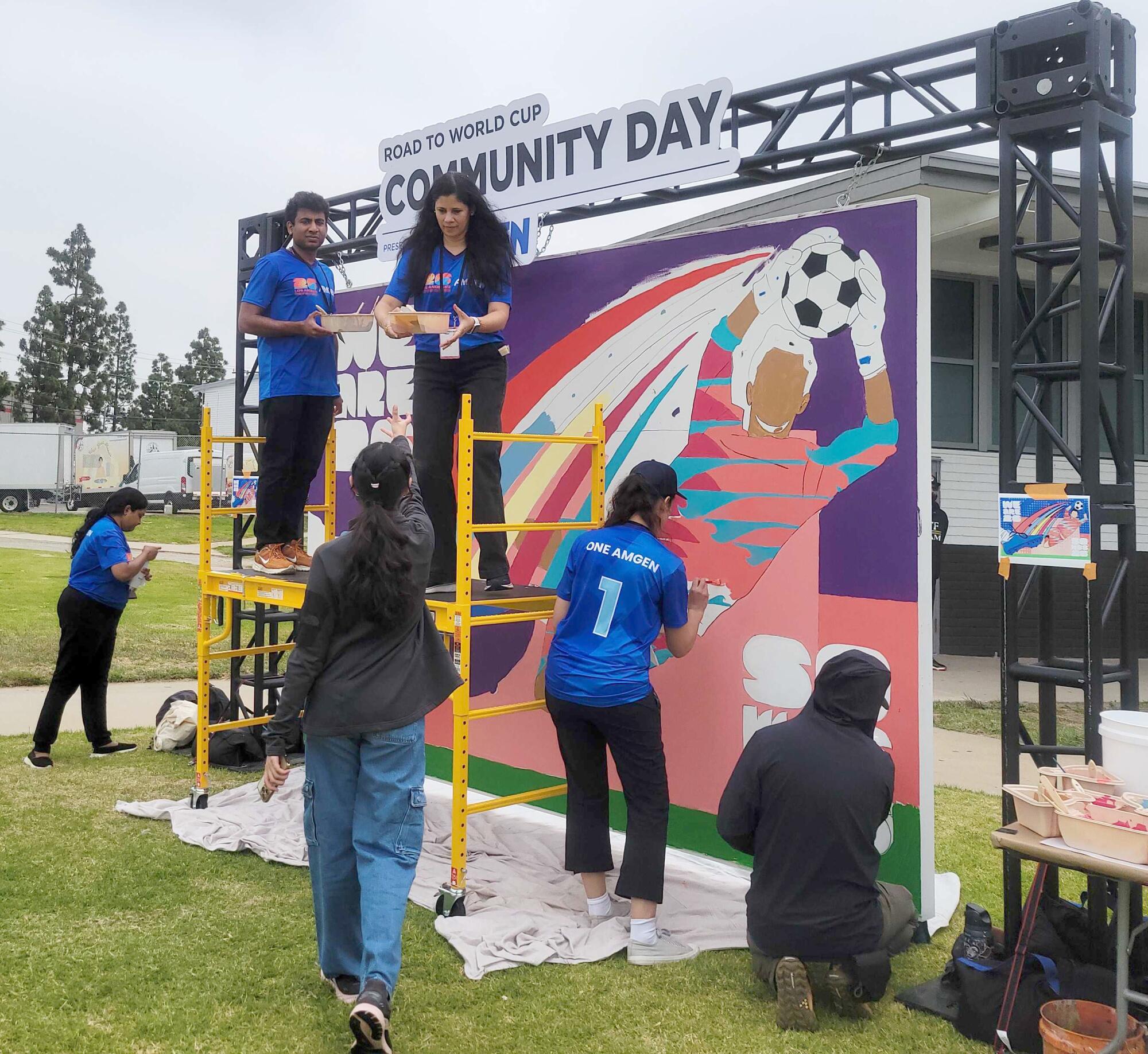
Students and community members help paint a mural panel during a Road to World Cup Community Day event May 2 at Inglewood High School.
(Dawn M. Burkes / Los Angeles Times)
“I was right there, kind of supervising, making sure that everything went as planned. And if anybody has questions, they’re more than welcome to let me know about them. But, yeah, it’s pretty easy for them to kind of be involved and feel that sense of ownership and have a sense of pride that, ‘Yeah, I was part of that mural-creation process.’ It’s a rich experience for them.”
Acordagoitia sketched several table-top designs for the public to paint at the event.
“They did great,” he said of the community members. “They helped a lot. They were asking questions. They got all the other colors correct. So, yeah, they were excited. A lot of kids were excited to see the live painting, because now kids are used to being on their phones. So that was a great experience for them.”
Acordagoitia also opted to paint a mural panel on his own because “it was a little more technical,” involving portraits of his 8-year-old son, a nephew and a friend.
“I wanted to focus more on the youth because that’s really our future,” he said. “So that’s, that’s the main thing about the mural, just about the kids, soccer, culture, community. It’s exciting for me, because I grew up playing soccer and to include soccer with art, it’s just a dream come true.”
Guerrero said “the community was a big help in filling in all the background colors that I need in order to build the detail and layers” on the two mural panels she designed.
“My whole style is based on culture. And I think that there’s a connection there with the World Cup and how I feel like it brings together all the culture and just, like, celebration,” Guerrero said. “It kind of goes hand in hand with the type of work I do, because my stuff is really festive, celebrating culture. And just as an L.A.-based artist, I think the collaboration made sense.”
The four artists also took part in another Road to World Cup Community Day in downtown L.A. at Gloria Molina Grand Park on March 14. At that event, the artists sketched designs on large sculptures shaped like soccer balls and an oversized picnic table, also for community members to paint.
While Mr. Ace opted to paint his permanent mural at Inglewood High School United on his own, he was sure to include the community theme into his work.
“The idea was really centered around just creating something that was community-based — something that represented the World Cup but also represented some sense of community,” he said. “And so what I did was try to create something that was symbolic, very direct in terms of its relationship to soccer and figuring out through that how to create something simple that [brings] into that a sense of community. And that’s how I landed on the two hands holding the soccer ball.”
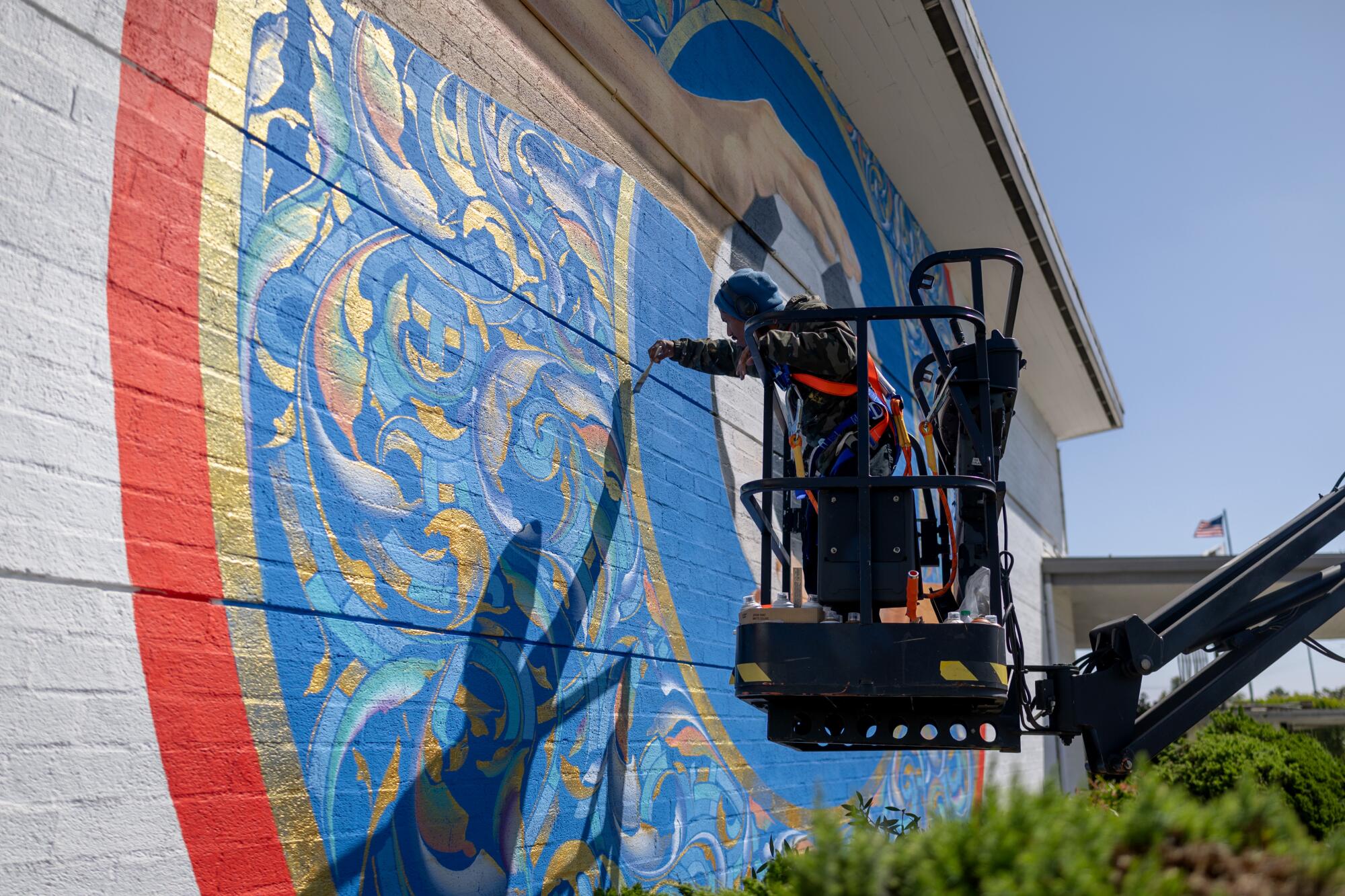
Local artist Mr. Ace works on his World Cup-themed mural at Inglewood High School United on May 11.
(Eric Thayer / Los Angeles Times)
Back when he was a student on that campus, Mr. Ace said he was always involved in art and knew he wanted a career as an artist. He struggled to come up with the right words to describe how it felt being back there creating a work of art to be shared with the students, all of the community and everyone who happens to see it on the way to a World Cup match.
“I guess there’s no words to really describe it,” he said. “I think if any artist gets the opportunity to paint at their own high school — especially if they’ve been doing large-scale works around the city, the country or the world — I think that is a little touching. When it’s attached to something like the World Cup … you know, a large part of my childhood was spent in Inglewood, so coming from my circumstances and life, I think it’s even more intriguing.”

NEWYou can now listen to Fox News articles!
The best Indianapolis 500 finish could be subjective, depending on which driver a fan was rooting for to win.
It certainly is in the eye of the beholder.
So take this list for what it’s worth. One view of the 10 best finishes in Indianapolis 500 history. Of course, it skews to more recent decades when the runs have come a little faster and the finishes have had a tendency to be a little closer.
We’ll add one each day to this list of fantastic finishes ahead of the 110th running of the Indy 500 on May 24 (12:30 p.m. ET on FOX).
10. Ericsson outduels O’Ward (2022)
After a red flag, Marcus Ericsson held off Pato O’Ward in a two-lap shootout. The shootout didn’t last two laps, though, as there was a crash on the final lap behind them. Ericsson had a comfortable lead when the red flag came out for a crash with four laps to go, a situation where in past Indianapolis 500 races, they likely would have ended the race under caution with Ericsson as the winner.
9. Foyt survives chaos (1967)
How does a driver who wins by two laps end up on this list? It’s because the win nearly didn’t happen on the last lap. A big crash with cars and debris littering the frontstretch just ahead of Foyt as he came to the checkered flag forced him to navigate through the wreckage for the win.
8. Sato can’t catch Franchitti (2012)
This was one of those finishes where the leader holds on for the win, but boy did the leader have to hold on. Takuma Sato tried to pass Dario Franchitti early on the final lap but to no avail and Franchitti sped off for the victory. This was one of those Indy 500s that made you hold your breath all the way to the checkered flag.
-

 Utah2 minutes ago
Cocker spaniel joins Utah County Sheriff’s Office as detection dog
-
 Vermont8 minutes ago
Smilin’ Steves closes three Vermont pharmacies, including at Woodstock clinic – Valley News
-

 Virginia14 minutes ago
West Virginia man charged with 2nd-degree murder of woman connected to Bristol
-

 Wisconsin26 minutes ago
Overnight storms could bring downpours, wind & hail to Central WI
-

 West Virginia32 minutes ago
West Virginia police announce an arrest in the Gretchen Fleming case, after remains found in September identified
-

 Wyoming38 minutes ago
Snowstorm Shuts Down Southern Wyoming, Motorists Stranded On I-80 For Hours
-

 Crypto44 minutes ago
TikTok user scams Sioux Falls woman out of $400K
-

 Finance50 minutes ago
Lending Momentum Builds for 2026

