Sports
Caitlin Clark has a new coach. Here’s what to expect from Indiana Fever’s Stephanie White


Stephanie White couldn’t hide her enthusiasm at her introductory press conference for the Indiana Fever. Beyond her extensive ties to the organization and the region, White is stepping into a particularly exciting role as the head coach of a talented young team, led by the last two rookies of the year, Aliyah Boston and Caitlin Clark.
It was Clark’s historic rookie season that vaulted the Fever into the next phase of team building and prompted the franchise to seek out a coach of White’s pedigree — one who could make Indiana a championship contender. White has already been effusive in her praise of the Fever guard, suggesting that Clark could be the greatest point guard of all time and that her No. 22 (which was also White’s number as an Indiana player from 2000-2004) won’t ever be worn by another Fever player. Clark was already one of the best players in the league before White arrived in Indianapolis, but a primary role will be further developing Clark.
GO DEEPER
Caitlin Clark, Indiana Fever championship timeline accelerated by sudden coaching change
Here’s how she’ll try to do it:
• White’s desire to reduce Clark’s ball dominance has emerged as a theme. Although Clark was prolific as a passer and scorer, carrying both duties was a heavy weight. A 2025 goal will be to reduce that burden. That means playing Clark for fewer minutes but also experimenting with her role.
“Helping her anticipate what’s going to be coming her way, trying to move her around a little bit more on the floor so she’s not quite as easily predictable in what action’s happening,” White said.
• Looking back at White’s previous two seasons in Connecticut, much of the facilitating came from Alyssa Thomas in the frontcourt, which allowed the Sun to spring their shooters off the ball in a variety of ways. No other forward in the league can match Thomas’ playmaking, but Boston and NaLyssa Smith have enough passing ability to replicate one of Connecticut’s favorite sets.
The Sun often started possessions with Thomas at the top of the key, and a guard or wing running off of a stagger from the corner to then setting a screen for Thomas in the middle of the court. The staggered screens already put the defense in a bind to start the play, and if Clark were the backcourt player coming, that would put additional pressure on defenders to navigate the screens to stay attached. Even if the defense managed that, the result would be the ballhandler able to rumble her way through the paint. Smith seems ideally suited for that role.
That play is one of many examples of Connecticut stacking actions on top of actions. Look at this possession from opening night of 2024 when three separate screens led to a pick-and-roll for Ty Harris and Thomas. Presumably, the defense wouldn’t go under if Clark acts as the ballhandler, but with all the space cleared on that side of the floor, the screen-setter would at least have an easy roll to the basket.
More @ConnecticutSun stacking actions
Drag by ONO.
AT swings and then they set a stagger for Dijonai.
AT sets a wide pin for Ty Harris.
Empty corner PnR with Thomas & Ty.
The Indiana defense goes under and that’s too much airspace to give Ty Harris = Ty 3. pic.twitter.com/g8tq4llrHX— Evin Gualberto (@evin_gual) May 15, 2024
• White has expressed how impressed she is by Boston’s passing in the half court. Several of the Sun’s layered sets were intended to result in a big catching the ball at the elbow, where Boston (mimicking Brionna Jones) could then direct the action from the post. Indiana has great cutters, specifically Kelsey Mitchell and Lexie Hull, for Boston to find from that setup in the elbow. Again, the idea is Clark factoring into the play by drawing her defender beyond the 3-point line but not required to create the scoring chance.
Of course, the combination of drag screens, pin-downs, and flares could all be decoys to eventually get Clark the ball anyway, albeit with the opportunity to attack a shifted defense rather than a set one.
“We can get to the same action on the second or third side,” White said. “We can get to it after a first or second action, being able to move her around a little bit more.”
White noted that Clark needs to add strength, which would aid in all of the goals she has laid out for the star guard. Strength should help Clark’s consistency on her jumper and her durability down the stretch of games — she shot 31.3 percent on 3s in clutch situations compared to 34.4 percent overall. It could also make her a better screener if she can generate more contact, and shooters already make the deadliest screeners because defenders don’t want to leave them.
• Clark’s main area of improvement, one that White has coached to great effect in Connecticut the last two years, will be focused on defense. Clark has been a non-factor on that end, and a player that the Sun even tried to hunt. In their first-round playoff series, Connecticut regularly ran the offense through the perimeter player Clark was defending and found a series of wide-open 3-pointers on the wing when Clark was unable to close out.
During the 2024 season, five of the top 20 players in defensive win shares came from the Sun, with Marina Mabrey, who arrived midseason, just missing the cut. A White-coached team will demand more defensive accountability, even from Clark. Success will require being “a little more tough-minded team on the defensive end of the floor.”
White has proven to be among the more adaptable coaches in the WNBA during her recent tenure. After Jones was lost for the 2023 season, she pivoted to a small-ball lineup, using Thomas essentially as a point center. The next year, Connecticut went back to the double-big look but still had the flexibility to downsize when necessary.
In Indiana, White’s creativity won’t be necessary to keep the Fever afloat. Her No. 1 priority will be to maximize a deeper roster with more talent and get the most out of Clark.
(Photos of Caitlin Clark and Stephanie White: Jesse D. Garrabrant / NBAE via Getty Images, Chris Coduto / Getty Images)



A Florida judge set a $1 million bond for former Detroit Lions cornerback Terrion Arnold, who has been in jail since being arrested last week in connection to an alleged armed attack on a group of men in Tampa, Fla., in February.
Arnold will not have to wear an ankle monitor while he awaits trail on eight felony charges of kidnapping and robbery that could keep him in prison for life if convicted, thus clearing the way for him to practice and play football during that span.
He won’t be doing so, however, with the team that drafted him at No. 24 overall in the 2024 draft. The Lions announced Monday afternoon on X that they have released Arnold, with no other details provided.
Hillsborough County Judge Christopher C. Sabella said during Monday’s hearing that Arnold already has a “paparazzi monitor” that would prevent any potential attempts to flee.
“If he is late for practice, ESPN will let us know,” Sabella said. “If he violates the conditions of his bond, he will be found.”
Arnold was ordered to remain at his Tallahassee home except for when he’s playing, training and traveling with the Lions. He also has to turn in his passport and cannot have any contact with other people tied to the case.
The Hillsborough County state attorney’s office had argued for Arnold to remain behind bars until trial. The county jail’s inmate tracker has not been updated and does not indicate if he has posted bond or been released.
According to the Tampa Police Department, Arnold is believed to be the “primary conspirator” in an alleged plot that left three young men with “visible injuries from being battered, held at gunpoint, and pistol-whipped before their personal property was stolen and they were ordered to leave.”
Arnold turned himself in Wednesday night and pleaded not guilty at his arraignment hearing Thursday afternoon.
“Today’s ruling by Judge Sabella confirms that there is very little evidence to even suggest any criminal involvement by Mr. Arnold,” Denise White, chief executive of EAG Sports Management, which represents Arnold, said in a statement emailed to The Times.
The Associated Press contributed to this report.
Sports
Thekla embarrasses Stardom’s Starlight Kid after retaining AEW World Women’s Championship at Forbidden Door

NEWYou can now listen to Fox News articles!
Thekla has had every reason to talk as much trash as she’s done.
She made her debut in All Elite Wrestling (AEW) last year and quickly moved up the ladder to win the AEW Women’s World Championship in a strap match against Kris Statlander in February. She’s continued to hold the title even when three opponents were thrown her way at Double or Nothing.
COMPLETE PRO WRESTLING COVERAGE ON FOX NEWS DIGITAL
Thekla enters the ring during the women’s pro-wrestling event “Stardom” at Korakuen Hall in Tokyo, Japan, on Jan. 13, 2025. (Etsuo Hara/Getty Images)
Thekla declared war on Stardom and New Japan Pro-Wrestling (NJPW) in the buildup to Forbidden Door. She demanded that Stardom send its best to challenge her at Forbidden Door, and they obliged. Starlight Kid stepped up against the “Toxic Spider” and the two put on a great match in front of the pro wrestling audience at the SAP Center in San Jose, California.
Thekla taunted Starlight Kid throughout the match and it appeared she got more than she bargained for at points during the match.
Starlight Kid wouldn’t stay down and gave every effort to bring the AEW Women’s World Championship back to Japan with her. Starlight Kid worked on Thekla’s knee toward the end of the match. But the champion would not quit.
Starlight Kid enters the ring during the Women’s Pro-Wrestling “Stardom” 15th Anniversary at Edion Arena Osaka in Osaka, Japan, on Feb. 7, 2026. (Etsuo Hara/Getty Images)
Thekla got out of the submission hold and avoided being pinned by mere seconds. Thekla was put to the test more than any other opponent she’s faced since becoming the champion.
The “Toxic Spider” hit two stomps and finally put away Starlight Kid to retain the title.
With Stardom president Taro Okada in attendance, Thekla continued her assault against Starlight Kid. Skye Blue and Julia Hart came out to support Thekla. Hart handed Thekla a pair of scissors and the champion ripped the mask off Starlight Kid’s head and spit in it.
Thekla taunted Okada with the mask and hit the wrestling executive with it.
Thekla enters the ring during the women’s pro-wrestling event Stardom at Yokohama Budokan in Yokohama, Kanagawa, Japan, on March 8, 2025. (Etsuo Hara/Getty Images)
CLICK HERE TO DOWNLOAD THE FOX NEWS APP
Thekla stayed the champion and added a trophy to her mantel.
Remember when we were sure the World Cup would suffer from all the issues that had everyone seeing red before the first ball was kicked?
And remember when we were certain soccer could never catch on in this country?
Despite controversies over visas and ticket prices and transportation, and in spite of consternation over expansion and new rules, the game has, as usual, proved too good to fail.
And we, the American people, have become unusually engrossed in it.
We’ve been tuning in on TV in record numbers and, even at exorbitant prices, helping to sell out our 70,000-some-capacity stadiums. Before group play was even finished, this tournament — staged also in Mexico and Canada — already outdrew the 1994 World Cup, which was hosted by the United States and set an attendance record of nearly 3.6 million.
We’ve been loving the healthy cultural exchange, and we’re being reminded that cultural barriers of traditional sports fandom can be breached.
So now, to keep our interest from drying out like a pitch on a hot summer day, the goal should be to keep the market saturated with soccer. That will take Major League Soccer tearing down all the walls.
It’s already turned the page on its calendar, adopting a summer-to-spring season format that will better blend with the global game.
Now MLS needs to make its games easier to watch, and to do its part to make the sport easier to play.
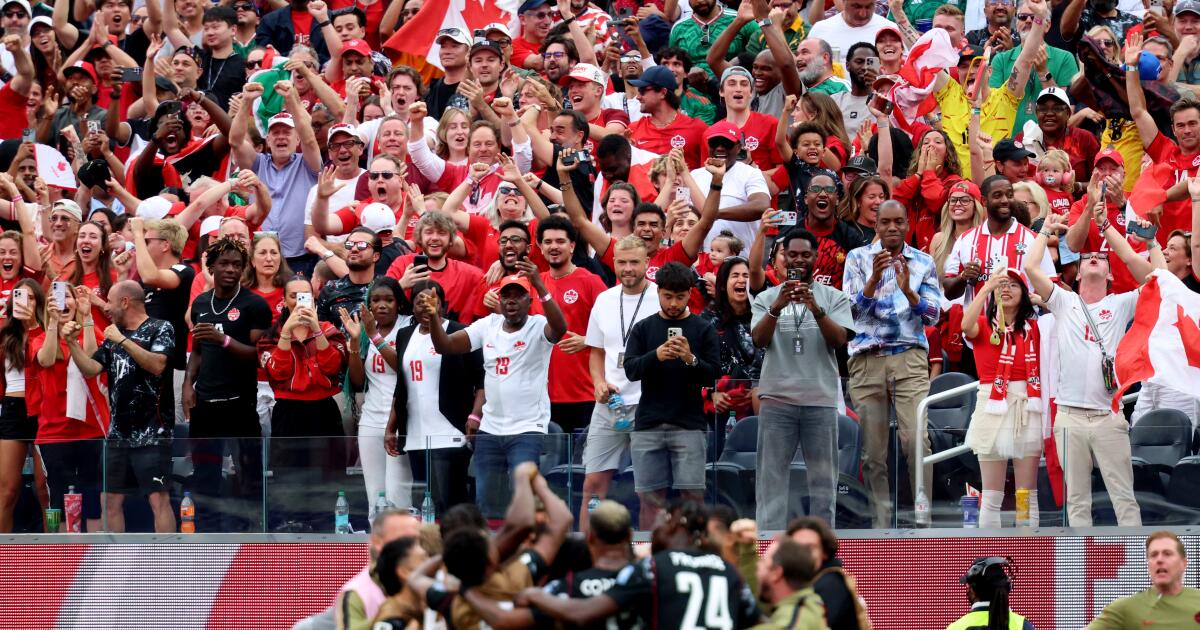
Canada goalkeeper Maxime Crépeau, left, celebrates with teammate Jonathan David after a 1-0 win over South Africa at the World Cup on Sunday.
(Kelvin Kuo / Los Angeles Times)
While the proverbial iron is hot, it needs a strike like Stephen Eustáquio’s winning rocket in the 92nd minute of Canada’s 1-0 victory against South Africa on Sunday at SoFi Stadium.
Eleven players on the two teams were MLS representatives — including Eustáquio, who spent the last six months in LAFC’s midfield.
Goalkeeper Maxime Crépeau, who played two seasons with LAFC and now plays for Orlando City, stopped the only shot he saw for his second clean sheet this World Cup, which saw the Canadians succeed in their first knockout stage appearance.
There’s been no avoiding MLS players in this World Cup. The greatest of them is piling up goals for Argentina: Lionel Messi, the Inter Miami superstar, is now the all-time World Cup goal-scorer (with 19).
MLS has set an attendance record too, with 45 players participating. It ranks as the league with the second-most players apart from the top five European leagues. LAFC had three current players in the mix.
But wait. Record skip. Before you celebrate the MLS’s contributions to this soccer spectacle, check with the VAR. Yep, without the 13 MLS players representing nations that rank 40th or lower in FIFA’s world ranking, there actually would be fewer than the 37 MLS participants at the World Cup four years ago.
A baby’s first steps are for celebrating, but three decades after the league’s formation, MLS is still searching for a giant leap. It’s still having a mean time of trying to make “fetch” happen for real.

It would help to make its games more readily available — not to the already converted, but to fans who didn’t even know what they didn’t know about soccer until the World Cup began in their backyards.
MLS has already brought MLS from behind Apple’s season pass paywall. And the league and streaming service also reportedly have agreed to a revised media rights deal that will end at the end of the 2028-29 season, three and a half years earlier than expected.
But the hat trick would be to remove the need to subscribe to streaming service to watch MLS games altogether, and then get those matches onto the networks people know to tune into for their sports.
Normalize watching American soccer.
And stop gatekeeping. MLS’s developmental programs are too restrictive and exclusive — they’re not developing more soccer players, they’re curtailing who can play.
It’s in the league’s interests, and the sport’s in this country, to encourage as many players to play as much as they can — including for their high school teams, which MLS Next bars.
They’ve got people in the tent; the goal should be to make them want to stay.
To make them want to join the world’s circus, not to let it pack up and move on, out of sight and out of mind, until it swings back through years from now.
-
Sports11 seconds ago
Lions release cornerback Terrion Arnold soon after judge sets his bond at $1 million
-

 World8 minutes ago
EU will ‘come to its senses’ on Israel, former Netanyahu adviser says
-
 News33 minutes ago
Senate Ethics Committee dismisses complaint against Sen. Ruben Gallego
-

 New York2 hours ago
Read the Indictment of Malik Beasley
-

 Los Angeles, Ca2 hours ago
Stolen Sea Scouts boat found in Marina del Rey, suspect arrested
-

 Detroit, MI2 hours ago
Michigan House passes bill to restrict big investors from amassing single-family homes
-

 San Francisco, CA2 hours ago
San Francisco rolls out heightened security measures ahead of World Cup knockout match, 4th of July
-

 Dallas, TX3 hours ago
Klyde Warren Park reveals expansion plans, construction timeline

