Sports
Brazil are trapped in a cycle of apathy – just as rivals Argentina thrive


Brazil have endured so many low ebbs over the past 15 years that it can be hard to remember them all.
The historically embarrassing 7-1 defeat to Germany at their own World Cup? Sure, but don’t forget the moronic reappointment of Dunga as coach in the immediate aftermath or the twin Copa America meltdowns of 2015 and 2016. The doomed, drawn-out pursuit of Carlo Ancelotti has to be on the list, too, as should about six other federation-level failures. You’d need a team of forensic experts to properly sift through all this rubble.
There is also a more recent option that might have passed you by. In November 2023, led by their second interim coach of the year, Brazil welcomed Argentina to Rio de Janeiro for a World Cup qualifier. They lost 1-0, a predictable result that nonetheless tipped the crisis-o-meter towards ‘existential’.
It was Brazil’s third defeat in the first six rounds of qualification. It left them sixth in the 10-team South American group. Venezuela, no one’s idea of a major football power, were above them in the standings. So were Ecuador and they had started the campaign with a points deduction.
The expansion of the World Cup and an extra automatic qualifying spot for the CONMEBOL region (there are now six, with an inter-continental play-off for the nation finishing seventh) ought to have reduced Brazil’s chances of failure to nought. Instead, they were flirting with disaster.
Sixteen months on, the situation is under control. A hard-fought victory over Colombia last week lifted Brazil to third. There is an eight-point buffer between them and seventh. We can say with some certainty that they will be at the 2026 World Cup. The drama is over.
That, though, is not to say that all is sunshine and roses. Indeed, as Brazil prepare to face Argentina for the first time since that reversal in Rio de Janeiro, there is a lingering sense of unease about the direction of travel.
Vinicius Junior celebrates his late winner in Brazil’s 2-1 win over Colombia on Friday (Buda Mendes/Getty Images)
Brazil’s results have improved, but it would be generous to say they have been playing well. They were stodgy in the extreme at last summer’s Copa America and recent matches have followed the same template: there are little spurts of inspiration, most of it individual, but also long periods when Brazil are fretful and frantic. They started well against Colombia but let all momentum seep away, as they often do.
Vinicius Junior’s late winner, a deflected strike from range, owed more to pluck and luck than any collective plan. “I hope it unlocks something,” Vinicius Jr said after the game. He is not the only one.
Dorival Junior, who took over as coach in January 2024, is a likeable character. He arrived with a reputation as a firefighter, someone who could avert the impending crisis. On that count, it’s job done. Mathematically, Brazil are safe. The question now is whether he has the tactical acumen to turn them into a proper team.
The jury is very much out on that one. He says he wants his star forwards — Rodrygo, Vinicius Jr, Raphinha — to play with freedom, but more structure is needed against organised defences. His system can leave Brazil’s two midfielders exposed and he is slow to react to shifts in the pattern of a match. “Sometimes it’s difficult to get your message across clearly,” he said after the Colombia game, an admission that was far more revealing than he can have intended.
Another line from his press conference — “We’ve seen a considerable improvement in every game” — drew the ire of the Brazilian press. “You need a magnifying glass to see any progress,” deadpanned Jessica Cescon of GloboEsporte. “We need something different, a gust of originality,” wrote Tostao, the former Brazil striker.
The juxtaposition with Argentina is a painful one on every level. Few would ever admit to such heresy, but all sensible Brazilian football fans will feel an acute pang of jealousy when they look across their southern border.
Most obviously, there are the trophies. Argentina won the World Cup in 2022, something Brazil have not managed in over two decades and don’t look like doing any time soon. The last two editions of the Copa America have gone Argentina’s way, too. Brazil won that competition in 2019, but that seems a long time ago now. For the past six years, this has been an incredibly one-sided rivalry.
Part of the charm of this period of Argentine dominance is that it was so unexpected. Argentina, like Brazil, spent the 2010s lurching between crises, yet found a winning lottery ticket down the back of the sofa. Lionel Scaloni has not solved every issue behind the scenes — he came close to walking away from the job last year after allegedly falling out with the federation hierarchy — but he has filtered out the noise and the nonsense to transformative effect. Brazil would kill for a little slice of the same.

Dorival Junior took over as Brazil head coach in January 2024 (Evaristo Sa/AFP via Getty Images)
On the pitch, Argentina are everything Brazil are not: settled, drilled, coherent. Obviously, the presence of a world-historical footballer is always likely to swing things in your favour, but Argentina know how to get by when Lionel Messi is absent, as he will be in Buenos Aires on Tuesday. This is Scaloni’s seventh year in charge and you can tell. Brazil’s players, as Marquinhos put it this week, “are still getting to know each other”; Argentina’s dogs of war know each other inside out.
Perhaps the most stark contrast, though, is to be found in the stands and in the streets.
It is impossible to think about Argentina’s World Cup win without remembering those amazing scenes of support and jubilation in the country’s cities: the swaying seas of fans in city squares, the tears, the singing, the lads clinging to telephone poles, hollering themselves hoarse.
Success always breeds attachment, but there is something extra here, genuine communion. Argentines do not just watch these players; they feel in tune with them, represented by them, ennobled by their many attributes. (And, less positively, defensive of their flaws.)
Things are different for Brazil. There is, understandably, no great groundswell of support for the Selecao in its current iteration. More interesting is the lack of any great national outrage about the team and its diminished standing. The overriding feelings are apathy and drift.
This is not a new phenomenon. Brazilian pundits have wrung their hands about the lack of connection between the national team and the public for years, maybe even decades. The players are asked about it all the time. Every game is painted as an opportunity to get people onside, to start forging a new, united front. It’s an impossible thing to track empirically, but the persistence of the discourse tells its own story.
A few factors are usually cited as reasons for the malaise. One is that many national team players have no real links with the Brazilian public, having left the domestic scene before playing much — or any — senior football. Another is that Brazil spent years playing friendlies all over the globe, prioritising revenue over kinship.
Then there are the usual, tired tropes about players caring more about their bank accounts and club teams than they do for their country, an argument completely undermined by the willingness of those same players to cross the Atlantic multiple times per year to get jeered whenever they don’t win 3-0. (It would be unfair to conduct any analysis of the team-fan relationship without noting the strains of entitlement and impatience that exist within the Brazilian fanbase.)
It’s not clear how you solve any of this. It’s not clear that you even can. The best hope, you’d say, is simply to start winning things — to kickstart a virtuous cycle that obscures all of the fissures, much as Argentina did when they appointed Scaloni in 2018.
As Brazil head to Buenos Aires, to another raucous stadium, to yet another exhibition of symbiosis between team and public, they will know that there is a path out of purgatory. Bottling lightning like Argentina did, however, will not be easy.
(Top photos: Getty Images)



Sports
UConn’s Braylon Mullins hits game-winning 3-pointer to shock Duke, advance to men’s Final Four

NEWYou can now listen to Fox News articles!
The UConn Huskies needed to dig themselves out of a hole in the second half against the Duke Blue Devils, and behind Braylon Mullins’ clutch 3-pointer and Tarris Reed Jr.’s high-percentage scoring, they were able to pull off an incredible comeback victory to advance to the Final Four.
The Huskies were able to effectively pressure the Blue Devils into a turnover with less than seven seconds left. Caden Boozer had his pass deflected and the ball got into Mullins’ hands.
UConn guard Braylon Mullins (24) celebrates after a basket against Duke during the second half in the Elite Eight of the NCAA college basketball tournament, Sunday, March 29, 2026, in Washington. (AP Photo/Stephanie Scarbrough)
UConn guard Braylon Mullins, right, celebrates his game winning basket with guard Malachi Smith (0) during the second half in the Elite Eight of the NCAA college basketball tournament against Duke, Sunday, March 29, 2026, in Washington. (AP Photo/Stephanie Scarbrough)
The freshman was well beyond the 3-point line when he chucked up the ball. His prayer was answered as the ball went through the back of the net. UConn’s 19-point comeback was complete as the Huskies’ bench jumped in jubilation.
UConn was able to get the ball into Reed many times over the course of the game and for nearly half of the second half, the Huskies were in the bonus. Reed finished with 26 points on 10-of-16 from the field with nine rebounds. He was 6-of-9 from the free-throw line.
MICHIGAN ROUTS TENNESSEE TO WIN REGIONAL FINAL, ENTER NCAA MEN’S FINAL FOUR
Duke guard Dame Sarr celebrates a basket against UConn during the first half in the Elite Eight of the NCAA college basketball tournament, Sunday, March 29, 2026, in Washington. (AP Photo/Stephanie Scarbrough)
Duke was up three points with 28 seconds to go. UConn guard Silas Demary Jr. was fouled and went to the free-throw line for two shots. He missed the first and made the second. The second free throw enabled UConn to set up its press defense and force the turnover in the end.
The Huskies outscored the Blue Devils 44-28 in the second half after being down 44-29 in the first half.
Cameron Boozer led Duke with 27 points and grabbed eight rebounds.
UConn forward Tarris Reed Jr. (5) dunks during the second half against Duke in the Elite Eight of the NCAA college basketball tournament, Sunday, March 29, 2026, in Washington. (AP Photo/Abbie Parr)
CLICK HERE TO DOWNLOAD THE FOX NEWS APP
UConn is back in the Final Four for the third time in three years. The Huskies will be looking to get back to the national championship after winning two titles in the last three years. UConn will take on Illinois and Michigan will go up against Arizona in the Final Four.
Follow Fox News Digital’s sports coverage on X and subscribe to the Fox News Sports Huddle newsletter.

SACRAMENTO — The team that can’t stop dancing won’t stop dancing.
The top-seeded UCLA women’s basketball team beat Duke 70-58 in the Elite Eight. It wasn’t balletic, but beautiful.
Sunday’s game at Golden 1 Center in Sacramento wasn’t a fun, free-flowing joy ride that so many of the Bruins’ wins have been this season.
It was a rattling, teeth-gritting, heart-thumping roller-coaster ride — weeeeee!
The Bruins weren’t having fun, exactly. They were having the time of their lives.
And in the end, they shoved their way to the front of the stage — and back to the Final Four.
Now the TikTok countdown is on before final exams in Phoenix, where redemption and legacy and a rematch await with either winner of the No. 1 Texas vs. No. 2 Michigan tussle in the Fort Worth Regional final.
And any questions — ahem, mine — about how the barely-battled-tested boogie-down Bruins respond to a significant stress test were answered.
The Bruins are built for this.
They’re not just talented. And they’re not just talented dancers (and postgame, Lauren Betts, Charlisse Leger-Walker and Gabriela Jaquez reprised the routine that went viral when they did it with the UCLA Dance Team during halftime of a men’s game this season).
They’re tough. And they’re locked in.
And unlike last season, when their program’s Final Four debut ended in a 85-51 national semifinal blowout loss to eventual champion Connecticut, they’re ready for what comes next.
They let us know in the second half Sunday.
Duke came floating in, still buzzing from Friday’s buzzer-beater in the Sweet 16. That slow-motion-in-real-time three-pointer by Ashlon Jackson that rolled around and around the rim as though the basketball gods needed just a little more time to determine UCLA’s opponent Sunday.
UCLA’s Lauren Betts, left, Gabriela Jaquez celebrate after the Bruins defeated Duke on Sunday to advance to the Final Four.
(Eric Thayer / Los Angeles Times)
It was to be Duke, who proved a dangerous No. 3 seed. The Bruins weren’t prepared for the Blue Devils to be so prepared for them, trailing at the break for just the second time this season. The first time was in November against Texas, when the Bruins — now a program-record 35-1 — suffered their only loss this season.
Still their only loss.
Even a fool could read the determination on the Bruins’ faces as they roared back from a 39-31 halftime deficit; they’d come so far together, but they so badly wanted to go further.
No one was ready to get off the ride, not least the six seniors who played the entirety of the second half, seizing momentum and the moment and hitting the Blue Devils (27-9) with a white-knuckled flurry of activity.
“Compliment them,” Duke coach Kara Lawson said, “for turning up their defensive intensity.”
There were 50-50 balls in name only, because UCLA seemed to be winning 100% of them.

UCLA players were ripping away passes. They were diving all over the floor and were all over the boards. They ratcheted up the intensity so much it spread into the stands, where the largely pro-Bruins crowd of 9,627 cheered deliriously.
Shots started falling. Turnovers stopped cascading. UCLA found its rhythm.
And UCLA’s 6-foot-7 star center Betts did what she does, with 15 points, eight rebounds and two blocks in the second half, of which she played all 20 minutes.
“I was just pretty mad,” she said. “You know, my senior season is on the line, so I kind of got to wake up a little bit.”
Angela Dugalic continued to be the matchup nightmare she has been all March; the 6-4 sixth woman scored 15 timely points to take some pressure off Betts.
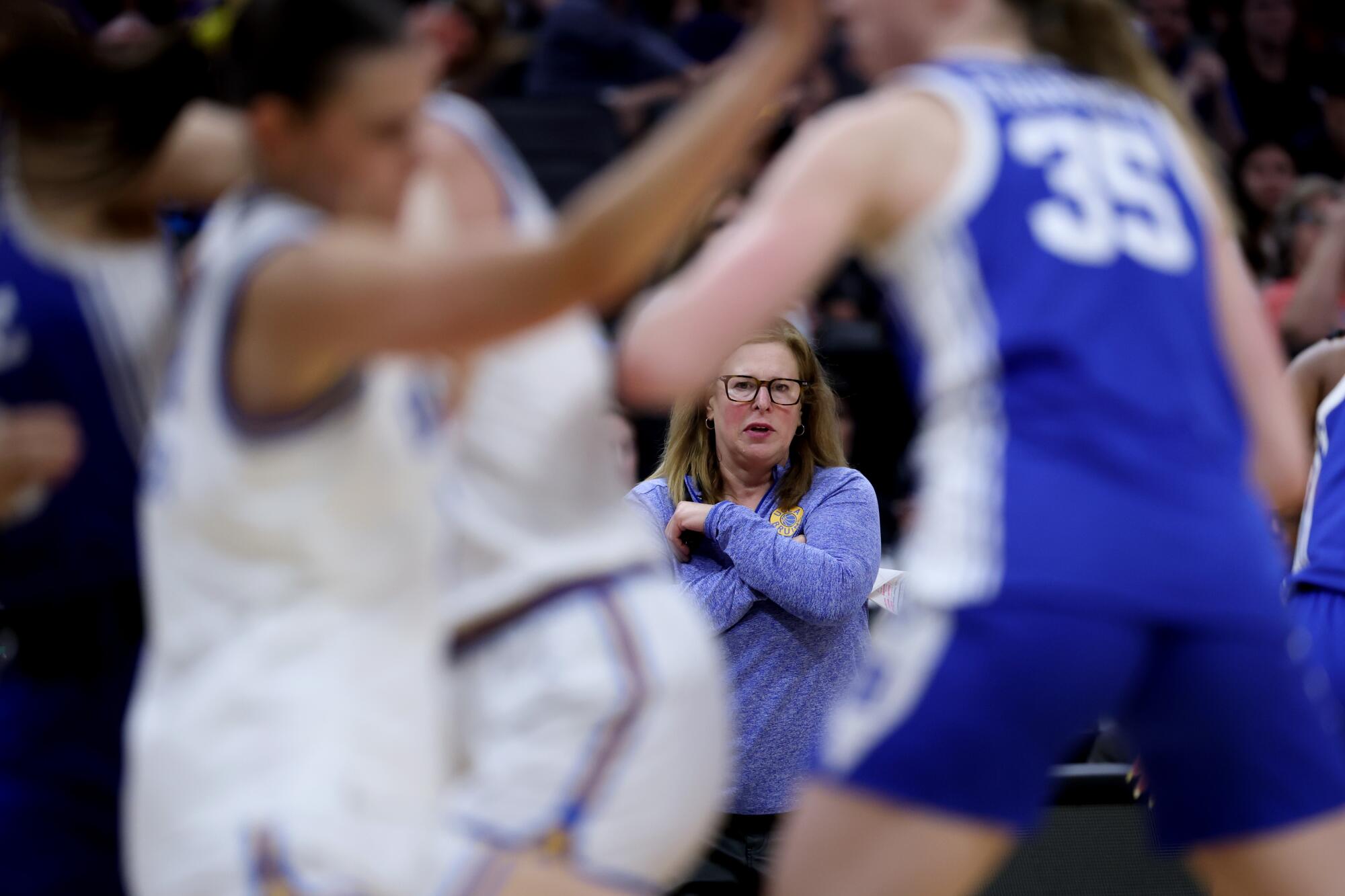
UCLA coach Cori Close watches play during the Bruins’ win over Duke on Sunday.
(Eric Thayer/Los Angeles Times)
“I’m just so proud of her,” Betts said. “The confidence and her poise … you could get in your head in moments when we’re down … but she did all the right things and what we needed at the time.”
It was an entertaining Elite Eight clash that was brought to you by two coaches who staged, like up-and-coming chefs, under two of the greatest leaders the sports world has known.
UCLA coach Cori Close and Lawson committed to making sure we won’t lose John Wooden’s and Pat Summitt’s recipes — never mind all the seismic, disorienting shifts happening in college sports.
A former Tennessee star, Lawson brings Summitt’s brand crackling intensity to Duke, a mindset that she’s said calls for supreme confidence, chasing excellence and holding oneself to an all-around standard of success.
UCLA’s bench was uplifted all season by Close’s warm intentionality, learned from years of mentorship from Wooden. The main ingredients, she’ll tell you, requiring a dollop of growth, gratitude, of giving and not taking.
“[Our] team culture is not this nebulous thing or phrases on a wall,” Close said. “It’s a group of people that are willing to be committed to the hard, right behaviors over and over again. I cannot tell you how many times throughout that game we referred to our values, who we are, what our identity was, what we had to get back to.
“… I’m just really humbled and thankful to be a part of a team and staff that cares about things from the inside out. What you saw on the court is a reflection and a byproduct of what’s happened on the inside.”

NEWYou can now listen to Fox News articles!
Max Verstappen snatched the torch from Lewis Hamilton and became one of the most unstoppable Formula 1 drivers in the sport from 2021 to 2024.
The 2025 and 2026 seasons have been a struggle for the Red Bull racer. He finished second to McLaren’s Lando Norris in the drivers’ standings last season, ending his streak of world championships, and has yet to finish in the top five this year.
Red Bull driver Max Verstappen of the Netherlands steers his car during the Japanese Formula One Grand Prix at Suzuka in central Japan, Sunday, March 29, 2026. (AP Photo/Hiro Komae)
After finishing eighth in the Japanese Grand Prix, Verstappen suggested he was contemplating retirement at the age of 28.
“Privately I’m very happy,” Verstappen told the BBC. “You also wait for 24 races. This time it’s 22. But normally 24. And then you just think about is it worth it? Or do I enjoy being more at home with my family? Seeing my friends more when you’re not enjoying your sport?”
He made clear he was suggesting that 2026 could be his final season.
“I want to be here to have fun and have a great time and enjoy myself. At the moment that’s not really the case,” he said. “Of course I do enjoy certain aspects. I enjoy working with my team. It’s like a second family. But once I sit in the car it’s not the most enjoyable unfortunately. I’m trying. I keep telling myself every day to try and enjoy it. It’s just very hard.”
ISRAELI RACING STAR ‘NERVOUS’ AS FAMILY DEALS WITH IRAN’S RETALIATORY STRIKES, EXPRESSES HOPE FOR REGION
Red Bull driver Max Verstappen, right, of the Netherlands and Mercedes driver Kimi Antonelli of Italy talk during the drivers parade ahead of the Japanese Formula One Grand Prix at Suzuka in central Japan, Sunday, March 29, 2026. (AP Photo/Eugene Hoshiko)
Part of the struggles for Verstappen has been trying to get acclimated to the regulation changes.
“I can easily accept to be in P7 or P8 where I am,” he said. “Because I also know that you can’t be dominating or be first or second or whatever, fighting for a podium every time. I’m very realistic in that and I’ve been there before. I’ve not only been winning in F1.
“But at the same time when you are in P7 or P8 and you are not enjoying the whole formula behind it, it doesn’t feel natural to a racing driver,” he continued. “Of course I try to adapt to it, but it’s not nice the way you have to race. It’s really anti-driving. Then at one point, yeah, it’s just not what I want to do.”
Maybe a break in the schedule will help clear Verstappen’s head.
Formula 1 will have a few weeks off as two races that were set for April in Bahrain and Saudi Arabia were canceled because of military operations in Iran.
Red Bull driver Max Verstappen of the Netherlands leaves during the qualifying session of the Japanese Formula One Grand Prix at the Suzuka Circuit in Suzuka, Japan, Saturday, March 28, 2026. (Franck Robichon/Pool Photo via AP)
CLICK HERE TO DOWNLOAD THE FOX NEWS APP
The next race is set for May 3 in Miami.
The Associated Press contributed to this report.
Follow Fox News Digital’s sports coverage on X and subscribe to the Fox News Sports Huddle newsletter.

Power Players: FIFA World Cup 2026 — New York / New Jersey World Cup Host Committee

I-25 northbound maintenance slows commute between Albuquerque and Santa Fe

WNC wildfire updates for Monday, March 30, 2026

North Dakota punches ticket to 23rd Frozen Four in SF

Ohio EPA funding emergency generator projects to keep water moving

Florida High School Football Rankings: Top 25 teams – Oct. 21

How old is Bo Nix? What to know about Oregon quarterback ahead of 2024 NFL Draft

Cleary's 21 help Le Moyne down Central Connecticut State 69-64 in OT

99th annual Pony Swim held in Virginia

Indiana Members Credit Union announced as new anchor tenant at Bottleworks District

Video: Iran to Allow More Oil Ships Through Strait of Hormuz, Trump Says

Dem senator warns deportation could let Virginia woman’s illegal immigrant killer ‘escape accountability’

Newsletter: G7 ministers to hold talks on war’s economic fallout
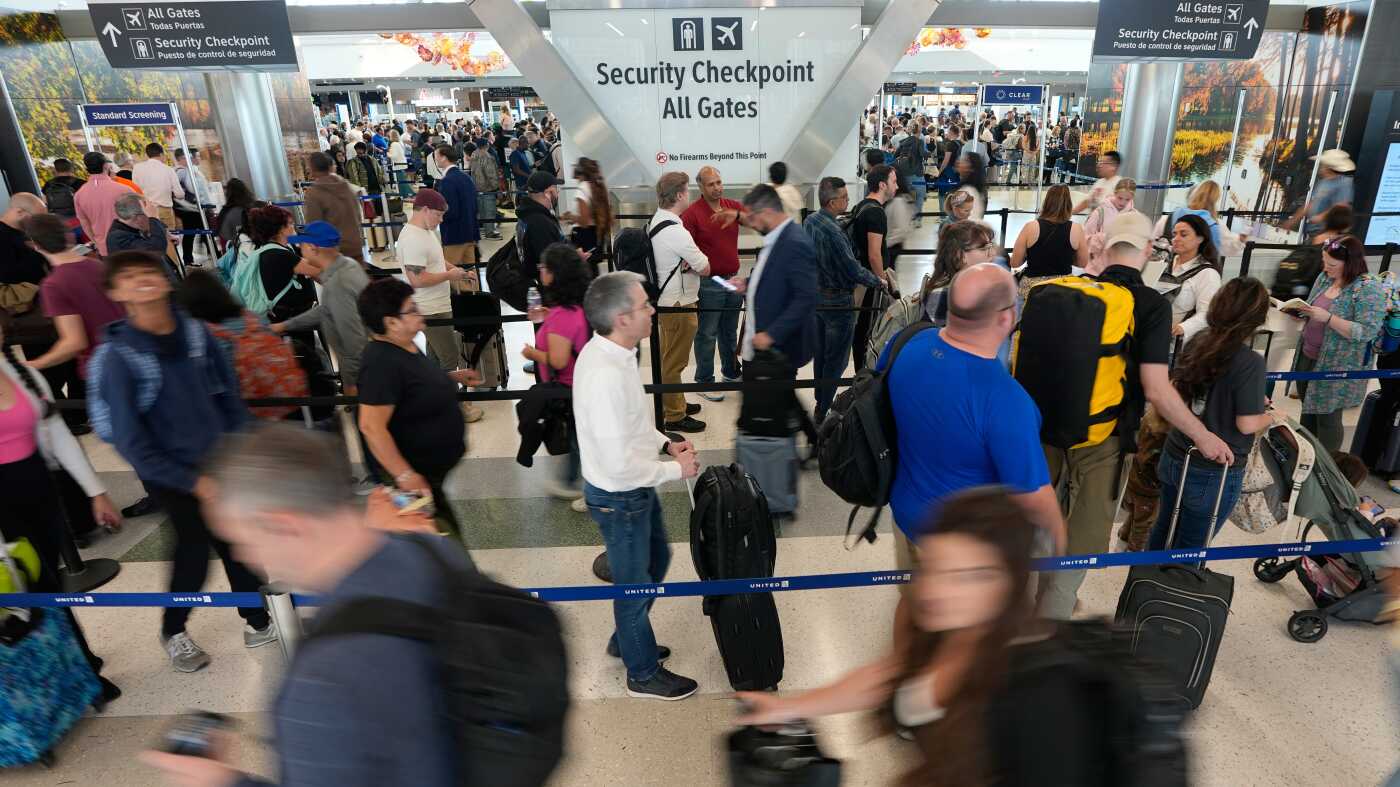
ICE officers could remain at airports after TSA workers are paid

Scathing report claims nation’s oldest labor union ‘betrayed’ MAGA members through ‘shocking’ spending
-

 Sports1 week ago
IOC addresses execution of 19-year-old Iranian wrestler Saleh Mohammadi
-

 Miami, FL4 days ago
Jannik Sinner’s Girlfriend Laila Hasanovic Stuns in Ab-Revealing Post Amid Miami Open
-

 New Mexico1 week ago
Clovis shooting leaves one dead, four injured
-

 Politics1 week ago
Schumer gambit fails as DHS shutdown hits 36 days and airport lines grow
-

 Tennessee7 days ago
Tennessee Police Investigating Alleged Assault Involving ‘Reacher’ Star Alan Ritchson
-

 Minneapolis, MN4 days ago
Boy who shielded classmate during school shooting receives Medal of Honor
-

 Science1 week ago
Record Heat Meets a Major Snow Drought Across the West
-

 Technology1 week ago
YouTube job scam text: How to spot it fast