Sports
Amid rising MLS popularity, should its teams gamble on bigger stadiums?

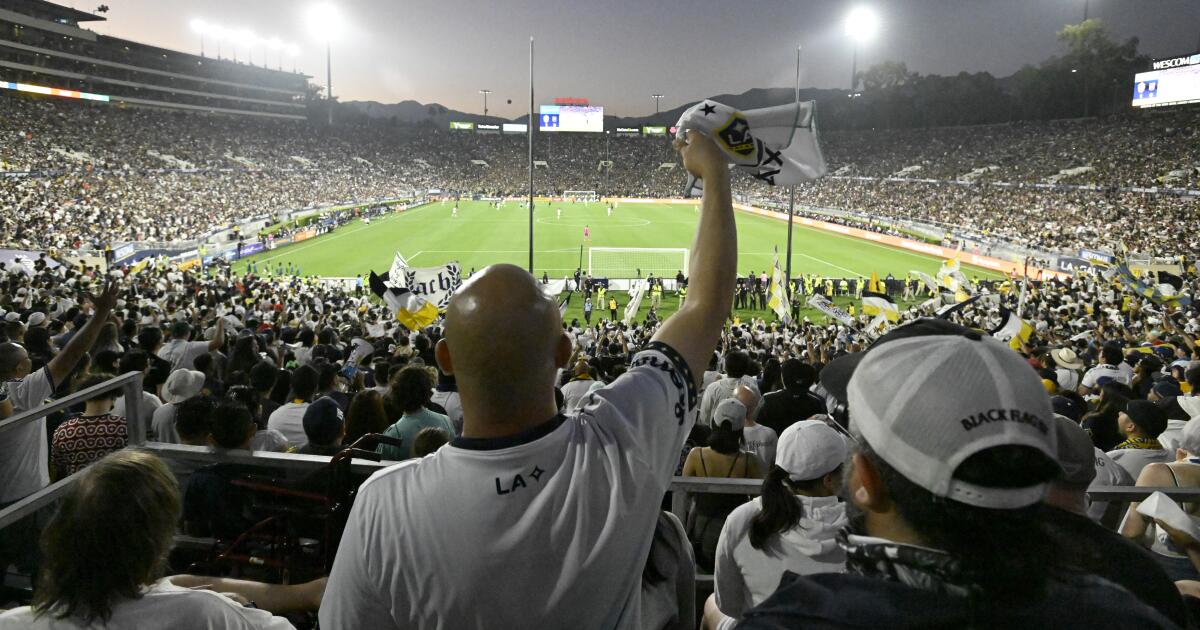
Major League Soccer was born 28 years ago in cavernous NFL stadiums. Three seasons later, the league was averaging 14,312 fans a game in venues built to house five times that many.
At most games it was so quiet you could hear each team’s profits drop.
So with the league on the verge of bankruptcy in 2002, clubs began building their own soccer-specific stadiums with smaller grandstands, wider fields and a much better atmosphere. Less than a decade later, more than half the teams played in soccer-specific homes, most with fewer than 26,000 seats. And thanks to that change, MLS not only survived, but began to thrive.
Now, however, with soccer exploding in popularity across the U.S., is the league beginning to outgrow those humble surroundings?
“We don’t think so,” said Camilo Durana, the executive vice-president for properties and events at MLS.
The numbers tell a different story. On Thursday, when the Galaxy and LAFC renew their rivalry at the Rose Bowl, the game could draw as many as 75,000 people, the second-largest crowd in league history behind only the 82,110 the two teams drew at the Rose Bowl last July. That’s more than three times the number of fans they can fit into their soccer-specific stadiums, yet it’s just the crest of a very big attendance wave sweeping through MLS.
A little more than halfway through the season, the league is stretching at the seams, having already drawn more than 6.73 million fans, a jump of more than 7% from this time last year. Twenty-five of the 29 teams are drawing larger crowds than they did last season, while nine teams, including LAFC, are playing to 100% of their stadium’s capacity. Five matches have drawn more than 65,000 people.
Yet while the attendance growth has been impressive, Duran said it’s important to look at more than just the numbers.
“The soccer-specific stadiums provide a lot more than just capacity,” he said. “It’s better sight lines. The camera angles provide a much better broadcast experience. Our clubs can actually own the facility and dictate the schedule. All that delivers a much better experience.
“They can also make decisions on the type of seating available to fans. Standing sections have been wildly successful. That has helped us in the last 24 months to drive attendance up.”
The cozy confines also drive up demand for tickets. The listed attendance for BMO Stadium, where LAFC plays, is 22,000 but the team, which has a season-ticket base of 18,000 and a long waiting list, regularly draws more than that, creating an intimidating atmosphere for visiting teams.
As a result, no team has a better record at home than LAFC since it entered the league in 2018.
LAFC fans show their support during a game against Inter Miami at BMO Stadium in September.
(Francine Orr / Los Angeles Times)
Soccer specific doesn’t have to mean small, however, nor does it mean giving up things like safe-standing sections.
When Nashville SC owner John R. Ingram prepared for his team’s entrance into MLS in 2020, he predicted that soccer attendance would swell and wanted to marry the need for bigger venues with the ambiance of a small building.
“His view was, ‘I want to build this for to where the game’s going, not where it is.’” Ian Ayre, the club’s chief executive officer, related.
The result was Geodis Park, which opened in 2022 with a capacity of 30,000, making it the largest soccer-specific stadium in the league. Two seasons later, Nashville’s average attendance of 28,605 in fifth-best in MLS, trailing four teams that play in NFL stadiums.
“We have 24,000 season-ticket holders and we’ve been sold out of premium [seating] since Day 1,” Ayre said. “So I think we made the right decision. Maybe we need to be bigger.”
Teams with a more modest season-ticket base have chosen to take high-demand games to nearby football stadiums. The San José Earthquakes, who play in PayPal Park, with 18,000 seats, the smallest stadium in the league, have drawn more than double that by playing LAFC at Santa Clara’s Levi’s Stadium and the Galaxy at Stanford Stadium. And Sporting Kansas City attracted 72,610, the third-largest crowd in MLS history, in April when it moved its game with Lionel Messi and Inter Miami — who have combined to drive much of the attendance increase — from tiny Children’s Mercy Park (18,467) to Arrowhead Stadium.
“It does speak to the growth of soccer, the growth of our league and how special it is to be able to do that,” said Galaxy president Tom Braun, who has been instrumental in putting together the two Rose Bowl games.
Still, Durana said MLS isn’t ready to move away from the stadium experience that drove the league to this point.
“The experience for fans is much more than just where they’re seated,” he said. “It’s the food options, what they’re seeing coming into the stadium, rituals that are built into the facility. So a move to a larger venue has a much greater impact on the fan experience.”
It can also be expensive. In most cases, because the MLS teams do not own the larger stadiums, they have to pay rent, give up concession, sponsorship and parking revenue and relocate season-ticket holders. Merchandise stores are different, if they exist at all, as are the food and beverage offerings.
“It’s impossible to co-exist in someone else’s venue,” said Ayre, whose team played its first two seasons in Nissan Stadium, the 69,000-seat home of the NFL’s Tennessee Titans.
If the soccer-specific stadium feels like an old shoe for loyal supporters, the bigger venue may feel foreign and uncomfortable. The same can be said for the players, who have a strange locker room, a different field and a less-intimate atmosphere to get used to. Rarely does the home-field advantage carry over.
“There’s a bit of a gamble,” Braun admitted.
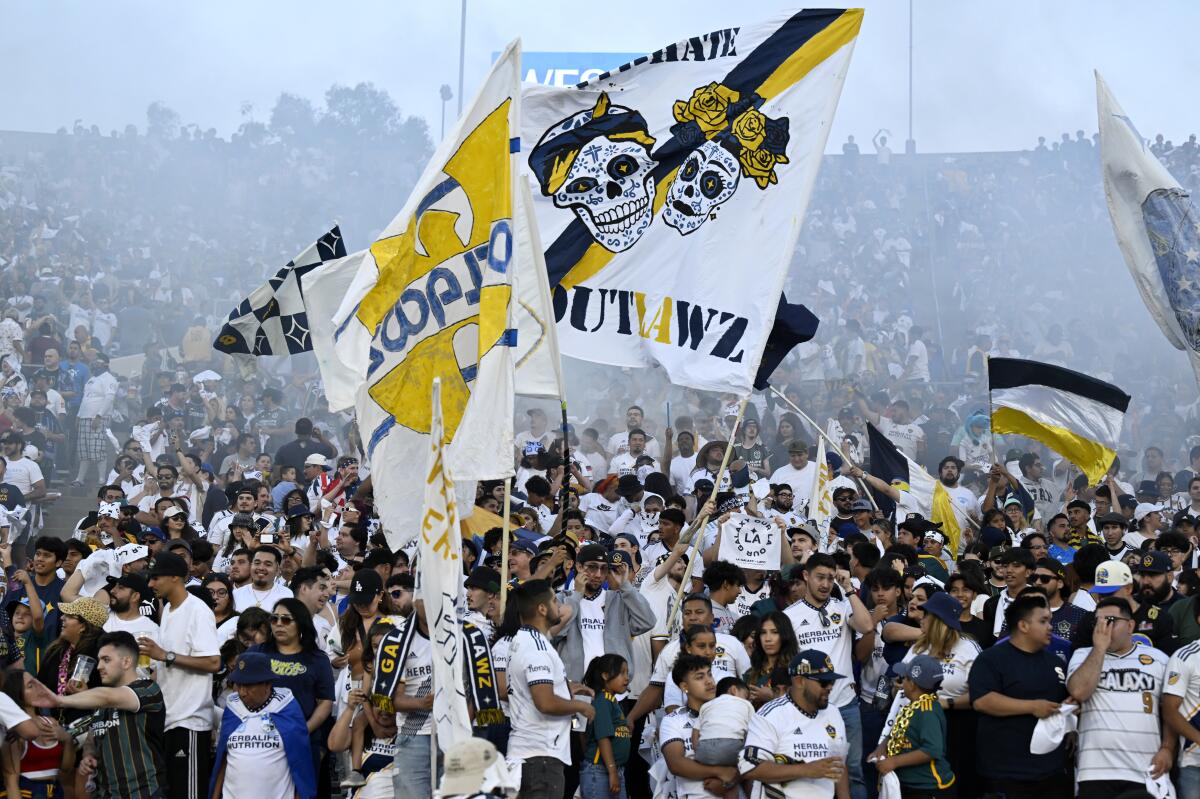
Galaxy fans cheer during a match against LAFC at the Rose Bowl on July 4, 2023.
(Alex Gallardo / For The Times)
In the case of LAFC-Galaxy, moving the game from Dignity Health Sports Park to a larger venue is probably a bet worth taking, though. Not only is the crosstown El Tráfico annually the most passionate rivalry in MLS, but this week there is more that just bragging rights on the line.
The Galaxy (11-3-7) and LAFC (12-4-4) come in tied for the top spot in the Western Conference standings. And while the Galaxy have lost just one of their last 11 matches dating to April, LAFC hasn’t lost in its last nine games, the longest unbeaten streak in the league.
Maybe this game will eventually need a stadium even bigger than the Rose Bowl.
“Dignity Health Sports Park is a special stadium and it’s the best experience in MLS,” Braun said, but “taking the game to the Rose Bowl is a special moment for the league. And it’s just representative of where our league started and where our league is going.
“I can’t say that necessarily big stadiums are the answer. At some point, maybe.”
You have read the latest installment of On Soccer with Kevin Baxter. The weekly column takes you behind the scenes and shines a spotlight on unique stories. Listen to Baxter on this week’s episode of the “Corner of the Galaxy” podcast.


NEWYou can now listen to Fox News articles!
Oba Femi and Brock Lesnar’s feud will come to a head at SummerSlam in August, and the showdown has the potential to be WWE’s match of the year.
Femi beat Lesnar at WrestleMania 42 and led to “The Beast Incarnate” deciding to retire – at least for a moment – at Allegiant Stadium in Las Vegas. Lesnar made a dramatic return a few weeks later, challenging and beating Femi at Clash in Italy.
COMPLETE PRO WRESTLING COVERAGE ON FOX NEWS DIGITAL
Oba Femi looks on during Monday Night RAW at Allstate Arena on July 6, 2026, in Chicago, Illinois. (Melina Pizano/WWE via Getty Images)
At SummerSlam, Femi and Lesnar will do battle inside a Hell in a Cell.
WWE Hall of Famer John Bradshaw Layfield called the next meeting between Femi and Lesnar a “generational matchup.”
“I’ve never seen anything like Oba – well, I have. I’ve seen Brock,” he told Fox News Digital. “It’s very much the carbon copy of Brock coming in. Brock coming in was like, oh my God, who is this guy? The guy can even talk, and he’s gonna be one of the biggest stars in wrestling. Not only could he talk, he’s a really smart guy. Brock became one of the biggest draws in professional wrestling. He came one of the biggest draws in UFC. It’s an unbelievable story, and now you got somebody who can rival that character.
Brock Lesnar in action against Oba Femi during “Monday Night Raw” at TD Garden on March 23, 2026, in Boston, Massachusetts. (Michael Owens/WWE via Getty Images)
“This Oba Femi comes out with the silly little walk he does. Everyone kinda does it, it’s like The Bushwackers. But the whole arena does it. I was in Vegas and I didn’t want to go to the matches and deal with the traffic and deal with the backstage area, and so I kinda just watched it in a sports bar. I stood in the back where nobody could recognize me, and as soon as Oba came out, the entire sports bar was sitting there doing that Oba Femi dance. The guy is just unbelievably over.
“I really think that somewhere in the NFL this year, you’re going to see an entire NFL arena doing this dance. You’re gonna have somebody like Saquon Barkley or ‘King’ (Derrick Henry) or some of these guys do this dance, and it’s infectious. Once one of them does, one of these great running backs or wide receivers, or somebody scores a touchdown, that’s when I think you’re gonna see entire arenas doing it. I just think Oba Femi is lightning in a bottle and Brock has always been that way. This is, to me, a generational matchup.”
Brock Lesnar and Oba Femi face off during WrestleMania 42: Night 2 at Allegiant Stadium on April 19, 2026, in Las Vegas, Nevada. (Georgiana Dallas/WWE via Getty Images)
CLICK HERE TO DOWNLOAD THE FOX NEWS APP
SummerSlam will take place on Aug. 1 and 2 at U.S. Bank Stadium in Minneapolis.
Sports
Commentary: ‘I don’t want any handouts.’ Amid the Angels’ drought, a starry homecoming for Mike Trout

Mike Trout last played in an All-Star Game seven years ago. It’s crazy, really. The best player of the previous decade, the link that ties Barry Bonds and Albert Pujols to Aaron Judge and Shohei Ohtani, has not taken an All-Star at-bat this decade.
Injuries, mostly. And he turns 35 next month.
Next week’s All-Star Game takes place in Philadelphia, about 40 miles north of Trout’s hometown of Millville, N.J. Major League Baseball reserves a potential All-Star roster spot or two each summer for distinguished players: Bryce Harper and Justin Verlander this year, Clayton Kershaw last year, Pujols and Miguel Cabrera in past years.
That could have been Trout’s spot this summer: a worthy honor for a three-time most valuable player, a local hero feted on the national stage the Angels have failed to provide him.
“I wouldn’t have done it,” Trout said.
Not even at home?
“It’s an honor to get voted in and represent the American League,” he said. “For me, I don’t want any handouts.”
Trout is an All-Star for the 12th time, the old-fashioned way: He earned it.
Fans voted him into the starting lineup, with the most final-round votes of any AL outfielder. His peers voted him as one of the top three outfielders in the AL.
“It means a lot,” he said. “I’ve been through a lot of hurdles, a lot of adversity. I put some hard work in, and I did not let up. I could have easily got down on myself and not pushed through it and not come back.
“I know what I am capable of. I know I have the confidence to get back to the player I used to be.”
His .874 OPS entering play Thursday ranks second among AL outfielders, a career season for many players. In 11 of his 14 full seasons — all but the previous three — he has posted a higher OPS.
In April, in a four-game series against the New York Yankees, Trout hit five home runs and drove in nine runs.
“Everything was clicking,” he said. “When I first came up, that’s how I felt the whole season.
“Just to be able to get that feeling back, that little spark, to know it’s still in there, it makes you feel pretty good.”
For him, so does playing in Philadelphia. The first time he played there with the Angels, Millville basically closed down for the night, and just about everyone in town boarded a bus to the game. Then Trout had an exceptionally rare experience, a visiting player cheered at the home of the boo.
Mark Gubicza can testify to that. Gubicza, the two-time All-Star pitcher and now the Angels’ television analyst, grew up in Philadelphia.
“I don’t care if you were God himself, if you were wearing a different color uniform, I was still booing you,” Gubicza said. “But he was cheered.”
Still is. Trout is a diehard Philadelphia Eagles fan, with his season tickets not in some climate-controlled luxury suite but along the sideline.
“The players all walk by him and say ‘Trouty!’ ” Gubicza said. “Before they all go out to get their heads beat in, they’re all saying hi.
“He’s not one of those guys that comes there to be seen. He’s going there to root. That’s why they love him: He’s one of us.”
Said Trout: “I know how passionate I am about the Eagles. From my experience as an Eagles fan, it’s just different.
“It’s like win or die.”
It’s not like that in Southern California, where almost no one listens to sports-talk radio, and where a nice day is always a day away.
No one would begrudge Trout for living year-round along the Orange County coast. (OK, maybe Philadelphia fans would.)
Roy Hallenbeck, Trout’s high school coach, remembered visiting years ago on what he called “a perfect day” and asking Trout how he could ever get tired of all that sunshine.
“Yeah, coach, I couldn’t live here,” Trout told him. “‘I need my seasons.”
Trout built a family home near his boyhood home. He built his Trout National golf resort, with a course designed by Tiger Woods, in Millville.
He is as loyal to the Angels as he is to Millville. He appreciates the team that “took a chance on a kid from a little town in southern New Jersey” and signed him to two nine-figure contract extensions.
Trout was the last Angels player to take a postseason at-bat, in 2014. Even amid baseball’s longest playoff drought, he still considers Anaheim a special place, and always will.
“It’s where it all began,” Trout said. “I think the fuel of people doubting us kind of makes it more of a fire for me to try to get back to the playoffs. I think that’s the biggest key for me.
“Could I take the easy way out and just leave? Yeah. But I think — I said this last year around this time, but it’s the same feeling I’ve been having — I really haven’t sat down and talked to anybody about it specifically, but I know there’s a time where, if things change, who knows? I don’t know. But, for me, right now, my focus is on trying to get this club back in the playoffs.”
At the All-Star Game, Trout might well hear Phillies fans beseech him to come play for the home team. However, Hallenbeck said, the hometown folks no longer are as strident in that long-held wish.
“I think the overriding sentiment of most people I talk with, even Phillies fans, is we would all — as people that know him, love him and care for him — love to watch him play relevant baseball in August and September,” Hallenbeck said. “It doesn’t matter where. It doesn’t matter who. Just being relevant late in the season would be something we would all love to see.
“Hopefully, it’s with the Angels. They’ve been so good to him. We’d love to see it there.”
So would we. In the meantime, in the absence of a World Series, Trout deserves to enjoy his homecoming game.
Sports
London descends into disorder as Morocco fans flood streets after World Cup elimination by France

NEWYou can now listen to Fox News articles!
Public unrest began in parts of London late Thursday night, and it appears Morocco’s exit from the 2026 FIFA World Cup at the hands of France is the reason.
France took down Morocco 2-0, eliminating the African country for the second consecutive tournament, this time in a quarterfinal match.
As a result, many feared Paris would erupt into riots, especially after the chaos that followed Paris Saint-Germain’s UEFA Champions League victory over Arsenal in May.
Instead, images and videos from Edgware Road in northwest London showed police clashing with large crowds as smoke billowed through the streets and debris littered the roadway.
A police vehicle is parked in a road as people from pro-Palestinian activist groups gather near the Edgware United Synagogue during a demonstration against the “Great Israeli Real Estate Event” organized by real-estate agency My Home in Israel, which markets property in Israeli settlements in the occupied West Bank, in London, Britain, June 14, 2026. (Toby Shepheard)
Riot police, equipped with shields and body armor, tried to contain the crowds as they clashed with people launching fireworks and throwing debris. One video also appeared to show an officer down.
KYLIAN MBAPPÉ, OUSMANE DEMBÉLÉ FIRE FRANCE INTO WORLD CUP SEMIFINALS WITH WIN OVER MOROCCO
It’s unknown what happened to the officer who was down on the asphalt or how he was injured.
Fans waved Moroccan flags in the middle of the streets, which held up traffic. Some even jumped on top of vehicles trying to get through the area.
Moroccan fans in the stands before a FIFA World Cup 2026 quarterfinal match between France and Morocco at Boston Stadium July 9, 2026, in Foxborough, Mass. (Richard Sellers/SportsphotoAllstar)
Similar scenes unfolded after Egypt’s World Cup exit, when Argentina rallied for a controversial 3-2 victory that featured several disputed officiating decisions.
Paris, on the other hand, looked more like a city celebrating than one on the brink of a riot. Supporters of both France and Morocco flooded the streets, slowing traffic in several parts of the city.
One video showed horns blasting from cars with French and Moroccan flags out the windows on the L’avenue des Champs-Élysées in Paris. Supporters on the side of the road, waving their own flags, joined in on the celebration.
France’s Kylian Mbappé scored his eighth goal of this World Cup, which ties him for the most with Argentina’s Lionel Messi. Ousmane Dembélé also scored in the second half for France in the 2-0 win over Morocco.
It’s the third straight semifinal appearance for France, while Morocco still made World Cup history despite the loss. After becoming the first African country to reach the quarterfinals and semifinals in World Cup history in 2022, Morocco added to that by becoming the first-ever African nation to reach more than one quarterfinal.
Moroccan fans react while attending a watch party for the World Cup round of 8 match between France and Morocco in Boston, Massachusetts, on July 9, 2026. (Joseph Prezioso/AFP)
CLICK HERE TO DOWNLOAD THE FOX NEWS APP
Morocco’s exit means there are no more African nations alive in the World Cup. France will be taking on the winner of Spain and Belgium, while England and Norway and Argentina and Switzerland face off in the quarterfinals.
Follow Fox News Digital’s sports coverage on X and subscribe to the Fox News Sports Huddle newsletter.
-

 Finance40 seconds ago
From Love Island to Precious Metals, Prediction Markets Are Changing Finance | PYMNTS.com
-

 Fitness4 minutes ago
80-year-old fitness icon Joan MacDonald reveals her simple exercise for a stronger, more stable core
-

 Movie Reviews16 minutes ago
‘Gail Daughtry and the Celebrity Sex Pass’ Review: We’re Off to Hump the Wizard
-

 World23 minutes ago
Backlash on ethanol-blend fuel intensifies in India, puts carmakers in the dock
-
Politics34 minutes ago
Crews Drape Tarp Over White House in Latest Trump Restoration
-

 Health49 minutes ago
GLP-1 Users’ Guide to Protein Snacks: Here’s What a Dietitian Actually Recommends
-
 Lifestyle1 hour ago
‘The Invite’ is a marriage comedy with sex and heart
-

 Technology1 hour ago
I spent a week using the Trump phone — it sucks

