Sports
A Hall of Fame coach's son got his fairy tale ending. Now he wants to know how the story began


EAST LANSING, Mich. — Steven Izzo sat in his locker, aw-shucksing the high point of his adult life, playing a familiar part.
The first basket of his five-year career on his father’s Michigan State basketball team was an act of comedic defiance. The gall of this move. Against a Rutgers defender with 6 inches and 50 pounds on him, Steven Izzo took two dribbles to his left, stopped, reversed direction, flicked the ball between his legs, took two more dribbles and, falling backward, flung a prayer in the general direction of the backboard. The ball landed upon the rim, spun back to the glass, danced on the heel, and, as if knowing what the moment called for, dropped through the net.
What followed was some kind of shared catharsis. Never mind that Steven is 23 — everyone’s little brother made this shot. Teammates fell over each other to get to Steven. The student section, aptly known as “The Izzone,” screamed and jumped and hugged. Grown fans brushed away tears. After years of chanting for him to play and screaming for him to shoot, it felt like a release. Overembellishment be damned, that basket, on that day, scored in the waning moments of a blowout win, stands as one of the loudest moments in Breslin Center history.
In front of reporters afterward, Steven said everything he was supposed to say. That what matters most to him is putting on the jersey, being with his father. That he can’t believe how fortunate he is. That scoring was just a bonus. “I haven’t been necessarily worried about stats,” he shrugged. “Nor should I.”
The whole scene was perfect.
Later, in private, Steven recounted the shot, frame by frame. The smile was still fresh, except this time he added, “It’s nice to give people the fairy tale version.”
That version is the one Steven has always felt people wanted. The one free of complications, the novelty they root for. Steven has never needed his own identity because being Tom Izzo’s son was always enough.
But then there’s reality. That ever since he was 3 or 4 years old, back when mom read bedtime stories about adopted kids and told him to clasp his hands in prayer for his biological mother, he’s known there’s another part of him; a part that’s rarely mentioned. While Steven’s Michigan State biography says he was born in East Lansing, Mich., he was, in fact, born on June 16, 2000, in West Virginia.
That version is another story, one that required Steven to open a door and pick up a box.
Second-floor closet. Second shelf from the floor. A clear plastic container, blue lid, tucked among linens for the guest room, some cleaning supplies and a commemorative Final Four Beanie Baby.
That’s where the rest of the story starts.
His former life lasted four days. Steven Izzo was 5 pounds when he entered a world that was unsure where to send him. His mother was 19. Presented with a list of potential adoptive parents, she chose a couple in Michigan because it was the farthest option.
Tom and Lupe Izzo had married nine years earlier, when Lupe operated a Lansing water purification franchise and Tom was a manic assistant basketball coach. Tom was an Italian-American from the otherworld of Michigan’s upper peninsula. Lupe was a Mexican-American from Texas. They never saw each other coming. But by getting married later in their lives, they were immediately on the clock to start a family. That’s when things got difficult.
Those early miscarriages were hard, but eventually along came Raquel. A bouncing, smiling girl. Tom and Lupe’s daughter was born in August 1994 at Sparrow Hospital in Lansing. Tom and Lupe were 40.
The next few years were harder. The specialists. The injections. Hope, then agony. “To the point where I just finally said to Tom, I don’t think I can do this anymore,” Lupe now says. “To lose a child every time, it was too much.” The Izzos decided to add their name to some adoption lists.
Lupe was home on June 16, 2000. Life was, in many ways, finally settling down. The five years since Raquel’s birth were a blur — Tom was named Michigan State head coach in 1995, lost a bunch of games early, feared he’d be fired, then won the Big Ten in 1998, went to the Final Four in ’99 and won a national title in 2000. The Spartans’ championship parade was still fresh in her mind when, walking down the stairs with a bin of laundry, Lupe fumbled with her phone. She might’ve ignored the call, but it was Nick Saban.
“Lupe, I’m trying to get a hold of Tom, but he’s not answering.”
Saban coached football at Michigan State from 1995 to 1999, but left seven months earlier for LSU. The families remained close because Nick and Tom are who they are, but also because the Sabans had previously adopted two children from Nick’s home state of West Virginia. He knew people there and pulled all levers within his power to line up the Izzos.
“Are you sitting down?” Saban asked Lupe. “A baby boy was just born. Are you interested?”
The laundry hit the floor.
Tom and Lupe didn’t know Steven’s race or ethnicity, didn’t know the details of his birth, didn’t know he was severely malnourished, didn’t know his weight would continue dropping after he was born. They didn’t know his name because he wasn’t given one. All they knew was he might be their son. In her retelling, Lupe demanded to Tom something like, “You can get me on a plane, or I’m gonna start walking.” The next day, they grabbed an old car seat from the attic, held Raquel’s hands, and climbed aboard a propeller plane bound for somewhere in West Virginia.
The adoption was private, but Tom and Lupe learned the biological mother faced steep medical costs. They offered to cover the bills and, as a result, learned information about her that they might not have otherwise. It was information that would eventually find its way into a file, one that would be tucked away in a closet for safekeeping.
News spread rapidly. Local media covered the adoption, so much so that, fearing unprocessed paperwork could hit a snag, Lupe called a few reporters’ wives and implored them to ask their husbands to use more discretion. At 46, the thought of getting so close to adding to their family, only to see it come undone, terrified Lupe.
Six months later, on Dec. 22, the adoption was finalized in a Lansing courthouse. The family’s second child was given the most Izzo-ian name imaginable. Steven for his dad’s best friend, Steve Mariucci. Thomas, for Tom. Mateen, for his dad’s best player, Mateen Cleaves. Steven Thomas Mateen Izzo. Raquel hit the gavel and everything was perfect. Christmas was coming. Michigan State was off to a 9-0 start and ranked No. 2 in the country. The judge presiding over the ceremony told the Lansing State Journal: “You’re talking about one of our sports icons. He’s a god in this town.”
Twenty-three years later, on a recent afternoon in East Lansing, that same icon sat in his Michigan State office and told a hard truth. Maybe it’s not that easy to be the adopted son of a deity.
“I’ve often thought to myself, man, this kid really hit the lottery of life, you know? The things he’s gotten to do. All his needs taken care of, all that stuff,” Tom Izzo, now 69, says. “But, damn, it hasn’t been easy for him.”
Steven is 5 feet 8, 150 pounds. His size is the first feature attributed to him at all times, in all settings. An easy running joke. Opposing fans love it. Voices on social media love it. Of course they do. He’s small! And made somehow smaller by standing next to Division I basketball players. He’s a foot and a half shorter than 19-year-old freshman teammate Xavier Booker.
It’s always been easy for people to dig in on Steven’s size because his dad is a 5-foot-9 Vesuvius — this angry, fire-breathing, swear-spewing, short man, stomping and flailing along the sideline. If Izzo’s stature is fair game, why not lump in Steven, too, right?
Maybe that was the grade school bullies’ rationale, too. There were a few of them, and they were relentless. Shy and emotional, Steven was an easy mark. Fifth through eighth grade? Really bad. “Felt trapped once those doors closed,” he says now. Steven stopped growing, stunted while the other boys hit puberty and shot past him. School only made matters worse.
Diagnosed with severe attention-deficit hyperactivity disorder in second grade, Steven was so far behind in reading programs that Lupe and Tom sought out specialized help. To this day, he’s embarrassed to read in public.
Deep in the back of his mind, Steven always wondered why. Why did he struggle so much in school? Why didn’t he grow taller? Why do his hands shake constantly? Why do his nervous habits border on compulsion? It always went unsaid that the answers could lie in his origin story. That wasn’t a place Steven was willing to go, though.
“You can’t show anyone that it hurts,” Steven says. “You just play it off. Then get angry later.”
Lupe drove her son to school every day, glancing in the rearview mirror to find him stewing, furrowed brows under blond hair. She’d beg him to talk about his feelings, beg him to open up, beg him to stop acting up. The big conversation, she knew, was coming, but Steven wouldn’t budge. Finally, the day came sometime around 2008. Lupe stood over a sink full of dishes; the afternoon monotony was set to a soundtrack of daytime talk shows. Unbeknownst to her, that day’s episode of “The Oprah Winfrey Show” was about adoption.
Steven gamboled around the living room, playing mini basketball, but then the bouncing stopped.
The 8-year-old poked his head up above a counter he could barely see over. He asked his mother why some moms and dads give up their children. Lupe, in the middle of dinner prep, only half paying attention, responded that there are different reasons, but it isn’t because they don’t love them.
Steven finally burst. “But why did they get rid of me?”
Lupe dropped what was in her hands, careened to Steven and grabbed him by the shoulders. She told him that he was given the greatest gift — that his biological mother loved him so much that she wanted to place him in the healthiest situation possible, with a mommy and daddy that could care for him, and give him a family, and that she loved him so much that she made the hardest decision possible.
Then Lupe picked up the phone.
“Tom, Steven asked about his adoption.”
“I’ll be right home,” Izzo said.
So it went. Outward acknowledgments of the adoption were rare and volatile. In fifth grade, Raquel asked her brother if he was curious about what his biological parents looked like. Steven exploded. From time to time, Lupe would share morsels of information, hoping he might engage. Steven never flinched. Instead, over time, he found various defense mechanisms. “I didn’t care if I was an a——,” he now says. “I was going to hold my ground.”
All of this while trying to be Tom Izzo’s son. Steven’s adoption came with a predetermined role that seemingly metastasized into his entire character. As the years went on, his adoption sort of became acceptably ignored. Strangers stop him often to say how much he resembles his father. He’s never bothered correcting them. A few weeks ago, “CBS Morning News” produced a five-minute segment on the Izzos’ father-son story. It never mentioned Steven’s adoption.
“I think a lot of people either don’t know, or have forgotten, or feel awkward asking,” Steven says.
Which is, perhaps, why Steven is sharing all of this. Those close to him, including Lupe, Tom and Raquel, were taken aback when learning he’s talking publicly about his adoption, unpacking this for all to see. Many of his family, including a massive army of nearly 40 cousins courtesy of Lupe’s 11 siblings, don’t know what’s happened over the last 10 months.
But that’s why we’re here. Because Steven has come to figure out a few things.
Steven, center, with dad, Tom, and grandfather, Carl, has been a Michigan State basketball fixture for two-plus decades. (Courtesy of the Izzo family)
It began around freshman year of college. Those nights when Steven’s eyes snapped open. A sudden, spontaneous gasp. Heart thumping. Thoughts racing. Wide awake, all at once. This is what happens when there’s nowhere to put the things you don’t know.
“There are periods when you don’t think about it at all,” Steven explains. “And then there are periods when all you do is think about it. And then you obsess over it.”
Around 2008, when the family moved to its current home, a plastic container filled with all of Steven’s files – his social security card, his adoption paperwork, some information pointing to his biological family – went missing.
Then came the pandemic summer of 2020. Like every other family in America, the Izzos cleaned their attic. Lupe was up there, shuffling boxes, moving this, clearing out that, when, voilà, a clear plastic bin with a blue top.
Lupe rushed to tell Steven. His excitement didn’t match hers. So Lupe said she would place the box in the second-floor hallway closet. If he ever wanted to know more, it would be there waiting for him. She placed it on the second shelf from the floor.
He says now it was always just a matter of time before he cracked. Last May 19, a Friday, was another spring day, until it wasn’t. Steven was alone at the house preparing for a long-anticipated trip to Italy. His dad was somewhere doing something. His mom and sister were in Florida on a vacation preceding the arrival of Raquel’s first child in July. Steven was bumming around when, before he knew it, he was pulling the closet door open. Spontaneous self-discovery, like pulling a Clue character out of the envelope. He lifted the plastic container off the shelf, tugged open the blue lid. One page after another. Eyes darting. Dates. Locations. Names.
“I still don’t know what I was looking for,” he says.
Fifteen minutes passed, maybe 30, before Steven hurriedly put every page back, each in the exact order “so nothing looked like it was messed with,” placed the box back on the shelf, closed the closet and walked away.
He couldn’t unsee it. Twenty-four hours later, he was back, rifling through it all again. This time at the kitchen table. Laptop out. Googling this. Googling that. He at one point clicked on a LinkedIn profile and feared he might have tipped off his quest with a notification that he viewed the page. Little by little, the dots connected, a path formed, and, then, one click. There she was.
It had been exactly 22 years, and 10 months since 5-pound Steven last saw his biological mother. Now, numb, he was looking at her Facebook page, photos of her smiling, posing with children; children who he assumes are his half-siblings. He took a picture of her picture, closed the laptop, sorted the papers, and returned to the closet. He didn’t know what to feel or how to feel it, so he drove over to an aunt’s house, showed her the picture, and broke down.
Lupe and Raquel returned from Florida the same day. Early that evening, Steven walked into his mother’s bedroom and told her about the box and the papers and the Googling and the Facebook page and about finding his biological mother. As it often goes with adoptees, the fear of potentially hurting his adopted parents weighed as much as the burden of discovering where he came from. Curiosity and guilt in equal proportions.
There were tears. Then Steven drove to Raquel’s house, told her. More tears. The two of them went back to their parents’ house. Lupe called Tom, told him to come home. “It’s important.”
Soon, the Izzo family was together, talking, everything out in the open. But Tom sensed a deep unease. “Hey, buddy, I think I left something in the office. Take a ride with me.”
This ride? It was 23 years coming.
In hindsight, maybe Steven didn’t pursue the details of his adoption sooner because he was busy chasing a tougher task: getting his father’s attention. If Izzo wasn’t coaching, he was recruiting. If he wasn’t on campus, he was traveling. If he wasn’t solving one of his problems, he was solving someone else’s. Steven naturally felt like the son of a giant and wanted to somehow be seen. As a kid, he lived at Breslin Center, damn-near raised by the program — taken care of by players, looked after by staff and managers. That’s how he could be close to dad. But there was always only so much attention to be spared. Izzo’s work was both the reason for all his success — 25 straight NCAA Tournament appearances, eight Final Fours — but also an imbalance of priorities that remains a massive regret.
When Steven joined the team at Michigan State five years ago, it wasn’t because he was good enough, it was because he wanted time with his dad, and his dad wanted time with him.
The two Izzos drove everywhere and nowhere that night. Two men talking. Tom more than Steven. He told Steven, “You are my son.” He told Steven, “You are your mom’s son.” And then Tom told Steven that it was all OK. It’s OK if he wants to learn about his biological family. It’s OK, even, if he wants to take it further.
“That,” Lupe says, “I think kind of gave him a license to move on with his life.”

Tom Izzo hugs his son after Steven scored his first career points against Rutgers on Jan. 14. (Adam Ruff / Icon Sportswire via Getty Images)
Steven popped out of a living room chair one night last week. “Hold on, hold on.” He hopped up the stairs, pulled open a closet door, flipped on the light, grabbed a plastic container, and returned downstairs. He shuffled through some papers and clarified a snippet of information.
His mother, nestled in a lounge chair with the family pup, a Shih Tzu named Bear, watched on with eyes like saucers. The slightest shake of the head. Parental amazement. It’s all so new.
After all those years of suffering more than he let on, Steven sat casually talking about what he knows and doesn’t know. That he thinks about his biological mother, not his biological father. The face in the picture. He kind of looks like her. He mentioned his potential half-siblings. They’re younger. He wonders if they’re maybe Michigan State fans. “What do you know about them?” Lupe asked.
Steven talked around the question. So Lupe repeated it. They looked happy in the pictures, so that’s good. He wonders if they know about him, what they’d think about him.
“How does that make you feel to know they’re out there?” Lupe followed.
Here, Steven still doesn’t know where to go, but he can finally talk about it. He’s honest, not only with his mom, but with himself. He feels surreally fortunate that, for some reason, the game show wheel landed on him. He’s lived this fantasy life of fame and basketball and privilege, and asks himself often, why me? “I get emotional because I think of how wrong this all could’ve gone, and how right it went. What are the chances?”
Curiosity is growing, like tree roots pushing through soil. After spending his entire life with an agreed-upon identity — Tom Izzo’s son, the walk-on, the human victory cigar checking in for the final minute — Steven Izzo is interested less in being a novelty act and more in being Steven Izzo.
He just needs to understand who that is.
“I’ve come to realize,” he says, “that for my entire life, (my family) has wanted me to figure this out more than I wanted to figure it out.”
By law, Steven’s biological mother cannot contact him, but he admits he checks Facebook “every once in a while” to see what’s happening.
“I’m like, oh, did she post any new photos? I’ll just see what’s going on,” he says. “It’s like, I don’t care, but I do, in a sense. I definitely like to act like I don’t care. But, at the end of day, I might find myself wanting to know if they’re doing something new.”
Steven has this image in his head, what he calls “my Disney World mind.” It’s of this week’s Senior Day, his final game in a Michigan State uniform at Breslin Center, the place he’s spent more time than any other, including his actual house. He’s thought, what if he invited his biological family? What if they were there? Maybe up at the top rows of the arena, able to see him, able to see how he turned out. Close, but not too close.
“That’d be cool,” he says. “But I’m not ready.”
He doesn’t want to impose. What if he complicates things? That’s a box that, once open, cannot be closed.
Instead, for now, he’s considering a letter. One to his biological mom.
He’s tried to start a few times, only staring at a blank computer screen. “I don’t know where to start.”
Maybe someday he’ll find the words. He can tell her about his life. How his family has loved him, how his sister is his closest friend, and how his new niece is his favorite person. He can share what he’s overcome, from struggling in grade school to winning academic awards in college, from fearing reading in public to wanting to be a public voice advocating for adoption. Maybe he can mention that bucket against Rutgers, too. That was pretty cool.
And, thank you. Because that’s what he really wants to say.
That he made it. That he’s figuring out who he is.
(Illustration: John Bradford / The Athletic; photos: Courtesy of the Izzo family; Rey Del Rio, Adam Ruff / Getty Images)



NEWYou can now listen to Fox News articles!
Russell Wilson has had his share of ups and downs in his NFL career.
He helped the Seattle Seahawks to a Super Bowl championship in 2013 and was named to the Pro Bowl four times. But the last few years of his career arguably did some damage to his legacy as he’s spent the last three seasons with three different teams.
ZERO BS. JUST DAKICH. TAKE THE DON’T @ ME PODCAST ON THE ROAD. DOWNLOAD NOW!
New York Giants quarterback Russell Wilson watches from the sidelines during the second quarter against the Philadelphia Eagles at MetLife Stadium in East Rutherford, N.J., on Oct. 9, 2025. (Brad Penner/Imagn Images)
Wilson is still on the free-agent market as he looks to latch on to a new team for 2026. However, former NFL star Aqib Talib implored Wilson to hang up the cleats.
“Do your TV thing, Russ. It’s over with, man. Once you’ve got to decide, do I even want to play?” Talib said on “The Arena: Gridiron.” “I think you don’t really want to play. I hate when guys get to the later part of their career and then they start doing the bounce-around thing and they’re not going to win. There was no chip in New York. That’s just going to be another stop on your resume.”
Wilson reportedly garnered some interest from NFL teams.
New York Giants quarterback Russell Wilson stands on the field before a game against the Philadelphia Eagles at Lincoln Financial Field in Philadelphia, PA on Oct. 26, 2025. (Bill Streicher/Imagn Images)
He told the New York Post that the New York Jets were one of them.
Wilson also was reportedly a candidate to take Matt Ryan’s spot on CBS’ “The NFL Today” after Ryan left to take a front office job with the Atlanta Falcons.
Wilson has 46,966 passing yards and 353 passing touchdowns in 205 career games, but the 2025 season with the New York Giants was one to forget.
Wilson started three games and made some bizarre decisions in a loss against the Chiefs. Jaxson Dart was named the starting quarterback. As he came in to take a few snaps while Dart was being checked for a concussion, Wilson was booed.
New York Giants quarterback Russell Wilson watches from the sidelines during the second half against the Denver Broncos at Empower Field at Mile High in Denver, Colo., on Oct. 19, 2025. (Ron Chenoy/Imagn Images)
CLICK HERE TO DOWNLOAD THE FOX NEWS APP
Should he end up signing with another team, Wilson will be entering his age-38 season.
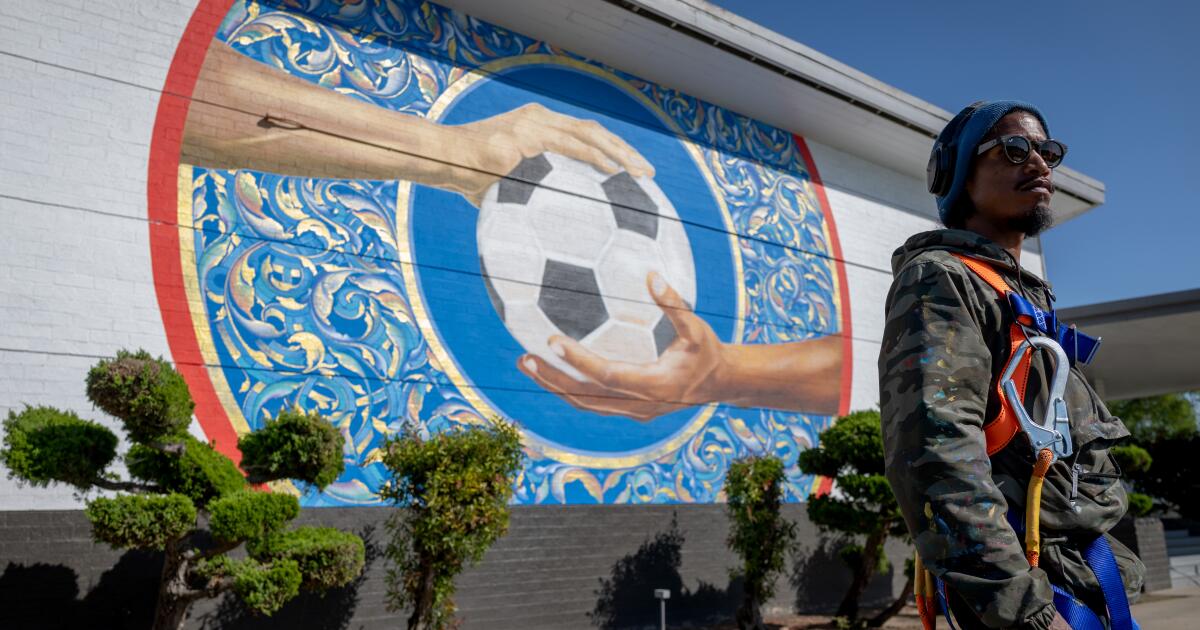
A lot has changed since Jacori Perry attended Morningside High School.
Perry is now a renowned artist who goes by the names Mr. Ace and AiseBorn.
The school is now known as Inglewood High School United.
And the lecture hall on that campus now features a large, ornate mural of a soccer ball being grasped by the hands of two people — freshly painted by the 2004 Morningside graduate as the city of Inglewood prepares to host eight World Cup games at SoFi Stadium starting next month.
Local artist Mr. Ace works on his mural at Inglewood High School United on May 11. The artists, whose real name is Jacori Perry, attended the school when it was known as Morningside High more than two decades ago.
(Eric Thayer/Los Angeles Times)
“If you told me that I would be back here painting one of the walls on this campus when I was in high school, I don’t think that I necessarily would have foreseen it,” Mr. Ace said as he was putting the finishing touches on his mural last week. “So I’m a little in amazement about just the way life works in that sense.”
He was one of several Los Angeles-based artists to participate in a Road to World Cup Community Day last month at Inglewood High United. Many of the artists — including Juan Pablo Reyes (“JP murals”), Michelle Ruby Guerrero (“Mr. B Baby”) and Angel Acordagoitia — sketched designs on portable panels (12-feet by 8-feet) and picnic tables for community members to paint.
The picnic tables will remain at the high school in front of Mr. Ace’s mural. The mobile murals will be placed throughout LAX to welcome visitors arriving for the World Cup.
Kathryn Schloessman, CEO of the Los Angeles World Cup 2026 Host Committee, said in a news release that the event was “just one example of how the energy of the World Cup can be felt in neighborhoods across our region.”
“Students, artists, and volunteers came together to create a work of art that will live on well beyond the end of the tournament,” Schloessman said. “It’s a reflection of the creativity, diversity, and community pride that makes our region so special as we prepare to host the world for FIFA World Cup 2026.”
Community members were encouraged to take part in the painting process, no matter their skill level.
“We made it easy enough for people that have zero experience to a proficient level of experience, for them to all be involved,” said Reyes, who designed and helped paint two mural panels and three tables. “We did the sketch, and then I tried to dab a little bit of color — whatever color is supposed to be there, I dabbed a little bit of color right there, so they would have a guide. …
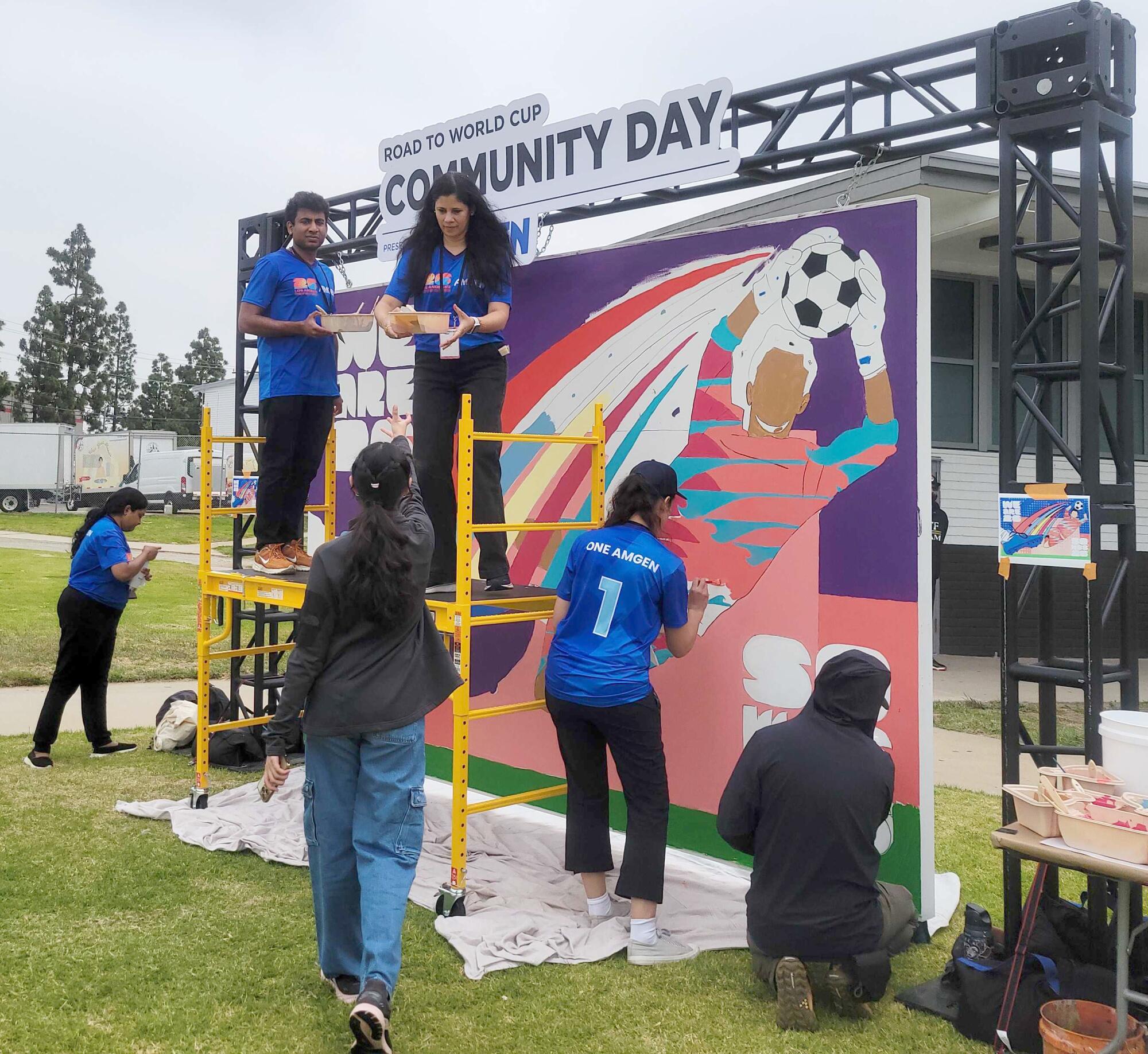
Students and community members help paint a mural panel during a Road to World Cup Community Day event May 2 at Inglewood High School.
(Dawn M. Burkes / Los Angeles Times)
“I was right there, kind of supervising, making sure that everything went as planned. And if anybody has questions, they’re more than welcome to let me know about them. But, yeah, it’s pretty easy for them to kind of be involved and feel that sense of ownership and have a sense of pride that, ‘Yeah, I was part of that mural-creation process.’ It’s a rich experience for them.”
Acordagoitia sketched several table-top designs for the public to paint at the event.
“They did great,” he said of the community members. “They helped a lot. They were asking questions. They got all the other colors correct. So, yeah, they were excited. A lot of kids were excited to see the live painting, because now kids are used to being on their phones. So that was a great experience for them.”
Acordagoitia also opted to paint a mural panel on his own because “it was a little more technical,” involving portraits of his 8-year-old son, a nephew and a friend.
“I wanted to focus more on the youth because that’s really our future,” he said. “So that’s, that’s the main thing about the mural, just about the kids, soccer, culture, community. It’s exciting for me, because I grew up playing soccer and to include soccer with art, it’s just a dream come true.”
Guerrero said “the community was a big help in filling in all the background colors that I need in order to build the detail and layers” on the two mural panels she designed.
“My whole style is based on culture. And I think that there’s a connection there with the World Cup and how I feel like it brings together all the culture and just, like, celebration,” Guerrero said. “It kind of goes hand in hand with the type of work I do, because my stuff is really festive, celebrating culture. And just as an L.A.-based artist, I think the collaboration made sense.”
The four artists also took part in another Road to World Cup Community Day in downtown L.A. at Gloria Molina Grand Park on March 14. At that event, the artists sketched designs on large sculptures shaped like soccer balls and an oversized picnic table, also for community members to paint.
While Mr. Ace opted to paint his permanent mural at Inglewood High School United on his own, he was sure to include the community theme into his work.
“The idea was really centered around just creating something that was community-based — something that represented the World Cup but also represented some sense of community,” he said. “And so what I did was try to create something that was symbolic, very direct in terms of its relationship to soccer and figuring out through that how to create something simple that [brings] into that a sense of community. And that’s how I landed on the two hands holding the soccer ball.”
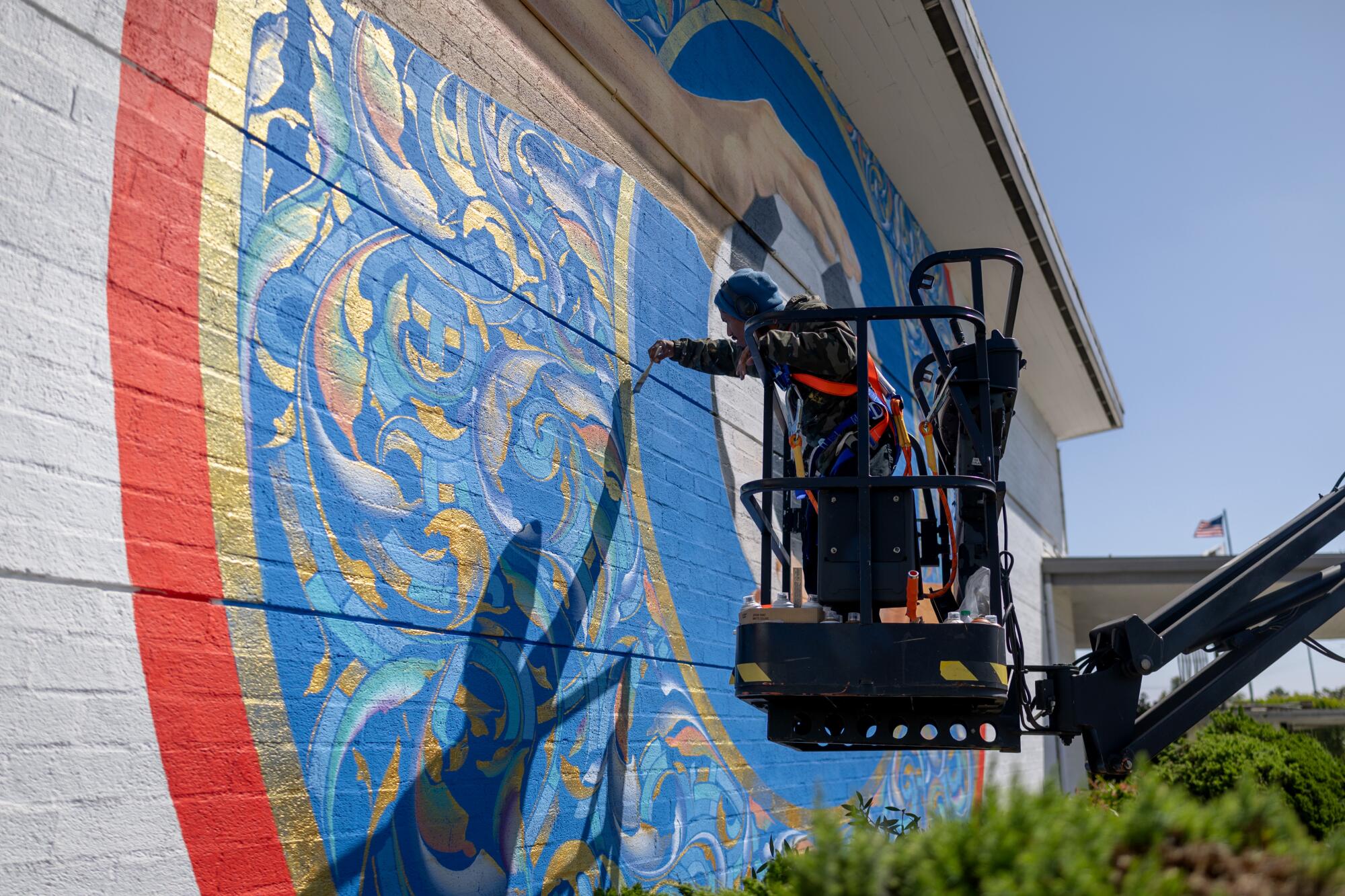
Local artist Mr. Ace works on his World Cup-themed mural at Inglewood High School United on May 11.
(Eric Thayer / Los Angeles Times)
Back when he was a student on that campus, Mr. Ace said he was always involved in art and knew he wanted a career as an artist. He struggled to come up with the right words to describe how it felt being back there creating a work of art to be shared with the students, all of the community and everyone who happens to see it on the way to a World Cup match.
“I guess there’s no words to really describe it,” he said. “I think if any artist gets the opportunity to paint at their own high school — especially if they’ve been doing large-scale works around the city, the country or the world — I think that is a little touching. When it’s attached to something like the World Cup … you know, a large part of my childhood was spent in Inglewood, so coming from my circumstances and life, I think it’s even more intriguing.”

NEWYou can now listen to Fox News articles!
The best Indianapolis 500 finish could be subjective, depending on which driver a fan was rooting for to win.
It certainly is in the eye of the beholder.
So take this list for what it’s worth. One view of the 10 best finishes in Indianapolis 500 history. Of course, it skews to more recent decades when the runs have come a little faster and the finishes have had a tendency to be a little closer.
We’ll add one each day to this list of fantastic finishes ahead of the 110th running of the Indy 500 on May 24 (12:30 p.m. ET on FOX).
10. Ericsson outduels O’Ward (2022)
After a red flag, Marcus Ericsson held off Pato O’Ward in a two-lap shootout. The shootout didn’t last two laps, though, as there was a crash on the final lap behind them. Ericsson had a comfortable lead when the red flag came out for a crash with four laps to go, a situation where in past Indianapolis 500 races, they likely would have ended the race under caution with Ericsson as the winner.
9. Foyt survives chaos (1967)
How does a driver who wins by two laps end up on this list? It’s because the win nearly didn’t happen on the last lap. A big crash with cars and debris littering the frontstretch just ahead of Foyt as he came to the checkered flag forced him to navigate through the wreckage for the win.
8. Sato can’t catch Franchitti (2012)
This was one of those finishes where the leader holds on for the win, but boy did the leader have to hold on. Takuma Sato tried to pass Dario Franchitti early on the final lap but to no avail and Franchitti sped off for the victory. This was one of those Indy 500s that made you hold your breath all the way to the checkered flag.
-

 Detroit, MI14 minutes ago
Twerking for your vote: Detroit 13th Congressional Candidate not shy on social media
-

 San Francisco, CA26 minutes ago
San Francisco’s last jeepney helps highlight city’s Filipino culture
-

 Dallas, TX32 minutes ago
Dallas Sumer of Safety initiative is back
-

 Miami, FL38 minutes ago
FIFA launches official World Cup merchandise shop in Miami Beach
-

 Boston, MA44 minutes ago
With the World Cup weeks away, Boston and the T clash over Summer Street closure – The Boston Globe
-

 Denver, CO50 minutes ago
Denver weather: More rain expected this week
-
 Seattle, WA56 minutes ago
The Seattle Opera Hosted Its First Official Furry Night – The Stranger
-

 San Diego, CA1 hour ago
What we know about the San Diego shooting victims, suspects, possible motive and more

