West Virginia
Repair work on busiest bridge in West Virginia to happen in phases to “minimize disruptions”


CHARLESTON, W.Va. — Traffic in the Capital City will soon have to adjust as the busiest bridge in West Virginia draws closer to undergoing a rehabilitation project.
The West Virginia Division of Highways recently awarded a $74.5 million contract for the rehabilitation of the Eugene A. Carter Bridge to Triton Construction. The bridge, also known as the Fort Hill Bridge, is located in the Capital City and carries Interstate-64 over the Kanawha River.
Around 100,000 vehicles travel across the bridge each day.
Gov. Patrick Morrisey joined state and local officials Thursday at Magic Island to officially announce the contract awarding. DOH officials have told MetroNews that crews will build two median crossovers this August, with the majority of that construction taking place at night and on weekends to minimize its impact on traffic. Official repair work is expected to begin in early 2027, with an anticipated conclusion next December.
DOH officials said everything should be “back to normal” by Spring 2028 under the current timeline.
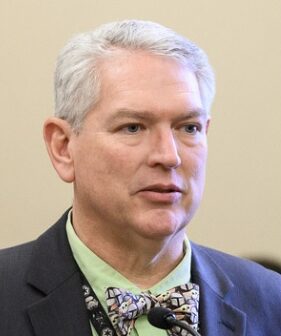
Del. J.B. Akers, R-Kanawha, was on hand for the news conference. He emphasized that motorists will have to be flexible with their routes.
“We’ll have a little bit of an inconvenience while that’s going on,” Akers said. “This is going to be a huge project that impacts traffic from all over the East Coast, really.”
Issues have popped up at the Carter Bridge in recent years. The state DOH made emergency repairs to fix potholes that had popped up last summer, causing traffic delays. Triton Construction also repaired concrete, installed a waterproof membrane, and added a 2-inch layer of asphalt last October.
Minimizing the impact on motorists during this project has been a top priority, according to state Transportation Secretary Todd Rumbaugh.
“Our team at the Department of Transportation has worked tirelessly to phase this construction, so we minimize the disruptions on your daily commute and your businesses,” Rumbaugh said.
DOH officials said crews will work on one side of the bridge first, then crews will shift traffic and begin work on the other side. Motorists can stay up to date on the project by visiting the Division of Highways website to see the anticipated construction schedule.
Akers commended Morrisey and Rumbaugh for taking action now.
“For doing the hard thing, on a project like this, which is a maintenance and repair project,” Akers said. “They’re not kicking the can down the road for some other administration to deal with. They’re dealing with a major issue, right now, and this will be a generational project for this bridge. It’s going to prevent us from having to deal with this in the future.”
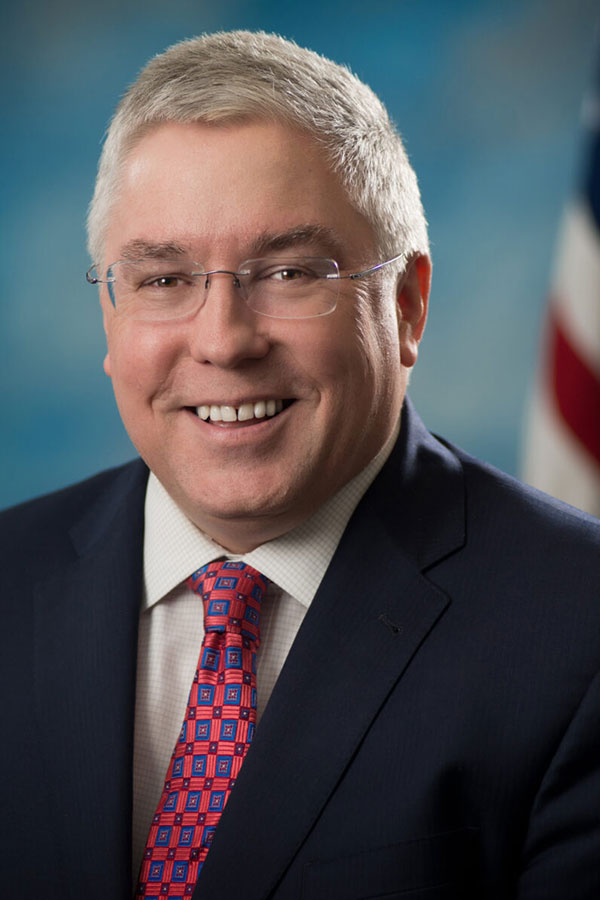
The governor mentioned the state had previously been given poor grades by national surveys on bridge safety. He said his administration is committed to improving bridges all across the state, starting with the heavily trafficked bridge in Charleston.
“This is a signal that we take bridge repair work very seriously,” Morrisey said. “When we inherit being an ‘F’ in bridges, I do not want that to be the case. We need safe bridges for our people, and I’m going to keep working every day to make sure that happens.”
Morrisey said in his year and a half as governor, the administration has been focused on “getting back to the fundamentals.”
“Site-selection and remediation, speed to build; cutting red tape faster, that’s what’s why I’m so excited about our one-stop shop permitting. (That’s) going to make things go even faster, and responsibly.”
Those efforts have been paying off, Morrisey said.
“When you have that kind of economic growth, that level of construction, it’s particularly important to make sure that your infrastructure is strong,” Morrisey said. “That’s really why we’re here today.”
Rumbaugh said the investment signals a commitment to the future of the Mountain State and its travelers.
“This rehab project represents a once-in-a-generation investment in our economic corridor,” Rumbaugh said. “It’s about much more than concrete, structural steels, and orange barrels. It’s about safety, reliability, and planning for the next 50 years.”



West Virginia
Concerned West Virginians speak out against proposed Monongalia County power plant – WV MetroNews

CHARLESTON, W.Va. — Concerned citizens, coal miners, and political candidates made a unified stand against a proposed gas-fired power plant in Monongalia County.
32 people spoke during the state Public Service Commission public comment session Wednesday night in Charleston. Every single one opposed the plant.
The PSC is reviewing a proposal from Mon Power and Potomac Edison for a combined cycle gas plant at the Fort Martin Power Station in Maidsville. There would be three solar arrays as part of the investment as well, one each in Tucker, Preston, and Hancock counties.
The plant would generate 1,200 megawatts of electricity and construction would cost around $2.48 billion. The solar arrays warrant an estimated $182 million cost for installation.
To foot the bill on the investment, Mon Power has proposed an initial surcharge to customers of .9 percent or $1.18 per month.
One speaker, Britta Aguirre, said she had to choose a few months ago between paying her phone or electric bill. She said this struggle is not unique to herself in West Virginia; many residents have lived that experience.
She wondered what’s going to happen going forward as bills continue to rise.
“Can you really call yourself free when you’re working full time, three jobs, and you still can’t pay your electric bills?” Aguirre asked. “Come on. When you have to choose between groceries and your medicines, when your power bills go up and we don’t consent, and y’all (the PSC) still don’t listen. That’s not freedom. That’s survival.”
Nine coal miners, who are also members of the United Mines Workers of America (UMWA), addressed PSC Chairwoman Charlotte Lane during the meeting. They expressed concern over what would become of the coal industry with this investment.
Former UMWA Research Director and coal miner Michael Buckner said there have been mixed messages from Mon Power/First Energy when discussing the Fort Martin property. Buckner said while there have been claims that they won’t replace the existing coal-fired plants, there have been statements suggesting to the contrary.
“The CEO of First Energy, Brian Tierney, was quoted in the press last month saying, “I could see us adding between one and four combined cycles of about 1,000 megawatts each that could ultimately replace Fort Martin and Harrison,”” Buckner said.
Buckner said the coal industry is a critical piece of West Virginia economy, not just providing jobs in the mines. He said there’s a ripple effect with each coal mining job, as he said every single one creates five additional jobs in the community.
Mike Knight, a fourth-generation coal miner and local union president at the Ohio County Mine, said if the PSC approves the Mon Power request, the coal industry will be devastated in the Fort Martin area.
“The new gas plant will replace the coal-fired power plant at Fort Martin, wiping out high-paying coal jobs and pushing more coal companies towards bankruptcy,” Knight said. “When those companies collapse, so do the retirement benefits earned through decades of hard work, and dangerous work.”
Raleigh County native Courtney Vandall said her grandfather and great-grandfather were coal miners. She said her great-grandfather was killed in the mines. Vandall blasted the proposed plant, saying it’s the latest example of West Virginians getting exploited for national gain.
“This isn’t for West Virginians,” Vandall said. “That’s nonsense to pretend like that this is for West Virginians. This is for the companies. This is for the corporation. This is for a CEO that makes over $13 million, and I bet he’s never had to worry about how he’s going to pay his power bill.”
Longtime West Virginia House of Delegates member Barbara Evans-Fleischauer spoke at the meeting. Her main point was that there’s no demand in the Mountain State for this type of investment.
“West Virginia residential consumers did not ask for or demand AI (artificial intelligence),” Evans-Fleischauer said. “We resent being forced into becoming cash cows for giant multinational corporations for something we may not ever want or need.”
Paige Reiring, the Mountain Party’s 79th District candidate for the West Virginia House of Delegates, said this investment is not about helping West Virginians at all. She said it’s all about fueling data centers. For people in the state who already struggle to pay their bills, Reiring said this will continue to be devastating.
“Now we are being asked to bear even more financial burden for a project that will continue to pollute our state, poison our bodies, and leave us on the hook for every cost,” Reiring said. “You can’t enhance the economy unless people actually have money to spend.”
Energy Efficient West Virginia Legal and Policy Director Emmett Pepper attended the meeting. He discussed the proposal on MetroNews “Midday” on Tuesday and said the power plant seems to be for two data centers.
“If those companies want to build their own power plant, they’re free to, and actually, First Energy, the parent company, would be free to build a power plant for those two companies if they wish, but it wouldn’t have to be paid for by a ratepayer,” Pepper said. “But that’s not what they’re asking for. They’re asking for guarantees, money starting to flow immediately, even if it’s never used.”
Another speaker, Michael Attfield, said there’s no guarantee that the power plant will remain successful going forward. He said increased costs to electric bills are tough to take when they’re based on projections.
“The power plant proposal depends on assumptions about future electricity demand, future fuel prices, future construction costs, future market conditions, and what resources will be available years from now,” Attfield said. “If those assumptions are wrong, customers will still have big electricity bills to pay.”
Jim Kotcon, chairman of the citizen advisory group Morgantown Municipal Green Team, sounded the alarm on environmental impacts of the plant. He said it would be a mistake to continue down this path.
“The bottom line is that climate change is real. Mon Power knows that climate change is real,” Kotcon said. “If Mon Power executives and their shareholders had to share the risk for a fossil fuel plant, they would make better decisions.”
The PSC has scheduled evidentiary hearings on the matter to begin Thursday morning. The hearings start at 9:30 a.m. in downtown Charleston and will continue into Friday.
West Virginia
New law allows employers to provide benefits for independent contractors in West Virginia

CHARLESTON, W.Va. (WCHS) — Gov. Patrick Morrisey signed House Bill 4009 Wednesday, authorizing portable benefit accounts in West Virginia.
The Voluntary Portable Benefits Plan Act gives businesses the option to provide benefits for independent contractors without reclassifying those workers as employees.
The measure permits companies to offer insurance and retirement while keeping workers as an independent contractor.
Contributions may be made using funds of the employer or withholding a percentage of payment from employees.
Lawmakers estimate more than 90,000 independent contractors are in West Virginia.
West Virginia
Belle residents learn about, discuss proposed Clean-Seas plastic repurposing plant – WV MetroNews

BELLE, W.Va. — A plastic repurposing plant was the topic of a multi-hour town hall meeting in eastern Kanawha County hosted by the West Virginia Department of Environmental Protection.
Over 50 residents in the town of Belle attended a public comment hearing Tuesday evening to learn more about a proposed plastic-conversion facility planned for the area. The plant is planned at the former 84 Lumber property along Dupont Ave.
Clean-Seas West Virginia is the company seeking an air quality permit from the DEP. The Clean-Seas company website said it converts plastic through a process called pyrolysis, breaking down plastic at the covalent bond level, and repurposes it into new plastics, fuels, and industrial chemicals.
Tuesday’s hearing featured DEP and its Division of Air Quality personnel outlining their role in the process, in addition to taking questions from Belle residents. The hearing is mandated in the permit process in a 30-day public comment period. Public comments about the permit will be accepted until July 27 at 5 p.m.
DEP officials emphasized that they can’t control which businesses come to the area, but rather they determine whether Clean-Seas is compliant with DEP and air quality rules and regulations.
Concerns included a myriad of topics. Residents voiced concerns as to how emissions would affect children, how much oversight the Clean-Seas company would have from the DEP, and the overall safety of the proposed plant itself.
Joe Kessler with the Division of Air Quality was one of the officials who took questions during the meeting. One of the concerns he addressed was compliance from the company and how much monitoring would take place from air quality division. He said because their staff can be stretched thin, they can’t constantly monitor every single facility across the state. Instead, he said companies fill out compliance forms — and crews make inspections as necessary.
“Whether we like it or not, we don’t have enough staff to have somebody all the time at every facility across the state,” Kessler said. “That’s obvious. So, we have to build in monitoring for the company to do, and that they have to certify it. There’s a form they certify it with.”
“If we catch them lying, and there are ways to do that, if we feel they’re lying, we can prosecute them criminally, then we can shut the plant down, so there’s a weight behind that,” Kessler continued. “No company is going to want to be issued a violation for lying on their certified record.”
Kessler said it’s not a foolproof system, but rather the reality of having a limited staff.
Morgan King, climate and energy manager with the community organization West Virginia Citizen Action Group, addressed the DEP personnel and said she’s heard a widespread desire to block Clean-Seas from coming to Belle. She said West Virginia Citizen Action is against the plant’s arrival, citing safety concerns.
“The operation poses potential health risks to the people in the upper Kanawha River Valley, especially for those most vulnerable,” King said. “Our students, local schools, and community members who live nearby, and visit the library, the clinic, and the shopping complex.”
Community organizer and Belle resident Eric Caruthers said his entire family would be affected by the Clean-Seas plant. He said his nephew attends Riverside High School, and his sister teaches at Midland Trail Elementary; both schools within a mile from the Clean-Seas property. Caruthers said his parents also live nearby.
Caruthers asked the Division of Air Quality to deny the Clean-Seas’ request for an air permit.
“As a resident, my concern is not based on rhetoric. It is based on proximity and process reality,” Caruthers said. “Heating 50 to 200 tons of plastic daily releases volatile organic compounds, hazardous air pollutants, and fine particle matter.”
Caruthers said giving the permit to Clean-Seas would be taking an “unacceptable risk” of harming the Belle community’s health and well-being. He said air permitting relies upon honest self-monitoring and accurate emissions reporting on the part of plants.
“Clean-Seas has repeatedly mischaracterized this operation to the public as a zero emission, green process, when independent data shows that this plastic oil is primarily destined to be burned as industrial fuel,” Caruthers said. “They have already broken community trust through shifted timelines and misleading narratives. These behaviors have caused us to lose all confidence in Clean-Seas as an organization of integrity.”
The pyrolysis process remains “unproven,” Caruthers said, and the Belle community should not be a “testing ground for industrial experimentation.”
Another concerned resident, Martha “Marty” Gibson, said she has health challenges that could be impacted by Clean-Seas.
“I’m asthmatic,” Gibson said. “(When) I see somebody burning a fire, I don’t step out of my house. That makes me a prisoner in my house. and I shouldn’t have to do that. I’m not going to stand still and have a company come in here who only wants to make money, doesn’t care about the people of this state, and let them make me a prisoner in my house as well.”
Clean-Seas has brought equipment to the property already, which is within their rights before receiving a permit, Kessler said. They just can’t “hook up” anything unless that permit is secured.
Learn more about DEP permitting processes here.
-

 Hawaii1 minute ago
New Honolulu police chief plans to launch drone program to help catch crime
-

 Idaho7 minutes ago
Boating, beaches, and mountain scenery: Escape to this bright blue Idaho reservoir
-
Illinois13 minutes ago
Illinois awards AD Josh Whitman a new contract worth more than $31 million over the next 10 years
-

 Indiana19 minutes ago
WATCH | Drone video captures Big Boy rolling through Northwest Indiana
-

 Iowa25 minutes ago
Jaylen Raynor Wisely Predicted To Be Starting Quarterback for Iowa State Football
-
Kansas31 minutes ago
Chiefs Name Burns & McDonnell as Owner’s Representative for New Practice Facility and Headquarters in Olathe
-

 Kentucky37 minutes ago
Saturated soil raises flooding risk across Kentucky after recent heavy rain
-

 Louisiana43 minutes ago
Why Louisiana is one of the most mosquito infested states in the US

