West Virginia
Fall study to provide insight into trout harvest rates, movement in West Virginia


CHARLESTON, W.Va. — Biologists in West Virginia will be studying trout harvest rates during the state’s fall trout-stocking season to better understand how long trout stay in stocked streams, how they move over time, and whether they survive through the summer.
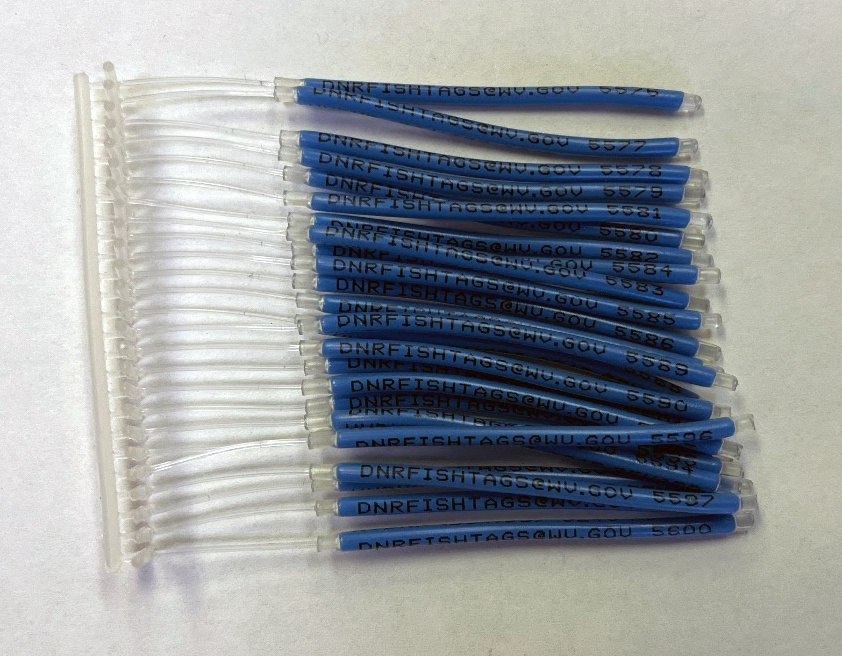
As part of the effort, the state recently released rainbow and golden rainbow trout marked with unique numbered blue tags into waters during fall stockings. Anglers who catch a tagged trout are asked to clip off the tag and report it using the contact information printed thereon.
Brett McMillion, director of the W.Va. Division of Natural Resources in Charleston, said his agency is looking forward to the help of anglers in the process.
“We appreciate our anglers and their cooperation in this important research,” McMillion said. “Anglers who report tagged trout contribute to the science that helps us improve how we manage and stock trout across West Virginia.”
Anglers may keep or release the fish after removing the tag. If a fish has more than one tag, all tags should be removed and reported to the authorities.
To assist with data collection, division biologists are asking anglers to provide the following information when reporting a tagged fish:
- Tag number
- Location and date of catch
- Whether the fish was harvested or released
- Contact information for sending the reward
All anglers 15 years old and older must have a valid West Virginia fishing license and a form of identification while fishing. Anglers fishing for trout are also required to have a trout stamp. Fishing licenses and stamps can be purchased online at WVFish.com, where anglers can also upgrade their annual license with a collectible license card.
Tag reports can be submitted by email to dnrfishtags@wv.gov or by calling 304-637-0245. Participants in the study will receive a gift card valued up to $100.
Trout in West Virginia
Trout are cold-water fish that play a vital ecological and cultural role in West Virginia’s highland environments. The state supports three primary species—the native brook (Salvelinus fontinalis), as well as two non-native but widely established species: the rainbow (Oncorhynchus mykiss) and brown (Salmo trutta). Brook is the only species native to the Appalachian region and is often regarded as a biological indicator of pristine water quality.

Brook trout inhabit small, shaded headwater streams where water temperatures rarely exceed 65°F and dissolved oxygen levels remain high. These fish depend on coarse gravel beds for spawning and clear, well-oxygenated flows for survival.
Their presence typically signifies stable watersheds with intact forest cover and minimal human disturbance. Genetic studies have shown that many of West Virginia’s brook trout populations are isolated remnants of postglacial colonization, making them of significant conservation interest.
Rainbow and brown species were introduced to West Virginia in the late nineteenth and early twentieth centuries to expand recreational fishing opportunities and now occupy a variety of cold-water streams and rivers. While both species have naturalized, they can outcompete native brookies for food and spawning habitat.
Environmental pressures, including acid rain, rising stream temperatures, and land-use changes, have reduced the range of native brook trout to an estimated 500 miles of streams, primarily in the Allegheny Highlands.
Restoration initiatives by the state and partner organizations focus on improving stream habitat, restoring riparian vegetation, and mitigating water chemistry imbalances through liming projects.
The species remains an important part of West Virginia’s aquatic biodiversity, serving as an indicator of ecosystem health and as an emblematic species of the state’s cool, high-elevation mountain waters.
Trout fishing in West Virginia
West Virginia has earned a strong reputation as a top destination for angling thanks to its extensive network of cold, clear streams, active stocking programs, and accessible wild habitats. The state regularly stocks more than 40,000 pounds in about 40 lakes and streams each fall, bolstering both stocked fisheries and angler interest.
Meanwhile, many streams such as the Elk and Cranberry rivers are celebrated as quality wild and stocked waters. The state’s combination of rugged backcountry access, scenic mountain settings, and strong fisheries management attracts fly-fishing enthusiasts, families, and newcomers alike, making trout fishing an integral part of West Virginia’s outdoor tourism appeal.
Sign up to receive a FREE copy of West Virginia Explorer Magazine in your email weekly. Sign me up!


CHARLESTON, W.Va. — The West Virginia International Yeager Airport director is getting a pay raise.
The Central West Virginia Regional Airport Authority board approved a four-percent increase for Dominique Ranieri for Fiscal Year 2026 during their meeting Wednesday. Ranieri will also receive an additional four-percent salary increase for Fiscal Year 2027. Ranieri entered into a five-year contract in December 2023 with a $237,000 annual base salary, and the raises add on to that.
The 2026 increase will be paid as a lump sum before the end of the fiscal year — which is June 30.
Airport authority chairman Todd Goldman praised Ranieri for her work. The board discussed the compensation adjustment in Executive Session during Wednesday’s meeting and announced the raise afterward.
“A lot of it is the work that she’s performed, and the grant funding that she’s secured,” Goldman said. “As well as the team that she’s assembled up at Yeager, and their ability to execute plans, which has put us in a favorable position with the FAA (Federal Aviation Administration). You’ll see a lot of construction up there, and most of that work is due to the work that they’ve put together with her being an obvious, strong leader.”
Ranieri has served as airport director and CEO since 2022. With her appointment, she became the first woman to lead the West Virginia International Yeager Airport. She previously worked as assistant airport director at Yeager for several years and has worked at CRW since 2017.
The Yeager Airport is in the midst of lengthy renovation projects called “CRW Next.” Ranieri has overseen those projects as they progress, including last year’s first phase that added a second baggage belt and updated lobby restrooms.

CRW Next is currently in its second phase, focusing on pre-security areas such as curbside improvements, new flooring, new lighting, and new ticket counts.
Goldman said he and the board have full faith in Ranieri to steer the ship through it all.
“One hundred percent confidence,” Goldman said. “She’s a very strong leader, she’s attuned to every piece of these projects, has excellent people that work with her, and so we have complete confidence in her ability to execute all those plans.”
Finances
The board heard positive news about airport revenues and expenses during the meeting. Board vice-chairperson Lisa Pack reported revenue in May 2026 was up $94,000 compared to last May. She said expenses were increased around $30,000 as well, but the net income was around $64,000 for the month.
Additionally, the first eleven months of Fiscal Year 2026 saw a $322,000 increase from budgeted revenue to the amount actually taken in by the airport, a 2.5-percent increase. Pack noted that the airport’s revenues have increased by $910,000 compared to last year at this time.
Yeager Airport had budgeted $1.9 million for its total operating net income. Pack said the airport ended up taking in $3.175 million, a 60-percent increase from the anticipated figure.
Ranieri said it’s great to hear the positive financial numbers, to have revenues up and costs down.
“That is our mission here at the airport,” Ranieri said. “Everything we do is so that we can afford to do the capital improvement projects that this airport needs. So, every decision we make, every penny that we spend, is shown to our board and is open to the public, and it is so that we are prepared to carry forward CRW next and to be ready for the future of aviation here in West Virginia.”
Equipment facility project
The board also approved the awarding of a $5.75 million construction bid to the Morgantown-based March-Westin Company on a Snow Removal Equipment (SRE) building. The bid is subject to FAA approval. The new building will be located across the Marshall University Bill Noe Flight School.
Ranieri said the current maintenance storage area is overflowing and no longer meets the airport’s needs. Construction could begin on the SRE building this winter or next spring, with the goal of having it ready for Winter 2027.
Advertising partnership
Ranieri announced a new five-year advertising agreement with the Marshall University Lewis College of Business during the meeting. She noted that five years was unusual — the typical length would be a year — but there’s a substantial investment from the College of Business into an LED display. The college will give $20,000 up front and pay the remainder of the $70,968 in installments.
“They are advertising some new (MBA) degree programs that they are going to be starting through that college,” Ranieri explained. “So, very exciting and they know that the folks that they want to target for those degree programs are our passengers here at CRW. So, you will be able to see what’s going on with that college of business and we hope it attracts a lot of new students.”
Ranieri said the display will be located across from the B1 gate area at Yeager.
Global Entry Event
Yeager Airport Chief Marketing Officer Paige Withrow said there’s a Global Entry event coming up in August. The event was originally scheduled with Customs and Border Patrol several months ago but had to be rescheduled because of the federal homeland security shutdown.
Global Entry is a program that speeds up international clearance for passengers. It costs $120 per person and also offers TSA Precheck to travelers.
“If you need Global Entry, it’s very useful when you are traveling internationally,” Withrow said. “Please make sure to sign up for those appointments because they are hard to get. So, this is great for our community to be able to go and grab some of those appointments right here at home.”
Workers’ compensation
The Encova Workers’ Compensation Insurance costs for 2027 were down $5,066 from previous years. The board renewed the insurance for next year on Wednesday. Ranieri said they’ve done more staff training on workplace safety, in partnership with Encova, which has helped reduce the policy premiums.

The Inter-Mountain photo by Joe Blankenship
Clans march during the fourth annual West Virginia Wild and Wonderful Celtic Festival and Highland Games at 4-H Camp Pioneer Saturday.
The Inter-Mountain photo by Joe Blankenship
A bald eagle was on display during the fourth annual West Virginia Wild and Wonderful Celtic Festival and Highland Games at 4-H Camp Pioneer Saturday.
The Inter-Mountain photo by Joe Blankenship
A mythical creature turned up for the fourth annual West Virginia Wild and Wonderful Celtic Festival and Highland Games at 4-H Camp Pioneer Saturday.
The Inter-Mountain photo by Joe Blankenship
A bull was among the livestock on display during the fourth annual West Virginia Wild and Wonderful Celtic Festival and Highland Games at 4-H Camp Pioneer Saturday.
The Inter-Mountain photo by Joe Blankenship
Clans march during the fourth annual West Virginia Wild and Wonderful Celtic Festival and Highland Games at 4-H Camp Pioneer Saturday.
-
The Inter-Mountain photo by Joe Blankenship
Clans march during the fourth annual West Virginia Wild and Wonderful Celtic Festival and Highland Games at 4-H Camp Pioneer Saturday.
-

-
The Inter-Mountain photo by Joe Blankenship
A bald eagle was on display during the fourth annual West Virginia Wild and Wonderful Celtic Festival and Highland Games at 4-H Camp Pioneer Saturday.
-
-
The Inter-Mountain photo by Joe Blankenship
A mythical creature turned up for the fourth annual West Virginia Wild and Wonderful Celtic Festival and Highland Games at 4-H Camp Pioneer Saturday.
-
-
The Inter-Mountain photo by Joe Blankenship
A bull was among the livestock on display during the fourth annual West Virginia Wild and Wonderful Celtic Festival and Highland Games at 4-H Camp Pioneer Saturday.

Community Bulletin
Fred W. Eberle Technical Center in Buckhannon is enrolling students in its commercial driver’s license (CDL) training program, an accelerated course that can be completed in five to seven weeks. Both daytime and limited evening sessions are available. Read more →
This story brought to you paywall-free, courtesy of the My Buckhannon team and our community partners
CHARLESTON, W.Va. — The West Virginia Division of Natural Resources announced that it is accepting applications for a controlled waterfowl hunt, scheduled to take place October 3-11 at McClintic Wildlife Management Area near Point Pleasant in Mason County.
Waterfowl hunters who wish to participate must submit their application by 11:59 p.m. August 14 at WVhunt.com. Successful applicants will be notified by mail by the second week of September.
“Controlled hunts like this are an important part of our mission to manage wildlife resources responsibly, while also giving hunters access to high-quality hunting experiences,” said WVDNR Director Brett McMillion.
The event allows hunters to hunt from a shooting station in a controlled waterfowl hunting zone at McClintic WMA during the October split of the waterfowl season. Hunters who are successful in the lottery draw are assigned an area free of charge and are permitted to bring one guest. A shooting station is also available for hunters who have a disability.
Hunters successful in the draw will be randomly assigned a day to hunt. They must report to the McClintic WMA office prior to 6 a.m. that day. Applicants not selected may come to the McClintic office on the morning of each day’s hunt to sign up for an opportunity to hunt shooting stations not filled by selected hunters.
For more information, consult the West Virginia Migratory Bird Hunting Regulations, which will be available online at WVdnr.gov and at WVDNR offices by the end of August.
-

 Iowa7 minutes ago
Iowa one of nine states that won’t have to match portion of federal SNAP benefits
-

 Kansas9 minutes ago
Body believed to be Kansas City highway shooting suspect found in burned home’s basement by family: police
-

 Kentucky15 minutes ago
Kentucky’s Otega Oweh headed to Thunder in 2026 NBA Draft trade
-

 Louisiana22 minutes ago
GOP candidates trade attacks, differ on carbon capture in Louisiana Senate race
-

 Maine25 minutes ago
Hearts of Pine halt 4-game skid with emphatic win
-

 Maryland29 minutes ago
Republican candidates ask judge to block Maryland primary certification
-

 Michigan37 minutes ago
Michigan heatwave on way. See day likely to set a record high
-

 Massachusetts39 minutes ago
Massachusetts man accused of wanting sex with girl busted in World Cup trafficking operation

