West Virginia
At a cemetery in West Virginia, a massive landslide wiped out more than a hundred headstones. What happens next isn’t clear.


WHEELING, W.Va. — The thick, brown swath of mud and debris cut starkly across the neatly trimmed green hillside.
Days of rain last week pushed creeks and streams over their banks, but it thoroughly saturated the ground, too. And eventually the steep incline along Fairmont Avenue in Wheeling let loose, sending hunks of hillside and mud downward.
The mass came to rest at the bottom of the steep hill, a couple of dozen yards from a small stream and rusty guardrail that separate the Wheeling Mt. Zion Cemetery from the two-lane road.
Among the tangled mess of trees and dirt piled at the bottom: the flat edges and rounded corners of headstones.
When the slope collapsed, it rolled over some 150 of them, dragging and pushing the grave markers down the hill with the chunks of earth.
Charles Yocke points out that if you look closely, green grass can be seen beneath the muddy path of the slide. That’s good, he said — it means the debris slid down the hill rather than cutting through it. The vaults beneath the headstones, then, likely are undisturbed.
Yocke is president of the Wheeling Mt. Zion Cemetery Corp., a group he and a few other volunteers formed nearly a decade ago to take care of the centuries-old cemetery. Through donations and burial fees — burials that Yocke does himself — the group maintains the landscaping and other upkeep.
The call came Wednesday morning.
On Saturday, he pointed to the top of the hillside overlooking the cemetery. See that house? Across the street from that is where Yocke’s friend from school lives.
“He called (Wednesday) at 7:30 a.m. and said, ‘Yock’ — because he knows I take care of it — he said, ‘Yock, you got a mudslide up here, you’ve got a big problem.”
The slide had started at the top of the hill and split into a pair of smaller paths at the base of a massive pine tree. He saw the smaller of the two sides first.
“I seen that side and said, ‘Oh, (expletive),’” he said. “I couldn’t believe it.”
He pulled around to the main gate of the cemetery, rain still falling hard against the roof of his truck.
“And I looked at it and thought, ‘What the hell are we gonna do?’ And for a grown man, how much time I’ve put into this — I started crying.”
He’s still in disbelief Saturday as he takes in the sight from across the road.
“I’ve seen so many slips,” he says, his voice trailing off.
‘It’s hard to think about’
Melissa Miller and her mother usually visit Wheeling Mt. Zion a few times a year. Miller lives in Columbus, Ohio, but she was raised in Wheeling. Her grandparents and great-grandparents are buried there, and so is an aunt and a nephew who died at birth. When they visit, they take care of the area around the graves, and they sit and talk with their late family members.
On Saturday, they came to assess the damage.
“Where it stopped, they’re right beneath it,” Miller said of the graves of her grandparents and great-grandparents. “If it continued to slide, they could have been more impacted, but thank goodness they’re at the bottom.”
Her aunt’s grave, though, was farther up the hill, she said, right in the path of the slide.
“We’re heartbroken over my aunt being … in that,” she said, gesturing toward the jumble of earth.
She said it’s a helpless feeling because, for safety reasons, no one is permitted in the cemetery right now. Yocke and Stein, on the advice of the fire department, put up no-trespassing signs. On Facebook, they warned: Stay out of the cemetery.
As Miller and her mother stood at the guardrail and looked at the mess, a man walked his dogs onto the property from the other side. From his spot across the road, Yocke yelled at the white-haired man to get out.
The man shouted back that he was looking for his uncle. Yocke told him to get out for his own safety.
“I’m not trying to be ignorant,” Yocke said. “It’s not safe. He’s pointing at me. I should go talk to him.”
He approached the would-be trespasser, who choked back emotion.
“It’s hard to think about,” he told Yocke.
As Yocke explained that the hillside hadn’t been stabilized, the man cut in: “I’m 70, I don’t care.”
“I’m not trying to give you a hard time,” Yocke said. “We don’t want nobody killed.”
Going to rest in a good place
Yocke lives near the cemetery on the same road, and his wife’s parents are buried a good distance up the hillside. It was Mother’s Day in 2015, he said, and the grass across the graveyard was three feet tall. He had to cut a path for his wife to place flowers at her mother’s grave.
“I went home that night and I just thought, ‘This is bull (expletive),’” he said.
The cemetery was owned by Ohio County, and commissioners said they wouldn’t spend taxpayer money for upkeep.
“What were these people?” he asked, gesturing toward the cemetery. “Taxpayers. They paid their taxes.”
So he and Fairmont Avenue neighbor Paula Stein began cutting grass and trimming the weeds around the headstones. Eventually, they formed the Wheeling Mt. Zion Cemetery Corp. They started a Facebook page to collect donations to pay for gas for the mowers and weed-cutters.
They put up an American flag at the main gate. There are about 400 veterans — some from as far back as the Civil War — buried in Wheeling Mt. Zion. Each and every one of those graves is marked with a small flag.
“They say you’re only supposed to do it at certain times, but the way I look at it, and the way Paula looks at it, is those guys went out and fought for us 365 days a year,” he said. “They should have a flag 365 days a year.”
The number of volunteers has ebbed and flowed over the years, and at this point, Yocke said, the work falls mainly to himself and Stein, whose parents are buried there.
It has been a labor of love, he said, and it’s taken a toll. He’s a contractor by day, and his knees have gone bad and his right shoulder is no good.
He’s not sure what will happen once he and Stein can’t take care of the cemetery anymore.
“We think about it all the time,” he said.
A man slows his sedan to a stop in front of Yocke near the cemetery, not bothering to pull off the road. Yocke tells him he’s doing an interview. The man jokes that he better tell the truth.
“I’ll lie and go to confession tomorrow,” he shouts back.
“I’ll just give you 10 Hail Marys and three Our Fathers now,” the man said. He’s not a pastor, just a mayoral candidate, Yocke says. He’s done contracting work on the man’s house in the past
There are hundreds of graves across the property, and a handful of people are still buried there each year, usually in family plots. Yocke takes care of the burials himself. He charges $750 to bury an urn and $1,150 for a traditional burial. He lines up the date and time and has a man he knows dig the hole with an excavator. He invites the family to add a shovelful of dirt to the hole.
“I think that’s what keeps on making me stay,” he said. “Because when I do a burial, the family is sad, but they see (their loved one is) going to rest in a good place.”
The money from the burials goes toward upkeep. Just last year he paid $5,000 to have a fallen tree limb cut up and hauled away.
There have already been myriad offers of help with the cleanup from the mudslide last week, Yocke said, including from state politicians.
“Everybody’s got a lot of talk,” he said, noting that it’s an election year. He hopes that means that those offers of assistance from higher up will come to fruition.
Other offers of help also pour in. Friends with small excavators have told Yocke they’re ready and willing, and many have offered to come armed with shovels.
“This ain’t no shovel job,” he said.
The mailman pulls over about 11 a.m. Saturday, stopping to chat and hand over the cemetery corporation’s mail.
“One, two, three …” Yocke counts the small envelopes, most covered in cursive scrawl. There are six of them — six donations that people have sent to help.
Recovering from the devastation will be a process.
The first thing will be to stabilize the hillside. Engineers who work with drilling companies are coming to look things over Monday, Yocke said. The hope is they’ll be able to do some of that work for free.
The tougher part will be sifting through the debris to see what’s a rock and what’s a headstone. Each headstone will have to be pulled out and cleaned, meaning they’ll all likely need to be hauled to another part of the cemetery for evaluation.
They might have to bring in someone to use x-ray machines to figure out where the vaults are. But then they have to make sure they know who is in the vault. There are lots of photos of the hillside, he said, and he’s familiar with where most of the graves were since he was the one cutting the grass for years. On Facebook, followers were already offering up historical maps of the cemetery.
“The most delicate part is putting the stones right back on the same spot,” he said. “I think that’s going to be the biggest part.”
He said a lot of people have been aggressive toward them on the corporation’s Facebook page. They want to know whether their loved one’s headstone was affected. Yocke said he has to tell them that’s something that has to be set aside until the hillside is stable.
Some have accused Yocke and Stein and other volunteers of causing the landslide.
“You’ve gotta blame somebody,” he mused. “But I think you better blame Mother Nature.”
She can be cruel.
“We put all that sweat and tears in,” he said, “and one day Mother Nature takes it away from you.”

West Virginia
Secretary of State maintains West Virginia’s elections are “safe, secure” after Trump claims – WV MetroNews

CHARLESTON, W.Va. — West Virginia’s Secretary of State maintains that elections in the Mountain State are secure after voter information corruption claims by President Donald Trump.
Secretary of State Kris Warner joined MetroNews “Talkline” Friday to unpack claims by President Trump that voter information for over 200 million Americans had been compromised by China, starting in the 2020 election. Trump addressed the nation Thursday night and said 18 states had experienced corruption by the Chinese government in regard to voter data.
“Our elections are safe, secure, fair, and honest,” Warner said. “We have 55 county clerks and about 8,500 poll workers that did a phenomenal job in the Primary Election, and we’re ready, less than four months away to conduct a general midterm election. So, there’s confidence in our elections and we’re very proud of that.”
Warner said his office has not heard from federal officials.
“I know the President mentioned 18 states, but West Virginia’s not been contacted by the White House, by anyone in the intelligence community; nobody from FBI, CIA, DNI (Director of National Intelligence), or any other federal agency alerting us to any real or existing threat for our upcoming election,” he said.
If the White House or other officials reach out to the Secretary of State’s office with “actionable intelligence,” Warner said the election division will investigate it. Warner praised his office, saying that other states consider West Virginia as a gold standard for election safety,
“People from all over the country look to us,” Warner said. “So, obviously, anything that comes our way that we can act on, we want to increase our election security even further. But until then, we’re going to stay the course.”
West Virginia’s elections are quite secure, Warner emphasized, because the state uses ballot-marking devices. He said that not only are ballots marked electronically, but those votes are also noted on paper.
“Every vote in West Virginia cast is backed up by a paper ballot,” Warner said. “You get to see that paper ballot and make sure that it is exactly who you intended to vote for.”
Because of this commitment to security, Warner said, the election officers in West Virginia will catch anything out of the ordinary. He said his office tracks previous elections and understands the typical numbers of who votes in each precinct. Additionally, he said that 10 days after the election, an audit occurs to confirm results through hand counting.
West Virginia has also been one of the states targeted by the U.S. Department of Justice over disclosure of voter information. A federal judge tossed out a DOJ lawsuit against West Virginia earlier this week over voter data.
Warner said Trump’s claim doesn’t change West Virginia’s stance on refusing to hand over voter information to the DOJ.
“West Virginia law says I’m not to share personal information — that’s social security numbers, driver’s license numbers, tied to birth dates, in some cases, cell phone numbers, email addresses, your home address,” Warner said. “Again, there would need to be actionable intelligence that is going to strengthen our election security before we do anything further.”
While he said he agrees with the mission — keeping people outside of the law from voting — but this isn’t the way to do it. Warner said voter information is personal, and it doesn’t need to be “floating around to vendors” in the nation’s capital, Washington, D.C.

WEST VIRGINIA (WCHS) — On Wednesday, Gov. Patrick Morrisey announced a statewide plan to review every bridge in the state.
Bumpy roads and crumbling bridges are something drivers in West Virginia like Molly Darby are all too familiar with.
“We just bought a newer car and we actually got to take out additional insurance just for the tires, because you worry about that,” Darby said. “You worry about the popping and that can be a huge added expense to a lot of other people.”
About 19% of the state’s 7,300 bridges were deemed to be in poor condition in the 2025 infrastructure report card.
“We have DOT conducting a comprehensive review of all the bridges across West Virginia,” Morrisey said. “We have to be proactive. We have to stay ahead of maintenance and never let our state fall behind.”
Transportation Secretary Todd Rumbaugh said his team at the DOT is working to lower the number of problem bridges that effect every corner of the state.
“We are doing a comprehensive review of all of our bridges,” Rumbaugh said. “We’ve been going through making priorities and we currently have our statewide transportation improvement plan out there for public comment.”
One massive step being taken on the infrastructure front is the nearly $75 million bridge deck replacement on the Fort Hill Bridge in Charleston, one of the most traveled bridges in the state.
“This rehab project represents a once in a generational investment in our economic corridor,” Rumbaugh said. “It’s about much more than concrete, structural steel and orange barrels. It’s about safety reliability and planning for the next 50 years.”
West Virginia
Repair work on busiest bridge in West Virginia to happen in phases to “minimize disruptions”

CHARLESTON, W.Va. — Traffic in the Capital City will soon have to adjust as the busiest bridge in West Virginia draws closer to undergoing a rehabilitation project.
The West Virginia Division of Highways recently awarded a $74.5 million contract for the rehabilitation of the Eugene A. Carter Bridge to Triton Construction. The bridge, also known as the Fort Hill Bridge, is located in the Capital City and carries Interstate-64 over the Kanawha River.
Around 100,000 vehicles travel across the bridge each day.
Gov. Patrick Morrisey joined state and local officials Thursday at Magic Island to officially announce the contract awarding. DOH officials have told MetroNews that crews will build two median crossovers this August, with the majority of that construction taking place at night and on weekends to minimize its impact on traffic. Official repair work is expected to begin in early 2027, with an anticipated conclusion next December.
DOH officials said everything should be “back to normal” by Spring 2028 under the current timeline.
Del. J.B. Akers, R-Kanawha, was on hand for the news conference. He emphasized that motorists will have to be flexible with their routes.
“We’ll have a little bit of an inconvenience while that’s going on,” Akers said. “This is going to be a huge project that impacts traffic from all over the East Coast, really.”
Issues have popped up at the Carter Bridge in recent years. The state DOH made emergency repairs to fix potholes that had popped up last summer, causing traffic delays. Triton Construction also repaired concrete, installed a waterproof membrane, and added a 2-inch layer of asphalt last October.
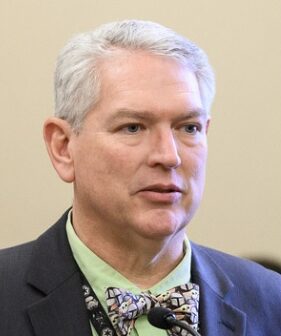
Minimizing the impact on motorists during this project has been a top priority, according to state Transportation Secretary Todd Rumbaugh.
“Our team at the Department of Transportation has worked tirelessly to phase this construction, so we minimize the disruptions on your daily commute and your businesses,” Rumbaugh said.
DOH officials said crews will work on one side of the bridge first, then crews will shift traffic and begin work on the other side. Motorists can stay up to date on the project by visiting the Division of Highways website to see the anticipated construction schedule.
Akers commended Morrisey and Rumbaugh for taking action now.
“For doing the hard thing, on a project like this, which is a maintenance and repair project,” Akers said. “They’re not kicking the can down the road for some other administration to deal with. They’re dealing with a major issue, right now, and this will be a generational project for this bridge. It’s going to prevent us from having to deal with this in the future.”
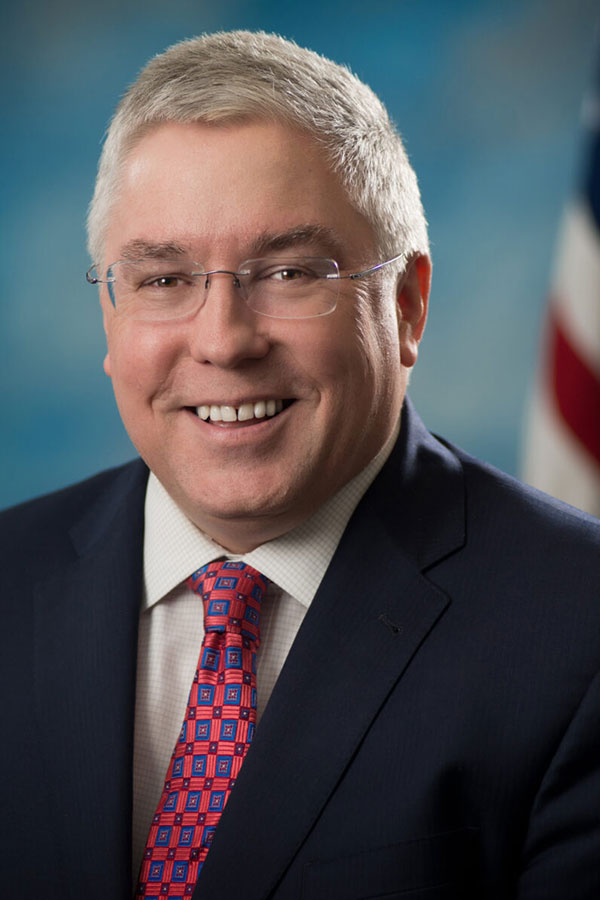
The governor mentioned the state had previously been given poor grades by national surveys on bridge safety. He said his administration is committed to improving bridges all across the state, starting with the heavily trafficked bridge in Charleston.
“This is a signal that we take bridge repair work very seriously,” Morrisey said. “When we inherit being an ‘F’ in bridges, I do not want that to be the case. We need safe bridges for our people, and I’m going to keep working every day to make sure that happens.”
Morrisey said in his year and a half as governor, the administration has been focused on “getting back to the fundamentals.”
“Site-selection and remediation, speed to build; cutting red tape faster, that’s what’s why I’m so excited about our one-stop shop permitting. (That’s) going to make things go even faster, and responsibly.”
Those efforts have been paying off, Morrisey said.
“When you have that kind of economic growth, that level of construction, it’s particularly important to make sure that your infrastructure is strong,” Morrisey said. “That’s really why we’re here today.”
Rumbaugh said the investment signals a commitment to the future of the Mountain State and its travelers.
“This rehab project represents a once-in-a-generation investment in our economic corridor,” Rumbaugh said. “It’s about much more than concrete, structural steels, and orange barrels. It’s about safety, reliability, and planning for the next 50 years.”
-

 Los Angeles, Ca43 minutes ago
‘Moana’ is a triumph for Pacific Islander representation on the big screen
-

 Detroit, MI1 hour ago
Five shot during funeral at Detroit church
-

 San Francisco, CA1 hour ago
San Francisco Giants Announce Intriguing Roster Move Ahead of Mariners Series
-

 Dallas, TX1 hour ago
Dallas seafood wholesaler fined $250K for false salmon labeling
-

 Miami, FL2 hours ago
Absolutely Not: Florida woman’s “suggestive” license plate goes viral
-

 Boston, MA2 hours ago
Ariana Grande fan gets better tickets to TD Garden concert in Boston after resolving StubHub issue
-

 Denver, CO2 hours ago
Mitchell Fraboni will be the Bronco long snapper in 2026
-

 Seattle, WA2 hours ago
Seattle real estate owner sentenced to prison for $4.7 million tax evasion scheme – MyNorthwest.com

