Washington, D.C
William Simons of Albi is The MICHELIN Guide Washington, D.C. 2024 Sommelier Award Winner


Congratulations to William Simons of One MICHELIN Star Albi, MICHELIN Guide Washington, D.C. 2024 Sommelier of the Year winner, presented in partnership with Franciacorta!
Meaning “my heart” in Arabic, Albi is inspired by heartfelt flavors originally cooked by Chef Michael Rafidi‘s grandparents, who immigrated to the U.S. from Palestine. Brilliantly complementing the hearth-fired cuisine, Advanced Sommelier (CMS) William Simons serves as the restaurant’s wine director, overseeing a selection filled with fantastic gems.
In his role, Simons balances a sense of education and fun. The menu is sprinkled with historical anecdotes like early winemaking in Armenia, as well as wine quotes from people like Freddie Mercury. He tells guests, “Sauvignon Blanc can be a bit like George Clooney when he was on The Facts of Life, and he was gawky and awkward. But when we blend it with sémillon, now you’re dealing with George Clooney from Oceans Eleven.”
We spoke with him to learn more about his wine list and his own wine journey.
Join our community of travelers and food lovers! Create a free account to enjoy personalized recommendations, exclusive hotel rates, and the chance to share your feedback with our Inspectors!
How were you introduced to the world of wine?
My joking answer is that I read too much Jack Kerouac in high school. Despite reading about traveling hobos, I didn’t drink any wine until I was 18. The first wine I had was Beringer White Zinfandel. Nowhere to go but upward from there.
I was working in restaurants. I developed a reputation among my friends as the guy that knew about wine, but I felt I had a significant degree of imposter syndrome, which drove me to reading. I got hooked on the confluence of place and culture and history, and it grew from there.
A lot of reading and working in restaurants, and then I got thrown into the deep end at a pretty serious wine shop in New York. In retail, you get to taste more broadly than you do in most restaurants, because you have to try to be all things to all people.
Albi has a reasonably large wine list at around 300 bottles, but in a retail shop, that would be tiny. There’s a lot of exposure that comes along with that. I worked in wine retail for years. I made the move back to restaurants and started working the floor as a sommelier and pursuing some certifications, because I moved cities and my resume didn’t mean all that much.

Rey Lopez / Smoked & Infused
Could you tell us more about your wine list at Albi?
We have a global wine list that disproportionately favors wines that feature notable textures and acidity, smokiness to complement things off of the hearth.
We certainly list Lebanese, Palestinian, Cypriot, and some Syrian wines. But we don’t focus on those exclusively. We say, what are the flavors that make sense with this cuisine? What are the textures that make sense with this cuisine?
In some ways, we have a lot of liberty. If a person goes to a French or Italian restaurant, they tend to have a solid understanding of what they’re going to drink. Here, people walk through the door without any real preconceived idea of what they should be drinking, because it’s not a cuisine that they’re used to thinking of with wine.
In the Arabic-speaking world, you have a period of roughly 400 years of de facto prohibition under the Ottomans, and winemaking continued as a personal endeavor. People could make wine for their own consumption, but as an industry, it basically ceased to exist.
As the industry returned, it was largely under the tutelage of the French, so the wine culture that evolved was largely geared toward a French palate and arguably not geared toward the cuisine of the region. This is one of the areas where vitis vinifera originated and certainly where it proliferated under the time of the Phoenicians, yet a disproportionate number of wines are French varieties imported in the late 1800s and early 1900s – cabernet sauvignon, merlot, syrah, sauvignon blanc, and chardonnay.
We offer wines from all different producers in Lebanon (where the most are able to be found) of the old guard French varieties and Bordeaux styles, as well as the new guard. [For the new guard], there are winemakers in the region asking, what does an authentic Lebanese wine look like without French influence? Older winemaking techniques like amphora, indigenous varieties.
Rey Lopez / Mersel & Co
Do we see sustainability on your wine menu?
Pretty much exclusively. I shy away from using the word natural for Albi’s wine list in particular, for a lot of reasons.
One is that it just doesn’t mean anything. When the conversation around natural wine got started, the main focus was on the idea that producers cared about the land, that they took a multigenerational view of their obligation to place. They were stewards of the Earth. Certainly, all of the producers that we have on the list at Albi adhere to that idea. They’re mostly family-owned, mostly smaller operations. An overwhelming majority farm organically, whether they’re certified or not.
How has your taste in wine changed over time?
The things that I look for in wine have been largely consistent over time. I favor acidity and freshness and elegance over power.
I had a brief dalliance with big, high-octane wines, just because when I was exposed to them, I had never tasted anything like them before, and so I was fascinated by them. But then, personally, I find them a little bit exhausting. It’s a chore to try and drink a wine that’s fighting you with alcohol and tannin. So, freshness and elegance and a sense of place have always been things that I’ve looked for.
Once I started to get really interested in wine, Burgundy was the first place that really spoke to me. The combination of complexity and simplicity that it has in that it’s “just two grape varieties.” There’s still this incredible variation within it.
Rey Lopez / Philokalia
What’s the biggest misconception about being a sommelier, or wine in general?
People don’t know just how much time you spend in front of an Excel spreadsheet. I love inventory, cataloging, counting bottles, digging into spreadsheets, and organizing things. But at the same time, we do get to taste wine and talk about wine and pursue what we’re passionate about.
The misconception I worry about most is trust. We talk about servers and captains being guest advocates, but there often is a perception that sommeliers are just there to make the sale. Any good sommelier should be interested first and foremost in pairing wine to the guest at the table and developing that trust in that relationship with the guest.
What advice would you give to someone who wants to be in a position like yours?
Take your time. I came into working in wine before the Somm craze and before the documentaries that made the certifications household names.
For me, taking my time was something that was viable because it was the older model of the industry, where it was based a little bit more on the idea of an apprenticeship. In the kitchen you still see it. You don’t take a test that says you’re a sous chef. They have to work their way into the role.
Chart your own path, whatever that is. Find a place that works and make it your own, or don’t. Move around, gain experience, work other places while you’re young and still can. There’s a lot of different avenues to get there.
Hero image: Hawkeye Johnson / William Simons
Alain Ducasse and Daniel Humm chat life, what they think of each other’s cuisine, and the future of fine dining.



Among the liquor store, barber shop and dry cleaners at the Watergate Complex’s retail plaza, there is a new pop-up museum dedicated to the scene of the crime that toppled Richard Nixon’s presidency.
Among the liquor store, barber shop and dry cleaners at the Watergate Complex’s retail plaza, there is a new pop-up museum dedicated to the scene of the crime that toppled Richard Nixon’s presidency.
The temporary exhibit features the work of artist Laurie Munn — portraits of members of the Nixon administration and those connected to the Watergate break-in. The exhibit features members of Congress, the media and some who were on Nixon’s enemies list.
Keith Krom, chair of the Board of Directors of the Watergate Museum, told WTOP the exhibit was first featured in the gallery in 2012 for the 40th anniversary of the break-in at the Democratic National Committee.
“When she (Munn) learned about our museum effort, she offered to reassemble them as a way for us to expand awareness of the museum,” Krom said.
Krom, who lives in the Watergate, said his favorite portrait is of one of the special prosecutors, whose firing sparked the “Saturday Night Massacre” in 1973.
“I had the pleasure of being a student of Archibald Cox,” Krom said. “He served as my mentor for my third-year writing project.”
Krom said during this time, at the Boston University School of Law, he spent a great deal of time with him.
“I didn’t realize how much he must have gone through. Here he was, this one man, who was challenging the president of the United States over something pretty serious,” Krom said.
The pop-up opened in October and was recently extended to stay open until April 25. Krom said the hope is to find it a permanent location within the Watergate Complex, where they can “present the history of Watergate, but with two perspectives.”
The first would be on the building’s “architectural significance to D.C.,” he said.
“You may not like the design, you actually may hate it,” Krom said. “But you cannot deny that it changed D.C.’s skyline.”
The secondary focus would, of course, be on the mother of all presidential scandals that changed the course of American history.
“That’s where that suffix ‘-gate’ started and continues to be used for almost every scandal that comes out today,” Krom said.
The inspiration for the museum spawned from an interaction from a tourist outside the Watergate.
“He says, ‘This is the Watergate, right?’ And I was like, ‘Yeah, it’s one of the buildings,’” Krom recalled.
The tourist then asked Krom, “So where’s the museum?”
“I was like, ‘Oh, we don’t have a museum.’ And he literally just looked at me and said, ‘That’s so sad.’ And he got on his bike and rode away,” Krom said.
While the self-proclaimed political history nerd said he “still gets goose bumps” when he drives by the Capitol at night, Krom hopes that when people leave the museum, “they’ll walk away with a new appreciation for how our government works, the guardrails that are in place.”
“Maybe an understanding that those guardrails themselves are kind of frail, and they probably need our collective help in making sure they last — that’s what we hope to accomplish,” Krom said.
Get breaking news and daily headlines delivered to your email inbox by signing up here.
© 2026 WTOP. All Rights Reserved. This website is not intended for users located within the European Economic Area.

According to the National Park Service at the National Mall, famous cherry blossoms around the nation’s capital have hit peak bloom conditions. The National Park Service X account for the National Mall proclaimed this morning, “PEAK BLOOM! PEAK BLOOM! PEAK BLOOM!”
It became apparent yesterday that the bloom would be at peak today. “Despite a sunny afternoon and patches of blue sky, the cherry blossoms remain at Stage 5: Puffy White,” the Park Service wrote on X yesterday. Stage 5, “Puffy White”, is the final stage blossoms go through before being in full bloom. They start at Stage 1 as a “Green Bud”, grow into Stage 2 with “Florets Visible”, and then florets become extended at Stage 3. In Stage 4, there is “Peduncle Elongation” which sets the stage for the puffy blossoms to appear in Stage 5. Puffy White and Peak Bloom are defined as when 70% of the blossoms on the trees reach that stage.

Peak bloom varies annually depending on weather conditions; the most likely time to reach peak bloom is between the last week of March and the first week of April. According to the Park Service, extraordinary warm or cool temperatures have resulted in peak bloom as early as March 15 in 1990 and as late as April 18 in 1958.
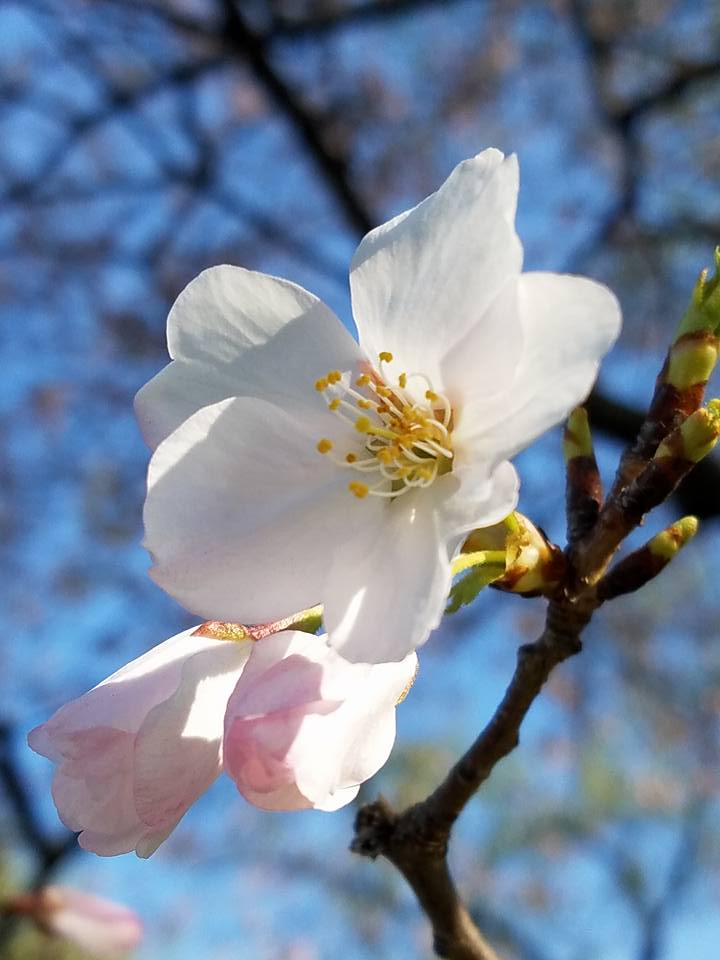
The planting of cherry trees in Washington DC originated in 1912 as a gift of friendship to the People of the United States from the People of Japan. In Japan, the flowering cherry tree, or “Sakura,” is an important flowering plant. The beauty of the cherry blossom is a symbol with rich meaning in Japanese culture.
Dr. David Fairchild, plant explorer and U.S. Department of Agriculture official, imported seventy-five flowering cherry trees and twenty-five single-flowered weeping types from the Yokohama Nursery Company in Japan. After experimenting with growing them on his own property in Maryland, he deemed that the cherry tree would be perfect to plant around the Washington DC area. This triggered an interest by a variety of individuals to plant the tree around Washington. In 1909 the Mayor of Tokyo, Yukio Ozaki, donated 2,000 trees to the United States on behalf of his city. When the trees arrived, they were riddled with disease and insects and to protect other agriculture, they were burned. The Tokyo Mayor made a second donation of trees in 1910, this time amounting to 3,020 trees. This started the forest of cherry trees that now line the Potomac basin around Washington DC. In a gesture of gratitude back to Japan, President Taft sent a gift in 1915 of flowering dogwood trees to the people of Japan. Thousands of trees have been added since, including another gift of 3,800 trees from Japan in 1965.


WASHINGTON (7NEWS) — Authorities are searching for an SUV after an officer with the Metropolitan Police Department (MPD) was struck by a hit-and-run driver in Southwest D.C. on Wednesday night.
The crash happened just before 10 p.m. at Martin Luther King Jr. Avenue and Forrester Street, SW.
Police confirmed the officer, an adult man, was conscious and breathing when he was rushed to a nearby hospital for treatment of his injuries. There is no word on his condition.
The driver involved fled the scene, and investigators are looking for a white Range Rover with a partial South Carolina tag of “403.”
Anyone with information is urged to call 202-727-9099 or text tips at 50411.
This is a developing story that will be updated as more information becomes available.

Two Iowans sentenced to prison for creating child pornography

Will Flory Bidunga Return to Kansas, Enter the NBA Draft, or Transfer?

Kentucky among Southeastern states receiving FEMA disaster recovery funding

Guest Column: Louisiana can only win with a stronger workforce

Ski Maine, Where Skiing’s Main Street Ends

Florida High School Football Rankings: Top 25 teams – Oct. 21

How old is Bo Nix? What to know about Oregon quarterback ahead of 2024 NFL Draft

Cleary's 21 help Le Moyne down Central Connecticut State 69-64 in OT

99th annual Pony Swim held in Virginia

Indiana Members Credit Union announced as new anchor tenant at Bottleworks District

Video: Will ICE Change Under Its New Leader?

DHS shutdown breakthrough comes at cost for Republicans as funding fights nears end

Rubio joins crucial G7 talks as Iran war set to dominate second day

A surprise resignation could open the door for an independent to win a Montana Senate seat

Video: Savannah Guthrie Says She Believes Her Mother Was Taken for Ransom
-

 Detroit, MI1 week ago
Drummer Brian Pastoria, longtime Detroit music advocate, dies at 68
-

 Science1 week ago
How a Melting Glacier in Antarctica Could Affect Tens of Millions Around the Globe
-

 Movie Reviews1 week ago
‘Youth’ Twitter review: Ken Karunaas impresses audiences; Suraj Venjaramoodu adds charm; music wins praise | – The Times of India
-
 Science1 week ago
I had to man up and get a mammogram
-

 Sports6 days ago
IOC addresses execution of 19-year-old Iranian wrestler Saleh Mohammadi
-

 New Mexico5 days ago
Clovis shooting leaves one dead, four injured
-
 Business1 week ago
Disney’s new CEO says his focus is on storytelling and creativity
-

 Texas1 week ago
How to buy Houston vs. Texas A&M 2026 March Madness tickets