Washington, D.C
What I Saw At The Insurrection


I looked everywhere for Mike Johnson at the No Kings rally in the heart of the nation’s Capitol last Saturday. I even wore my Civil Beat press pass so I could ask him questions, one professional to another.
But the House speaker was nowhere to be found. Maybe he took the day off. The government was shut down, of course, and House representatives were on an extended paid recess.
I covered the protest in my role as a journalist and, after a few hours, I wanted to ask Johnson why he’d said the gatherings opposing President Donald Trump were “hate America” rallies. Because all I saw that day were tens of thousands of people of all ages and backgrounds exercising the right to peaceably assemble along with the freedom of speech, press and even religion.
It was, to use the words of Trump about Jan. 6, 2021, a “day of love.”
All that was missing was the right to petition the government for a redress of grievances.
But then, that First Amendment clause was implicit. The D.C. rally, part of an estimated 7 million protesters at more than 2,700 locations in all 50 states and D.C. (according to No Kings), sent a simple message: America does not need a king.
Trump is not a king, but you can be forgiven if you believe he’s acting like one. He wants to mint a commemorative $1 coin with his mug on it. His first foreign visit as president was to a kingdom, Saudi Arabia, and his second was to the United Kingdom. He wants to build an arch, based on the Arc de Triomphe in Paris, across from the Lincoln Memorial — an “Arc de Trump.”
Ed O’Keefe of CBS News reportedly asked the president who the arch is for, and Trump pointed at himself: “Me.”

The purpose of No Kings is to accuse the president of behaving more like a monarch than an elected official, and it is succeeding in that regard.
One of the first speakers at the D.C. rally, Democratic Sen. Chris Murphy of Connecticut, reminded the huge throng that his state was the first to adopt a written constitution, thus rejecting the English monarchy. The nation, he said, was not “on the verge” of an authoritarian, totalitarian takeover but smack dab in the middle of one.
Murphy then asked rhetorically if that scared people.
“You can handle the truth,” he said, answering his own question and thrilling the crowd.
‘Jesus Was An Immigrant’
I was in D.C. to attend the Society of Professional Journalists MediaFest 2025. I cut out a bit early on Saturday to make my way toward the location of the No Kings rally at Pennsylvania Avenue Northwest and 3rd Street Northwest, an area astride The Mall and not far from the U.S. Capitol.
My CB colleague in D.C., Nick Grube, had shared with me beforehand advice from the National Press Club on reporting in potentially dangerous environments: “If protesters want to shout in your face, don’t get into arguments with them. If police ask you to step back, do not just take one step and look defiant. Ask them how far back to go.”
Nick also advised that I write his phone number on my arm in case I needed to post bail.

It wasn’t necessary.
My first encounter with security on No Kings day came well before I got to the rally site. Dozens of Metropolitan police, on foot and bicycles, were paralleling a large group of protesters as they marched and chanted toward Pennsylvania Avenues.
“Excuse me,” one officer politely said as he pedaled by me.
“Sorry,” said another.
Then, as the marchers were to turn on to 10th Street, someone fell. The procession halted and the police asked everyone not in the march to clear the street by moving to the sidewalks. Everyone complied as the police surrounded the injured man and someone called an ambulance.
I was momentarily worried that a fight might erupt. Surreally, the man fell on the same block as Ford’s Theatre. (“Sic semper tyrannis,” John Wilkes Booth shouted after assassinating the 16th president.)
But it was all good, the injured man walked it off and the rally soon resumed.
Trump allies may link No Kings participants to the far-left Antifa movement and the “pro-Hamas wing,” essentially deriding them as domestic terrorists. But it’s hard to imagine a masked, hardcore activist in black pausing to let the authorities do their job.
The peaceful display of civil disobedience was also to the credit of No Kings organizers and supporters, all linked over the internet and social media. Most rallies lasted only two hours, something easy to squeeze into a weekend. Most participants took public transportation or walked. People were advised to bring water and snacks and sunblock and hats.
It was also recommended folks wear something yellow to show unity, echoing previous large protests in Hong Kong and Ukraine. But the colors I saw most that day were red, white and blue. These patriots were proud to be American, concerned about the direction of their country and willing to show their faces in public even as federal troops and U.S. Immigration and Customs Enforcement officials prowl the streets.
The best part of a No Kings rally are the homemade signs. Here are a few that for me captured the mood that day: “Free D.C.” “Detox from Fox.” “Fight truth decay.” “Jesus was an immigrant.” “It’s so bad even I am here.”
It is obvious that many No King attendees are not fans of the 45th and 47th president. The f-word was used liberally, even though there were kids all around, many of them costumed as animals to mock ICE agents.
Johnson told ABC News the next day that he was upset about the rhetoric of protesters, for example, calling Trump a fascist. The rallies, he said, were ironic.
“If President Trump was a king, the government would be open right now,” he said. “If President Trump was a king, they would not have been able to engage in that free speech exercise out on the (National) Mall.”
In fact, Trump has pushed successfully to silence and punish many of his critics — in the courts, in the Congress, in the governors’ mansions, in the universities, in the media. It sometimes seems as if he wants the U.S. to be more like Thailand, where a lèse-majesté law forbids insulting the monarchy.
One could practically predict Trump’s reaction to the No Kings events: He posted an AI-generated video showing him wearing a crown in a fighter jet showering the people with poop.
The Right To Assemble
Insurrection can be defined as an act or instance of revolting against civil authority or an established government. Insurrections are often violent, but there was no violence at No Kings in D.C. Unless I missed it, for example, no one was holding a sign that read, “Hang JD Vance.”
And, while some protesters called for impeachment, Trump has already been impeached in the House twice and yet still occupies 1600 Pennsylvania Ave. He won the electoral college in 2024 and a plurality of the popular vote, and he will remain in the White House (albeit one now missing its East Wing) until his term ends or the 25th Amendment is invoked.
The No Kings rally was all the more remarkable for its disciplined dissent, coming as it did on a long week of stunning news for many worried about the direction of the country:
John Bolton was indicted. Charlie Kirk’s widow accepted the Presidential Medal of Freedom on his behalf. The U.S. Supreme Court indicated it may further erode the Voting Rights Act. The head of U.S. Southern Command stepped down less than a year into his post amidst the administration’s military strikes against alleged drug-smuggling boats in the Caribbean. Kristi Noem posted a TSA video in airports blaming the shutdown on the party that neither controls Congress nor the White House. Dozens of Pentagon reporters walked out of the building and surrendered their press badges, including representatives of Fox News and Newsmax. Admiration for Nazis was expressed by a group of Young Republicans and a congressional staffer. Marc Benioff said he was fine with troops coming to San Francisco (although he later changed his mind). The sentence of George Santos was commuted.
And Speaker Johnson? He’s refused to seat a newly elected Democrat from Arizona whose vote could open the Epstein files.
Something’s different now. And this protest felt more like an insurrection than a political rally.
Will more No Kings rallies succeed in driving Trump from office? Nope. But they are a shining example of what is best about America: the right to speak up.
The D.C. rally closed with Bernie Sanders railing against billionaires Elon Musk, Jeff Bezos and Mark Zuckerberg for sucking up to Trump. The shutdown, the Vermont socialist argued, was all about paying for a trillion-dollar tax cut for the wealthiest among us.
The fate of democracy itself, Sanders warned, is at stake.
“Our experiment,” he said, “is in danger.”
One thing appears certain: The resistance will continue. It’s everywhere and growing:


Sign up for our FREE morning newsletter and face each day more informed.


(NEWS FROM THE STATES) – Visitors from across the United States traveled to the National Mall Thursday for the opening day of the Great American State Fair, a days-long event that is part of President Donald Trump’s Freedom 250 celebration of the nation’s semiquincentennial.
States and territories showed off cultural and agricultural exports at exhibits stretching nearly a mile. Attendees snapped photos on the small Grand Ole Opry stage in the Tennessee booth, kids tried putt-putt at Indiana’s miniature golf course and cowboys rode horses at Montana’s rodeo.
A 110-foot Ferris wheel slowly turned at the center of the freshly manicured lawn, framing the Washington Monument and the U.S. Capitol in the distance on either side. Nearby stood a model of Trump’s controversial “triumphal arch.”
People collected swag from each state — drawstring bags from Ohio, stickers from South Dakota, snacks from Tennessee — and could receive a stamp on state fair passports.

The fair is part of the larger Freedom 250 programming and kicked off Wednesday night with a rally on the mall featuring a speech from the president that closely resembled his remarks along the 2024 presidential campaign trail. The festivities will continue over Independence Day, when Trump will deliver a second speech followed by what is promised to be an impressive fireworks display.
The president will visit North and South Dakota as part of his Freedom 250 tour for the opening of the Teddy Roosevelt presidential library and Independence Day eve fireworks above Mount Rushmore.

Freedom 250 then extends into August with a high school athletic competition in Washington, D.C., dubbed the “Patriot Games” and a Freedom 250 INDYCAR race around the National Mall.
The administration’s celebration is separate from the America250 commission, created by Congress a decade ago, and which has its own nationwide programming this year.
From Lake Erie to the Ohio River
Ohio Gov. Mike DeWine and first lady Fran DeWine greeted guests in Ohio’s pavilion. The couple posed for photos in front of a map of the Buckeye State.
“We wanted to see on the wall all the different things, from Lake Erie to the Ohio River, all the different fun things you can do in Ohio,” the Republican governor said, adding the state has local celebrations and initiatives planned for the 250th anniversary, including “Movies in Ohio” for community showings of films that feature the state.

Ohio’s first lady showcased a children’s literacy exhibit on the opposite wall and touted the roughly 427,000 participants in the state’s partnership with the Dolly Parton Imagination Library, a program that mails free children’s books monthly to households with kids under age 5.
“We’ve mailed out 27 million books. We know that a child’s brain is 80% developed by age 3, so we want to get them those books early,” she said.
Reflecting on America’s milestone birthday, the governor said, “We’re always a work in progress, Ohio’s a work in progress, this country is a work in progress.”
“I think you know the thing we need to keep in mind, all of us, is there’s some essential core principles that we all believe in. … We may disagree about different policies, but the core principles are the same,” he said.
Cartwheels on the lawn
People from various states walked from exhibit to exhibit, while stopped in the nation’s capital during road trip vacations.
Tanya Geders, 43, of St. Louis, Missouri, did a cartwheel in the mall lawn, trying to persuade her son to join in. The family stopped at the state fair on their way to Virginia Beach.
“We’re like, well, if we go to the ocean, we can go to D.C. and what a better time to be here than the 250th anniversary,” Geders said.

Robyn Toman, 71, of Severn, Maryland, escorted her 12-year-old grandson Miles to meet DeWine and grab a photo with the governor.
Toman said she remembers the country’s bicentennial.
“I was a kid about his age, and I came in 1976. I said, ‘We’re gonna go, let’s go down to D.C. for a couple days and see this,’” she said.
“We’ve enjoyed it. We went over to the archives yesterday, and saw the Constitution, and the Declaration of Independence, and the Bill of Rights. And, oh, that was so nice, that was fantastic.”
Not all states are there. A spokesperson for Washington state’s lieutenant governor’s office told States Newsroom the administration declined to join because of “the costs to the state associated with participating.”According to news reports, Connecticut, Massachusetts, North Carolina, Oregon, Pennsylvania, Rhode Island and Vermont did not contribute exhibits, though many are still represented by flags outside the individual booths.The state officials did not immediately respond to States Newsroom for confirmation.
All states that reportedly did not participate, with the exception of Vermont, are Democratic-led.
See a spelling or grammatical error in our story? Please click here to report it.
Do you have a photo or video of a breaking news story? Send it to us here with a brief description.
Copyright 2026 KOTA. All rights reserved.
Washington, D.C
DC reaches settlement with man detained while protesting troops with Darth Vader song

The District of Columbia has reached a settlement agreement for an undisclosed amount of money with a resident who claims police illegally detained him for following an Ohio National Guard patrol while playing Darth Vader’s theme song from “Star Wars” on his phone — an act of protest against the Trump administration’s federal law-enforcement surge in the nation’s capital.
A court filing late Thursday says the plaintiff, Sam O’Hara, will drop his lawsuit’s claims against the District and four Metropolitan Police Department officers within three business days of receiving the settlement payment. The filing doesn’t specify a dollar amount for the deal between the district and O’Hara, who is represented by the American Civil Liberties Union of the District of Columbia.
In an email on Friday, an ACLU spokesperson referred to the settlement’s financial terms as “a significant amount” that O’Hara “is pleased with” but said they aren’t disclosing the dollar figure to protect his privacy. A spokesperson for D.C. Attorney General Brian Schwalb’s office declined to comment on the settlement.
O’Hara’s agreement with the district doesn’t resolve his related claims against an Ohio National Guard member. Attorneys for the Guard member, Sgt. Devon Beck, have asked a judge to dismiss O’Hara’s claims against him.
“He was there because that was his assigned duty,” Beck’s lawyers wrote. “This was not an accidental encounter or a one-time disagreement on a public sidewalk.”
An earlier court filing, in February, said O’Hara had reached a settlement agreement “in principle” with the district. In response, a judge agreed to suspend the case while they negotiated terms.
O’Hara sued the district last October, claiming police officers violated his First Amendment rights to free speech and his Fourth Amendment rights against unreasonable seizures and excessive force.
The ominous orchestral music of “The Imperial March” from Star Wars movies was the soundtrack for O’Hara’s peaceful protests against President Donald Trump’s ongoing deployment of Guard members in Washington. Millions of TikTok users have viewed O’Hara’s videos of his interactions with troops, according to his lawsuit.
A series of major events tied to the nation’s 250th anniversary celebrations promise to bring big crowds and heightened security. On the News4 Rundown: That security is likely to include more National Guard troops as a new report says there’s a limit to their impact on safety in D.C.
O’Hara, an artist who works in the hospitality industry, says he didn’t interfere with the Guard troops during their Sept. 11, 2025, encounter on a public street. One of the troops summoned Metropolitan Police Department officers, who stopped O’Hara and kept him handcuffed for 15 to 20 minutes before releasing him without charges, according to the lawsuit.
“The law might have tolerated government conduct of this sort a long time ago in a galaxy far, far away. But in the here and now, the First Amendment bars government officials from shutting down peaceful protests,” the suit says.
Trump, a Republican, issued an executive order declaring a crime emergency in Washington last August. Within weeks, hundreds of Guard troops and federal agents were helping police patrol the city. The surge inflamed tensions with residents of the heavily Democratic district. Hundreds of Guard members remain deployed in the district nearly a year later, with no clear end in sight.
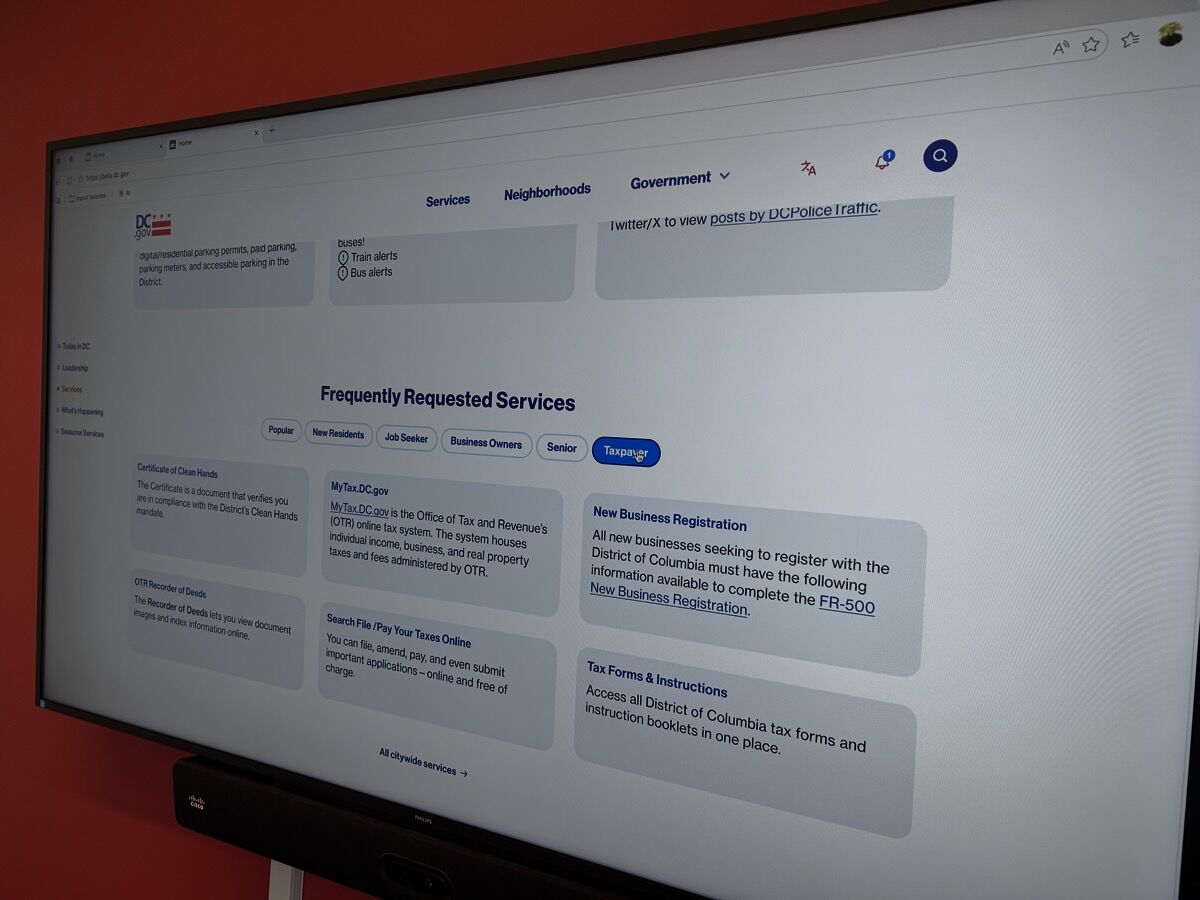
The overhaul is the first in more than a decade and comes in response to feedback that it’s hard to find information on the current site without being efficient at using Google or other search tools.
The D.C. government’s website is getting a complete revamp, a step city leaders hope will make it easier for residents, visitors and business owners to access the help they need.
The District unveiled a beta version of the new DC.gov — beta.dc.gov — and plans to have the redesigned site ready to launch before the end of the year.
The website’s overhaul is the first in more than a decade. It comes in response to feedback that it’s hard to find information on the current site without being efficient at using Google or other search tools.
“This website, it’s really going to eliminate the alphabet soup that you have to remember every day,” said Stephen Miller, the District’s chief technology officer. “So, do you need to know that it’s DPW that’s picking up your trash, or you just need to know that it’s dc.gov?”
The site is built on Drupal 11, which the city said has stronger built-in security features. It includes an integrated calendar and sections for seasonal government services.
Popular searches, based on site traffic data, will also be featured prominently on the main page.
“It’s going to show you, here’s popular services today, based on being a resident, based on being a new resident, based on being a job seeker, based on being a business owner, or based on just being a general resident of the city,” Miller said.
The project cost about $500,000 in dedicated funds.
“We’re setting this up so that you can just go in, say, ‘My trash was missed,’ and it’s going to tell you exactly how to fix that problem,” Miller said.
D.C.’s Office of the Chief Technology Officer is collecting feedback. Residents can leave comments on the beta site and at events at Haynes Senior Wellness Center and Eastern Market, among others, in the coming weeks.
An artificial intelligence-powered search tool, built using Google’s AI technology, will be included on the new DC.gov site after its official launch.
The District, Miller said, is “trying to clean up our content, because what we want to make sure is when we put AI into this site, it’s giving you the right information.”
“We see a lot of future use with AI,” Miller said. “I’d love to get to a point where it’s, ‘Hey Siri, renew my driver’s license,’ and we’ve laid out the foundation for something like that to happen in the future.”
Get breaking news and daily headlines delivered to your email inbox by signing up here.
© 2026 WTOP. All Rights Reserved. This website is not intended for users located within the European Economic Area.
-

 Wisconsin6 minutes ago
Baboucarr Ann’s commitment pushes Wisconsin into nation’s top three
-

 West Virginia9 minutes ago
Justice firm’s delinquent DEP fines rise past $1.6M amid DOJ criminal liability relief
-

 Wyoming14 minutes ago
Wyoming, women, and winning the right to vote: Historian presents suffragette research
-

 Crypto21 minutes ago
4 arrested in Poland for SIM-swapping and cryptocurrency theft
-

 Finance24 minutes ago
Your Savings Account Is Failing: 3 Shifts to Reclaim Your Wealth
-

 Fitness29 minutes ago
Steffie Bryant, Alistair Brownlee to Share AI, Performance Insights at European Congress – Health & Fitness Association
-

 Movie Reviews39 minutes ago
Movie Review: SUPERGIRL – Assignment X
-
World51 minutes ago
Cape Verde’s dream run continues, becoming smallest country into World Cup knockout round


