There is a house a little south of D.C. that is, most of the time, just a house. A tidy, brick-faced single-family home on a quiet street full of other similar, unassuming homes.
Washington, D.C
Washington’s most exclusive new music venue: Noochie’s ‘Front Porch’


“We back again, y’all,” the homeowner, 28-year-old Antwon Vincent, a rapper who performs under the name Noochie, announced to a crowd of about 10 one frigid December night. “Rain, sleet or snow. Whether it’s hot or it’s cold.”
Then he introduced that evening’s featured performer to the stage — er, porch. Grammy-nominated singer-songwriter Eric Roberson walked through the front door, shook Noochie’s hand and started crooning a slow-jam love song into a mic as if he were appearing on a late-night talk show with a studio audience.
Welcome to Noochie’s “Live From the Front Porch,” the D.C.-centric, residential equivalent of NPR’s “Tiny Desk” concert series. It has featured big-name acts like Raheem DeVaughn and Ruben Studdard and attracted hundreds of thousands of viewers on YouTube and Instagram.
“Live From the Front Porch” originated about five years ago, when Noochie, who had been signed to Atlantic Records, was in the process of leaving his contract. Since he was in limbo with his record label, he didn’t want to release any official music, not knowing where ownership rights would lie. Instead he grabbed his iPhone and a portable speaker and started recording himself freestyling over industry beats from his front porch. Then he shared the results on Instagram.
“I was like, let me do something that has no attachment to anything and let me just rap it. I’m not going to monetize from this, but it’ll just show people that I’m skilled and give people a visual, too,” the “Sneaky Tape 2” artist says. “It was completely out of hunger.”
Noochie kept up the performances through the pandemic, and in March 2023, his friend Tyler Benson offered to help him increase the series’s production value. Benson replaced the rapper’s iPhone with a professional camera, which gave the duo an opportunity to do multiple takes and edit as needed. Benson’s changes also meant Noochie could capture more of his front porch, so he had an idea: “Let me put a whole band on the porch.” He swapped his portable speaker for live instrumentals.
Expanding “Live From the Front Porch” to “Live From the Front Porch Presents” happened almost by accident.
“There was no goal to put other people on it,” Noochie says, chuckling. “This started because other people weren’t putting me on stuff. People weren’t calling me. … People that I wanted to work with weren’t working with me. So I was like, ‘You know what, let me just go to square one with my own people, at my house, with my skills that I know how to do.’ I mixed all the audio myself.”
Noochie had always dreamed of having go-go legends the Backyard Band perform for his birthday, so in July he made the invite, set up the porch and decided to record the session. “Instead of being selfish,” he remembers thinking, “I can give it to everybody.”
In the nine months since, the Front Porch sessions have animated the D.C. music scene, as followers try to track down the exact location of the house and speculate on the timing of the next concert.
But Noochie wants the events to be in service of the musicians as much as the fans.
That’s what Don Choo, a longtime family friend who used to work with Noochie’s father, D.C. hip-hop trailblazer Oneway Boobe (real name Roger Vincent), says is the real appeal of “Live From the Front Porch.” It gives artists an opportunity to home in on what they love most — the music.
“Some of the best jam sessions have happened here because there’s no ‘Lights, camera, action’ with thousands of people. This is just the artist vibing out. You get better music that way because it’s a performance that comes from the heart, it’s not to wow an audience,” Choo said on the night of the Eric Roberson concert. “Like there’s nobody here, there’s no audience, it’s just us.”
That feeling means a lot to Noochie — it’s the essence of what he’s trying to preserve and promote. The tidy, brick-faced single-family home used to belong to his father. It was here that he watched his father push through his own challenges as a musician.
“I grew up in the era of him pursuing hip-hop in a city that was really only accepting of go-go,” Noochie says. “It was kind of like I already got to experience seeing an uphill battle firsthand.”
The rapper inherited this house just a year before his father was incarcerated in 2018.
“My dad, he was the reason I started. He’s incarcerated right now, and this was his house. He tried to sell it, but I fought for it to make sure it didn’t go nowhere, and fast-forward, here we are, and it brought a whole other meaning to what this house has meant already,” Noochie says. “This used to be the studio; like Shy Glizzy got his start here, Fat Trel has been here, there’s a lot of history here.”
Noochie, who will perform this weekend at the National Cannabis Festival, sees “Live From the Front Porch” as a way of continuing his father’s legacy — and carving out his own.
“He was a nucleus to all these people, so I’m just keeping it going; that’s how I look at it,” he says. “It’s a different group of individuals, but the spirit of it is the same. Just making sure that we all chasing the dream and we all get closer to it together.”



Among the liquor store, barber shop and dry cleaners at the Watergate Complex’s retail plaza, there is a new pop-up museum dedicated to the scene of the crime that toppled Richard Nixon’s presidency.

Among the liquor store, barber shop and dry cleaners at the Watergate Complex’s retail plaza, there is a new pop-up museum dedicated to the scene of the crime that toppled Richard Nixon’s presidency.
The temporary exhibit features the work of artist Laurie Munn — portraits of members of the Nixon administration and those connected to the Watergate break-in. The exhibit features members of Congress, the media and some who were on Nixon’s enemies list.
Keith Krom, chair of the Board of Directors of the Watergate Museum, told WTOP the exhibit was first featured in the gallery in 2012 for the 40th anniversary of the break-in at the Democratic National Committee.
“When she (Munn) learned about our museum effort, she offered to reassemble them as a way for us to expand awareness of the museum,” Krom said.
Krom, who lives in the Watergate, said his favorite portrait is of one of the special prosecutors, whose firing sparked the “Saturday Night Massacre” in 1973.
“I had the pleasure of being a student of Archibald Cox,” Krom said. “He served as my mentor for my third-year writing project.”
Krom said during this time, at the Boston University School of Law, he spent a great deal of time with him.
“I didn’t realize how much he must have gone through. Here he was, this one man, who was challenging the president of the United States over something pretty serious,” Krom said.
The pop-up opened in October and was recently extended to stay open until April 25. Krom said the hope is to find it a permanent location within the Watergate Complex, where they can “present the history of Watergate, but with two perspectives.”
The first would be on the building’s “architectural significance to D.C.,” he said.
“You may not like the design, you actually may hate it,” Krom said. “But you cannot deny that it changed D.C.’s skyline.”
The secondary focus would, of course, be on the mother of all presidential scandals that changed the course of American history.
“That’s where that suffix ‘-gate’ started and continues to be used for almost every scandal that comes out today,” Krom said.
The inspiration for the museum spawned from an interaction from a tourist outside the Watergate.
“He says, ‘This is the Watergate, right?’ And I was like, ‘Yeah, it’s one of the buildings,’” Krom recalled.
The tourist then asked Krom, “So where’s the museum?”
“I was like, ‘Oh, we don’t have a museum.’ And he literally just looked at me and said, ‘That’s so sad.’ And he got on his bike and rode away,” Krom said.
While the self-proclaimed political history nerd said he “still gets goose bumps” when he drives by the Capitol at night, Krom hopes that when people leave the museum, “they’ll walk away with a new appreciation for how our government works, the guardrails that are in place.”
“Maybe an understanding that those guardrails themselves are kind of frail, and they probably need our collective help in making sure they last — that’s what we hope to accomplish,” Krom said.
Get breaking news and daily headlines delivered to your email inbox by signing up here.
© 2026 WTOP. All Rights Reserved. This website is not intended for users located within the European Economic Area.

According to the National Park Service at the National Mall, famous cherry blossoms around the nation’s capital have hit peak bloom conditions. The National Park Service X account for the National Mall proclaimed this morning, “PEAK BLOOM! PEAK BLOOM! PEAK BLOOM!”
It became apparent yesterday that the bloom would be at peak today. “Despite a sunny afternoon and patches of blue sky, the cherry blossoms remain at Stage 5: Puffy White,” the Park Service wrote on X yesterday. Stage 5, “Puffy White”, is the final stage blossoms go through before being in full bloom. They start at Stage 1 as a “Green Bud”, grow into Stage 2 with “Florets Visible”, and then florets become extended at Stage 3. In Stage 4, there is “Peduncle Elongation” which sets the stage for the puffy blossoms to appear in Stage 5. Puffy White and Peak Bloom are defined as when 70% of the blossoms on the trees reach that stage.

Peak bloom varies annually depending on weather conditions; the most likely time to reach peak bloom is between the last week of March and the first week of April. According to the Park Service, extraordinary warm or cool temperatures have resulted in peak bloom as early as March 15 in 1990 and as late as April 18 in 1958.
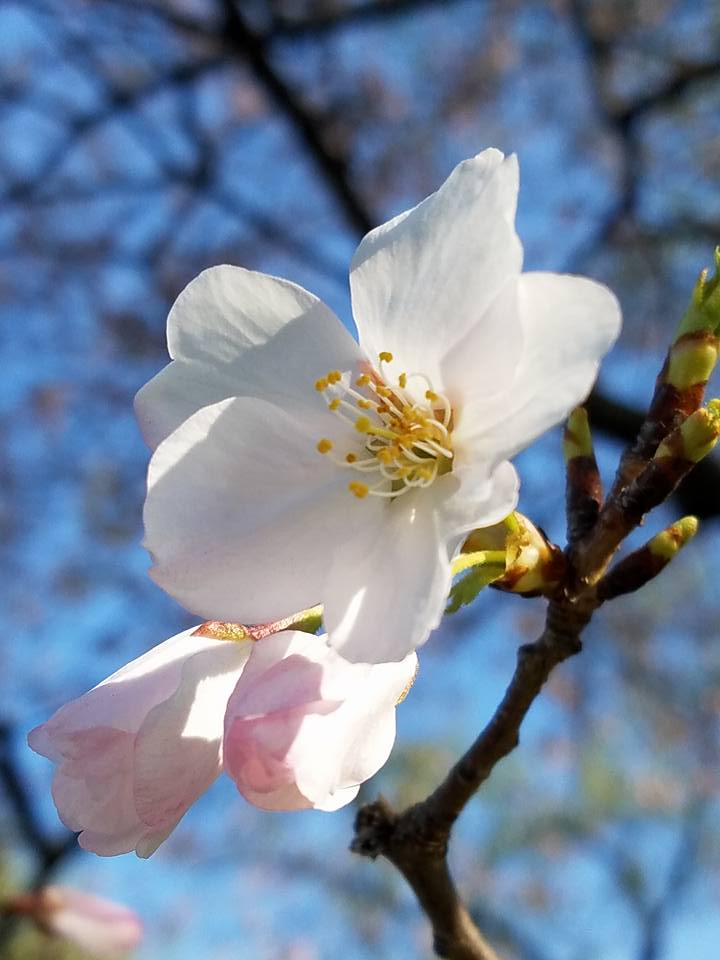
The planting of cherry trees in Washington DC originated in 1912 as a gift of friendship to the People of the United States from the People of Japan. In Japan, the flowering cherry tree, or “Sakura,” is an important flowering plant. The beauty of the cherry blossom is a symbol with rich meaning in Japanese culture.
Dr. David Fairchild, plant explorer and U.S. Department of Agriculture official, imported seventy-five flowering cherry trees and twenty-five single-flowered weeping types from the Yokohama Nursery Company in Japan. After experimenting with growing them on his own property in Maryland, he deemed that the cherry tree would be perfect to plant around the Washington DC area. This triggered an interest by a variety of individuals to plant the tree around Washington. In 1909 the Mayor of Tokyo, Yukio Ozaki, donated 2,000 trees to the United States on behalf of his city. When the trees arrived, they were riddled with disease and insects and to protect other agriculture, they were burned. The Tokyo Mayor made a second donation of trees in 1910, this time amounting to 3,020 trees. This started the forest of cherry trees that now line the Potomac basin around Washington DC. In a gesture of gratitude back to Japan, President Taft sent a gift in 1915 of flowering dogwood trees to the people of Japan. Thousands of trees have been added since, including another gift of 3,800 trees from Japan in 1965.


WASHINGTON (7NEWS) — Authorities are searching for an SUV after an officer with the Metropolitan Police Department (MPD) was struck by a hit-and-run driver in Southwest D.C. on Wednesday night.
The crash happened just before 10 p.m. at Martin Luther King Jr. Avenue and Forrester Street, SW.
Police confirmed the officer, an adult man, was conscious and breathing when he was rushed to a nearby hospital for treatment of his injuries. There is no word on his condition.
The driver involved fled the scene, and investigators are looking for a white Range Rover with a partial South Carolina tag of “403.”
Anyone with information is urged to call 202-727-9099 or text tips at 50411.
This is a developing story that will be updated as more information becomes available.

Sports3 minutes ago
Indiana coach Cignetti sends message to star transfer with pre-practice dress code lesson

Technology9 minutes ago
Drone food delivery launches in New Jersey

Business15 minutes ago
FKA twigs sues ex-boyfriend Shia LaBeouf over ‘unlawful’ NDA
Entertainment21 minutes ago
LAPD chief backed cops who shot at author, Weezer bassist’s ex; commission overruled him

Lifestyle27 minutes ago
What European Luxury Can Learn From American Fashion

Florida1 year ago
Florida High School Football Rankings: Top 25 teams – Oct. 21

Oregon2 years ago
How old is Bo Nix? What to know about Oregon quarterback ahead of 2024 NFL Draft

Connecticut2 years ago
Cleary's 21 help Le Moyne down Central Connecticut State 69-64 in OT

Virginia2 years ago
99th annual Pony Swim held in Virginia

Indiana2 years ago
Indiana Members Credit Union announced as new anchor tenant at Bottleworks District

World57 minutes ago
Rubio joins crucial G7 talks as Iran war set to dominate second day

News1 hour ago
A surprise resignation could open the door for an independent to win a Montana Senate seat

News11 hours ago
Video: Savannah Guthrie Says She Believes Her Mother Was Taken for Ransom

Politics12 hours ago
Stefanik grills University of Michigan leader on lack of audit after string of Chinese national arrests

World13 hours ago
Photos: More than one million displaced by Israel’s evacuations in Lebanon
-

 Detroit, MI1 week ago
Drummer Brian Pastoria, longtime Detroit music advocate, dies at 68
-

 Science1 week ago
How a Melting Glacier in Antarctica Could Affect Tens of Millions Around the Globe
-

 Movie Reviews1 week ago
‘Youth’ Twitter review: Ken Karunaas impresses audiences; Suraj Venjaramoodu adds charm; music wins praise | – The Times of India
-
 Science1 week ago
I had to man up and get a mammogram
-

 Sports6 days ago
IOC addresses execution of 19-year-old Iranian wrestler Saleh Mohammadi
-

 New Mexico4 days ago
Clovis shooting leaves one dead, four injured
-

 Texas7 days ago
How to buy Houston vs. Texas A&M 2026 March Madness tickets
-

 Tennessee3 days ago
Tennessee Police Investigating Alleged Assault Involving ‘Reacher’ Star Alan Ritchson