Washington, D.C
Trump forges ahead with D.C. cityscape transformation against growing resistance

WASHINGTON — A relentless push by President Trump to reshape Washington‘s cityscape is facing mounting resistance, threatening a slate of transformative monuments intended to cement his legacy in the nation’s capital.
Eager to see his projects completed before leaving office, Trump has responded to growing legal and political obstacles by pushing ahead, attempting to force approvals through faster than opponents can challenge them. But the scramble to fast-track construction has inflated their costs for taxpayers, imperiling his plans and amplifying his political risks as the midterm elections approach.
Urban design has become a preoccupation for Trump since the start of his second term. Cranes dot the skyline of the city, and construction fences block access to many of its most cherished parks and venues less than a month before the nation celebrates 250 years since its founding on July 4.
Cranes from the White House East Wing ballroom construction project rise from behind the U.S. Treasury Department building on Thursday in Washington, D.C.
(Kevin Carter/Getty Images)
Government lawyers are defending the president’s use of the wrecking ball, arguing in court that he has unfettered power to build and destroy. Should he ever choose to tear down the Statue of Liberty, the Justice Department told a judge Friday, no one could stop him.
Yet a recent series of legal setbacks, as well as increasing Republican opposition on Capitol Hill, have cast doubt on the fate of his most lavish designs, including the construction of an imposing ballroom at the White House and the erection of a massive triumphal arch on the sightline of the National Mall.
It’s become a race against time for the president, who could soon confront a Democratic-controlled Congress armed with renewed oversight authority and subpoena power, further gumming the works of elaborate construction projects, which could stymie their completion before he leaves office.
“This is very much on the committee’s radar,” said one Democratic source with the House Oversight Committee, citing “serious concerns surrounding corruption.”

Visitors at the Mall gather in front of the Lincoln Memorial and near the Reflecting Pool, which is under renovation on Friday in Washington, D.C. President Trump dismissed criticism of the recent Lincoln Memorial Reflecting Pool renovations, rejecting claims the project amounted to merely a “paint job.”
(Roberto Schmidt / Getty Images)
Trump as ‘builder-in-chief’
Several of Trump’s more modest initiatives, referred to by the administration as beautification projects, are complete or well underway.
At the White House, a historic rose garden conceived by Jacqueline Kennedy was paved over, and its adjoining colonnade refurbished with black granite and gilded presidential portraits. The Palm Room foyer was decked in marble and chandeliers. New flagpoles fly supersized American flags on the North and South lawns.
The en suite bath of the Lincoln Bedroom in the residence has been gutted and renovated. And the Oval Office now practically drips in gold, while an adjoining study, once used by Franklin Roosevelt to scrutinize war maps and Lyndon Johnson to monitor the space race, was converted into the president’s personal swag shop.
A temporary Ultimate Fighting Championship arena constructed on the White House South Lawn is another example of how Trump is leaving a visual mark on the presidential residence. The structure, which towers over the White House, was paid for by the UFC, which is scheduled to host a series of fights on the premises.
Outside the White House complex, fountains across the city are coming back to life after decades of neglect, from DuPont Circle to Freedom Plaza and Union Station. The idyllic Logan Circle, surrounded by historic mansions, is being revitalized by the National Park Service, as is Lafayette Square, the site of an infamous clash between Trump and protesters shortly after George Floyd’s murder in 2020.
1

2

1. National Park Service Conservator for the National Mall and Memorial Parks Ali Cavicchio puts a clear coat over the recently repainted “I Have a Dream” marker at the Lincoln Memorial on June 05, 2026 in Washington, DC. The marker’s letters are carved into stairs of the Lincoln Memorial where Dr. Martin Luther King Jr. stood and delivered his “I Have A Dream” speech in 1963. (Chip Somodevilla / Getty Images) 2. Members of the West Branch Area School District in Morrisdale, Pennsylvania, student marching band perform at the Lincoln Memorial on the National Mall on June 05, 2026 in Washington, DC. (Chip Somodevilla / Getty Images)
In some parks, even the turf is getting a makeover.
“People are all thanking me because Washington is beautiful again,” Trump told reporters last week. “The parks are open, we changed the grass. You know, grass has a life, also. Like people, grass has a life, and that grass hasn’t changed in 70 or 80 years.”
On Friday morning, several people sat by the restored cascading fountain at Meridian Hill Park. They walked their dogs, read books and exercised by the water.
Jean Luc, 33, was one of them. As he took a stroll with his 2-month-old daughter, Juno, he said it had been nice to see the government fix up the park, which he says he tries to enjoy with his daughter daily.
“It’s been nice to see the whole process,” he said. “I love it.”

President Trump displays a chart titled “Our Pool is Bigger than Skyscrapers” while discussing his renovations to the Lincoln Memorial Reflecting Pool on Wednesday in the Oval Office.
(Kevin Dietsch / Getty Images)
The Lincoln Memorial Reflecting Pool has been painted over in “American Flag Blue” by a firm that Trump said had worked on the swimming pool at his golf club in Virginia. Millions will be spent to regild the hulking Art Deco statues that buttress Arlington Memorial Bridge. And Trump has plans to connect the Lincoln Memorial to the Potomac River by building a promenade, one of many projects he has said may be named after himself.
Federal contracting data show that the Virginia firm Terra Site Constructors has been awarded roughly $60 million in contracts from the National Park Service to complete work on the various fountain rehabilitation projects across the city.
Another Virginia firm, Atlantic Industrial Coatings, holds a contract for $14.2 million to paint the reflecting pool.
The funding for both contracts comes from the entrance fees paid by national park visitors.
“How fortunate are we to have the builder in chief?” Interior Secretary Doug Burgum said Thursday in the Oval Office. “Someone who both has the vision and the understanding of how to get projects done that would make our city safe and beautiful.”

Construction continues on the White House East Wing ballroom on May 29, 2026.
(Kevin Carter / Getty Images)
‘The finest ballroom anywhere in the world’
Yet other, more controversial projects, exacting irreversible change to capital institutions, are facing greater opposition.
On Thursday, the Kennedy Center for the Performing Arts directed its staff to begin removing Trump’s name from its facade after a judge ruled that the attempted name change, and his effort to close the venue for two years of dramatic renovations, were illegal.
Angered by the court’s decision, Trump directed the Commerce Department to make arrangements to transfer control of the Kennedy Center to Congress. The move would give lawmakers power over the center’s operations, maintenance and management. It was originally an act of Congress that gave the Kennedy Center its name and mandate.
In other areas of the city, preservationists have successfully delayed the president’s bid to paint over the natural gray granite of the Eisenhower Executive Office Building. And Republican lawmakers have refused to vote to fund the construction of a ballroom at the White House that has already laid waste to the East Wing and, if completed, would dwarf the landmark residence.
Construction crews began tearing down the East Wing in October to make way for the 90,000-square-foot facility. Trump, who built a career as a real estate developer, has frequently touted the project, gushing over the sounds of jackhammers and excavation trucks.

Construction continues on the White House South Lawn on June 1, 2026, for an upcoming UFC match. President Trump is hosting a UFC match on the White House grounds to mark the nation’s 250th birthday.
(Kevin Carter / Getty Images)
“Oh, that’s music to my ears. I love that sound,” Trump told Republican senators at a White House event last fall. “A lot of people don’t like it. When I hear that sound, it reminds me of money.”
The ballroom project was initially expected to cost $200 million, a price that has since doubled. It is being financed by private donors and Trump, who has called it a “gift to the United States.”
“We are building what will be the finest ballroom anywhere in the world,” the president said last month.
More than half of the publicly identified donors of the ballroom projects — 14 of the 27 known corporate contributors — have won new or bigger federal contracts worth more than $50 billion in the six months since construction began, according to a report released by Public Citizen, a watchdog group.
“These giant corporations aren’t funding the Trump ballroom fiasco out of the goodness of their hearts,” said Jon Golinger, a public policy advocate at Public Citizen and author of the report. “They have massive interests before the federal government and they hope to curry favor with, and receive favorable treatment, from the Trump administration.”

White House military aides stand next to the giant mirror that hangs along the Rose Garden Colonnade at the White House on May 21, 2026.
(Chip Somodevilla / Getty Images)
The White House has challenged the report’s assertions, saying critics of how the project is being funded are “only people who suffer from a severe and incurable disease known as Trump Derangement Syndrome.”
“President Trump is making the White House beautiful and giving it the glory it deserves at no cost to taxpayers — something everyone should celebrate,” White House spokesman Davis Ingle said in a statement.
The report came out as the ballroom project has faced persistent hurdles in court and Congress.
The National Trust for Historic Preservation sued to stop construction, arguing the administration had not followed the legally required review process and had not secured congressional approval. In March, a federal judge halted aboveground construction, but an appeals court quickly allowed work to resume through June while the case proceeds.
On Friday, the panel heard the case and expressed skepticism about Trump’s push to build the ballroom without congressional approval.
On Capitol Hill, Senate Republicans dropped a proposal to set aside $1 billion in security funding for the ballroom after several GOP senators said it lacked the votes to pass.
Trump has insisted the funding is not necessary to complete the project, though he said it would help secure the complex. Without it, he told reporters last month, “the White House won’t be a very secure place.”

(Los Angeles Times photo illustration; Photo by Kevin Dietsch / Getty Images)
Arc de Trump
The president is also seeking to build a 250-foot-tall “triumphal arch” near Arlington National Cemetery, across the Potomac River at the foot of Memorial Bridge.
Renderings show the arch would be twice the height of the Lincoln Memorial, crowned by a golden statue of Lady Liberty sporting outstretched wings. An observation deck on its roof would offer sweeping views of the city.
Preservationists have criticized the plan as disrupting a sacred sightline between the memorials to Abraham Lincoln and Robert E. Lee, designed as a statement of unity after the Civil War. Even advocates of adding an arch in Washington have criticized the size of Trump’s proposed structure as overbearing. And a group of Vietnam War veterans has sued to try to stop its construction, arguing the project lacks congressional approval and would “dishonor their military and foreign service” because it would block the view of the cemetery.

Commission of Fine Arts member Pamela Hughes Patenaude, left, hands colleague Matthew Taylor a model of President Trump’s proposed triumphal arch to commemorate the country’s 250th anniversary during the commission’s public meeting at the National Building Museum in Washington on April 16, 2026.
(Andrew Harnik / Getty Images)
Despite public opposition, the National Capital Planning Commission last week advanced the project in its review process.
Trump praised the planning commission’s support, saying that “when completed, it will be, without question, the Greatest Arch of them all!”
The president has yet more plans to leave his mark — in some cases with his name, in others with his face.
Transportation Secretary Sean Duffy has proposed a $22-billion overhaul of Dulles International Airport outside the capital that would include a new terminal brandishing Trump’s name. Limited-edition U.S. passports will feature his portrait. And the Treasury has plans to mint a $250 bill featuring Trump’s mugshot from his 2023 Fulton County arrest, pending congressional approval — an unlikely prospect.

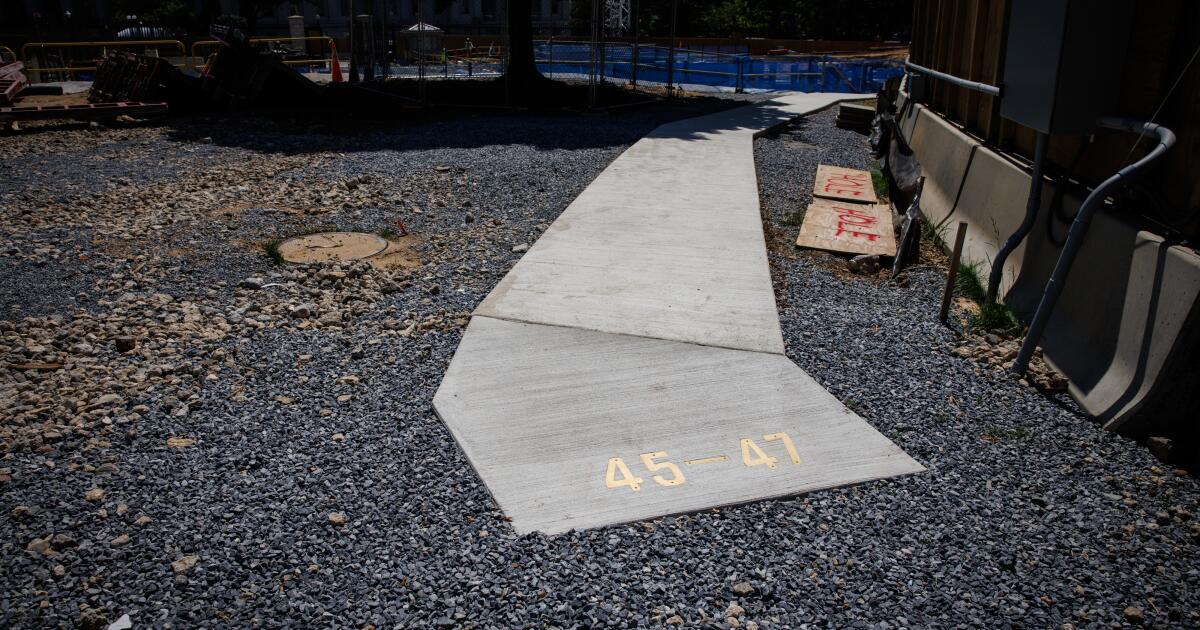
A walkway with the numbers “45” and “47” leading to construction on the new ballroom extension of the White House in Washington, D.C., on May 19. President Trump said a military hospital and research facilities will be built on the site of his planned White House ballroom, offering more details about the scope of the sprawling, controversial project.
(Samuel Corum/Bloomberg via Getty Images)
In a moment that went viral on social media, Sen. Jon Ossoff (D-Ga.), who is generating buzz over a potential run for the Democratic presidential nomination in 2028, offered a theory on what’s driving the president.
“He’s trying to put his face on the money. He’s building a monument to himself,” Ossoff told a crowd of supporters.
“But see, Atlanta, he’s doing these things now because no one will honor him when he’s gone,” he added, “because he’s a failed president and a national disgrace.”
Wilner reported from Los Angeles and Ceballos from Washington. Times staff writer Ben Wieder contributed to this report.

Berk Kutay Gökmen
02 July 2026•Update: 02 July 2026
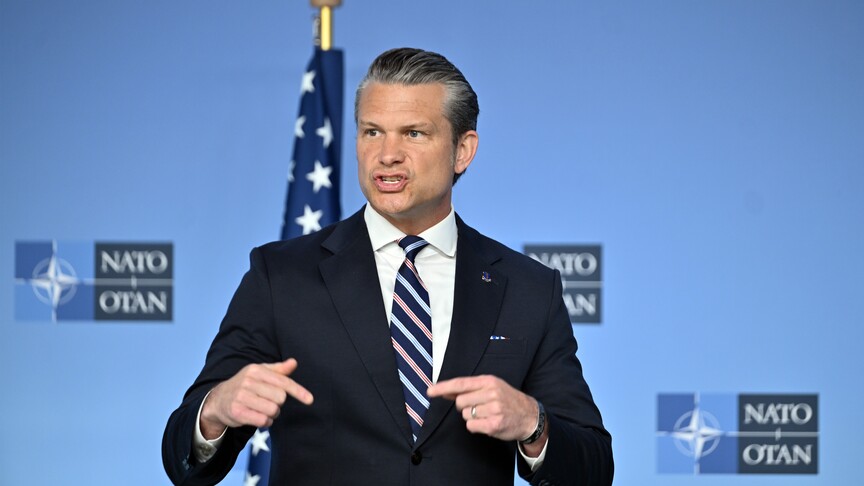
US Defense Secretary Hegseth on Thursday faced protesters while hosting the Trump administration’s DC Safe and Beautiful Task Force ceremony in Washington DC.
During the ceremony at Meridian Hill Park, which saw the gathering of National Guardsmen, dozens of demonstrators gathered near the park to protest Hegseth.
Footage shows the demonstrators chanting a short distance away from where Hegseth and roughly 200 members of the National Guard had gathered in the park
In social media posts, one protester was seen holding a Palestinian flag, while another person was holding a sign that reads “arrest Hegseth.” The protesters want a “Free DC,” according to social media posts.
In his address to the National Guard, Hegseth said that “this background noise is perfect,” referring to the protests.
“It’s the sound of ingrates, of ingratitude—of people who are so blinded by ideology they can’t see law and order and common sense in front of them,” he said.
Meridian Hill Park was repaired by the National Park Service and the Interior Department as part of a larger initiative to restore and enhance federal parks and public spaces throughout the nation’s capital in preparation for America’s 250th anniversary, which falls on this Saturday, July 4.
Though such beautification projects are typically popular with the public, the current initiative has been controversial both for its choice of projects and the use of no-bid contracts to hire firms to do the work, sometimes with disappointing results.
The work aligns with President Donald Trump’s DC Safe and Beautiful Task Force, established by a March 2025 executive order that directs federal agencies to coordinate public safety and beautification efforts across Washington.
Washington, D.C
Metro, DC leaders lay out more details on transit at new Commanders stadium – WTOP News

D.C. officials expressed an urgency Wednesday to begin preparing transit infrastructure for the opening in 2030 of the new Washington Commanders stadium on the old RFK Stadium campus.
D.C. officials expressed an urgency Wednesday to begin preparing transit infrastructure for the opening in 2030 of the new Washington Commanders stadium on the old RFK Stadium campus.
The work will impact far more than the single, cramped Metro station nearby.
During a roundtable discussion with District leaders, Metro General Manager and CEO Randy Clarke laid out the need for improvements to the existing Stadium-Armory Metro stop, and touted a new rapid bus transit line with dedicated lanes.
In tandem, those will be key to getting tens of thousands of people to events at the coming stadium, Clarke said.
“I absolutely believe the first couple of experiences that people have going to a Commanders game, going to some of the first big events, is going to dictate how people feel about taking transit,” D.C. Council member Charles Allen, who chairs the committee that oversees transportation projects, said. “So, we don’t have an option to get it wrong. We have to get it right.”
That’s why Clarke and other District leaders agreed that reaching a memorandum of understanding that lays out the roles, responsibilities and financials of these projects by July 23, the next Metro board meeting, is crucial.
“I think we’re all working towards that, and pretty optimistic,” Clarke said. “Then we’ve got to work really hard on design, we’ve got to work really hard on procurement, we’ve got to work really hard on construction.”
Clarke said the stadium’s ability to attract blockbuster events will depend on the transit agency and its ability to move people in and out of the complex.
“We’re not going to try to get, hosting the Super Bowl, we’re not going to try to host women’s World Cup, we’re not trying to get Taylor Swift and Beyoncé back here. I mean, at the end of the day, Metro is going to be the key to the success. We understand the pressure on us,” he said.
For the Stadium-Armory station, that means renovating the mezzanine and adding elevators to handle the increased demand. Clarke also talked about new street-level infrastructure to help manage the flow inside the station.
“So it’s very Disney-esque, where people feel like they’re constantly moving without actually going too far, if you know what I mean,” Clarke said. “Then we filter them where we need to go. That is a good example of what we need to do at the surface.”
But Metro won’t rely entirely on its trains. The roundtable also discussed what’s been dubbed the Gold Line, which would run buses from Union Station to the stadium.
Construction estimates for bus line are in the $75 million range, District Department of Transportation Director Sharon Kershbaum said
The Gold Line is to run through the heart of the H Street corridor, and transportation leaders said the impact will be everything the streetcar was supposed to be.
“This is now going to be the east-west corridor that we never were able to accomplish on the streetcar,” Kershbaum said.
“This is going to have frictionless service, because it will be center-running. So all of the issues — when a car double-parked and it stopped streetcar service — all of those things, we’ll be immune from. We are going to see the transportation service that was really never ever reached by streetcar achieved with this,” she said.
The vision for the Gold Line goes beyond the handful of weekends when NFL football is played at the stadium, and beyond initial Union Station-stadium route. Transportation officials see the buses eventually traveling between the Benning Road Metro Station and Rosslyn, Virginia.
“We want the Gold Line to solve the cross-town problem we’ve had in this community for a long, long time,” Clarke said.
That means providing access to the convention center and also solving the gridlock that fills up K Street NW every day. Clarke said coming up with dedicated lanes on K Street would actually be the most pivotal part of this new transit line.
“The downtown core of D.C. does not move, especially during p.m. rush hour,” Clarke said. “If you want people in Benning Road that may work, say on K Street, to have better transportation, solving K Street is equally as important, if not more important, because of time savings and reliability.”
Officials did not specify a timeline for the full expansion, but it would not be completed by 2030.
Where it does run, Gold Line buses would travel in the middle lanes, to avoid what caused problems for the Streetcar, which could grind to a halt when cars would double park. Building out the Gold Line would mean more changes to the way cars move along H Street in Northeast.
“You can’t do what you want to do and also keep all the parking,” At-Large Council member Christina Henderson said.
“There’s intersections where we’re going to have to take turns away at certain intersections, maybe parking in certain places,” Clarke said. “In other places parking could be kept, because we’re looking at putting platforms.”
Stadium-related transit construction will run far beyond H Street and the Stadium Armory stop.
“We do want to minimize outages, but there’s going to be significant outages to do this project,” Clarke said.
“It’s all about where we can turn trains around and how to manage that,” he added. “So if we do an outage to Stadium Armory, what that really means is we’re impacting customers from New Carrollton and Largo all the way through the system, and some people that are west of the system that want to go east of Stadium Armory won’t be able to.”
But with the project not even really in the design phase yet, it’s hard to plan out how and when those impacts will happen.
“We’ll be doing obviously overnight work,” Clarke said. “We’ll probably do some, what we call, early outs. Sometimes we’ll start at 10 o’clock at night. We might be able to do some single tracking on certain types of work. Other work is going to be complete shutdowns.”
“And the question is, is that going to be X amount of weekends or is it going to be like a two-, three-, four-week block at a time,” he added. “We’ve got to work through all of that.”
Get breaking news and daily headlines delivered to your email inbox by signing up here.
© 2026 WTOP. All Rights Reserved. This website is not intended for users located within the European Economic Area.

WASHINGTON, D.C. — Ohioans are among the visitors traveling to the nation’s capital this week for the Great American State Fair, part of the country’s 250th birthday celebration.
On Wednesday, visitors trickled into the Ohio state pavilion booth, which includes a map of Ohio’s most iconic places and an exhibit on several children’s initiatives championed by Gov. Mike DeWine, First Lady Fran DeWine and Lt. Gov. Jim Tressel.
“I wanted to come here, we wanted to see the sights here. We figured once in a lifetime,” said Carolyn Golamb of Fremont, who was visiting Washington, D.C. with her husband, Mark.
The fair has been a source of controversy after multiple musicians scheduled to perform at a kickoff concert withdrew, citing political concerns.
The event was organized by Freedom 250, a White House-backed group that has been accused of usurping the government’s official America250 commission, created by Congress 10 years ago for the same purpose. In addition, many elements of the fair have pushed a partisan message, such as President Donald Trump’s campaign-style rally on June 25 and events like “MAHA Mondays.”
Amid the controversy, attendance at the fair has been sparse.
Rep. Dave Taylor, R-Ohio, attributed the light turnout not to politics, but to forecasts of triple-digit heat this week.
“The weather is going to hold numbers down a little bit,” he said. “There’s a lot of walking to go from one place to another here, and people are here visiting with little kids. I think you’re going to see the numbers pick up as we get closer to Saturday for sure.”
Several visitors from Ohio said they did not notice any partisanship at the fair.
“That is the reason why I’m here, is because all of us have made a big positive contribution to what makes America great. And it’s not just one group or one party or anything. It’s all of us together,” said Toledo native Cassandra Newsome.
“It’s the 250th anniversary. No matter who was in power at the time, I still would be here,” said Mark Golamb.
The fair runs June 25 to July 10 on the National Mall.
-

 Nebraska5 minutes ago
Former Nebraska wrestler AJ Ferrari wanted in Lincoln, accused of assaulting pregnant woman
-

 Nevada12 minutes ago
NDW invites all to learn more about bighorn
-

 New Hampshire15 minutes ago
Exeter Clinic In August Offers Free Sports Physical Day For High School Athletes
-

 North Carolina20 minutes ago
Wake County woman says housing authority failed to pay thousands in rent for over a year
-

 New Jersey20 minutes ago
Air conditioning fails at Delaney Hall as heat wave leaves detainees struggling to breathe • The Jersey Vindicator
-

 New Mexico27 minutes ago
7 Best New Mexico Towns For Retirees
-

 North Dakota35 minutes ago
L.L. Bean to Open Store in North Dakota
-

 Ohio42 minutes ago
3 family members accused of murdering Ethan Vernon in Ohio

