Washington, D.C
To stay relevant and maintain support, NATO needs to get outside of Washington, DC


As the campaign between Vice President Kamala Harris and former President Donald Trump approaches the finish line, transatlanticists are growing more anxious about what the next four years could bring for US engagement in the world’s strongest military alliance. Either would-be president will face a litany of global challenges outside the Euro-Atlantic security environment. While a large majority of Americans still view NATO as essential to US security, it is incumbent upon leaders and policymakers to articulate the Alliance’s continued relevance in an era of emerging great-power competition. This requires the Alliance to effectively engage with local communities and communicate NATO’s successes where most Americans live—outside of the US capital.
To this end, the Atlantic Council, in partnership with NATO Allied Command Transformation, hosted a series of conferences across the United States to hear from voices outside the DC bubble. So far, we have engaged with students, local officials, industry partners, interested community members, and other relevant stakeholders in Austin, Texas, and Seattle, Washington, with additional cities to follow. While these conversations were certainly not representative of all perspectives across the United States, the discussions provided useful insights into how the Alliance’s supporters can more effectively communicate the enduring value that NATO provides to Americans.
Anti-NATO sentiments are overhyped—don’t play into them
The people my colleagues and I spoke with in Texas and Washington instinctively recognized the importance of strong alliances and partnerships, understanding that having friend in the fight is better than going it alone. Participants spoke passionately about the importance of US-European ties—citing the United States’ historical role in transatlantic defense instilled in the American consciousness during both world wars.
During these conversations, some participants offered nuanced perspectives on important issues, such as how NATO should redistribute the defense burden in an era of strategic competition. However, in these sessions, the participants always offered criticism in good faith, with the aim of strengthening the Alliance. The nature of these responses indicates that anti-NATO sentiments are more a feature of partisanship in Washington, DC, than a prevailing belief among the American populace. Although political rhetoric criticizing the Alliance presents genuine challenges for NATO, the notion that Americans are indifferent to supporting European allies is not borne out by the data or these discussions with citizens in Texas and Washington.
Transatlantic security ranks lower among citizens’ priorities—articulate a better strategy
As concerns over global and domestic challenges mount, participants in our sessions often ranked transatlantic security as lower on a growing list of priorities. As the conversations inevitably turned to Ukraine, participants recognized that Russia’s violations of the rules-based international order disrupt global security and jeopardize US interests.
In Austin, where the southern border is not far off, and in Seattle, with a port facing the Pacific, transatlantic security was not necessarily top of mind. Participants expressed concerns, following decades of wars in the Middle East and a chaotic withdrawal from Afghanistan, that US grand strategy is aimless and reactive.
Americans are increasingly looking for a sober assessment of the international security environment and a strategy with coherent priorities and clear-eyed plans for how to achieve them. NATO must articulate the vital role it plays as part of the broader US global strategy—or else risk ceding ground to other US priorities on the global stage.
NATO is more of a concept in these communities—make it hit closer to home
The role that local communities play in transatlantic security strongly resonated with the participants of these discussions. Texas is a leader in defense industrial production. Washington state is on the cutting edge of defense innovation and home to a major US Navy presence.
These ties are tangible. And they highlight how a seemingly far-away institution plays a direct role in the lives of individuals in these communities. More importantly, they reveal how Americans contribute to their own security and that of their allies. To reinforce its relevance, NATO should promote these direct ties wherever possible to ensure that people across the country are aware of how their communities interact with the world’s strongest military alliance.
Burden-sharing looms large—confront it head-on
There is a prevailing belief that the United States disproportionately bears the responsibility for European security. This should not come as a surprise to any ally. However, as a bloc, European allies do meet their 2 percent of gross domestic product defense spending commitment to NATO, though individual allies may fall short.
To counter this belief, European officials should engage with Americans across the United States on the issue of burden-sharing. Having these conversations directly with citizens outside of Washington, DC, is a powerful way to better contextualize European contributions to NATO.
The next generation of transatlanticists are coming into their own—capitalize on it
In both Austin and Seattle, our team met with extraordinarily engaged and forward-thinking students and professionals eager to make their mark on international security. From protesting conflict in the Middle East to starting their own university think tanks, these next-generation voices not only challenge the status quo, they also encourage new ways of thinking about emerging issues such as climate, cyber, space, and technological innovation.
As the next generation enters the ranks of officials across the Alliance, it will bring a transformative shift in how NATO prioritizes climate considerations and other emerging challenges. Transatlantic policymakers would be wise to integrate the voices of the next generation into current policy discussions to future-proof the Alliance.
Climate change takes center stage for students—don’t relegate it to second fiddle
While students recognize the growing geopolitical instabilities amid the Russian war in Ukraine and the conflict in the Middle East, climate change was top of mind for many, as students in both cities ranked it as the single biggest challenge to international security. Compounding climate risks will drastically impact the Alliance, and as a threat multiplier, it will spur other security concerns, such as mass displacement. Students and younger participants in these discussions are well aware of this.
In recent years, NATO has made promising strides on climate change, and it must effectively communicate its ongoing initiatives to make NATO more climate resilient. But more than that, the Alliance should listen to the growing concerns from the next generation on climate change and its impacts on international security more broadly.
Too often, debates on international policy and transatlantic relations are relegated to conference rooms in Washington, DC, without a clear understanding of the diverse and innovative views across the United States. As the American public weathers a moment of intense political division, it is vital for NATO and its supporters to establish a touchpoint with communities across the United States to understand how citizens view the world around them and their perspectives on the Alliance tasked with protecting them.
Kristen Taylor is a program assistant with the Transatlantic Security Initiative at the Atlantic Council’s Scowcroft Center for Strategy and Security.
Further reading
Image: Participants of the NATO-Ukraine Council during the 75th NATO Summit in the Walter E. Washington Convention Center in Washington, DC, on July 11, 2024. (Photo by Beata Zawrzel/NurPhoto)



One family, four generations with DC Metro
As Metro celebrates 50 years of service, one D.C. family is marking the milestone with a legacy of their own — four generations who have all worked on the system, helping keep the region moving for decades.
WASHINGTON – D.C. residents got on their first Metro train 50 years ago on March 27, 1976. Here’s a look back at the beginning.

Connecticut Avenue; NW; looking south. evening traffic-jams are aggravated by metro subway construction in Washington D.C. ca. 1973 (Photo by: HUM Images/Universal Images Group via Getty Images)
View of the Metro Center subway station (at 13th and G Streets NW) during its construction, Washington DC, November 16, 1973. (Photo by Warren K Leffler/PhotoQuest/Getty Images)
Standing in the cavernous tunnel, planners wearing hard hats discuss the construction progress of the Metro Center subway station at the intersection of 13th and G Streets in Washington, DC, November 16, 1973. (Photo by Leffler/Library of Congress/In
WASHINGTON, DC – NOVEMBER 07: FILE, Metro construction miners and blasters on a jumbo drill outside the hole they are working on at Rock Creek Parkway and Cathedral Ave NW in Washington, DC on November 7, 1973. (Photo by James K.W Atherton/The Washin
WASHINGTON, DC – MARCH 4: FILE, View of the Post Office at North Capital and Mass Avenue NE, and 1st NE where subway tunnels were being constructed in Washington, DC on March 4, 1974. (Photo by Joe Heiberger/The Washington Post via Getty Images)
WASHINGTON, DC – AUGUST 29: FILE, Workers rig a pipe at the entrance to the Rosslyn Metro Station in Washington DC on August 29, 1974 (Photo by Larry Morris/The Washington Post via Getty Images)
WASHINGTON, DC – MARCH 27: FILE, The crowd at Rhode Island Station on opening day of the Washington Metro on March 27, 1976. (Photo by James A. Parcell/The Washington Post via Getty Images)
WASHINGTON, DC – MARCH 28: FILE, Reverend Leslie E. Smith of the Episcopal Church, right, and George Docherty of New York Avenue Presbyterian church hold a joint service at the new Metro Center station in Washington, DC on March 28, 1976. (Photo by D
WASHINGTON, DC – JULY 1: FILE, An aerial view of metro construction where it crosses the Washington Channel. The Potomac River, the Pentagon and Northern Virginia can be seen in the distance. (Photo by Ken Feil/The Washington Post via Getty Images)
WASHINGTON, DC – JANUARY 27: FILE, A packed train of commuters on the Silver Spring metro on the Red Line on January 27, 1987. (Photo by Dudley M. Brooks/The Washington Post via Getty Images)
WASHINGTON, DC – JULY 4: FILE, Thousands of people press their way into the Smithsonian Subway station after the Independence Day fireworks in Washington, DC on July 4, 1979. (Photo by Lucian Perkins/The Washington Post via Getty Images)

Among the liquor store, barber shop and dry cleaners at the Watergate Complex’s retail plaza, there is a new pop-up museum dedicated to the scene of the crime that toppled Richard Nixon’s presidency.
Among the liquor store, barber shop and dry cleaners at the Watergate Complex’s retail plaza, there is a new pop-up museum dedicated to the scene of the crime that toppled Richard Nixon’s presidency.
The temporary exhibit features the work of artist Laurie Munn — portraits of members of the Nixon administration and those connected to the Watergate break-in. The exhibit features members of Congress, the media and some who were on Nixon’s enemies list.
Keith Krom, chair of the Board of Directors of the Watergate Museum, told WTOP the exhibit was first featured in the gallery in 2012 for the 40th anniversary of the break-in at the Democratic National Committee.
“When she (Munn) learned about our museum effort, she offered to reassemble them as a way for us to expand awareness of the museum,” Krom said.
Krom, who lives in the Watergate, said his favorite portrait is of one of the special prosecutors, whose firing sparked the “Saturday Night Massacre” in 1973.
“I had the pleasure of being a student of Archibald Cox,” Krom said. “He served as my mentor for my third-year writing project.”
Krom said during this time, at the Boston University School of Law, he spent a great deal of time with him.
“I didn’t realize how much he must have gone through. Here he was, this one man, who was challenging the president of the United States over something pretty serious,” Krom said.
The pop-up opened in October and was recently extended to stay open until April 25. Krom said the hope is to find it a permanent location within the Watergate Complex, where they can “present the history of Watergate, but with two perspectives.”
The first would be on the building’s “architectural significance to D.C.,” he said.
“You may not like the design, you actually may hate it,” Krom said. “But you cannot deny that it changed D.C.’s skyline.”
The secondary focus would, of course, be on the mother of all presidential scandals that changed the course of American history.
“That’s where that suffix ‘-gate’ started and continues to be used for almost every scandal that comes out today,” Krom said.
The inspiration for the museum spawned from an interaction from a tourist outside the Watergate.
“He says, ‘This is the Watergate, right?’ And I was like, ‘Yeah, it’s one of the buildings,’” Krom recalled.
The tourist then asked Krom, “So where’s the museum?”
“I was like, ‘Oh, we don’t have a museum.’ And he literally just looked at me and said, ‘That’s so sad.’ And he got on his bike and rode away,” Krom said.
While the self-proclaimed political history nerd said he “still gets goose bumps” when he drives by the Capitol at night, Krom hopes that when people leave the museum, “they’ll walk away with a new appreciation for how our government works, the guardrails that are in place.”
“Maybe an understanding that those guardrails themselves are kind of frail, and they probably need our collective help in making sure they last — that’s what we hope to accomplish,” Krom said.
Get breaking news and daily headlines delivered to your email inbox by signing up here.
© 2026 WTOP. All Rights Reserved. This website is not intended for users located within the European Economic Area.

According to the National Park Service at the National Mall, famous cherry blossoms around the nation’s capital have hit peak bloom conditions. The National Park Service X account for the National Mall proclaimed this morning, “PEAK BLOOM! PEAK BLOOM! PEAK BLOOM!”
It became apparent yesterday that the bloom would be at peak today. “Despite a sunny afternoon and patches of blue sky, the cherry blossoms remain at Stage 5: Puffy White,” the Park Service wrote on X yesterday. Stage 5, “Puffy White”, is the final stage blossoms go through before being in full bloom. They start at Stage 1 as a “Green Bud”, grow into Stage 2 with “Florets Visible”, and then florets become extended at Stage 3. In Stage 4, there is “Peduncle Elongation” which sets the stage for the puffy blossoms to appear in Stage 5. Puffy White and Peak Bloom are defined as when 70% of the blossoms on the trees reach that stage.

Peak bloom varies annually depending on weather conditions; the most likely time to reach peak bloom is between the last week of March and the first week of April. According to the Park Service, extraordinary warm or cool temperatures have resulted in peak bloom as early as March 15 in 1990 and as late as April 18 in 1958.
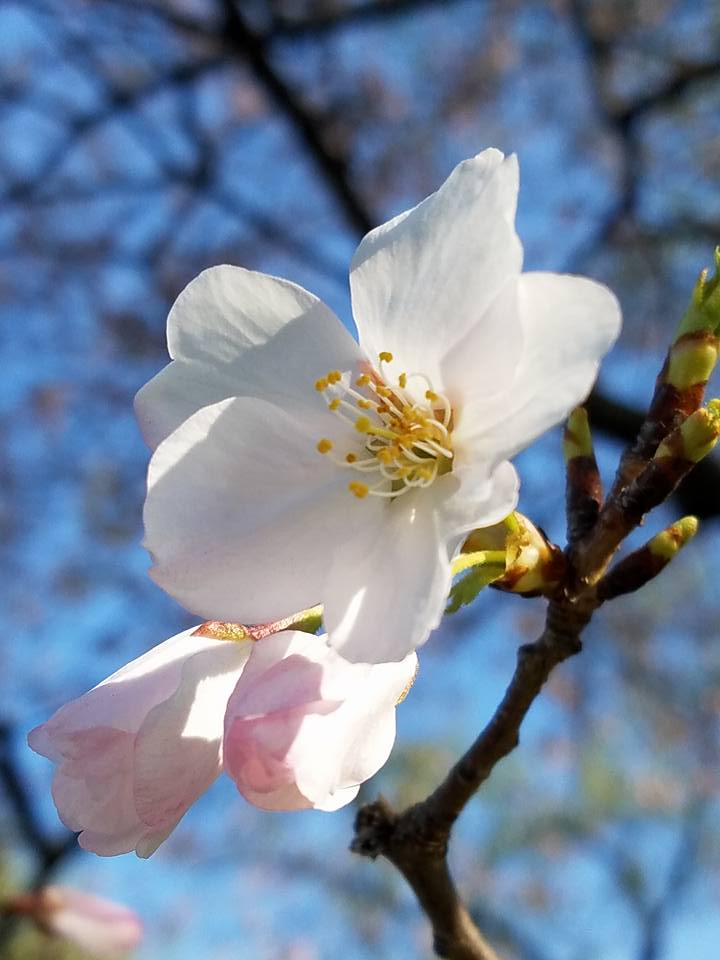
The planting of cherry trees in Washington DC originated in 1912 as a gift of friendship to the People of the United States from the People of Japan. In Japan, the flowering cherry tree, or “Sakura,” is an important flowering plant. The beauty of the cherry blossom is a symbol with rich meaning in Japanese culture.
Dr. David Fairchild, plant explorer and U.S. Department of Agriculture official, imported seventy-five flowering cherry trees and twenty-five single-flowered weeping types from the Yokohama Nursery Company in Japan. After experimenting with growing them on his own property in Maryland, he deemed that the cherry tree would be perfect to plant around the Washington DC area. This triggered an interest by a variety of individuals to plant the tree around Washington. In 1909 the Mayor of Tokyo, Yukio Ozaki, donated 2,000 trees to the United States on behalf of his city. When the trees arrived, they were riddled with disease and insects and to protect other agriculture, they were burned. The Tokyo Mayor made a second donation of trees in 1910, this time amounting to 3,020 trees. This started the forest of cherry trees that now line the Potomac basin around Washington DC. In a gesture of gratitude back to Japan, President Taft sent a gift in 1915 of flowering dogwood trees to the people of Japan. Thousands of trees have been added since, including another gift of 3,800 trees from Japan in 1965.


Former North Dakota deputy remains free on bail despite new charge

Remains of Ohio airmen killed in Iraq will be brought back March 29

Rapper Snoop Dogg to star in, produce ‘God of the Rodeo’ film shot in Oklahoma

Convicted murderer sentenced to life in prison for Falls City, Oregon killing in 2024

Suspect arrested for shooting near basketball court in Elkins Park, Pa.

Florida High School Football Rankings: Top 25 teams – Oct. 21

How old is Bo Nix? What to know about Oregon quarterback ahead of 2024 NFL Draft

Cleary's 21 help Le Moyne down Central Connecticut State 69-64 in OT

99th annual Pony Swim held in Virginia

Indiana Members Credit Union announced as new anchor tenant at Bottleworks District

WATCH: Senate hearing goes silent after Angel Father confronts top Dem over daughter’s death

US diplomat Marco Rubio denounces settler violence, tolls in Hormuz strait

Iran-linked hackers have breached FBI Director Kash Patel’s personal emails | CNN Politics

Live: CPAC 2026 Day 2

Video: Will ICE Change Under Its New Leader?
-

 Detroit, MI1 week ago
Drummer Brian Pastoria, longtime Detroit music advocate, dies at 68
-

 Movie Reviews1 week ago
‘Youth’ Twitter review: Ken Karunaas impresses audiences; Suraj Venjaramoodu adds charm; music wins praise | – The Times of India
-

 Sports6 days ago
IOC addresses execution of 19-year-old Iranian wrestler Saleh Mohammadi
-

 New Mexico5 days ago
Clovis shooting leaves one dead, four injured
-
 Business1 week ago
Disney’s new CEO says his focus is on storytelling and creativity
-

 Technology5 days ago
YouTube job scam text: How to spot it fast
-

 Tennessee4 days ago
Tennessee Police Investigating Alleged Assault Involving ‘Reacher’ Star Alan Ritchson
-

 Texas1 week ago
How to buy Houston vs. Texas A&M 2026 March Madness tickets