Washington, D.C
The most-searched issues by DC voters ahead of the 2024 election – Washington Examiner


Washington, D.C., has had some of the most reliably blue voters in the nation since its allowance of three Electoral College votes in 1961. Yet, the Washington Examiner’s swing-state project covers the surrounding local area as well as competitive states, taking into account what voters in this region are concerned about.
The Washington Examiner is following the key issues voters care about as they prepare to vote for the next president of the United States. The specific issues being tracked are Social Security, crime, abortion, the economy, and immigration.
The issues were chosen with the help of the Associated Press issues tracker. The Washington Examiner subsequently compared five of the key issues in Google Trends on a state-by-state basis, revealing which topics are most important to voters in swing contests, as well as the local contests of Virginia, Maryland, and Washington, D.C.
Here, you can track how important these various concerns are to the voters in the district on a rolling 30-day basis.
Crime
Crime was the top issue for district voters. As of October, crime rates are down by 17% compared to 2023, according to reports from the Metropolitan Police Department. There have been 144 homicides in Washington this year, which is a 33% decrease from October 2023.
Assault with a dangerous weapon is down by 27%, and robbery is down by 39%. Violent crime in total is down by 35%, and motor vehicle theft dropped by 31%.
This is a steep change from last year, though, which saw a general increase in crime throughout the district.
2024 ELECTIONS LIVE UPDATES: LATEST NEWS ON THE TRUMP-HARRIS PRESIDENTIAL RACE
Social Security
Social Security came in second place for voters. In the district, Social Security benefits are not taxed — even Social Security income that is taxed at the federal level is not taxed in Washington.
It was reported in Sept. 2024 that the Social Security Administration in Washington was experiencing IT issues both online and in person, restricting people’s access to the administration. The district has also added a warning on its government website about Social Security scams.
In May 2024, the Ways and Means Committee heard comments from the SSA’s commissioner, Martin O’Malley, about reforms to protect seniors and taxpayers. Many problems were highlighted, including improper payments from the SSA, the disability application backlog of over 1 million, and customer service phone calls that leave residents waiting for hours without getting issues resolved.
With steps being taken toward amending the SSA for the betterment of beneficiaries, it’s now a waiting game to see when changes will be made.
Abortion
Abortion ranked third for voters in the district despite the procedure being protected at every stage of pregnancy for both residents and visitors. Minors do not need parental notice or permission to receive an abortion, and there is no mandatory waiting period or counseling sessions.
Economy
Worries over the economy came in second-to-last for voters in the district. According to the Bureau of Labor Statistics and Economic Analysis, the district’s gross domestic production has seen limited growth since 2022. Its GDP rate of 2.4% amounted to $179.2 billion in goods and services as of November 2023. The growth rate places the district 49th in the nation for economic growth.
Also in November 2023, Washington’s unemployment rate was higher than the national average, coming it at 5% and placing it as the second-highest unemployment rate in the country.
The local economy accounts for 0.65% of the nation’s economy, and unsurprisingly, the district’s highest-grossing industry was government enterprises, amounting to $55.347 billion, followed by professional, scientific, and technical services, valuing at $39.06 billion. Educational services saw 5.1% growth, and real estate grew by 16.9%.
Immigration
Immigration ranks last for voters. With 1 in 7 district residents being immigrants themselves and 1 in 9 having at least one immigrant parent, it’s an unsurprising ranking.
Statistics from the American Immigration Council show that of the 98,500 immigrants in the district, 71,700 are in the workforce, accounting for 17.9% of it. The STEM industry consists of 21.1% immigrant workers, preceded only by the finance industry with 21.6%. There are 11,457 international students studying in Washington, D.C., with an economic contribution of $525.5 million.
CLICK HERE TO READ MORE FROM THE WASHINGTON EXAMINER
As of 2018, immigrants almost outpace U.S.-born district residents in higher education as 58% of immigrants hold a college or higher degree and 61% of U.S.-born adults hold degrees. Immigrants also make up 30% of entrepreneurs, seeing $172.4 million in business income. As of 2022, immigrants paid $2.2 billion in taxes and had just under $5 billion in spending power.
Of all the immigrants in the district, 52.5% are naturalized, 18,300 are eligible for naturalization, and 13.3% are undocumented.


US President Donald Trump escalated his criticism of Democratic mayoral nominee Janeese Lewis George, describing her as a “communist” and warning that her policy agenda could negatively affect Washington, DC, ahead of the city’s November mayoral election. Trump made the remarks on his Truth Social platform, placing crime, immigration and policing at the center of his criticism.Trump attacks Democratic agenda
In his statement, Trump claimed George supports measures including reducing prison populations, expanding sanctuary city policies, opposing Immigration and Customs Enforcement (ICE), restoring cashless bail, cutting police funding and resisting anti-crime initiatives. He argued that such proposals would weaken public safety in the US capital and reverse recent improvements.
George becomes favorite after primary victory
Janeese Lewis George secured the Democratic nomination earlier this month after winning the party’s mayoral primary in Washington, DC. Given the city’s strong Democratic voting base, her victory has positioned her as the leading candidate to succeed outgoing Mayor Muriel Bowser in the November general election.
Trump vows to protect Washington
Trump insisted that his administration would not allow Washington, DC, to be “destroyed,” arguing that the city has become significantly safer through crime reduction efforts and urban renewal projects. He also announced that he intends to meet with George, while describing the US capital as “again a Safe and Prestigious Community.”
Repeating his criticism, Trump said: “Many people, including myself, have worked long and hard to get it there, and we will not let it be destroyed by a Communist adherent who has no intention to, MAKE WASHINGTON GREAT AGAIN!”
Berk Kutay Gokmen
28 June 2026•Update: 28 June 2026
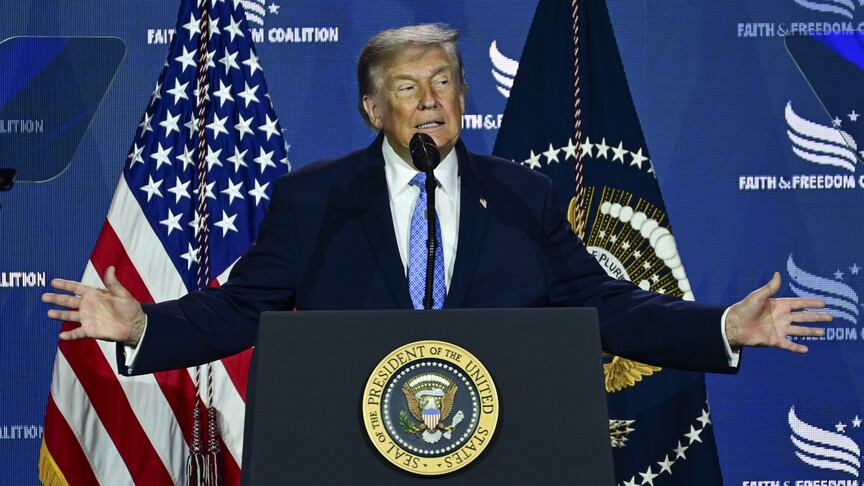
US President Donald Trump on Sunday criticized Democratic mayoral nominee Janeese Lewis George, calling her a “communist” and attacking her policy positions ahead of Washington, DC’s mayoral election.
“Janeese Lewis George, the Communist who is almost certainly going to be elected Mayor of Washington, D.C., has stated that she wants to empty the prisons, make D.C. a Sanctuary City, oppose ICE, welcome Criminal Illegal Aliens back into our beloved Capital, resist Anti-Crime Crackdowns, Defund the Police, continue and expand Cashless Bail, and so many other Capital destroying ‘things’,” Trump wrote on his Truth Social platform.
George won the Democratic primary for mayor of Washington, DC, earlier this month, securing her party’s nomination in the heavily Democratic city and becoming the likely successor to outgoing Mayor Muriel Bowser after the November general election.
Trump said he would not allow Washington, DC, to be “destroyed.”
“In the end, it will never work out, nor will I let it even have a chance because I have worked too hard to make Washington, D.C., the Envy of the World, with almost No Crime, and a Beautification process that has been second to none,” he said.
Trump also said he would “meet with Janeese Lewis George,” adding that Washington, DC, is “again a Safe and Prestigious Community.”
“Many people, including myself, have worked long and hard to get it there, and we will not let it be destroyed by a Communist adherent who has no intention to, MAKE WASHINGTON GREAT AGAIN!” he added.

Just in time for the Fourth of July, the Smithsonian Institution in Washington, D.C., has rolled out a big new exhibit highlighting nature in all its glory, with specimens from across America. But the Hawaiʻi offerings are a bit of a dud.
The Smithsonian’s National Museum of Natural History is a vast repository, occupying a stately edifice on the National Mall. It holds some 148 million objects, including more than a million from Hawaiʻi, including eight priceless feathered cloaks, but when the institution’s curators picked out one item to exemplify each state for this exhibit, they gave Hawaiʻi a rock.
Yes, a rock.
Seen in person, it’s a striking black clump of glittering pāhoehoe lava, and of course we are proud of our lava, but it comes across as, well, underwhelming.
Millions of visitors are expected to arrive in Washington, D.C. in the next two weeks. Many will be drawn by the fanfare associated with the 250th anniversary of the signing of the Declaration of Independence. In the eyes of many Americans, President Trump has tainted the occasion by claiming personal sponsorship of it.
To be fair, the city is looking pretty good, decked out in its finery for the events, and some improvements have been made. Flags are flying; the lawns look green and lush. The scene is drawing large crowds of tourists from all over the world, cheerfully milling about and popping into the many free museums that line the mall.
There are also some notable exceptions: The reflecting pond by the Lincoln Memorial is definitely tainted by algae infiltration. There’s also a bit of slime attached to what was reportedly a no-bid job for the renovation work by a Trump donor.
Also to be fair here: Hawaiʻi has had difficulties with its own reflecting pool, the now-waterless water feature at the State Capitol.

Amid the ongoing partisan warfare, Hawaiʻi’s state government, along with about 10 other Democratic-controlled states, has decided not to participate in the D.C. festivities. That includes the Great American State Fair, now being set up on the National Mall, which will host some 56 themed pavilions where individual states are expected to highlight what they believe makes them special. Sprawling over 10 city blocks, crowned by a 110-foot ferris wheel, the festival will feature concerts, military flyovers, fireworks displays, movie screenings and exhibit spaces representing the nation’s states and territories.
In a statement, Erika Engle, a spokeswoman for Gov. Josh Green, said the state is not officially participating, adding that no funds had been allotted for it by the Legislature or Congress.
She added that Washington, D.C, “is 5,000 miles away.”
That’s a distance that hasn’t previously inhibited the governor, whose peregrinations to the nation’s capital have almost qualified him as a frequent flyer.
This is supposed to be a sign of how Hawaiʻi’s leaders are effectively rejecting Trump. As if Trump cares whether Hawaiʻi participates or not.
It’s a strange place to make a stand. July Fourth is bigger than any president. The signing of the Declaration of Independence represents a rare kind of bravery. The 56 signers risked their lives to sign it, knowing they would have a target on their backs, placed there by King George III, one of the world’s most powerful monarchs.
In fact, people who signed resolutions against the king in the past could expect persecution not just in this life but in the next. In England in the 1630s, the autocratic King Charles I decided to bypass the elected body and instead to rule by executive order. Discarding established law and tradition, he disbanded Parliament for 11 years.
The English people thought that was high-handed and, amid a set of bloody civil wars that killed 200,000 people, he was eventually executed. But when his son was restored to the throne in 1660, the 59 people who had signed the former king’s death warrant were themselves hunted down. Many were drawn and quartered; the lucky were imprisoned for life.
Oliver Cromwell, the Parliamentary ringleader, had already died but his corpse was exhumed and he was hanged. His body was hung in chains and his decapitated head was impaled on a pike and put on public display for 20 years. Almost 100 years later, his embalmed head was still being carted about as a gruesome trophy, even as the signers of the Declaration of Independence put pen to paper.
Back in 1776, the memory of what vengeful kings do to their enemies was high in the minds of those who were publicly protesting Charles II’s autocratic heir, George III. In fact, one of the first ships built and commissioned by the Connecticut General Assembly, launched just two weeks before the Declaration of Independence was signed, was named the Oliver Cromwell.
Democracy has had its ups and downs.
Back to the exhibit at the Smithsonian.

The goal of the curators was to reflect America’s natural diversity and how humans interact with it. In dozens of exhibits spread over 5,000 square feet, visitors can learn about the oddities and idiosyncrasies in the natural world, from rocks to birds to butterflies to snakes to fossils to plants and also how humans have incorporated these items into crafts and artistry. It touched on the problems of animal extinction and climate change.
A video graphic allows people to track bird migration routes across the continental United States.
One display explains the long history of traditional blacksmithing in Guam, another provides examples of Samoan siapo bark cloth.
In addition to several lava rocks representing Hawaiʻi, the exhibit also featured a lovely Niʻihau snail shell necklace and a goby fish from Kāneʻohe Bay, which the exhibition touted as one of the largest sheltered bodies of water in Hawaiʻi, known for its living corals.
But more striking symbols of Hawaiʻi seemed notably sparse and some obvious elements are missing. How nice it would have been to see a feathered cape or an example of one of the brightly colored lizards that have played such an important role in Hawaiian mythology. I would have liked to have seen more of Hawaiʻi’s beautiful birds and butterflies.
Another thing that appears to have gone missing are Hawaiian philanthropic donors making the case for the state’s natural splendors. The display’s list of financial sponsors shows philanthropy from both blue and red states but nothing from Hawaiʻi.
That’s partly because we are suffering another form of extinction. We have a lot fewer large companies based in Hawaiʻi than we once did, and so there are fewer corporate sponsors. Even Hawaiian Airlines, once a mainstay of exhibits like this that appeal to frequent travelers, has been subsumed into an airline from another state.
We do have more billionaires than we once did, of course, but they own estates in so many places that it is hard to know what they actually consider home.
They just better not steal our rocks.

Sign up for our FREE morning newsletter and face each day more informed.
-

 Maryland5 minutes ago
Southern Maryland Cooling Centers Open As Dangerous Heat Builds Ahead Of July 4 Weekend – The BayNet
-

 Michigan12 minutes ago
60% of traffic restrictions to be lifted in Michigan during Fourth of July travel — what to expect
-

 Massachusetts15 minutes ago
4 shot during World Cup watch party in Massachusetts
-

 Minnesota20 minutes ago
David Doty, Minnesota federal judge who oversaw NFL’s labor disputes for decades, dies at 96
-

 Mississippi27 minutes ago
US Supreme Court endorses grace periods for Mississippi mail-in ballots
-

 Missouri30 minutes ago
Donut fundraiser helps mid-Missouri family’s medical expenses for treatment in Italy
-

 Montana35 minutes ago
French Montana Shares Rare Insight into Khloe Kardashian Relationship
-

 Nebraska42 minutes ago
Heartland Nebraska group presents Quilts of Valor to six veterans

