Washington, D.C
Suspect charged in Washington DC killings of two foreign officials


BBC News
The suspect accused of gunning down two Israeli embassy staff members outside a Jewish museum in Washington DC has been charged with first-degree murder, as well as murder of foreign officials and related firearm charges.
Wednesday night’s attack is being investigated as a hate crime, and more charges are expected, US Attorney Jeanine Pirro said at a news conference.
“This is a death penalty-eligible case,” she said on Thursday, adding that it is too early to say whether prosecutors will decide to seek a death sentence.
Steve Jenson, from the FBI’s Washington DC field office, called the killings “an act of terror and directed violence against the Jewish community”.
Couple Yaron Lischinsky and Sarah Lynn Milgrim were shot dead outside an event at the Capital Jewish Museum in Washington DC around 21:08 local time (02:08 BST) on Wednesday, police said. The suspect opened fire on a group of four exiting the event, killing the two victims, police said.
Police identified the suspect as 30-year-old Elias Rodriguez from Chicago. He was arrested at the scene shortly after the shooting.
 Reuters
Officials said he was seen pacing outside the museum before opening fire. Eyewitnesses told the BBC he initially was mistaken for a traumatised bystander, and given aid inside the museum.
One witness, Yoni Kalin, said people inside had been “calming him down”. “Little did we know he was somebody that executed people in cold blood,” he said.
Police said the suspect also shouted “free Palestine” before he was taken into custody.
The suspect landed in the Washington DC area one day earlier, Jenson said, and investigators are still piecing together his whereabouts before the attack. According to an affidavit, officials believe he flew on Tuesday from Chicago to Washington DC for a work conference.
Social media accounts linked to the suspect show he worked at the American Osteopathic Information Association (AOIA) in Chicago as an administrative specialist since 2024.
At his court hearing Thursday, the suspect was charged and ordered to remain in detention. His next hearing was scheduled for 18 June.

 Reuters
Israel’s ambassador to the US Yechiel Leiter said shortly after the shooting that Mr Lischinsky planned to propose to Ms Milgrim during an upcoming trip they had planned to Jerusalem.
“They were a beautiful couple,” Leiter said at a news conference.
A vigil for Ms Milgrim was expected on Thursday in her hometown of Kansas City. She previously had spoken out about her fears of antisemitism in American public life. In 2017, she was interviewed by a local TV station after her school in Kansas was vandalised with a Nazi swastika.
“I worry about going to my synagogue, and now I have to worry about safety at school and that shouldn’t be a thing,” said Ms Milgrim, who was in her final year of high school at the time.
Police said the suspect was not on their radar and has no prior interactions with law enforcement. They said he admitted to the attack and is believed to have acted alone.
The gun used in the attack was a 9mm handgun legally purchased in Illinois in March 2020 and brought to Washington in his checked luggage. Illinois has some of the most restrictive gun laws in the US.
Social media accounts linked to the suspect also indicate that he was heavily involved in the pro-Palestinian protest movement. Investigators said they were working to authenticate writings online purportedly authored by him, accusing Israel of genocide in Gaza, criticising US policy and discussing the use of political violence.
A home linked to the suspect in Chicago was seen being searched on Thursday, and authorities also said they were scouring his electronic devices.
One of his neighbours in Chicago, John Wayne Fry, told reporters that he lived in the same apartment building as the suspect for around a year.
The suspect displayed a photo outside his flat of a Palestinian-American child who was killed in Chicago in 2023, Mr Fry said.
The man who killed six-year-old Wadee Alfayoumi was convicted of hate crime charges earlier this month. Officials said he was motivated by hatred for Islam and the conflict in Gaza.
It is unclear whether the suspect had any direct contact with the boy’s family.
 Getty Images
Jojo Kalin, one of the event’s organisers in Washington DC, told the BBC that the event the victims attended was focused on how to build a coalition to help people suffering in Gaza amid the ongoing Israel-Hamas war.
She added it is “deeply ironic that what we were discussing was bridge building and then we were all hit over the head with such hatred”.
The attack was condemned by world leaders, including UK Prime Minister Keir Starmer, who said he “thoroughly” condemns the “antisemitic attack” in Washington DC.
Israeli Prime Minister Benjamin Netanyahu called the attack “a heinous antisemitic murder” and added that security would be increased for Israeli representatives and diplomatic missions worldwide.
US President Donald Trump also decried antisemitism in response to the attack, writing on his social media platform Truth Social that “hatred and radicalism have no place in the USA.”
Trump and Netanyahu later spoke over the phone about the incident, where the US president expressed sorrow to his Israeli counterpart, according to a readout of the call.
With reporting from Mike Wendling in Chicago

Washington, D.C
What’s that noise? What you need to know about D.C. flyovers Friday and Saturday – WTOP News

Reagan National Airport will close for America 250 flyover rehearsals Friday and celebrations Saturday featuring the Thunderbirds, Blue Angels and more.
Reagan National Airport will close from 10 a.m. to 1 p.m. Friday for rehearsals ahead of this weekend’s America 250 celebrations, meaning people around D.C., Arlington and Alexandria may hear and see low-flying military aircraft.
According to Freedom 250 event organizers, Friday’s “Wings of Freedom” demonstrations over the National Mall will feature parachute teams, helicopters and military aircraft, including the U.S. Marine Corps’ MV-22 Osprey and F-35B, the Navy’s F-18F and F-35C, the Air Force’s F-22 Raptor, the Thunderbirds and a tri-bomber formation.
On Saturday, the FAA will close the airport from noon to midnight for the full celebration. All arrivals and departures at Reagan National are scheduled to end before noon.
Flyovers and demonstrations are scheduled throughout the afternoon and evening along the National Mall and Washington Monument grounds, including appearances by Air Force One, the Thunderbirds, Blue Angels, military aircraft fleet reviews, parachute demonstrations and B-2 stealth bombers.
Highlights include an Air Force One flyover scheduled for 7:03 p.m., a Thunderbirds demonstration beginning at 6:25 p.m., a tri-bomber formation at 6:02 p.m. and a stealth aircraft flyover at 7:38 p.m.
Friday’s schedule of flyovers and demonstration rehearsals along the National Mall and Washington Monument
- 10 a.m.: Golden Knights, Leap Frogs
- 10:15 a.m.: Army Helo Flyover
- 10:20 a.m.: USMC V-22 Osprey Demo
- 10:35 a.m.: USMC F-35B STOVL Demo
- 10:50 a.m.: USN F-18F Demo
- 11:10 a.m.: USN F-35C Demo Team
- 11:30 a.m.: USAF F-22 Raptor Demo
- 11:50 a.m.: NASA F-5s
- 12 p.m.: HUGE (1) Formation
- 12:05 p.m.: USAF Thunderbirds
- 12:55 p.m.: USAF Tri-Bomber
Saturday’s schedule of flyovers and demonstration along the National Mall and Washington Monument
- 1:14 p.m.: – NASA F-5 Flyover
- 1:24 p.m.: -NASA Fleet Review
- 1:44 p.m.: USCG Helo Flyover
- 1:54 p.m.: USCG Fixed Wing Flyover
- 2:09 p.m.: Golden Knights, Leap Frogs
- 2:29 p.m.: Army Helo Flyover
- 2:44 p.m.: USAF Fleet Review – Wave 1 – Heavies
- 2:54 p.m.: USAF Fleet Review – Wave 2 – AFSOC
- 3:04 p.m.: USAF Fleet Review – Wave 3 – Fighters
- 3:29 p.m.: Executive Rotary Wing Airlift
- 3:39 p.m.: USMC Fleet Review – Wave 1 – Rotary
- 3:49 p.m.: USMC Fleet Review – Wave 2 – Fixed Wing
- 3:59 p.m.: USN Fleet Review – Wave 1 – Rotary
- 4:09 p.m.: USN Fleet Review – Wave 2 – Fixed Wing
- 4:19 p.m.: USN Fleet Review – Wave 3 – Fighters
- 4:21 p.m.: USN F-18F Demonstration
- 4:59 p.m.: USN Blue Angels
- 5:26 p.m.: USMC MV-22 Osprey Demonstration
- 5:44 p.m.: USAF Fleet Review – Fighters
- 6:02 p.m.: USAF Tri-Bomber Formation
- 6:05 p.m.: USN F-35C Demonstration
- 6:25 p.m.: USAF Thunderbirds Demonstration
- 7:03 p.m.: Air Force One Flyover
- 7:07 p.m.: USAF Thunderbirds Delta Break
- 7:17 p.m.: HUGE 1 Flyover Led by the Newly Renovated Air Force One
- 7:38 p.m.: U.S. Stealth Airpower Flyover
- 7:39 p.m.: F-22 Raptor Demo
- 7:53 p.m.: F-22 Raptor in Afterburner
- 7:59 p.m.: B-1 Flyover
- 8:07 p.m.: B-1’s in Afterburner
- 8:11 p.m.: HUGE ONE Fly Over Review
- 8:22 p.m.: Golden Knights Twilight Jump
- 10:36 p.m.: B-1 Afterburner Night Pass
Get breaking news and daily headlines delivered to your email inbox by signing up here.
© 2026 WTOP. All Rights Reserved. This website is not intended for users located within the European Economic Area.

An Air Force major was arrested in uniform on the steps of the Capitol after he called for the impeachment of President Donald Trump.
U.S. Capitol Police arrested Jason Watson, an active-duty service member, on Wednesday afternoon following remarks at a news conference where he said Trump and Vice President JD Vance should be removed from office.
The event was organized by the Removal Coalition, a group that lobbies members of Congress to impeach Trump, and attended by Rep. Al Green, D-Texas, who has repeatedly introduced articles of impeachment against Trump.
“I’m here with him because Rep. Green is the only member of Congress that has demonstrated the courage and conviction to … force a vote on articles of impeachment,” Watson said at the event. “If Congress followed his example, we could remove the entire Trump administration, but Congress remains unconvinced of the urgency and necessity for them to honor their oaths, so we must persuade them with our unrelenting, uncompromising civil resistance.”
Watson said he is not a Democrat and does not share policy positions with Green, who lost his re-election bid this year. Green’s office did not immediately respond to a request for comment on Watson’s arrest.
Capitol Police said in a statement that it “is generally against the law for the public to demonstrate on the House Steps unless they are with a Member of Congress.”
“Yesterday afternoon, a man was escorted to the House Steps by a Member of Congress,” the statement said. “When the Member of Congress left the area, our officers gave the man lawful orders to stop the illegal demonstration or he would be arrested. The man refused our lawful orders.”
Capitol Police identified the man as Watson, adding that he was arrested on charges of “Crowding, Obstructing, and Incommoding” and that it is legal to protest in other spots on the Capitol grounds.
Service members are subject to stricter laws than the average citizen when it comes to protesting. The Uniform Code of Military Justice prohibits officers from “using contemptuous language towards the President, Vice president, the Secretaries of War and of a military department, Congress, and certain other officials,” according to an Air Force memo last year.
An Air Force spokesperson said in a statement Thursday: “Service members must comply with all laws, regulations and policies governing conduct and the wear of the uniform. All Department of the Air Force personnel are expected to uphold the highest standards of discipline and professionalism, both on and off duty.”
All service members, not just members of the Air Force, are prohibited from participating in “political activities” in uniform.
Watson’s criticism of Trump and Vance focused on the administration’s actions in Venezuela and Iran, calling them “an unconstitutional usurpation of Congress’ authority and a violation of the War Powers Clause.”
“These violations resulted in the deaths of 13 service members and injuries of hundreds more,” he said, referring to the number of U.S. military deaths tied to the Iran war. “For this, the president and vice president must be impeached, convicted and removed.”
Watson also called the administration’s immigration policies and tactics unconstitutional.
The Removal Coalition did not immediately respond to a request for comment, and Watson could not be reached.
President Donald Trump responded to criticism of a financial disclosure that listed $1.4 billion in crypto earnings largely driven by meme coins.
Berk Kutay Gökmen
02 July 2026•Update: 02 July 2026
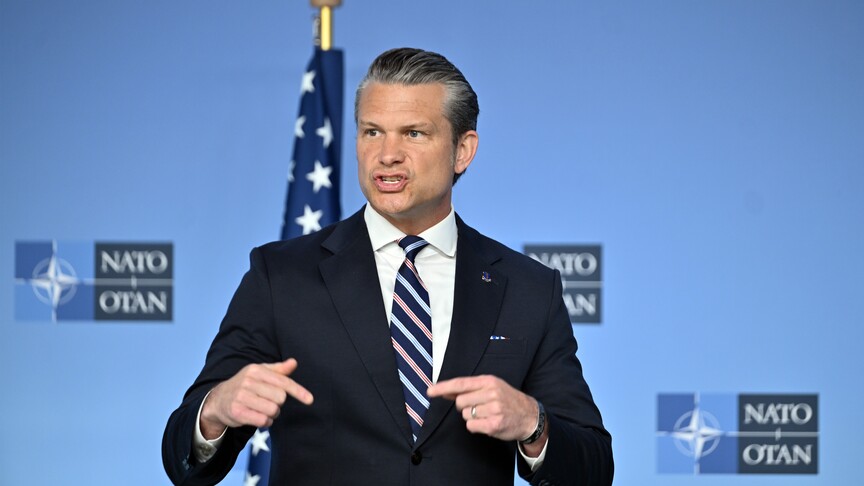
US Defense Secretary Hegseth on Thursday faced protesters while hosting the Trump administration’s DC Safe and Beautiful Task Force ceremony in Washington DC.
During the ceremony at Meridian Hill Park, which saw the gathering of National Guardsmen, dozens of demonstrators gathered near the park to protest Hegseth.
Footage shows the demonstrators chanting a short distance away from where Hegseth and roughly 200 members of the National Guard had gathered in the park
In social media posts, one protester was seen holding a Palestinian flag, while another person was holding a sign that reads “arrest Hegseth.” The protesters want a “Free DC,” according to social media posts.
In his address to the National Guard, Hegseth said that “this background noise is perfect,” referring to the protests.
“It’s the sound of ingrates, of ingratitude—of people who are so blinded by ideology they can’t see law and order and common sense in front of them,” he said.
Meridian Hill Park was repaired by the National Park Service and the Interior Department as part of a larger initiative to restore and enhance federal parks and public spaces throughout the nation’s capital in preparation for America’s 250th anniversary, which falls on this Saturday, July 4.
Though such beautification projects are typically popular with the public, the current initiative has been controversial both for its choice of projects and the use of no-bid contracts to hire firms to do the work, sometimes with disappointing results.
The work aligns with President Donald Trump’s DC Safe and Beautiful Task Force, established by a March 2025 executive order that directs federal agencies to coordinate public safety and beautification efforts across Washington.
-

 Videos55 minutes ago
Iran gets ready for Khamenei’s funeral • FRANCE 24 English
-

 Los Angeles, Ca1 hour ago
2 arrested after 3 LASD deputies injured during East L.A. World Cup celebration
-

 Detroit, MI1 hour ago
Ex-girlfriend in custody after Taylor man found fatally stabbed, police say
-

 San Francisco, CA2 hours ago
Marina braces for Golden Gate Bridge fireworks show, massive crowds
-

 Dallas, TX2 hours ago
Maradona’s ‘Hand of God’ ball heads to auction in Dallas
-

 Miami, FL2 hours ago
Miami-Dade sheriff urges residents to celebrate Fourth of July safely
-

 Boston, MA2 hours ago
Jaylen Brown says Celtics showed ‘lack of respect’ after trade to 76ers – The Boston Globe
-

 Denver, CO2 hours ago
Who are the Top 5 offensive linemen in Denver Broncos history?

